Bumper stickers usually go one of two ways. Either you have a large collection and enjoy looking at them, noting all the places you’ve been, admiring all the things you believe in or want to promote, etc.; or you plop a sticker or two on, thinking it looks good at the time, then regret it a few months later.
On top of that, you’ve got people out there where the sticker must be perfectly placed and perfectly straight, and other people who smack a sticker on, not caring at all whether it’s aligned with the one next to it or parallel to the back bumper. What kind of bumper sticker person are you?
Some folks treat bumper stickers like merit badges—each one hard-earned and carefully chosen. Others just like to have a laugh and pick out something silly or sarcastic to get a smile from fellow travelers on the road.
Of course, there are also those who slap one on in a moment of passion—maybe after a great hike, a big political moment, or a funny roadside souvenir stand—only to realize later that their taste has changed.
And let’s not forget the “sticker remover” crowd—the ones who bought a used RV or tow vehicle and are still trying to scrape off that last bit of someone else’s personality with a razor blade and a bottle of Goo Gone. Sometimes, the story isn’t about what you put on—it’s what you’re trying to take off.
If your RV or tow vehicle has a bumper sticker (or more than one) on it, what are they about? Travel stickers? Politics? Funny quotes? A combination? Tell us in the comments below after you’ve voted. Thanks!
By Dustin Simpson
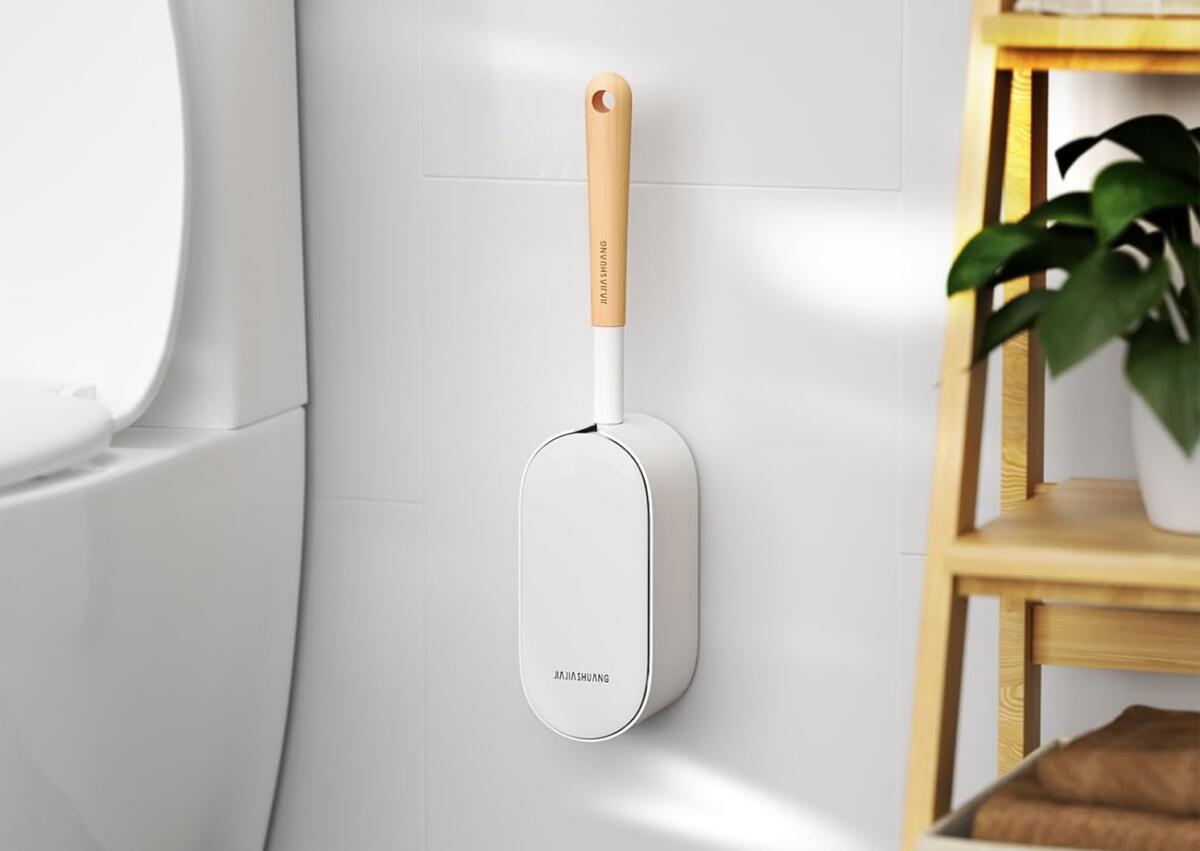
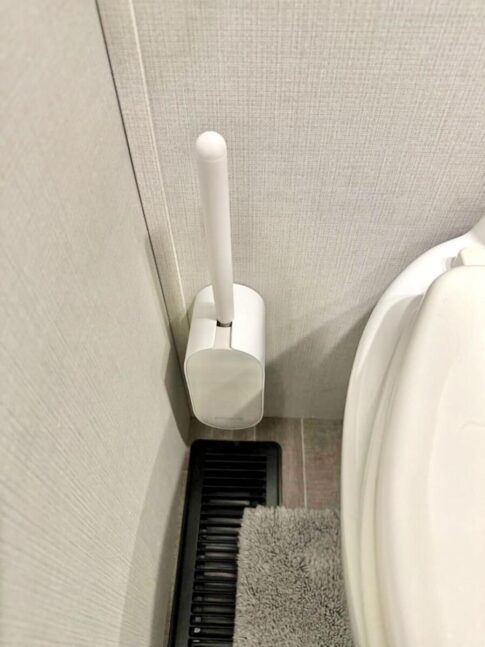
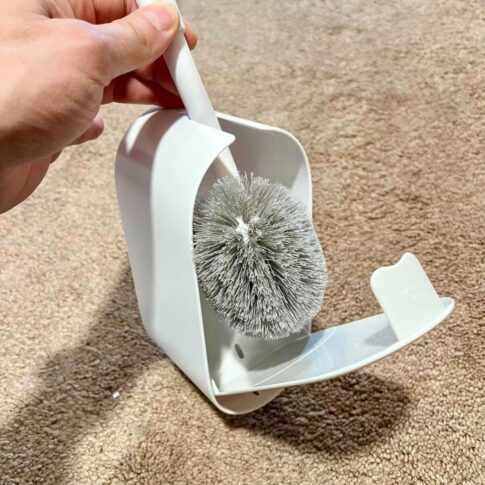
I see a lot of RVs in our shop with bulky toilet brushes in their bathrooms. And not only that, if the toilet brush isn’t mounted it can easily fall over and make a mess during travel. You don’t want those germs getting everywhere!
This compact RV toilet brush and wall holder set is a must-have for your RV.
Its sleek design fits seamlessly into your RV’s limited bathroom space, ensuring that your bathroom stays clean and organized without sacrificing style. The wall-mounted holder keeps the brush securely in place, making it easy to access when needed while keeping it out of sight when not in use.
It’s a practical and stylish solution that you’ll love, helping you maintain a tidy and well-kept bathroom on the road.
Designed for convenience and efficiency, it helps you maintain a spotless bathroom even in the tight quarters of your RV. With this brush, you’ll ensure that your RV’s toilet stays fresh and hygienic, making your travels more comfortable and stress-free.
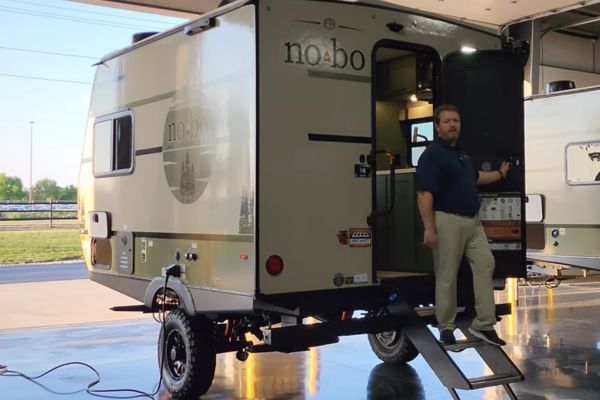
Looking for a full-featured SMALL RV? The 2026 Forest River No Boundaries NB18.1 keeps the body short, but it still brings a full bath, a convertible front dinette, and solid off-grid gear.
This travel trailer is aimed at buyers who want a compact trailer with a rugged look and useful camping features. The featured unit shown here also had the optional Beast Mode package, which changes the feel of the trailer both inside and out. To see this trailer in more detail, check out the video at the end of this post from Ray at All About RVs.
Key specs and Beast Mode package
The featured NB18.1 measures 14’11” long. It came in at around 3,395 pounds, as ordered, while the video description lists a UVW of 3,439 pounds. GVWR is 4,939 pounds; hitch weight is 450 pounds; and fresh, gray, and black tanks are all 30 gallons, which is surprising in a trailer this small.
Beast Mode is the main upgrade package here. It adds:
• Independent suspension
• A second 200-watt solar panel, for 400 watts total
• A 2000-watt inverter with controller
• A fresh water filter
• A Maxxair vent cover
That package also pairs well with the Westlake off-road Mud Legend tires, black aluminum wheels, and built-in tire pressure monitoring.
Inside the NB18.1
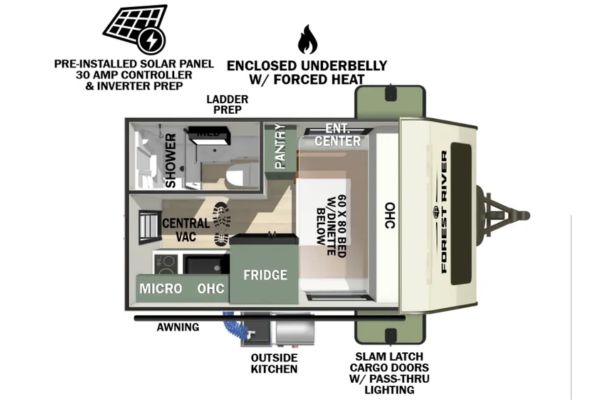
A floor plan decal by the entry gives shoppers a quick read before stepping in. Once inside, the main control area groups the Bluetooth stereo connection, heated holding tank switch, awning controls, battery and tank monitors, 30-amp solar controller, thermostat, and on-demand water heater functions.
The rear kitchen makes good use of the space. It has lower cabinet storage, a two-burner gas cooktop with a flip-up glass lid and lit knobs, a vent hood, a Furrion air fryer convection microwave, an opening window, and a sink with a high-rise sprayer.
The bathroom is compact but complete. It includes a porcelain foot-flush toilet, vanity, medicine cabinet, turbo exhaust fan, skylight, pull-across vinyl shower door, and a shallow ABS shower pan. Hot water comes from a Suburban on-demand system.
The Mossy Cloud interior leans into green and washed gray cabinetry, which gives the trailer a different look than the usual white-and-gray RV interior.
Up front, the U-shaped dinette has storage on both sides, pop-up outlets with USB ports, side windows that open, and a table that drops on a telescoping leg to form a bed. The front windshield stays fixed.
A 10.7-cubic-foot 12-volt fridge, pantry, 12-volt smart TV on a swing arm, furnace, central vac, and dustpan vac fill out the cabin.
Exterior, roof, and hookups
Outside, the NB18.1 sports tan fiberglass, Azdel-backed walls, tinted windows, black lower skirting, front storage under the dinette, and an 8-foot power awning with LED lighting. It also has outdoor speakers, a clear or amber porch light, an outside shower, gravity fresh fill, enclosed underbelly, spare tire, stabilizer jacks, portable solar input, rear camera prep, ladder prep, and a MORryde step rated for 500 pounds.
The roof carries the A/C, TV antenna, skylight, vent cover, plumbing vents, and two 200-watt solar panels.
Along the driver side are the dump valves, low-point drains, black tank flush, city water, detachable 30-amp cord, cable inlet, furnace exhaust, and water heater. Up front, you’ll find a power tongue jack, two 20-pound propane tanks, a battery tray, a battery disconnect, and a front cap with a lower diamond plate.
Final thoughts
The 2026 No Boundaries 18.1 makes the most sense for singles or couples who want a short trailer with better off-grid hardware than most small campers offer. Its size is easy to like, but the Beast Mode package is what gives it a broader camping range.
The video description lists a retail price of $38,670 for Beast Mode with a factory MSRP of $25,999.
For shoppers who like a rugged look and a compact footprint, this one leaves a strong impression.
For many RVers, especially boondockers and snowbirds who depend on public land across the West, the latest fight over Bureau of Land Management policy may sound like inside-the-Beltway political noise. But this one could eventually touch something much more personal: where people camp, how public land gets managed, and who gets priority when competing interests collide.
The Department of the Interior has rescinded a controversial Biden-era BLM rule that formally elevated conservation and restoration as recognized “uses” of federal public lands. Supporters of the rollback say it restores the agency’s traditional “multiple use” mission. Critics warn it could weaken protections for habitat and fragile landscapes.
For RVers, though, the practical question is much simpler: Could this eventually affect camping access, dispersed camping rules, road closures, or how public lands are managed?
The answer is complicated—and probably won’t become clear overnight.
What the rule tried to do
The Biden administration’s Public Lands Rule tried to give conservation and land restoration a stronger seat at the table alongside other traditional uses of BLM land, including grazing, mining, drilling, recreation, and energy development. Supporters argued that many public lands were already under growing strain from wildfire damage, drought, heavy visitor use, and years of environmental wear and tear. In their view, the BLM needed stronger authority to restore damaged areas before the problems got worse.
Critics, however, argued the rule created uncertainty and could gradually shift federal lands away from public access and traditional uses. Western lawmakers, grazing groups, mining interests, and some recreation advocates claimed the policy gave conservation groups too much influence over land management decisions.
The Trump administration says rescinding the rule restores the BLM’s original multiple-use mission.
Why RVers are paying attention
Many RVers have mixed feelings about this debate, and that may be why the issue is drawing so much attention in camping circles.
On one hand, public lands are the backbone of dispersed camping throughout much of the West. Millions of RVers depend on BLM land for affordable camping, especially in places like Quartzsite, southern Utah, Nevada, New Mexico, and large sections of Arizona.
On the other hand, longtime public land users have watched increasing restrictions appear in some popular camping areas over the past decade. Seasonal closures, stay limits, hardened campsites, permit systems, fire restrictions, and camping bans have all expanded in certain high-pressure recreation areas.
Some RVers worry conservation-based policies could eventually lead to more camping restrictions, additional road closures, fewer dispersed camping opportunities, expanded permit systems, and larger habitat protection zones in areas that already feel increasingly regulated.
Others argue the opposite problem already exists: too much damage from overuse.
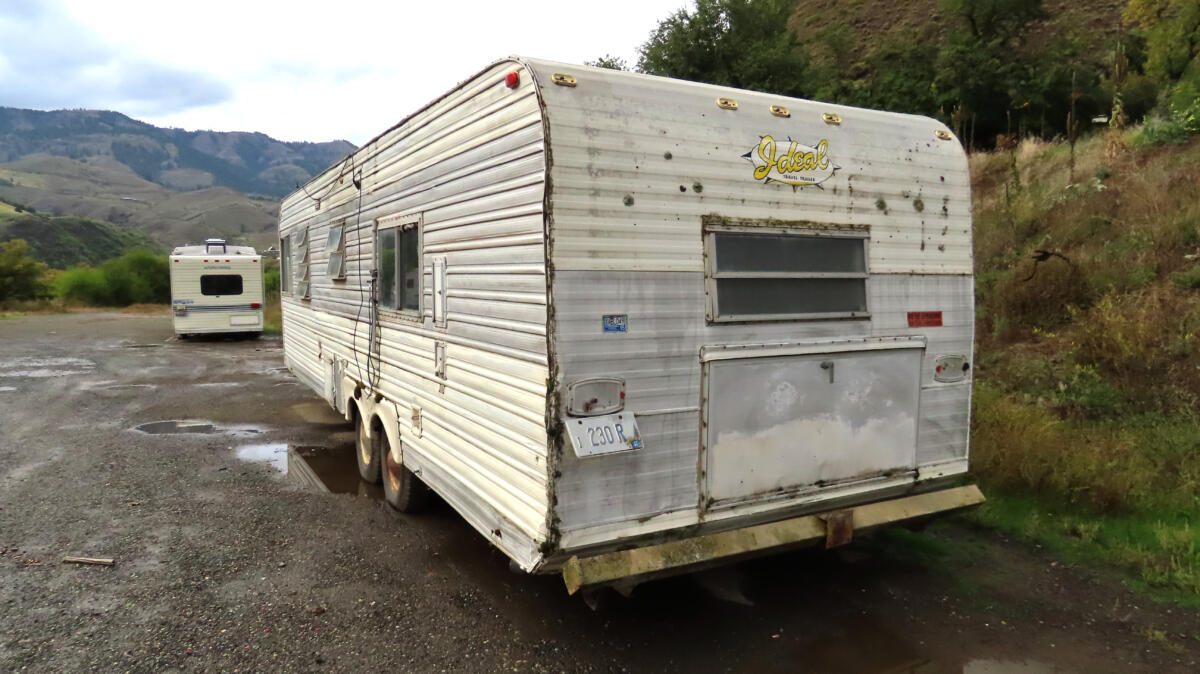
Abandoned RVs, illegal dumping, and more put pressure on the system. R&T De Maris photo.
Illegal dumping, abandoned RVs, human waste problems, wildfire concerns, and uncontrolled off-road travel have all created growing headaches in some heavily used camping areas. Even many RVers who dislike new restrictions admit certain public lands are starting to show the strain. Supporters of the old rule argued the BLM needed more flexibility to restore damaged areas before conditions got worse.
That tension has become increasingly visible in popular snowbird regions across the Southwest, where explosive growth in dispersed camping has sometimes collided with environmental concerns and local frustration.
The bigger issue may still be overcrowding
Even supporters and critics of the old rule agree on one thing: Public lands are under growing strain.
The pandemic camping boom changed the feel of a lot of Western public lands almost overnight. Some dispersed camping areas that used to have plenty of elbow room now look more like temporary RV towns during busy parts of the season.
That’s put local managers in a tough spot. They’re trying to keep areas open and usable without letting them get overwhelmed. In many cases, the restrictions RVers see today have less to do with politics in Washington and more to do with overcrowding, wildfire worries, trash problems, sanitation complaints, and damaged land.
In other words, rescinding this rule doesn’t automatically mean more places to camp tomorrow. Nor does it necessarily mean fewer restrictions.
Any changes RVers actually notice would probably happen gradually through things like road closures, camping limits, seasonal restrictions, or updated local management plans. In the real world, those on-the-ground decisions usually shape the camping experience a lot more than whatever politicians in Washington happen to be arguing about that week.
Why “multiple use” matters
At the center of the fight is a deceptively simple phrase: multiple use.
Under federal law, BLM lands are supposed to serve many competing purposes simultaneously. That includes recreation, grazing, mining, conservation, wildlife habitat, energy production, timber, and public access.
The disagreement is really about balance.
Supporters of the rollback argue conservation should remain one consideration among many—not elevated above the others. Supporters of the original rule argued conservation had historically been treated as secondary, despite worsening wildfire conditions, drought, invasive species problems, and habitat degradation.
In the end, what RVers actually see out on public land will probably depend on who’s in charge down the road and how local managers handle the growing pressure on popular camping areas.
What RVers should watch next
The rollback itself probably won’t create any immediate changes for most RVers this camping season. But folks who rely heavily on public lands should still pay attention to road closures, camping restrictions, wildfire projects, seasonal shutdowns, and other local changes that can subtly reshape popular camping areas over time.
Those decisions often shape the actual camping experience far more than the political headlines do.
And regardless of which administration is in power, one reality is becoming harder to ignore: America’s public lands are seeing more visitors, more competing demands, and more pressure than they did even a decade ago.
For RVers who value the freedom of public land camping, that larger trend may matter more than any single policy reversal.
(QUARTZSITE, AZ) An Arizona RV park is suddenly at the center of a fight that could make a lot of long-term RV residents uneasy—especially heading into another brutal Southwest summer.
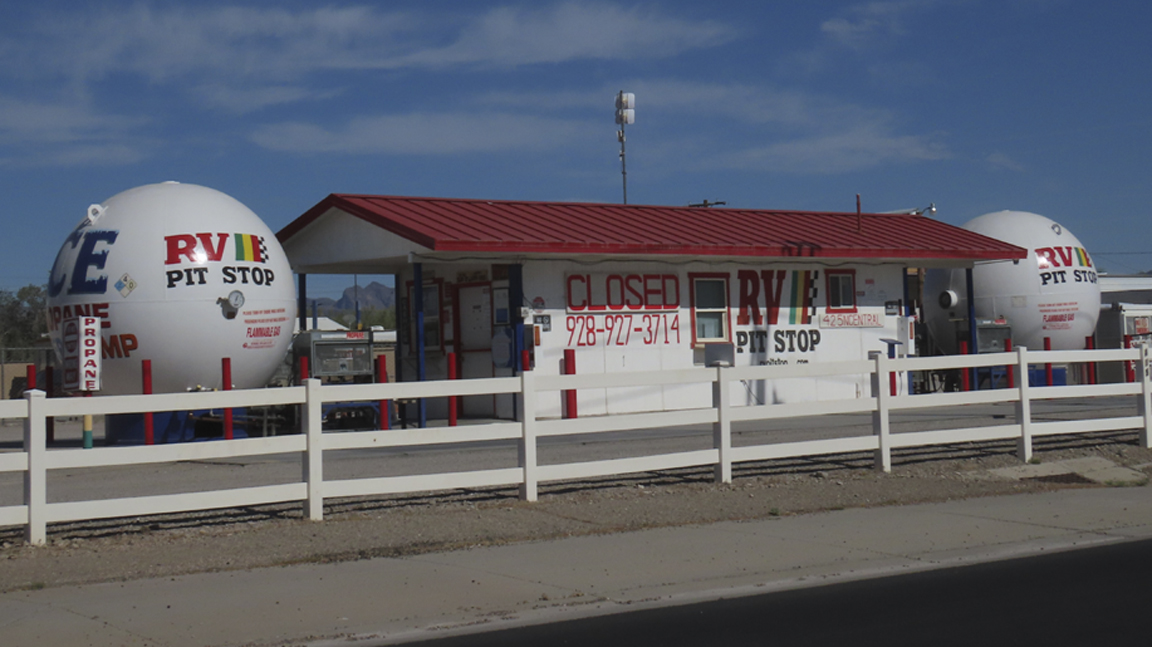
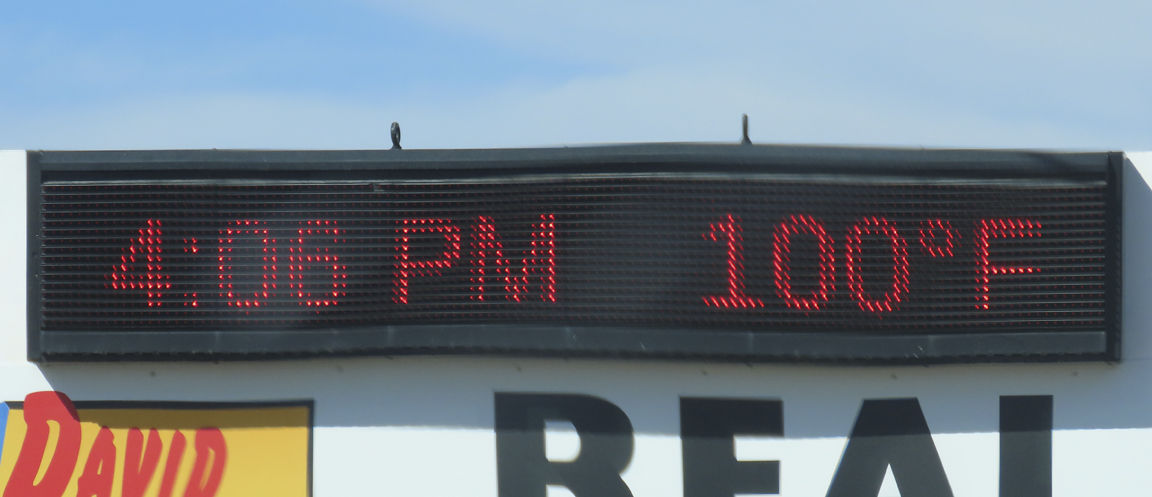
According to Arizona officials, residents at the park at RV Pit Stop in Quartzsite, Arizona, found themselves without electricity during triple-digit heat after power to the property was shut off amid an ongoing dispute involving park management and tenants. State officials later stepped in and ordered the power restored.
And in Arizona heat, losing power in an RV park is sounding like a paperwork dispute pretty quickly.
According to reporting by Arizona’s Family, Arizona Attorney General Kris Mayes issued a cease-and-desist letter to Alejandra and Ignacio Garcia, owners of the RV Pit Stop property. The report says state officials learned electrical power to residents had been shut off while tenants were ordered to leave the property within 48 hours.
That immediately raised a bigger question many RVers may never have considered: Once somebody has been living in an RV park long-term, what rights do they actually have?
Why this situation got attention so quickly
Quartzsite temperatures had already reached triple digits as the RV Pit Stop dispute unfolded. In Arizona desert heat, an RV can become dangerously hot within a short time after air conditioning fails. R&T De Maris photo.
This reportedly was not a case where a monsoon storm knocked out power lines or a park transformer unexpectedly failed.
State officials viewed the situation as serious enough to intervene during dangerous heat conditions. Anybody who has spent a summer in the Arizona desert already knows how quickly an RV can become dangerously hot once the air conditioner quits.
Inside temperatures can climb fast, especially in older rigs with limited insulation or rooftop A/C units already struggling to keep up with outside temperatures.
For some residents, losing power can also mean refrigerated medications warming up, medical equipment shutting down, pets trapped in dangerous heat, and refrigerators full of food spoiling within hours.
And unlike overnight campers passing through town, many long-term RV residents cannot simply hook up and leave on short notice. Some no longer even own a tow vehicle capable of moving their RV.
RV Pit Stop issues are building
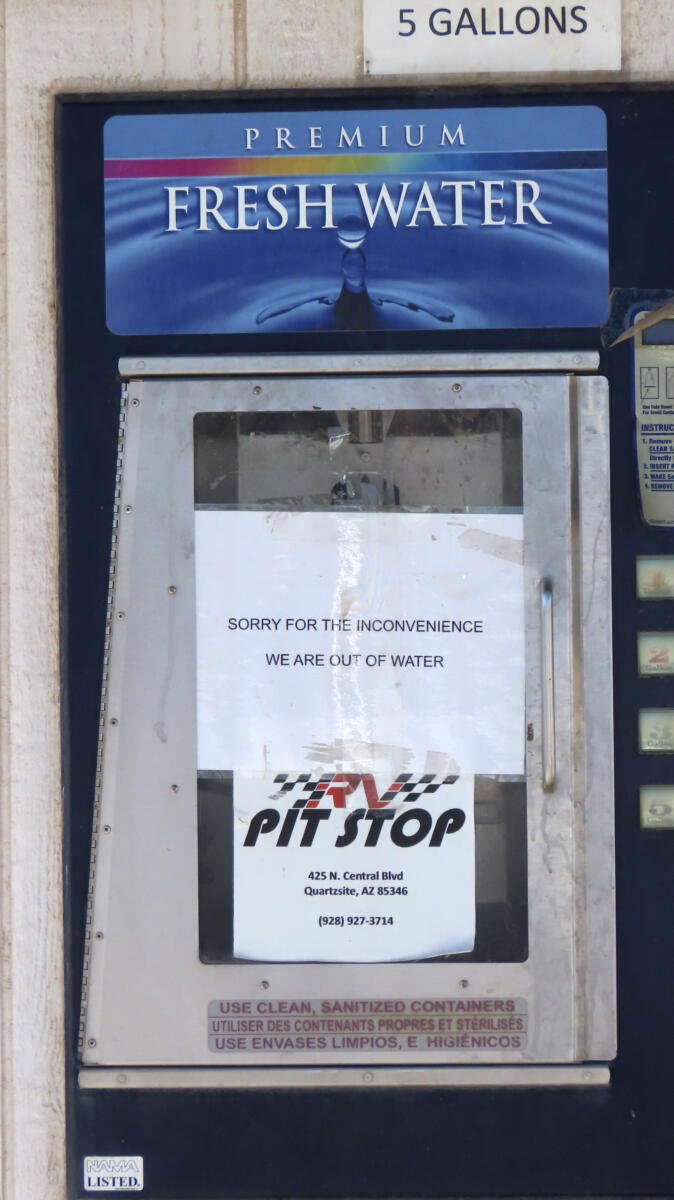
A notice posted on the RV Pit Stop water vending station informed customers the operation was “out of water.” Locals say both the RO water service and propane operation shut down abruptly earlier this year. R&T De Maris photo (Click to enlarge.)
The situation has attracted extra attention in Quartzsite because RV Pit Stop was already familiar to many Southwest RVers and snowbirds. The property had operated year-round for years and included a well-known propane filling station along with an RO (reverse osmosis) water vending service used by both residents and travelers passing through town.
But a couple of months ago, both the propane operation and water vending service abruptly closed without public explanation. For many locals, the sudden shutdowns now look far more significant in hindsight.
Long-term RV parks are becoming something else
This story also highlights something quietly changing across much of the Southwest.
A growing number of RV parks no longer function strictly as vacation campgrounds. In many places, they have become a form of affordable long-term housing for retirees, fixed-income residents, and people priced out of traditional housing.
Especially around snowbird communities, it is common to find residents who have occupied the same site for years.
That changes the tone of disputes like this one.
A weekend camper staying a few nights generally does not have the same expectations—or potentially the same protections—as somebody who has effectively turned an RV park into a long-term home.
And readers who have spent time in older desert RV parks probably recognize another uncomfortable reality too: Many parks were built decades ago for a very different kind of RVing.
Years ago, parks were typically serving smaller RVs with fewer high-draw appliances and far less year-round occupancy. Today, many parks are trying to support larger rigs with multiple air conditioners, residential refrigerators, electric heaters, and much heavier electrical demand.
That may or may not have played a role in this Arizona dispute. But it is one reason utility problems inside RV parks can escalate quickly once temperatures start climbing. We spoke with one RV Pit Stop resident about their issue. They reported that, happily, the power was only cut for about 14 hours.
What RVers should do if utilities are suddenly cut
Experts generally recommend documenting everything if a serious utility dispute develops inside a long-term RV park.
That means saving texts and emails, photographing notices, documenting temperatures during outages, and keeping receipts for emergency expenses like hotels, generator fuel, or spoiled food. Residents should also keep copies of rental agreements and written park policies involving utilities or eviction procedures.
And, perhaps most importantly, RVers should understand that not every stay inside an RV park is treated the same way.
For a growing number of people, RV parks are no longer just vacation stops.
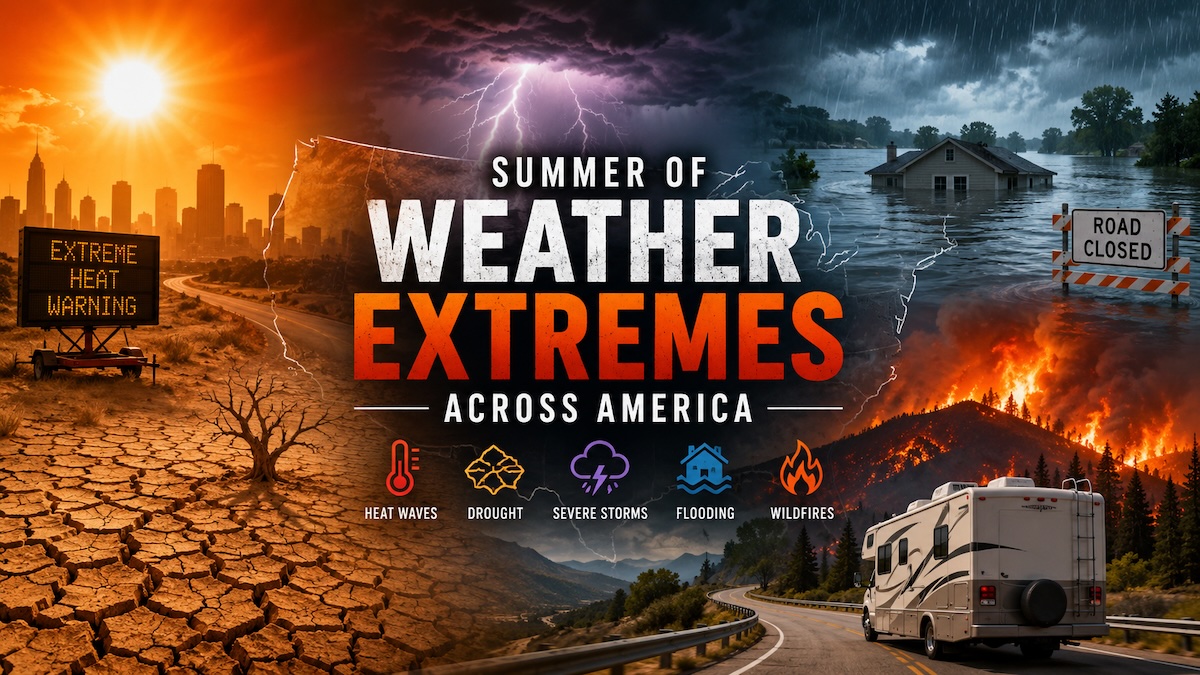
AccuWeather forecasters warn that the summer of 2026 could bring a wide range of dangerous weather extremes across much of the United States, including prolonged heat waves, drought, severe thunderstorms, flash flooding and major wildfires.
Graphic: AccuWeather
“This summer will likely be remembered for weather extremes,” said AccuWeather Lead Long-Range Expert Paul Pastelok. “Dangerous heat waves are likely in parts of the West and South. Storms and flash flooding may bring the biggest problems from the Plains to the Ohio Valley. Drought and wildfire risk will also be major concerns in the Northwest.”
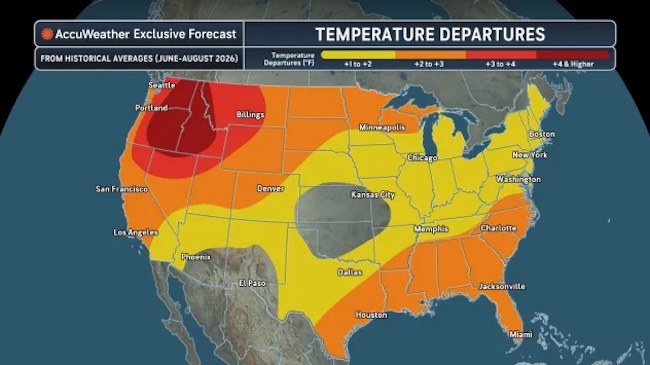
The hottest conditions are expected across parts of the West, South and Desert Southwest, where temperatures could challenge or break records during extended periods of extreme heat. AccuWeather said major cities from Phoenix to Dallas may endure repeated stretches of triple-digit temperatures, increasing health risks and putting extra strain on power grids.
The forecast also calls for worsening drought conditions in portions of the Northwest and northern Rockies. Dry vegetation and above-normal heat could create ideal conditions for fast-moving wildfires later in the summer, especially in forested areas already dealing with low soil moisture. Smoke from those fires could affect air quality hundreds of miles away.
Meanwhile, repeated rounds of thunderstorms are expected to increase the threat of flash flooding from Texas into the Mississippi and Ohio valleys.
AccuWeather said severe weather could remain active through much of June and July across the Plains, Midwest and Great Lakes, bringing the possibility of damaging winds, large hail and tornadoes before the storm track gradually shifts eastward later in the season.
Forecasters said a developing El Niño pattern in the Pacific Ocean is expected to play a major role in shaping this summer’s weather. That pattern often leads to hotter and drier conditions in the Western and Southern United States while increasing rainfall and storm activity across parts of the nation’s midsection.
America’s Original RV Newsletter. Since 2001
Issue 2904 • New issue every weekday This free edition is made possible by 6% of our readers who support RV Travel with a voluntary subscription. Advertising helps, but that alone is not sufficient.
Today’s thought
“Life is like a prism. What you see depends on how you turn the glass.” ―Jonathan Kellerman
Need an excuse to celebrate? Today is National Dance Like A Chicken Day!
On this day in history:1804 – William Clark and 42 men depart from Camp Dubois to join Meriwether Lewis at St. Charles, Missouri, marking the beginning of the Lewis and Clark Expedition‘s historic journey up the Missouri River.
Tip of the day How do you hang a TV wall mount on an RV wall?
RV TV wall mounts are great. Their swing feature allows users to turn the TV in multiple directions, great for the rather strange seating arrangements RV manufacturers often use. They also allow the TV to be pushed back out of the way when not in use. The trouble is, these articulating mounts typically require the use of wall studs for a safe and secure install. If the desired wall doesn’t have studs—typical of most fiberglass or composite exterior RV walls—what’s to be done? Here’s one way to get the job done.
Article and video Clever dual-purpose Toyota Sienna camper van build
A minivan camper usually asks for a compromise, but this 2025 Toyota Sienna build doesn’t. It keeps the second row, sleeps one person, and still looks like a normal family van from the outside. That dual-purpose layout is the whole story here. Horizon Camper Builds turned a hybrid XLE into a removable stealth camper that can still work as a four-passenger daily driver. Here, we get a full tour.
THURSDAY TRUTH: RV steps are either shin-height or ankle-height. They somehow know exactly where to hit.
Featured article 5 nifty gadgets that make RV life easier
By Gail Marsh
Who doesn’t love a great gadget? And a gadget that helps you RV is even better! During the past holiday season, I made a short wish list of things that I thought might be useful as we RV. I happily received a few of the items on my list. I plan to purchase the others in the days ahead. See what you think.
Time to make your RV shine!
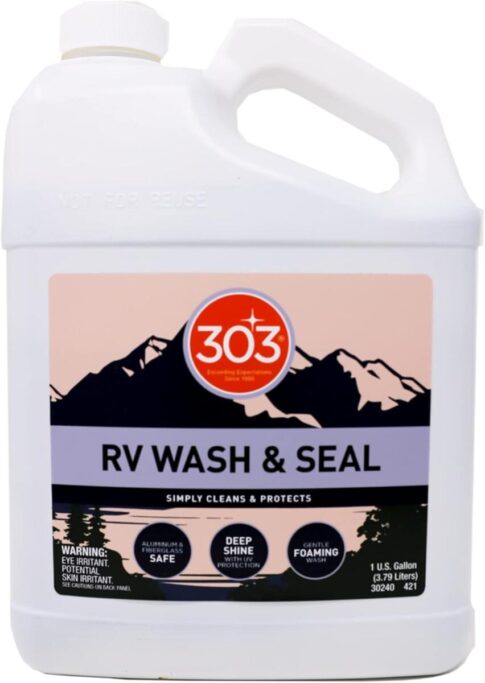
It’s the perfect time of year to get your RV looking as good as new. Make sure you wash and seal it. Here’s the product to get you started. One wash delivers a deep clean, streak-free shine, and UV protection—keeping your RV protected and looking like new all season long.
Ask Dave Are professional-grade tools really worth the money?
Need to remove a mattress from your motorhome or truck camper overhead? It can be a tight proposition! Start to roll up the mattress, then bind it around with ratchet-style tie-down straps. Cinch them up tight, then pull the mattress out. Or buy your new mattress from an outfit that will deliver and install your new mattress!
? MYSTERY PRODUCT OF THE DAY ? Make yourself laugh and your wife scream. Or perhaps make yourself laugh and make your husband scream. Either way, someone will laugh and someone will scream! See why.
Website of the day
Airbnb: Airstream & Camper Rentals
It’s the best of both worlds—you still get to “camp” in an RV, but it’s not yours so you don’t have to worry about reservations or parking! Explore this page and you’ll find incredible Airstreams and campers to book through Airbnb.
And the survey says…
We’ve polled RVtravel.com readers more than 5,000 times in recent years. Here are a few things we’ve learned about them:
• 26 percent say they carry every tool they could ever possibly need with them in their RV.
• More people always or mostly always read printed books over eBooks.
• 21 percent get five or more spam calls on their phone every day. Yikes!
Ain’t that the truth! Get this sticker for yourself here.
Trivia
In 1949, Popular Mechanics predicted that computers today would weigh approximately 1.5 tons. Wow! In the March 1949 edition, they wrote: “Where a calculator like ENIAC today is equipped with 18,000 vacuum tubes and weighs 30 tons, computers in the future may have only 1,000 vacuum tubes and perhaps weigh only 1.5 tons.”
Readers’ pet of the day
“Harper (English Springer Spaniel, age 1) was rescued from a bad situation when she was about 10 months old. She’s a good dog who has quickly adjusted to camper life.” —Corby Myles
Send us a photo of your pet with a short description. No blurry photos and please do not submit your photo more than once. Thanks!
AMAZON PET DAYS ARE ON! From May 11-15, expect big sales and deals on pet products. See what’s on sale here(and don’t miss out—tomorrow is the final day!).
FREE IS GOOD! Free copycat restaurant recipes from RecipeLion.com—from Cracker Barrel to Olive Garden.
Leave here with a laugh
Why couldn’t the pony sing a lullaby?
She was a little horse.
Take an extra 10% off a GhostBed luxury RV mattress!
The GhostBed RV mattress is 10” deep, crafted with gel memory foam for coolness, has 3 layers of luxurious comfort and is perfectly sized for your RV! Ahhhh… Wake up relaxed and rejuvenated. RVtravel.com readers now get an EXTRA 10% OFF a GhostBed Luxury RV Mattress! CLICK HERE and use code RVTRAVEL10. Watch RVtravel.com’s Tony Barthel’s RV mattress review here.
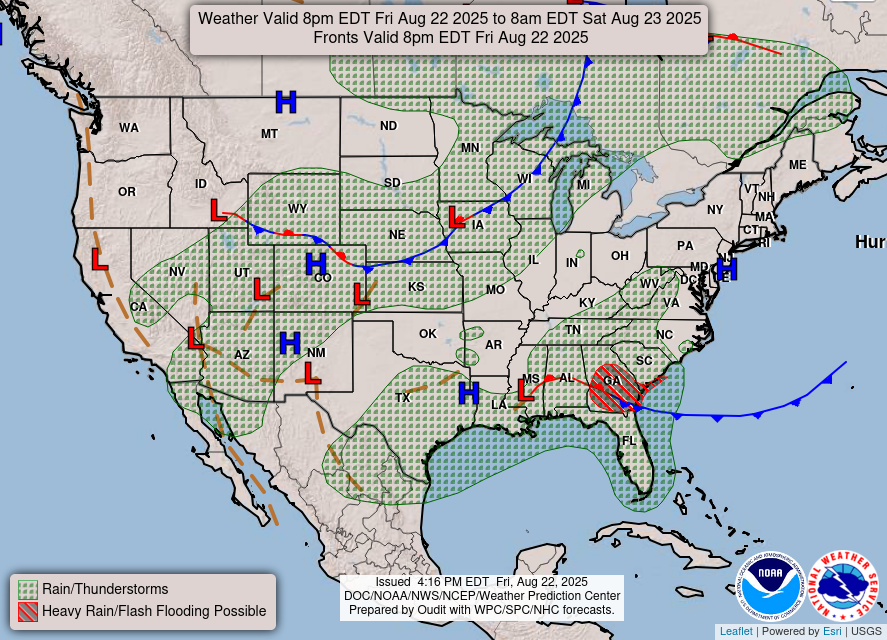
Today’s weather forecast across the nation THIS MAP UPDATES TWICE A DAY
If you shop at Amazon.com we’d appreciate you using this link. We get an itty bitty commission if you buy something, but they add up and help us pay our bills (most importantly our hard-working writers!).
Dear Dave,
Are the “professional-grade” power tools really worth the money? They sure demand a premium price. —Lance, 2023 GD Imagine
Dear Lance, I have used almost every brand of power tool from the cheapest imported models to the set of DeWalts I have now, and there is a difference. However, it really depends on what you are using them for and how often to justify the higher price.
Growing up, we had basically only two choices, SKIL® and BLACK+DECKER®. I think maybe Stanley (now Stanley Black & Decker) was thrown in there for a few hand tools, but there wasn’t much in the way of professional tools. Then Makita®, Bosch, and a few others came out with professional grade tools, and then cordless, as well.
If memory serves me (and oftentimes it doesn’t), Ryobi had a line of professional-grade tools that were actually pretty good. However, the line they have now being offered at home improvement stores and even discount stores is pretty much an occasional homeowner use tool.
My job when the RV industry declined
When the RV industry dropped to almost nothing in 2010, I helped a friend run a company that made commercial pressure washers that were installed in fast food restaurants. We had three technicians with trucks and trailers full of parts and tools, and they all wanted professional-grade DeWalt or Milwaukee.
After leaving several $300+ tools at locations around the country, we replaced them with Craftsmen or Ryobi. They did not like those, but we preferred they leave a $100 tool behind, instead.
The consumer-grade products did not perform as well, especially the batteries, and they took all day to charge back up. The drills held up fairly well, but were not put through as much of a challenge as the side grinders, hammer drill, and reciprocating saw. Those seemed to burn out fairly quickly. We eventually replaced everything with Milwaukee, with the agreement that if they lost or left a tool, they would replace it at their expense.
Back to the business of RVs
When the company got sold and the RV industry picked up again, I went back to making videos, writing articles, and conducting seminars. I also took a complete set of Craftsmen and Ryobi cordless tools, as the new owner wanted nothing to do with them.
So I have almost every price point tool you can imagine, including a “Tool Shop” sliding compound miter saw purchased at Menards for a home remodel project. That saw cost me $100 and has gone through about six major home improvement projects and is still spinning away.
The only downside is the unit is not as precise on miters anymore, and you really need to use a angle meter to make sure you get the right cut. Fortunately, all my projects were fairly simple and it worked. I just can’t see paying $375 for a DeWalt for one project.
In addition, I own a set of DeWalt cordless tools, including a hammer drill, screw gun, oscillating tool, and 6.5” circular saw. I started out with the set of screw guns on sale for $99, but the battery cost more than that. Then I got the oscillating tool for Christmas, and added the saw when my Ryobi burned up.
Habitat For Humanity
I have been volunteering for Habitat For Humanity, and these tools have been vigorously tested and are outstanding. The batteries last forever and the power is amazing. One thing I do not like is the drills are designed in a manner that part of my hand rests on the directional tab or button and reverses while I am using it, so I have to be careful.
I have one set of Craftsmen that I keep at the office/shop for my videos. I have a set of Ryobi at my stepdaughter’s house as they have various Ryobi lawn equipment items and a ton of batteries, which we always seem to need. If one of my brothers, neighbors, or business associates needs borrow a tool, they get the Ryobi! Once again, I would rather they forgot to return a free tool than my $150 DeWalt.
The plus side of professional tools
The advantage of a commercial-grade tool is the durability, performance, and longevity. I have dropped almost every tool I own off the bench or even a wall, and the DeWalt has yet to surrender. The power is superior, especially when you are trying to cut through tough wood, drill through steel, or other projects that the consumer models would freeze up on. Most of that is due, I believe, to the battery power.
The DeWalts are brushless technology. Not only do they provide superior power, but also consistency and a smooth operation.
The only drawback, in my opinion, is the cost of not only the tool, but the battery. Also, the fact that you seem to need to purchase everything in that model.
Just this weekend I had to buy a new set of screw bits. For some reason, I just had to have the DeWalt variety pack and spent $15 more than a generic brand. However, I do believe they are made with better steel and precise tips and will last longer before getting deformed. That is why I had to buy new tips.
The plus side of consumer-grade tools
The price! If you are just using them occasionally, there is no need to spend 5x more for a tool and 10x more for the battery. Sorry, guys. You can delete this part if your wife wants to read the article!
If you are just doing a few handyman projects or even a one-off larger remodel, the cheaper tools will do the job. I have found that to be true with my Tool Shop saw and a side grinder from Harbor Freight.
By Russ and Tiña De Maris
RV TV wall mounts are great. Their swing feature allows users to turn the TV in multiple directions, great for the rather strange seating arrangements RV manufacturers often use. They also allow the TV to be pushed back out of the way when not in use.
The trouble is, these articulating mounts typically require the use of wall studs for a safe and secure install. If the desired wall doesn’t have studs—typical of most fiberglass or composite exterior RV walls—what’s to be done? Here’s one way to get the job done.
Screws right out through the side of your RV?
TV nook on two outside walls. R&T De Maris photo.
Our travel trailer’s TV nest was in a cabinet that nestled into a corner of the rig. One wall was the sidewall; the other, the rear wall. Neither of these walls were studded, so here we were. We could leave the television on “feet” in the cabinet, and run the risk of having it topple out while underway. And if we wanted to turn the set on at an angle that could be seen from our dinette, we were at a dead end. The TV would have teetered on the edge of the cabinet.
We ordered an articulated wall mount from Amazon. On arrival, we learned it needed to be mounted with long lag bolts, or some kind of wall expansion bolts. Neither would work. The lags would have screwed right out through the fiberglass exterior, and the solid block insulation prevented the use of expansion bolts.
Construction adhesive in handy small tube.
Stymied, we had to think outside of the box. We finally hit on using a solid wood block to which to attach the wall mount. And to make the wood block hang on the wall? A liberal dose of construction adhesive.
If you’re not familiar with the stuff, construction adhesive is like very strong glue that bonds on a molecular level. You’ll need to pick an adhesive based on the surfaces to be bonded when you do your shopping. It used to be the stuff was only available in big tubes, the kind you’d dispense the contents with a caulking gun. You probably won’t need that much and, happily, many construction adhesives are sold in small, handheld tubes.
Wall prep may be required
In our case, we were bonding a wood mount to the wallboard material inside the existing RV TV cabinet. For us, Gorilla brand Heavy Duty Construction Adhesive was appropriate, and set us back about $8. If there’s wallpaper over the surface of the wallboard, you’ll want to remove it from the backing board first. A utility knife, scraper, and maybe even sandpaper are in order. Here’s how our project worked.
RV TV wall mount to pine block
Our relatively lightweight TV required an RV TV mount that impacts a relatively small wall surface. For us, we were able use a length of 1 x 4 pine board for our block. We saw to it that the board was clean. We then measured out the wall area and determined we wanted to mount the block at the center of the cabinet back.
First, we pre-drilled pilot holes for the screws that would give additional strength to our installation, and that would hold the block in place until the adhesive dried and cured. Here’s another shopping point. Some construction adhesives take a LONG time to cure to strength, others take less. Take this into account when buying. The pilot holes looked good, but we had our own set of “boobers” with that.
We marked out the spot where the block would need to be mounted. We then applied a liberal amount of construction adhesive, following the manufacturer’s instructions. The block was then stuck up on the wall, and we set in screws to hold it in place while the glue cured. Hey, presto!
But here’s the boober: Our pilot holes weren’t quite large enough, and, sure enough, we got a couple of very unwelcome cracks in the block. Since the block was now glued to the wall, there was no real way of going back. Happily, while the cracks look super-unprofessional, once the adhesive cured, there was no issue with holding power. Loss of pride, yes; but not loss of strength. Happily, the TV hides the minor mess.
Pilot hole size?
Business-end of TV wall mount hung on our pine mounting block. R&T De Maris photo.
After the cure time, we then used heavy screws to mount the TV wall mount to the block. This time we used adequate pilot holes! How do you determine what size pilot hole to drill? The bit should be the same size as the body of the screw, but not the threads. Since screw sizes are by number, not width, here’s a good chart to help you determine the hole size.
With the business end of the TV mount screwed down tight, we completed assembling the mount follow the instructions. We hung the TV on the mount, and we now have a TV we can pull out of the cabinet and point in whatever direction we need.
One issue we’re still working on is this: When we’re underway, the TV likes to “hunt” its way around in the cabinet. We’re hoping something less clobbered up than a bungee cord with two eyebolts will come to mind!
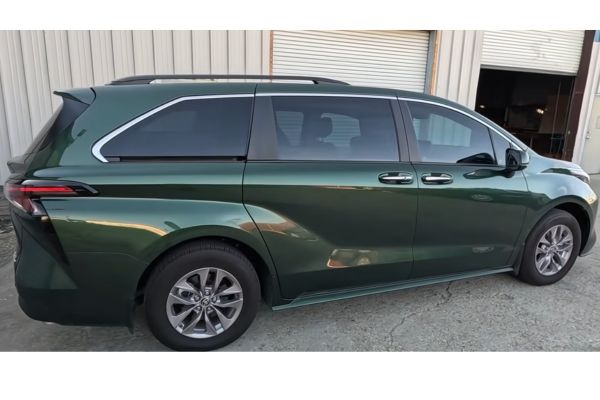
A minivan camper usually asks for a compromise, but this 2025 Toyota Sienna build doesn’t. It keeps the second row, sleeps one person, and still looks like a normal family van from the outside. That dual-purpose layout is the whole story here. Horizon Camper Builds turned a hybrid XLE into a removable stealth camper that can still work as a four-passenger daily driver. We get a full tour in the video at the end of this post.
A hybrid Sienna makes a strong stealth camper base
This build starts with a 2025 Toyota Sienna Hybrid XLE. The client wanted a one-person stealth camper, but she also wanted to keep the second-row seats. So the van stays useful in passenger mode, while the third row is removed for the camper setup.
The Sienna is a strong choice for this kind of project because the hybrid system helps in two ways. First, it gets around 40 mpg. Second, it can run the air conditioning overnight from the hybrid battery. If the battery gets low, the engine turns on to recharge it. According to the walkthrough, running the A/C all night uses about half a gallon of gas.
That matters in hot weather, and it also matters for stealth camping. On the outside, nothing gives the build away.
Passenger mode stays comfortable and usable
In van mode, the second-row seats still slide and recline with full adjustment. The build folds behind them, so rear passengers don’t lose their comfort. Because this is an XLE trim, both sides also get power sliding doors.
When the seats move forward, a walkway opens behind the driver’s side. That becomes the entry point into the rear sleeping and lounge area. The build is removable, so the third-row seat can go back in and return the van to a seven-passenger setup. The main win here is flexibility. This van can switch between family duty and solo camping without a permanent interior overhaul.
The bed folds out fast and leaves useful storage below
The sleeping setup uses a flip-over extension with a collapsible bracket. Once opened, it creates a single bed. The 4-inch folding foam mattress measures 75 inches long by 25 inches wide and has washable covers.
The mattress works in two positions. In lounge mode, it sits higher, so the fridge is still easy to reach. In sleep mode, it slides under the counter to form the bed platform. The head goes toward the front of the van, with feet toward the rear.
Under the bed, the space is left open instead of boxed in. That gives room for larger gear or storage totes. There is also space near the front extension and between the second-row seats for extra items.
Power, fridge, sink, and microwave fit into a compact rear kitchen
Inside the van, the bed can also work as a bench. A carpeted wooden floor anchors the build at four points, so it stays snug and quiet on the road. In front of the bench sits a Bluetti Elite 200 power station in a custom holder with small shelves around it and an open top for easy lifting.
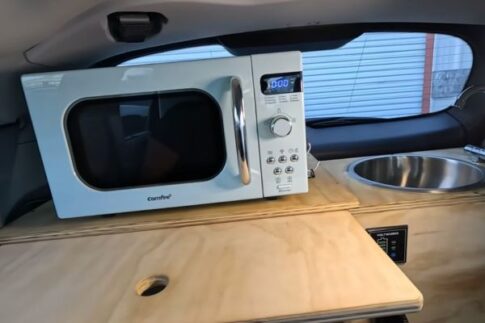
The van did not come with the factory AC outlet and inverter option, so the build adds a 1500W pure sine inverter under the bed. When the Sienna is turned on, that inverter can charge the Bluetti from the van’s battery. The power station runs the microwave and the 12V 30-quart BougeRV fridge.
The sink uses a collapsible faucet, a 13-inch stainless steel bowl, and a 12V pump. A side switch activates water flow. Two 5-gallon containers handle fresh and gray water. The sink topper doubles as a small table, and a slide-out extension under the microwave adds more prep space.
The rear liftgate turns the setup into an outdoor kitchen
The powered liftgate opens up the whole back of the van. Under it, there is shade from sun and cover from rain. The sink works from outside, the water jugs are easy to access, and the sink cabinet door can act as extra surface space for a stove.
The fridge is reachable from the rear, and the counter extension can slide out toward the back. If the microwave is removed, the rear counter opens up even more. The fridge cover and bed extension can also work as added work surfaces.
There is also retained access to the rear battery area and A/C vents. The wood was left unstained at the client’s request, but it was sanded smooth, and all edges were routed to remove sharp corners.
This Sienna build works because it stays simple. It keeps the second-row seats, adds a removable one-person camper, and makes smart use of the rear space without changing the van’s low-key look.
It seems like they’re never-ending these days. We’re talking about TV and movie streaming services like Netflix, Hulu, Max, Paramount+, Disney+, Peacock… geez, the list seems endless. See what we mean?
How many of these TV and movie streaming services are you subscribed to? Just one? A few? Five? 10? If you share them with your family, that counts too.
Some folks stick to just one or two favorites, while others collect streaming subscriptions like baseball cards—one for classic sitcoms, another for new releases, and maybe one just for those obscure British crime dramas you only watch on rainy days. Then there are the free options that still manage to suck us in with old reruns and surprising gems.
It’s easy to forget just how much we rely on Wi-Fi these days to stay entertained. Whether you’re binge-watching a series or just tuning in for a quick movie before bed, a solid internet connection can make or break the experience. For RVers, this adds an extra layer of planning. Do you download shows before hitting the road? Or do you rely on campground Wi-Fi, cellular data, or satellite internet?
And what about the cost? Subscription prices tend to sneak up on people. One here, one there, and suddenly you’re paying more per month than you would for cable TV. Some RVers we’ve heard from say they cycle through subscriptions—canceling one and picking up another depending on what they want to watch that month. Do you do the same?
Oh, and one last question: Do you find yourself streaming more TV/movies at home or while you’re out in your RV? Or is it about the same? Less? Feel free to leave a comment. Thanks!
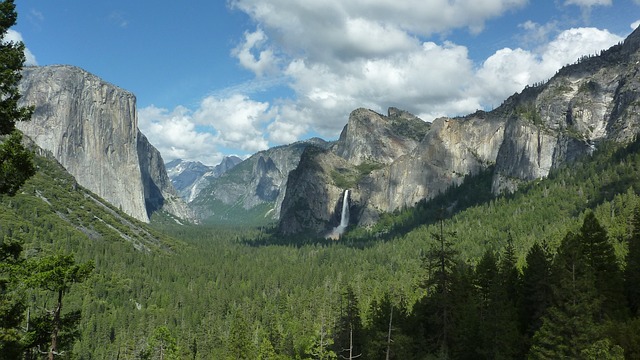
Yosemite National Park is preparing to welcome visitors for the peak summer season with expanded access across the park, including the reopening of popular trails, climbing areas and full campground availability.
All Yosemite front-country campgrounds will be open this summer and available for reservation via Recreation.gov. Most High Sierra Camps are returning to operation, offering visitors additional opportunities to experience the park’s backcountry.
Also reopening is a section of the Valley Loop Trail near Royal Arches and several popular climbing routes that were previously closed for safety monitoring. The Ice Cut section of the John Muir Trail is expected to reopen in July following visitor safety and trail improvements.
Tioga Road is scheduled to open to vehicle traffic Friday, May 15, the earliest opening in 16 years. The seasonal trans-Sierra route across the park gives visitors access to Tuolumne Meadows and the high country.
Glacier Point Road opened to vehicle access May 9, providing sweeping views of Yosemite Valley and easy access to high elevation trailheads. These roads provide visitors with convenient entry points to Yosemite’s High Sierra, with opportunities ranging from short day hikes to more remote wilderness experiences with a permit.
Hiking to the top of Half Dome, 5,000 feet above Yosemite Valley, is scheduled to open May15 via a daily lottery. The lottery application period is two days in advance of the desired hiking date.
“Yosemite continues to expand access while protecting the park’s extraordinary resources,” said Superintendent Ray McPadden.“We’re excited to welcome visitors to more areas of the park this summer and encourage everyone to plan ahead for a safe and enjoyable experience.”
Visitors should expect traffic if visiting on weekends, especially on Saturday mornings. To help reduce congestion, park officials strongly encourage visitors to:
Arrive early in the morning or later in the afternoon
Explore beyond Yosemite Valley
Digital park passes purchased in advance can significantly reduce time spent at entrance stations and help improve traffic flow into the park.
All visitors are encouraged to check current conditions, plan ahead, and prepare for changing weather and busy conditions. Parking in Yosemite Valley fills early during peak summer days, and services may be limited in some areas.
We use cookies to ensure that we give you the best experience on our website. By continuing to use our site, you consent to accepting cookies. We NEVER have or will sell reader's data. For more info, please see our privacy policy page.











 Inside the van, the bed can also work as a bench. A carpeted wooden floor anchors the build at four points, so it stays snug and quiet on the road. In front of the bench sits a Bluetti Elite 200 power station in a custom holder with small shelves around it and an open top for easy lifting.