

Most RVers have seen it.
A campground restroom closed for repairs. A picnic table covered in graffiti. A sign peppered with bullet holes. A fire ring damaged beyond use.
It’s easy to assume those things happen because public land agencies don’t have enough money to keep up with maintenance. Sometimes that’s true. But a recent vandalism case at a Wyoming campground highlights another reason some campground improvements never happen.
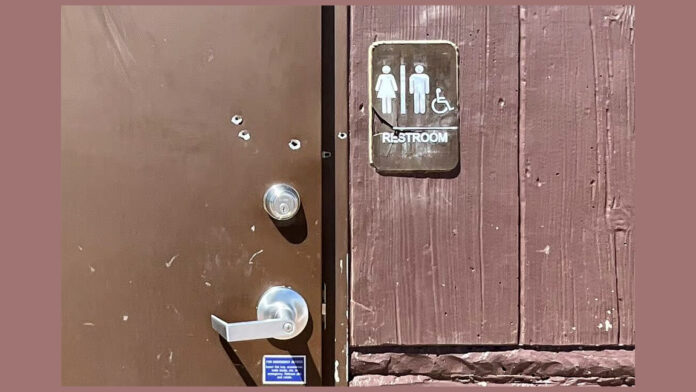
The Bureau of Land Management is investigating damage to a vault toilet at Continental Divide Campground near Rawlins, Wyoming. Someone fired multiple rounds into the restroom, causing an estimated $5,550 in damage.
The repair bill is significant. But the bigger story may be what that money could have paid for instead.
Campground upgrades get pushed aside
The damage isn’t limited to what’s broken. Campers also lose the improvements that money could have funded.
According to the BLM, money and staff time spent repairing vandalism can’t be used for other projects.
That means the cost of vandalism doesn’t stop at the damaged restroom.
It may mean a campground road waits longer for grading. A worn picnic table stays in service another season. A sign replacement gets postponed. A campground improvement moves to next year’s wish list instead of this year’s work schedule.
Most RVers have experienced the results. You pull into a campground and find a restroom closed. A campsite fixture looks like it should have been replaced years ago. A road is rougher than it ought to be.
Sometimes those delays happen because agencies have limited budgets. Sometimes they happen because crews have spent time fixing damage that never should have occurred.
The damage isn’t limited to what’s broken. Campers also lose the improvements that money could have funded.
The costs add up faster than many campers realize.
The Wyoming incident is hardly unique
Land managers across the West routinely deal with vandalized signs, damaged gates, graffiti, destroyed campground fixtures and shot-up facilities. In some cases, repair costs reach tens of thousands of dollars.
Those bills don’t arrive in a vacuum. The money has to come from somewhere.
While one damaged toilet may not seem like a major issue, repeated incidents can force agencies to spend substantial amounts of time and money simply restoring facilities to the condition they were already in before the damage occurred.
That’s frustrating for campground managers.
It’s also frustrating for campers who wonder why certain repairs or improvements never seem to move very quickly.
A safety issue, not just a maintenance issue
The Wyoming case also carried a more serious concern.
BLM officials noted that someone could have been inside the vault toilet when the shots were fired.
That detail turns the incident from simple property damage into something much more troubling.
Campgrounds are places where families expect to relax, hike, fish, ride bikes and enjoy the outdoors. Most visitors never think twice about walking into a restroom or using a campground facility.
Incidents like this serve as a reminder that reckless behavior on public lands affects more than property.
Why this matters to RVers
Most RVers take pride in public campgrounds.
Whether it’s a BLM campground, a Forest Service campground, a state park or a national park campground, these places depend on a combination of funding, maintenance and responsible visitors.
The vast majority of campers do their part. They pick up after themselves, respect facilities and leave campsites in good condition for the next visitor.
Unfortunately, it only takes a few people to create expensive problems for everyone else.
What RVers can do
Most campers will never shoot up a restroom or carve their name into a picnic table. But experienced RVers can still play a role in protecting the campgrounds they enjoy.
If you spot fresh vandalism, report it to campground staff or the managing agency. A damaged sign or restroom may seem obvious, but land managers sometimes don’t learn about problems until visitors report them.
If you witness vandalism in progress, avoid confrontation and contact authorities when it’s safe to do so.
And when facilities are damaged, resist the temptation to assume campground managers simply aren’t doing their jobs. In many cases, maintenance crews are spending time and money fixing problems created by a small number of visitors.
For RVers who rely on public campgrounds, protecting those facilities ultimately helps preserve the camping experience for everyone else.
When RVers encounter a closed restroom, a damaged facility or a campground improvement that seems long overdue, the reason may not always be a lack of money. Sometimes the available money has already been spent repairing damage that never should have happened in the first place.
And in Wyoming, one vandalized restroom just became the latest example.
SOME PRIOR CASES OF PUBLIC LANDS VANDALISM
- Another case of public lands vandalism. Can you help?
- Reward offered to help catch national park vandals
- Teen vandal at a KOA and his mother ended up behind bars
- Vandals trash colorblind viewfinder at scenic overlook
- Stupid crooks and attorneys: Lake Mead rock formation vandals finally caught
- Senseless vandalism destroys facilities in Idaho state parks
RVT1264b
