

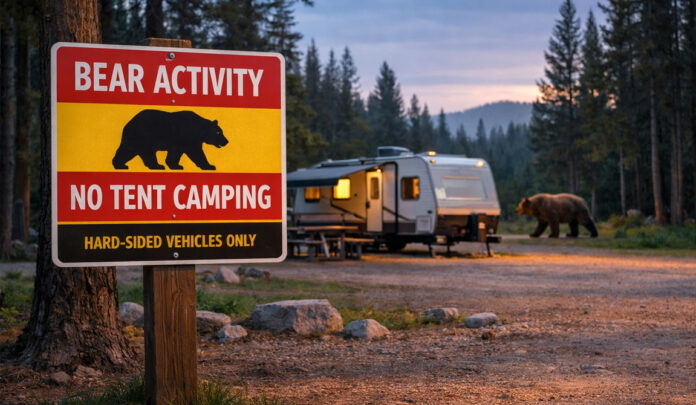
Campgrounds near Yellowstone National Park don’t always stay open to everyone. When Yellowstone bear camping restrictions kick in, some sites flip to a hard-sided-only rule—no tents, no exceptions. For RVers, that can mean the difference between staying put and packing up.
It’s not a new policy, but it still catches people off guard. When bears start frequenting campgrounds, especially those that have learned to associate people with food, land managers act quickly. In some cases, that means shutting out tent campers entirely, while allowing RVs and other hard-sided units to remain.
When bears move in, the rules can change overnight
The example that sparked this discussion comes from three campgrounds near Yellowstone where officials have previously banned tent camping after bears became a regular presence. The concern wasn’t just that bears were nearby—it was that they were lingering, returning, and showing behavior that suggested they were getting comfortable around human food sources.
A tent offers no real barrier. A bear that wants what it smells can get through fabric in seconds. A hard-sided RV, while not “bear-proof,” at least creates a physical separation and buys time.
So when risk rises, the rule kicks in: soft-sided camping out, hard-sided only.
Why RVs get the green light
Wildlife managers know they can’t eliminate bears from these areas. The Greater Yellowstone ecosystem supports a healthy grizzly population, and encounters are part of the deal. What they can do is reduce the chances of a dangerous interaction.
RVs help do that in a few ways. They limit direct access, reduce scent spread compared to open camps, and give occupants a better chance to stay secure if a bear wanders through. That doesn’t make RV camping “safe,” but it makes it safer than sleeping in a tent when bears are actively working a campground.
What this means if you’re heading that way
If your travel plans include Yellowstone or nearby national forest campgrounds, it’s worth understanding how quickly conditions can shift.
A campground that welcomes tents one day can restrict them the next. If you’re in a tent, that may mean relocating with little notice. If you’re in an RV, you’re more likely to be allowed to stay—but you’re still expected to follow strict food storage and campsite rules.
And those rules matter. Most of these restrictions don’t come out of nowhere. They follow repeated bear visits, unsecured food, or garbage issues that teach animals to come back.
The bigger shift RVers should notice
In high-risk wildlife areas, especially around Yellowstone, access increasingly depends on what you’re camping in. Hard-sided units aren’t just more comfortable, they’re often the only option when conditions tighten.
That doesn’t mean RVers should get complacent. Bears don’t care what you’re sleeping in. But when restrictions go up, your RV may be what keeps your trip from getting cut short.
And in bear country, that’s not a small thing.
RELATED
- Man gets jail-time for leaving Yellowstone boardwalk
- Yellowstone entrances, roads prepare to open
- Yellowstone grizzly bear deaths at alarming high due to humans
- Yellowstone geologists fetch 300 hats, pizza, and koala doll from hot springs
RVT1257b

I’m pretty sure this was the case last year too.
Thank you for sharing this reminder of rules when bears are prowling campgrounds, Russ and Tina. We were at a provincial campground in British Columbia a few years ago that encircled the tenting area with a high-voltage electric fence. I suppose that they had roaming bears even more frequently (?) than Yellowstone does. In any case, they opted for a different solution. Have a great weekend and safe travels.