

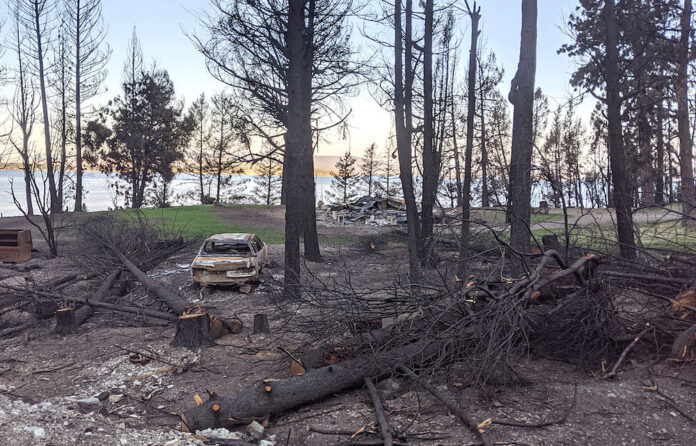
MISSOULA, Montana – More than three times as many houses and other structures burned in Western wildfires from 2010 to 2020 than in the previous decade, and that wasn’t only because more acreage burned, according to an analysis from the University of Montana and its partners.
Human ignitions started 76% of the wildfires that destroyed structures, and those fires tended to be in flammable areas where homes, commercial structures and outbuildings are increasingly common.
“Humans are driving the negative impacts from wildfire,” said lead author Philip Higuera, a UM fire ecologist and professor, who wrote the assessment during a sabbatical at the Cooperative Institute for Research in Environmental Sciences (CIRES) at the University of Colorado Boulder. “Human fingerprints are all over this. We influence the when, the where and the why.”
Most measures of wildfire’s impact – for example, expansion of wildfire season into new months and the number of structures in flammable vegetation – are going in the wrong direction, Higuera said. But the new finding, published Feb. 1 in the Proceedings of the National Academy of Sciences-Nexus, also means that human action can lessen the risks of wildfire damage.
“We have levers,” he said. “As climate change makes vegetation more flammable, we advise carefully considering if and how we build in flammable vegetation, for example.”
Higuera worked with several researchers to dig into the details of 15,001 Western wildfires between 1999 and 2020.
Burned area increased 30% across the West, the team found, but structure loss increased much more, by nearly 250%. Many factors contributed, including climate change, our tendency to build more homes in flammable ecosystems and a history of suppressing wildfire.
Ph.D. student Maxwell Cook, a co-author from CIRES/CU Boulder, said the forcible removal of Indigenous people from landscapes played a role by almost eliminating intentional burning, which can lessen the risk of more destructive fires.
“Prescribed fire is an incredibly important tool, and we have a lot to learn about how people have been using fire for centuries,” Cook said.
In the new assessment, the team found some horrible years for wildfires. Sixty-two percent of all structures lost in those two decades were lost in just three years: 2017, 2018 and 2020, Cook said.
And some states had it much worse than others. California, for example, accounted for more than 77% of all 85,014 structures destroyed during 1999-2020.
Across the West, 1.3 structures were destroyed for every 1,000 hectares (2,471 acres) of land scorched by wildfire between 1999 and 2009. Between 2010 and 2020, that ratio increased to 3.4.
Importantly, Higuera and his colleagues also found variability among states in how much burning occurred and how many structures were lost in wildfires. Montana sees less structure loss relative to the West as a whole, and most burning is from lightning ignitions. California, on the other hand, sees high losses from wildfires and burns much more overall.
The paper concluded that all states could benefit from policies that address human-related ignitions, especially during late summer and fall and near developments, as well as policies that address fire-resistant building materials and consideration of nearby vegetation.
Finally, the authors said climate change mitigation is also essential. Longer fire seasons – a result of climate change – mean that human-related ignitions are more consequential, leading to more destructive wildfires in the fall and early winter when they were once rare.
Florida’s dry season is winter, and generally that is when our parks do our controlled burns. We can have bad wildfires during summer droughts, like the one in 1998 when Governor Lawton Chiles banned personal fireworks and restricted municipality fireworks to those attended by Fire Rescue crews.
My Florida Trail Association chapter actually hiked through a controlled burn on Mothers Day one year. Most of peninsular Florida is sugar sand which collects duff, or flammable organic material, either until the pieces are weathered small enough to slip between the sugar sand grains, or it’s carried off by runoff, or burnt. It was STRANGE to see the ground burning except for the all-sand trail. One hiker had the soles separate from her shoes- Thank the Lord for duct tape!
Thank you, RV Travel! 🙂 I am unaware of any wildfires in our general vicinity. Within the borders of Tennessee fire permits are only issued for the period October 1 – April 30. Generally, the weather includes lots of precipitation then and our humidity level in general is much higher than in the west. Further, if the humidity level is unusually low or high winds anticipated, then burning is not allowed on those days. We also are required to notify the relevant fire department if burning is planned on any particular day. It seems to work pretty well for us. Thanks again, have a great weekend, safe travels, and safe stays! 🙂