

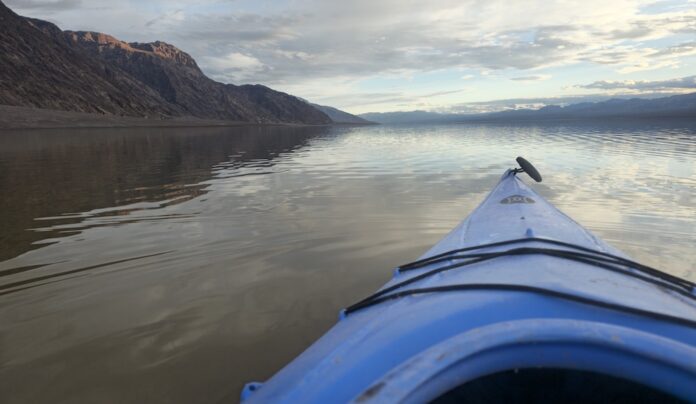
Here’s a one-time opportunity for bragging rights for the rest of your life—about how you kayaked in the driest place in the United States. A temporary lake at Badwater in Death Valley National Park provides that rare opportunity. But hurry: The lake won’t last long.
“You might think with no drain to the sea, that Death Valley would always have a lake,” says park ranger Abby Wines. “But this is an extremely rare event. Normally the amount of water flowing in is much less than the evaporation rate.”
Badwater Basin lies at the bottom of Death Valley in California. At 282 feet below sea level, it is the lowest elevation in North America. Badwater Basin is normally a bone-dry salt flat.
The magic ingredient this year was rain—and lots of it. Death Valley National Park averages about two inches of rain per year. The valley floor received 4.9 inches in the past six months, and surrounding mountains received greater amounts of rain. Most of that precipitation happened in two events: 2.2 inches during the remnants of Hurricane Hilary on August 20, and 1.5 inches during an atmospheric river February 4-7.
“The lake was deep enough to kayak for a few weeks after Hurricane Hilary, but unfortunately people couldn’t come enjoy it then,” said Wines. “Every road in the park was damaged by flash floods, and it took two months to open the first road into the park. Now most of the main roads are open, so it’s a great time to come visit!”
As of mid-February, the temporary lake, informally known as Lake Manly after the ancient lake that once occupied much of present day Death Valley, is about six miles long, three miles wide and one foot deep. It may only be deep enough to kayak for a couple weeks. However, park rangers believe the shallow lake will still create beautiful reflections through April.
Park rangers urge visitors to stay safe and to minimize their impact by following a few rules. Parking lots may be full. If parking on a road shoulder, drivers should be cautious of soft shoulders and ensure they are fully out of the driving lane. Footprints in the lakeshore can last for years. People should walk on established pathways.
All hotels and most campgrounds in the park are open (Sunset Campground at Furnace Creek almost always has space for RVs). Paved roads are open to most of the park’s primary features, including the temporary lake in Badwater Basin. The National Park Service is continuing to work on secondary roads, many of which are still closed due to flood damage. Full information is at nps.gov/deva.
##RVT1145b

This is right up our alley. Too bad we can’t get down there. It’s not that far from home. DANG!
Sure would be worth some bragging rights if I could get over to there and put the kayak out on the water while it lasts !
We were just down there a couple hours ago so we could see the lake. Pretty amazing site, having seen it in its normal dry state before!
Thank you, RV Travel! What an amazing, probably once-in-a-lifetime opportunity! But even more amazing to me is the ranger comment that footprints can last for years!?!? 🙂