


(Recycled from 2023, including helpful comments from our readers.)
Dear Dave,
My Snow River 810 camper says “Four Season” on the decals. I am assuming that this means the holding tanks are heated(?) and there is extra insulation(?). Unfortunately, I have been unable to obtain an owner’s manual so I cannot be sure of what I have. I keep the camper plugged in to AC so that I can use an Ironwood Air Dryer to control humidity. Twice recently I walked past the camper and heard the fan and felt air coming from the furnace vent. The furnace is turned off. I am wondering why the furnace fan is running. Malfunction? Or could this be part of the “Four Season” package? —Lynn, 2006 Snow River 810 pickup camper
Dear Lynn,
“Four Season” is one of those marketing hypes that make people believe they can use the rig year-round without any issues. I remember working at Owner Relations at Winnebago when the first “basement” models hit the market and the brochures touted “Heated basement for year around use.” Then I started getting calls from owners that had their water lines freezing in only 20 degree temperatures!
When I asked the product manager how this could happen, since a heat duct was routed to the service center, he stated; “We heat the basement, but not to keep it from freezing.” I kid you not. And this guy later became President and CEO! He also stated that marketing put anything they want in the brochure to sell units and we don’t get to proof any of it. Later, when I was the Marketing Manager, we often had “discussions” with engineering and service on what was realistic.
What does “Four Season” really mean?
Again, “Four Season” is a common marketing term and can mean many different things for different RV manufacturers. Typically it means the fresh water tank, plumbing, and water pump are heated either by a heat duct directed at the area or a heating pad placed under the tank. This does not mean there is sufficient heat to keep the area from freezing.
I have taken units out that had a dedicated heat duct directed at the water pump and plumbing and froze it solid a few times until I learned a little more about HVAC and airflow. Just because there is ducting to that area doesn’t mean the typical onboard heater has enough airflow directed to that area. There are much larger rooms in the RV that have superior airflow.
Plus, there is no cold air return in that compartment like in a residential HVAC setting, so it limits airflow and creates cold pockets. Remember, the plumbing in your RV is only 1/2” plastic pipe. If it is sitting directly against an exterior compartment door or even on the floor, a good wind can freeze it pretty fast.
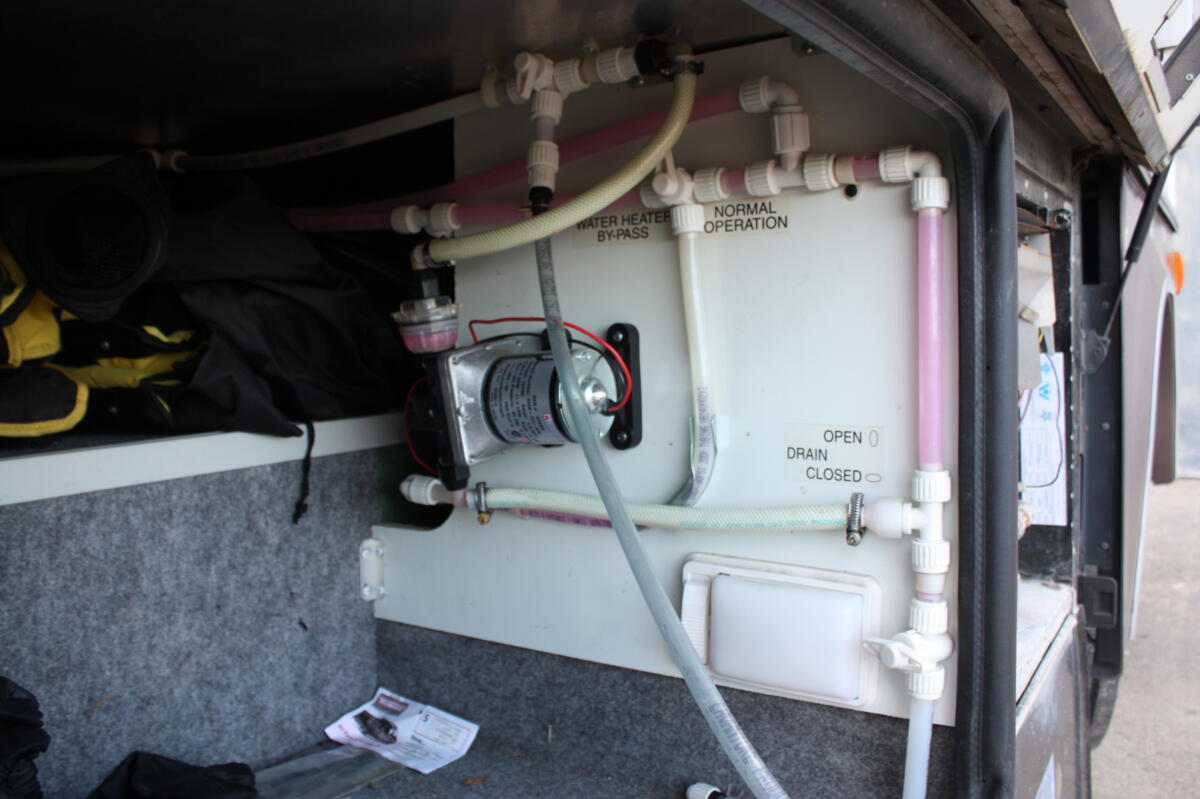
I have found that it is a good idea to provide supplemental heat in the service compartment at the point of the water pump and plumbing. This could be a small space heater or, better yet, a heat lamp with 65W bulb. That is safe and will supply enough heat to protect the area.
“Four Season” typically does not mean extra insulation
Four Season typically does not mean extra insulation as it would be impossible to add more width to sidewalls, a floor, or roof. However, I have found some come standard with loose fill insulation but have an upgrade that uses block foam insulation. That provides superior insulation for cold weather use. It’s not additional insulation, but rather a different type. You should be able to open the exterior refrigerator vent, if you have an absorption-type fridge, or remove a roof vent interior shroud to see what type of insulation is used.
Most Four Season packages also include a water heater bypass valve, dual pane windows, and a higher BTU furnace. Most do not have heated holding tanks as you can just dump RV antifreeze down then and not waste LP heating those.
Why is the furnace running?
I assume you have a traditional LP furnace that has an outside vent with an intake and exhaust.
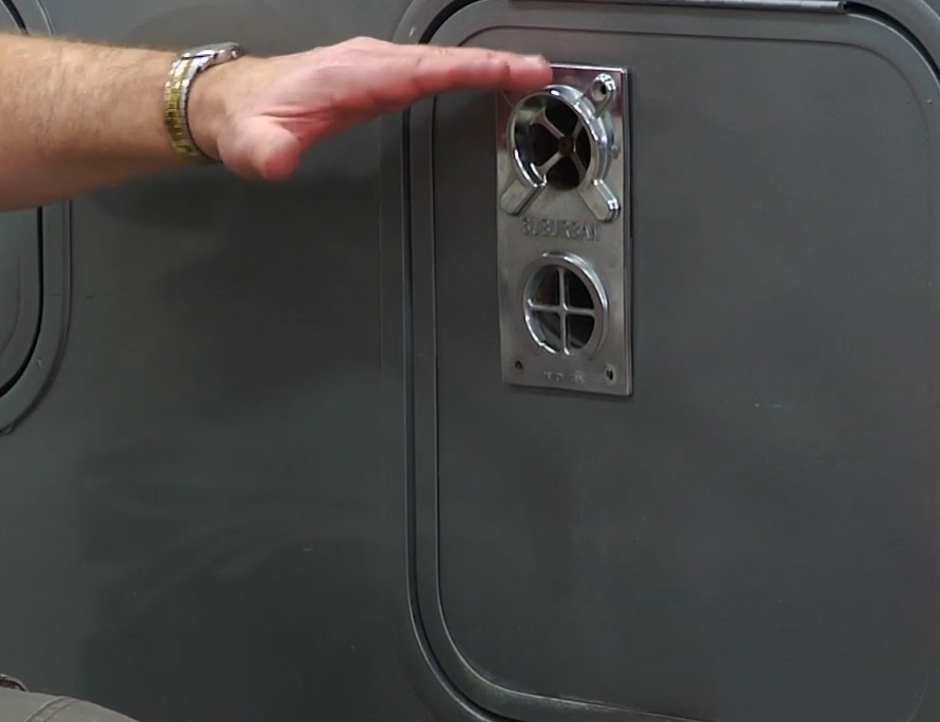
When the thermostat calls for heat, 12-volt power is sent to the furnace module board and it starts the blower motor. This pulls exterior air through the intake, runs it through the burner assembly to purge old air and exhausts it outside. Initially this would be the ambient temperature of outside air. At the same time, the blower motor draws interior air through the return air, which is blown over the burner assembly and out to the vents. This lifts a sail switch that verifies good airflow for a period of time. It then sends power to the module board to open the gas valve and start the spark sequence. Then the furnace lights, and the air coming out the exterior exhaust vent then gets hot.
What to check on furnace
If your furnace is off, there should be no airflow coming out this vent, even if you do have a Four Season package. The first thing I would check is the thermostat, which might have a fan switch allowing you to set the fan to run all the time, which would provide air circulation inside the coach. There would be an option for On, Off, and Auto, which would start the fan automatically only when the furnace is running. You might have the fan setting to On, which runs all the time. Otherwise, there would be a relay that has gone bad and provides power to the fan motor making it run all the time no matter what the setting is.
As you can see, there is no industry standard for what a Four Season package or option contains, and things can be pretty vague and sometimes confusing. I would suggest taking precautions mostly on the fresh water portion of your rig. Since it’s a truck camper, there’s not the labyrinth of plumbing lines hidden all over the place. Just make sure any lines located close to the sidewall or inside compartments are protected.
You might also enjoy this from Dave
At what temp should I be worried about exposed water lines freezing?
Dear Dave,
We have a 2017 Jayco 30X Class C RV. We love our rig and keep it extremely well-maintained as we travel 8-9 months out of the year. Occasionally we’re caught in cold weather, but we try our best to avoid temperatures from 25 degrees F or lower. …
Question: What are typical low temperatures a rig like ours can handle without freezing damage to lines? In addition, would it be reasonable to insulate the water lines under our rig to make our RV more of a four-season RV? Many thanks for your advice. We love your forums. —Greg
Read the rest of the question and Dave’s answer.
Dave Solberg is a leading expert in the RV industry and the author of the “RV Handbook.”
Read more from Dave here.
HAVE A QUESTION FOR DAVE?
Send your inquiries to him using the form below.
##RVDT2261, 2550
Four Seasons, Heavy Duty, Commercial Grade, Professional Quality, Wholesale To The Public. All the same meaning. as in “gotcha”.
You can add “Energy Star” to that list. No real standards as far as I can tell.
On a factory tour we saw how the heating ‘ducts’ blow a little bit of warm air under the floor of our trailer. Supposedly to keep the tanks from freezing. What a load of you-know-what! We’ve had pipes freeze three times when we least expected it. Once while in transit to our next stop. We got there and the only faucet that worked was the cold line in the kitchen. It took almost a whole day before we got water at all the faucets – even the shower. So much for “Four Seasons”. Our four seasons are spring, summer, summer, and fall.
I found that the bi-metal atwood thermostat is made to override the setting either low or off. This is done to try to prevent freezing. A newer digital type may work but yours is doing what it was designed to do. Your furnace will try to make heat even if you run out of propane. It doesn’t know.
Our 2017 Keystone TT is ‘4 season’. What this means is the belly in enclosed with everything inside the enclosed space, including waste gates. There is some foam insulation in this space. But mostly it means there is parasitic heat coming off the furnace ducts to reduce the likelihood of water freezes. It mostly works. We got down to 3F during the freak 2021 storm in Texas. Only a small part of our water system froze – ice climbed the low drain points and blocked the downstream part of one line. I have since shortened and insulated those exposed lines. We routinely see several hours down into the 20’s without issue.
Our small 2022 Gulf Stream TT puts the entire water system inside the cabin – except for the low drain points and a short run between fresh water tank and the rest of the system that goes under the floor. I installed rigid foundation insulation under that short run and again, shortened and insulated the low drain points. We have spent a number of nights down to 21F without a freeze.
Last point: I can’t tell you how many times I have seen heated water lines where the end points were left uninsulated and people were upset because their water froze. Old axiom: a system is only as strong as its weakest point.
My Gulfstream BT Cruiser has 12v 60 watt heat pads surrounding the gray/black tanks. With my lithium batteries I have no issues running them for a few hours from say 4am to 8am like last night at 15° here in Gallup NM. Worked fine!
Thank you, Dave! Interesting combination of features to be considered “four-season.”
Both Truma and Keystone have these enormous chambers that they can drive virtually any RV into and test their ability to keep you, and your pipes, comfortable and at what temperature those systems can withstand.
So Ember, for example, uses Truma’s chamber and has certified that their trailers can be fully functional down to 0°F.
Keystone, too, is beginning to use their climate chamber to test the systems in their RVs so they can test things like their AC systems to verify if they do, indeed, provide more cold air.
The trick with the Truma system is that you have to use Truma products for them to test your RV. But this is one way to put real numbers on “four season.”