


By Bob Difley
Snowbird season is on us. If you are planning to spend a few months boondocking in the deserts, you may find the following tips helpful as well as a partial check list before you set out, or to make adjustments if you’re already doin’.
 • Consider installing solar panels. Most of the desert is wide open to the sky and you get a full day’s worth of charging — even though the days are shorter. Even a single panel will provide enough electricity to run some of your systems, decreasing the amount of generator run time.
• Also consider a catalytic heater, which runs on propane — and since it has no fan, it draws no electricity. Your built-in forced air heater will quickly drain your batteries on those crispy desert nights.
• Make up a desert day pack for hiking, biking or just sightseeing, consisting of sunscreen, a floppy brimmed sun hat, sunglasses, refillable water bottle, energy bars, a stuff bag nylon windbreaker, and a small first aid kit.
• Stock your bookshelf with a selection of field guide books: deserts (such as Audubon’s Deserts), southwestern wildflowers, western or local regional bird book, desert wildlife (though the Audubon book has a wildlife, bird and wildflower section), desert plants, and a regional or state tour book like Lonely Planet or Moon Travel guides. Mike and Terri Church’s“Southwest Camping Destinations” lists all the campgrounds and related information for the Southwest. Edward Abbey’s “Desert Solitaire” is a good read also.
• Jerry jugs or inflatable water bladder for extra drinking water.
• If you plan on staying into April or beyond, when it heats up again, buy windshield and side window sun screens to keep the inside of your RV cooler.
• Sturdy-sided walking shoes or hiking boots to protect your ankles from cactus thorns and rattlesnake strikes. (I’m kidding about the snakes — they hibernate all winter, as do scorpions and Gila monsters.)
• Leave your ear plugs at home or you won’t hear the quiet — or the coyote serenade. And turn off your porch light if you want to see the spectacular Milky Way, as clear and sparkling as you ever imagined when seen through the clear, humidity-free desert air.
photo: R&T De Maris


 When it comes to freezing up your RV, the first rule is: Don’t let it happen. Freezing water in a line is expanding water, and it will likely cause damage. Let’s look outside first. When nighttime lows drop below the freeze point, most RVers abandon any idea of hooking up a hose to their “city water” inlet. Fill the rig’s fresh water holding tank and let your RV’s water pump keep water at the ready. Of course, it’s critical that you keep the RV warm — keep the heat on to keep the rig’s water lines from freezing up.
 My brother-in-law won’t invest in a TPMS (tire pressure monitoring system). He pays his house insurance, he pays his auto and RV insurance, he even pays for “umbrella” insurance — but he won’t pay for equipment for watching his tire pressures. Why? Because he’s never had a problem. He checks his RV and toad tires before a trip, and occasionally while en route. The fact that any tire can pick up a nail going out the driveway doesn’t bother him — but it does bother me. If it bothers you, a TPMS is an excellent choice.
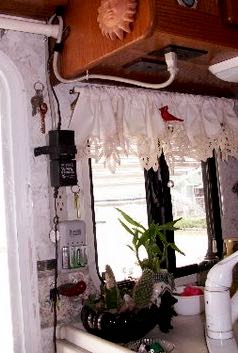 Power outlets under cabinets may be OK for a few appliances, like a mixer or a coffee pot (if the cord is long enough), but a little thing called gravity makes them totally useless for things like transformers, battery chargers and items with short cords. Here is one possible solution.
 Notice that a standard surge protector power strip was secured to the wall. The power strip cord was also secured to the wall and under the cabinet with screw-in wire holders. This makes a neat application utilizing the otherwise useless under-cabinet outlet.
 On arriving at a campground, don’t just assume the power supply is safe. First, make sure the breaker is turned off to the power outlet, then plug in the RV power cord. If you have an exterior power outlet on your rig, plug in an electrical circuit analyzer that indicates circuit problems. If you don’t have an outside outlet, plug the analyzer into an outlet inside and have a helper look at it.
 Only one segment of RVers are exclusively “campers” — those who “camp” for a week or two a year. These people generally camp in the summer, often on family vacations. They typically spend their days sightseeing or hiking and their evenings by the campfire. Their RVs, if they have one, are pretty basic and are often rented.
 In the majority of cases, the difference between the less expensive and the more expensive RV is far more than the “sum of the options” list. Normally, increased cost brings with it better construction, a bigger power train, larger wheels and tires, and so forth.
 When pulling into a campground during quiet hours, it seems that some forget they may be the only ones awake. A few tips to follow to be considerate to the sleepers: