Home Blog Page 2218

Tumacacori Mission south of Tucson offers humble history

Tumacacori National Historical Park is home to the Mission to the Pimas. Made of adobe, plaster and wood, today, “these ruins evoke tales of life and land transformed by cultures meeting and mixing.”

Visitors to Tumacácori enter the park through the visitor center, staffed by very gracious National Park Service employees and volunteers. The museum and bookstore provide a wealth of information, including a 15-minute video (started at any time by the push of a button).

A self guiding tour book can be borrowed in the bookstore. On the day we were there, a park volunteer led a walking tour of the mission and grounds.

Tortilla making at Tumacacori mission (Julianne G. Crane)

Local artisans demonstrate traditional crafts on the grounds which may include tortilla making, paper flower making, O’odham basket weaving, leather working or iron working.

During November-December look for demonstrations on the weekends. January-April, there are activities Wednesday through Sunday.

The mission, itself is fascinating.   Father Kino established Mission San José de Tumacácori in January 1691, one day before Guevavi, making it the oldest mission site in what is now Arizona.

“The Franciscans began work in 1800 on an ambitious undertaking – a church that would match the frontier baroque glory of the celebrated Mission San Xavier del Bac not far to the north. Under the direction of a master mason, a crew of Indian and Spanish laborers laid five-foot thick cobblestone foundations that year, but construction ground to a halt as funds dried up.

Inside the mission shows details of construction. (Julianne G Crane)
“Over the next few years they were able to add a few courses of adobe bricks, bringing the walls up to seven feet [high]. These were plastered inside and out and decorative handfuls of crushed brick were pressed into the wet plaster.”

“It was not until 1821 that work truly resumed. An enterprising Franciscan, Father Juan Bautista Estelric, sold 4,000 head of the mission’s cattle to a local rancher, Don Ignacio Pérez, and with the first payment hired a new master and pushed the work ahead. The walls were raised to 14 feet, but the rancher stalled on his payments and construction again ceased.

“Two years later, Father Ramón Liberós, a persistent friar, finally got the rancher to pay his bill, and work resumed. Within a few years the church was almost completed, although the bell tower was never capped with its dome. The church must have been a striking landmark in the flat Santa Cruz Valley, with its embellished and painted façade and plaster walls embedded with crushed red brick.”

If you go: 

Tumacacori entrance. (Julianne G Crane)

Hours: 9 a.m. to 5 p.m. daily, except Thanksgiving Day and Christmas Day, when the park is closed.

Entrance fee: $10 entrance. Free: 16 and younger; and those with America the Beautiful or Golden Age passes.

Directions: Tumacácori National Historical Park is located off of Exit 29 of I-19, 50 miles south of Tucson and 18 miles north of Nogales, Arizona.

The Visitor Center and Museum are located at 1891 East Frontage Road, Tumacacori, Arizona, 85640. (You can’t miss it.)

And, to make your drive to here even more worthwhile, check out two other places nearby where you might want to pull your RV off the interstate for a look-see, click here for information on the Santa Cruz Chili and Taumacacori Outpost.

— Julianne G. Crane
Go to RVWheelLife.com about the RV lifestyle, 

All images by Julianne G. Crane.

Alvord Desert Hot Springs – open year round

Approaching dry camp area near Alvord Hot Springs (Julianne G. Crane)

Alvord Hot Springs is a geothermal spring located in southeast Oregon on the eastern slope of the Steen Mountains on the western edge of the vast Alvord Desert. The springs sit at an elevation of 4,080 feet in the Oregon high desert region. Currently open to the public year-round.

Hot springs on Alvord Ranch (Julianne G. Crane)

The Alvord Hot Springs is on the Alvord Ranch, and is privately owned, as is most of the desert itself. Please be respectful of this, clean up after yourself, and do no harm.

After years of providing free access to the springs, as of March 1, 2013, a fee will be charged, according to an e-mail from Paul Davis, a member of the family who owns the Alvord Ranch.


(Update: 2/17/2013 e-mail from Paul Davis:


“As I see this, being the land owner, these are my options:

1. Continue to ignore the liability issue knowing that someday it WILL be addressed. 
2. Sell the property, but John Doe has the same options. 
3. Close off property, but to do so I will have to destroy it as people still will trespass. 
4. Charge for the use of this resource. 

“I have tried to lease the property to the BLM [Bureau of Land Management] since 2008 with the idea they take on the liability. To do so they want a 25-year lease. I will not do this because I feel it will be a publicized park. I would entertain the idea of a 5-year [lease] as this would keep advertising to a minimum. 

“So here is the plan:  March 1, 2013 a fee will be collected by a caretaker.  I will run with this for a year or two; but in the end, if it does not work, I have no choice but to close it down.” 
Paul Davis, Alvord Ranch

The spring and facility
At its source the spring water is a scalding 174 degree Fahrenheit, but flows through a series of channels down into a soaking pool, allowing the waters to cool considerably. A wooden platform provides easy access from the road. A windscreen and changing shed have been constructed around the pools, creating one outdoor and one sheltered pool.

Hot soak on cold day. (Julianne G. Crane)

Half of the pool is enclosed by a corrugated wall above the ground.  The outdoor pool is about 10-feet by 10-feet, with water three feet deep. The temperature at the pool stays around 112 degrees F.  The pool is bound by concrete walls with a concrete slab bottom and are surrounded by nice decking. Swimsuit optional.

Camping:
Currently dispersed, no fee. There is a large flat area directly across from the Alvord Hot Springs. There are no services and no shade, but plenty of level ground for dry camping. These campsites are not improved, so bring in your own toilet. Alvord Desert is a dry lake bed. This is a vast open space, so there is no protection from the wind. On the days we were there in mid-March it was windy and temperatures were below freezing with snow flurries.

Dry camping near Alvord Hot Springs.

Location:
Alvord Hot Springs is 107 miles southeast of Burns, Ore.
South of Burns on Hwy 205.
Drive north of Fields, Ore., on County Road 201 (gravel) for 25 miles.

Gas, groceries, a cafe, motel, propane and an RV park are located in Fields.

Sources: Gill Adventures and
‘Hot Springs and Hot Pools of the Northwest’ by Marjorie Gersh-Young.

To read more of Julianne G Crane’s writing, go to RVWheelLife.com.

Photos: Alvord Hot Springs by Julianne G Crane

Mission San Xavier del Bac one of the West’s earliest remaining buildings still in use

0

MISSION SAN XAVIER
DEL BAC
If you are a history buff, you know that in the
Western states, unlike along the eastern seaboard or New England, you don’t see
many historic sites chronicling European exploration with dates in the early 1500s,  1600s, and early 1700s when the Europeans were settling what would eventually become the United States of America. 
Father Eusebio Francisco Kino, a Jesuit Priest from Northern Italy, was one of the first missionaries to visit the wes. He visited Native Americans in the O’odham community of Wak (Bac),
south of what is now Tucson, Arizona  as long ago
as 1692. 
Though he fruitlessly attempted to build a rustic church as early as
1700, it was Father Alonso Espinosa who actually began building the first church of any
substance in 1756. Father Francisco Garces arrived in 1768 and became its first
minister.
The current structure, though added to and rebuilt over the
years, was begun during the American Revolution clear over on the East Coast, in 1776 and wasn’t completed until 1797. It is an outstanding
example of Spanish baroque architecture, with elegant arches, domes, and twin bell
towers (one left unfinished). Inside resides a historically priceless
collection of Mexican baroque art, frescoes, and wooden carvings. An ongoing process of restoration begun in the early 1990s
is restoring the original luster to the 200-plus year-old art. 
Mission San Xavier del Bac’s dazzling
white walls have given it the name “The White Dove of the Desert,” and
it still serves the Tohono O’odham today with daily masses.
Photography is permitted
when services are not in progress. Drive nine miles south of Tucson on I-19 and
take exit 92.  Turn west for one mile.
The church is open daily 8AM to 6PM. Admission is free and donations are accepted.
 
On the grounds outside the church the O’odham operate a
makeshift market of native jewelry, pottery,
arts and crafts, and several food booths featuring Indian fry bread. 

Homolovi Ruins State Park near Winslow, Arizona …

Park sign (Julianne G. Crane)

Driving near Winslow, Arizona, I recalled reading Consuelo Heath’s 2011 RV Short Stops’ post: “Standing on the corner in Winslow, Arizona.” What a nostalgic snapshot for people coming of age in the early 70s. (The location memorializes the corner mentioned in the second verse of “Take it Easy,” written by Jackson Browne and Glenn Frey,  and made famous by the Eagles in the band’s first single, released on May 1, 1972.)

As enticing as that downtown corner is, our destination was a couple miles north of Winslow and I-40 —  Arizona’s Homolovi Ruins State Park.

“Homolovi” is Hopi for “Place of the Little Hills” — the traditional name for Winslow, Arizona.

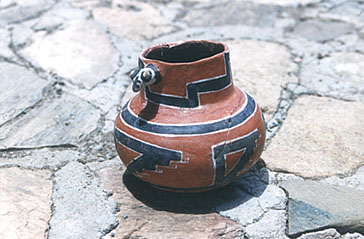
Pottery at Homolovi State Park museum.

“The Hopi people of today still consider Homolovi, as well as other precolumbian sites in the southwest, to be part of their homeland. They continue to make pilgrimages to these sites, renewing the ties of the people with the land. The Hopi tell us that the broken pottery and stones are now part of the land and are the trail the Bahana will follow when he returns. Therefore, these are mute reminders that the Hopi continue to follow the true Hopi way and the instructions of Masau’u,” according to the park’s website.

The park serves as a center of research for “the late migration period of the Hopi from the 1200s to the late 1300s. While archaeologists study the sites and confer with the Hopi to unravel the history of Homolovi, Arizona State Parks provides the opportunity for visitors to visit the sites and use park facilities” including a visitor center and museum, a number of hiking trails and an RV-tent campground.  Pullouts along a road through the park provide the opportunity to observe wildlife in this park of more than 4,000 acres at an elevation of 4,900 feet.

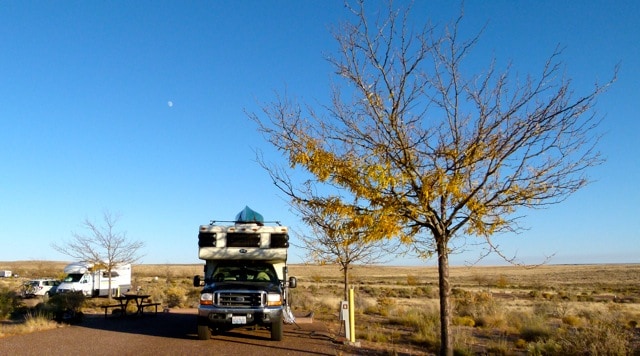
Homolovi State Park Campsite (Julianne G. Crane)

Location: North of I-40, Exit 247 (north of Winslow, between Flagstaff, Ariz., and the New Mexico border.

The Homolovi Visitor Center includes exhibits and gift shop. Hours: 8 a.m. – 5 p.m.

Campground
Our site was $20* for a 30 amp back-in site. (Remember the elevation is almost 5,000 feet and it does get cold overnight at least six months out of the year.)
Showers and restrooms are available throughout the year.

Reservations:
Make online by clicking here.
You can also call the Reservation Center at (520) 586-2283 seven days a week, from 8 a.m. — 5 p.m. MST. * There is an additional $5 non-refundable reservation fee per site. (We were drop-ins and only paid the camping fee.)

To read more of Julianne G Crane’s writing, go to RVWheelLife.com.

Explore the other-worldly depths of Arizona’s Kartchner Caverns

0

What was originally known as the “Secret Cave” was discovered by Gary Tenen and Randy Tufts in November 1974 when exploring the limestone hills at the eastern base of Arizona’s Whetstone Mountains. They were looking “for a cave no one had ever found” and found it.

The two kept the cave a secret until February 1978 when they told the property owners, James and Lois Kartchner, about their awesome discovery. But it wasn’t until years later, after making sure that the cave was properly protected and preserved that the caverns–named after the Kartchners–opened to the public as an Arizona State Park in 1999.

Kartchner is not just a cave, but a 28-room, 2.5-mile long cave system. The Examiner.com wrote about the caverns in 2010,

The immaculate cave decorations within Kartchner Caverns are some of the finest that you will see anywhere in the United States – and possibly worldwide. Over countless millennia water saturated with calcium carbonate and a variety of minerals has – drip by drip and inch by inch – steadily created a glorious array of speleothems which will delight both the spelunker and sightseer alike. The cavern ceiling is adorned with forests of Stalactites glistening like icicles on a frosty winter morning, reefs of delicate helictites with small white polyps are clustered in the caves nooks and crannies, a gleaming white calcite shield shaped like an angel’s wing is affixed to the wall like an ancient heraldic emblem whilst slender Soda Straws – fashioned like fine glass filaments – hang from the ceiling.

Guided tours are offered and camping is available at the state park and in nearby Benson. Go online to learn more about Kartchner Caverns SP or for a Calendar of Events.  Watch the video below for a virtual tour of the caverns.

The caverns are 12 miles south of Benson in southeastern Arizona.

Austin’s Congress Street always worth a look

Gibson Street Artisan Market. Click on photo to enlarge.  (Julianne G. Crane)

There is always much to see on Congress Avenue in Austin, Texas, there are plenty of reasons to venture downtown for both funky and family activities.

On a recent visit in early December, we started in the ‘Keep Austin Wierd’ SoCo Neighborhood on south Congress Avenue because of its abundance of unique shops and eateries–including the (top) Gibson Street Artisan Market, (1318 S. Congress Ave.) one of two artisan-ONLY markets in the entire city. Open Saturday and Sunday 11 a.m. to 5 p.m.

Crossing Town Lake in downtown Austin. (Julianne G. Crane)

According to an item on YELP.com: “All the artists are local, so the prices are good- as is the selection and product quality. Available regularly is a variety of jewelry, sewn goods, leather goods, and furniture. This is so Austin. You can adopt a dog; grab a crepe, burger or taco; and shop a variety of quality handcrafts all in one place.”

We drove north on Congress Avenue, crossing over the Town Lake Bike and Hike Trail toward the State Capitol Building.  The must-see Capitol building is modeled after the nation’s Capitol in Washington, D.C., and sits on 26 acres in the heart of the historic Capitol District. 

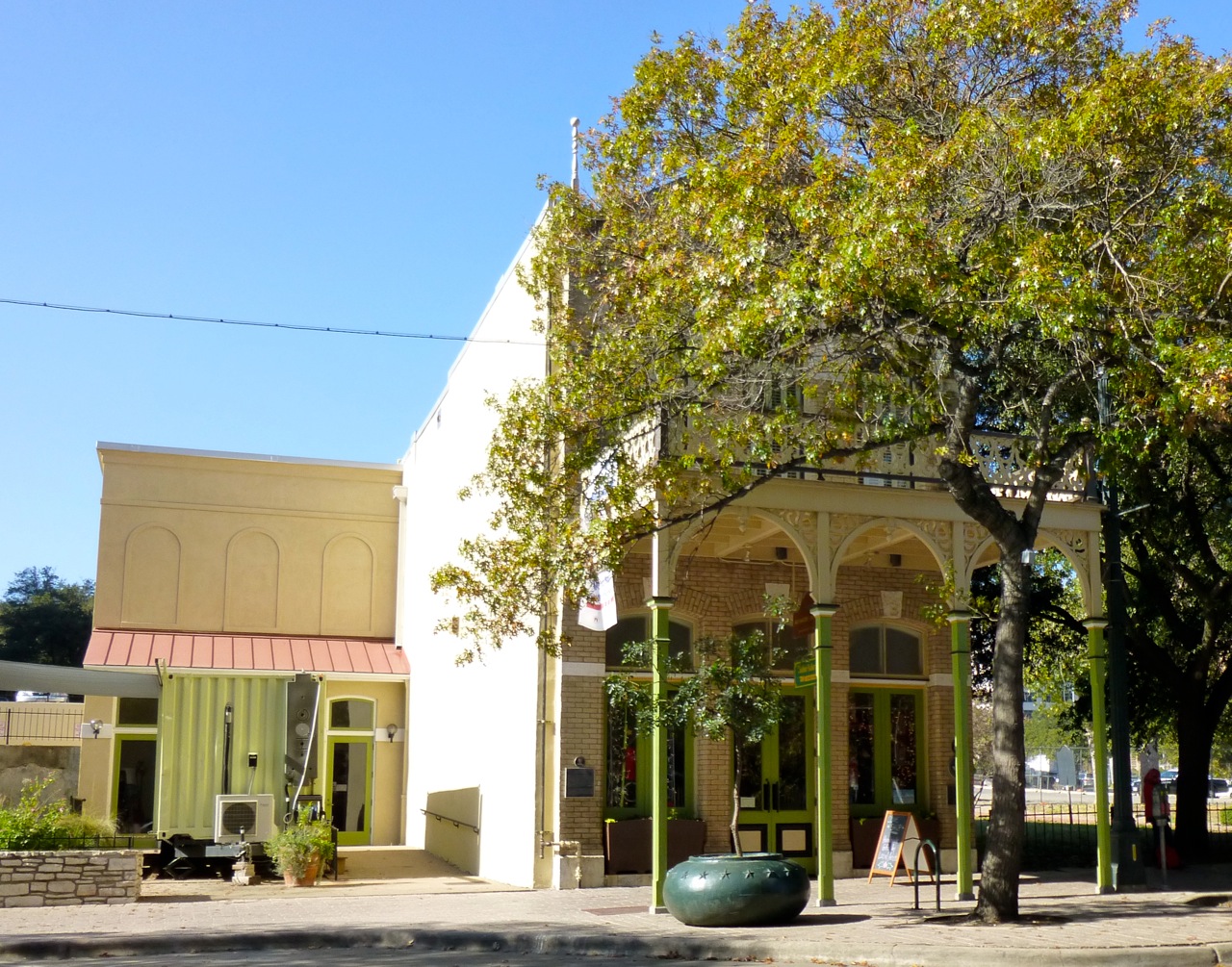
Old Bakery (Julianne G. Crane)

Less than a block from the Capitol is the historic Old Bakery and Emporium, (right) an Austin landmark bearing an official Texas Historical Commission medallion.

While it no longer serves food, it operates as a gift shop with unique gifts, Visitor Information Center, art gallery exhibiting local artists 50-or-better and houses a small museum, the Lundberg-Maerki Historical Collection.

To learn more about getting around Downtown Austin, click here.

Photos by Julianne G. Crane. (Click on photos to enlarge.) To read more by Julianne G. Crane, go to RVWheelLife.com

Toss out those printed directories

0

Mike Wendland of Roadtreking.com has some advice about what you might want to do with your printed campground and travel

Visit Patagonia Lake SP in December for weekend boat tours and programs

0

Weekends in December: Pontoon Boat Tours at Patagonia Lake SP

Tucked away in the rolling hills of southeastern Arizona is the hidden
treasure of Patagonia Lake State Park, with a 265-acre man-made lake
where anglers catch crappie, bass, bluegill and catfish. Pontoon boat
tours will be offered on the lake on Saturdays and Sundays in December.

Avian tours will be offered at 9 a.m. and 10:15 a.m. and will go to the
east end of the lake. An experienced birder will be on board to point
out, identify, and talk about the birds seen.

At 11:30 am the Lake Discovery Tour goes to the west end of the lake. The guide on board will point out geological formations, discuss the dam which created Patagonia Lake, and provide a brief history of the area.

A Twilight tour just before dark on Saturdays. The sunsets can be
spectacular from the lake and seeing the shoreline from the water is a
delightful experience.

The cost for each one-hour boat trip is $5, payable at the beginning of the trip in the Visitor Center. Reservations are advised. Call 520-287-2791. Plan to arrive at the Visitor Center 15 minutes before departure to sign in, pay and be outfitted with a life jacket.

Saturday Evening Programs
Saturday evening programs will cover a wide range of topics. Programs start at 7 p.m. and usually last an hour. Meet at the Sonoita Creek Visitor at Patagonia Lake.

Dec. 1: Ghost Towns of Santa Cruz County
Dec. 8: Discover Patagonia Lake & Sonoita Creek – Past & Present
Dec. 15: Birds of Patagonia Lake and Sonoita Creek
Dec. 22: Ghost Towns of Santa Cruz County
Dec. 29: An Introduction to the Sonoita Creek State Natural Area

Park Entrance Fees:
Per Vehicle (1-4 Adults): $10-$15
Individual/Bicycle: $3

Camping Fees:
Non-Electric site: $17
Electric site: $25-$28
Cabana or Boat Site: $17-$20

LBJ Ranch in Texas Hill Country

Lyndon B. Johnson National Historical Park, in the middle of Texas Hill Country, is a favorite destination of many RV snowbirds making their way to their winter homes. Managed by the National Park Service, the park is open year round except for Thanksgiving, Christmas, and New Year’s Day.

Lyndon Baines Johnson, the 36th President of the United States, ushered in landmark legislation such as Medicare, Head Start and the Civil Rights Act of 1964.

The tall Texan “had a deep attachment for place and heritage.” The LBJ Ranch was where he was born, lived, died, and was buried. It is said that President Johnson “flew home to his Texas ranch 74 times during his five years in office, living and working for 490 days—or about one-fourth of his presidency—at the Texas White House.”

After the President’s death in 1973, Mrs. Johnson continued to live at the Ranch part time until her death in 2007.

LBJ Texas White House. (Courtesy of National Park Service)

Self-Guided Ranch Tours

Visitors are now able to tour the Ranch at their own pace in their private vehicle with the ability to stop at sites along the way such as the President’s birthplace, Johnson family cemetery, and the Johnson’s ranch house known as the Texas White House.

Obtain a free driving permit at the LBJ State Park and Historic Site Visitor Center in Stonewall, Texas. You will also receive a map indicating the tour route and a CD containing narrative audio for the route. Driving permits are good only for the day of issue.

Hours of Operation

Seven days a week. Closed Thanksgiving, Christmas, and New Year’s Day.
Driving Permits are given out starting at 9 a.m. No Permits are given out after 4:15 p.m.
Ranch Entrance Gate: open 9 a.m. to 4:30 p.m.
Ranch Exit Gate: Closes at 5:30 p.m.

Texas White House Tours

Following the death of Mrs. Johnson in 2007, individual rooms were opened to the public as they become ready.

The first room to open was President Johnson’s office (the west room) on the 100th anniversary of his birth, August 27, 2008. The living room and dining room were opened in June 2009. As part of the self-guided Ranch Tour, visitors may stop for a ranger-guided tour.

Cost for tours of the ground floor of the Texas White House:

Ages 18 and older: $2.
Ages 17 and younger: free

Location:
Lyndon B. Johnson National Historical Park is located in the heart of the Texas Hill Country.

The park has two visitor areas separated by about 14 miles: the Johnson Settlement/Visitor Center/Boyhood Home/Park Headquarters in Johnson City and the LBJ Ranch near Stonewall.

The Park Visitor Center in Johnson City is 50 miles west of Austin and 60 miles north of San Antonio. The State of Texas manages a Visitor Center near Stonewall where the visitor can obtain a free driving permit to the LBJ Ranch.

RV camping opportunities are in Fredericksburg, 18 miles west of the LBJ Ranch. One is the Lady Bird Johnson Municipal RV Park located 3 miles south of Fredericksburg, TX, on State Highway 16.

Contact Texas Parks and Wildlife Department for other camping locations in the area or call 1-800-792-1112.

To read more by Julianne G Crane go to RVWheelLife.com

National Bison Range, Quinn’s Hot Springs in northwest Montana

Bull bison (Courtesy of National Bison Refuge)

Even in the winter, the National Bison Range
near Ravalli, Mont., is a great place to view a wide variety of indigenous Northwest wildlife and
native grassland species–as well as one of the largest bison herds in
the United States.

The National Bison Range is administered by the U.S. Fish and Wildlife Service as part of the National Wildlife Refuge System. Established in 1908 it is one of the oldest Wildlife Refuges in the nation.

The Refuge was established to support a population of American bison and is home to about 350-500 of these animals. Other large wildlife found on the Range include elk, white-tail and mule deer, pronghorn antelope, bighorn sheep and black bear. Because of its open grasslands, the Bison Range is an incredible place for the public to enjoy some excellent wildlife observation and photography.

Start at the Visitor Center that features interpretive displays and orientation videos, as well as, a bookstore and restrooms. Staff answer questions.

The Range is part of the U.S. Fee System and accepts and sells the Federal Recreational Area Passes and Federal Waterfowl Stamps. It also accepts the older Golden Passes.

Contact information:
National Bison Range
58355 Bison Range Road
Moiese, MT 59824
(406) 644-2211
URL: www.fws.gov/bisonrange/

Winter Hours (mid-October to mid-May)
Visitor Center open weekdays from 8 a.m. to 4 p.m.; closed weekends and holidays.
Winter Drive open daily 7 a.m. to dark (weather and road conditions permitting).

Quinn’s Hot Springs

Just 30 miles from the National Bison Range is a wonderful place for a dip in hot springs.

Quinn’s Hot Springs Resort has six mineral pools open to both lodge guests and day users. The water contains Silica, Sulfate, Calcium, Magnesium, Sodium, Potassium and Iron for soaking and swimming.

There are four soaking pools range in temperature from 60-106 degrees Farenheit. The two swimming pools typically range from 80-95 degrees F.

The water is natural, chemical free and flows through continuously.

Pool hours: Adult lodging guests may use the pools from 7 a.m.–11 p.m. weekdays and 7 a.m. to 1 a.m. Friday-Saturday.

Day passes are available from 9 a.m. to 8 p.m. On busy days, Quinn’s reserves the right to allocate pool use for day passes to 3-hour sessions to prevent overcrowding.

(by Julianne G Crane)

Rates: $10 per person per session. 

Contact information:

Quinn’s Hot Springs
190 Quinn’s Canyon Road / Hwy. 135 (Exit 33, I-90)
Paradise, Montana
800.628-0212
406.826-3150
URL: www.QuinnsHotSprings.com 

To read more by Julianne G Crane go to RVWheelLife.com

Illinois State Dickson Mounds Museum — Views of the past through amazing exhibits

Illinois State Dickson Mounds Museum (Julianne G. Crane)

The Dickson Mounds Museum in west-central Illinois “offers a unique opportunity to explore the world of the American Indian
in an awe inspiring journey through 12,000 years of human experience in
the Illinois River Valley.”

A branch of the Illinois State Museum and a National Historic Site, Dickson Mounds is one of the major on-site archaeological museums in the United States. Visitors encounter innovative interpretive exhibits including:

Dickson Mounds Museum houses multiple exhibit spaces.

River Valley Gallery (right) “explores the character of the Illinois River and traces the interaction between the river and the people who lived along it from the end of the Ice Age to the present day. The story is told through innovative displays and Legacy, a large-screen video production that captures the panorama of the past and leads one to a real-life view of the river valley today.”

– People of the Valley “portrays a sequence of cultures — from Ice-Age hunters to the tribal groups that left Illinois in the 19th century — through artifacts, murals, photographs, and exciting hands-on exhibits.”

‘Reflections on Three Worlds’ exhibit. (Julianne G. Crane)

– Reflections on Three Worlds “reveals the world of Mississippian people whose 800-year-old sites surround the museum today. The exhibits depict the complex life and culture of these people, trace in detail the evidence of archaeology, and lead to a spectacular multimedia event that takes one through a kaleidoscope of sights, sounds, symbols, music and voices of the three worlds of Mississippian belief.”

 If you go:

Illinois State Dickson Mounds Museum
10956 North Dickson Mounds Road
Lewistown, IL 61542
60 Miles northwest of Springfield, Routes 78 and 97
Location on MapQuest.
Open year-round, daily; 8:30 a.m. to 5 p.m. (Closed New Year’s Day, Thanksgiving and Christmas).

Free admission.

To read more of Julianne G. Crane’s writing go to RVWheelLife.com

Click on photos to enlarge. (Julianne G. Crane)

Willa Cather Center, Red Cloud, Nebraska

Willa Cather Center in downtown Red Cloud, NE (Julianne G. Crane)

‘Red Cloud’ has a magical ring to it … I don’t remember where or when I first heard of it … maybe it was as a youth reading about the lives of people living in small prairie towns … or maybe it was in college when I became aware of Red Cloud, the renowned Oglala Lakota chief.

Whenever the first time that name entered my consciousness is of little matter, I just knew I wanted to visit this community when we traveled through south central Nebraska on US 136 because it is home to the Willa Cather Center, the “largest living memorial to an author in the country.”

Inside the Willa Cather Center. (Julianne G. Crane)

Cather, a Pulitzer Prize winning author, was born in Virginia in 1873, and moved to Nebraska with family when she was nine years old.  Still very much considered on the frontier, Red Cloud was a deeply formative experience for Cather and helped shape her future writing.

“Cather’s removal from the settled and deeply felt culture of postwar
rural northern Virginia to the pioneering prairie of the Nebraska
Divide–a sensitive child at a critical age–was in many ways her making
as an artist,” states the Willa Cather Center website.

Willa Cather National Library poster.

“Dropped into such a place at such a time, naturally
curious, young Cather made the very most of it during her first year in
Nebraska. As she made clear repeatedly after O Pioneers! was
published, she had been afforded a rare opportunity for an incipient
writer: though sparsely settled, the Divide between the Republican and
Blue rivers offered her multiple opportunities to meet and gather
information from immigrants and other pioneers who spoke different
languages and engaged in other cultural practices.”

Cather (d. 1947) was awarded the Pulitzer Prize for One of Ours (1922), a novel set during World War I.

If you go:
Willa Cather Foundation
413 N. Webster
Red Cloud, NE 6897
1.866.731-7304 
URL: http://www.willacather.org/
Admission is free.
Tours available.

To read more of Julianne G. Crane’s writing go to RVWheelLife.com

Photos: Julianne G. Crane