Home Blog

RV Daily Tips. Thursday, June 18, 2026

America’s Original RV Newsletter. Since 2001
Issue 2929 • New issue every weekday


Today’s thought

“People who don’t travel cannot have a global view; all they see is what’s in front of them. Those people cannot accept new things because all they know is where they live.” —Martin Yan


Need an excuse to celebrate? Today is National Wanna Get Away Day, and it’s also National Fishing Day! How about you get away and go fishing for a while, huh?

On this day in history: 1928 – Aviator Amelia Earhart becomes the first woman to fly in an aircraft across the Atlantic Ocean (she is a passenger).


Tip of the day
18 ways to use “single-use” items more than once

By Gail Marsh
Did you know that many so-called “single-use” items can often be reused—and even more than once, in some cases? Reusing not only means less trash going to the landfill, but it also means more money stays in your pocket. That saved cash can go towards fuel, food, and campground fees. So, let’s get to the savings!


Article and video
Everything you need to know about storing an RV

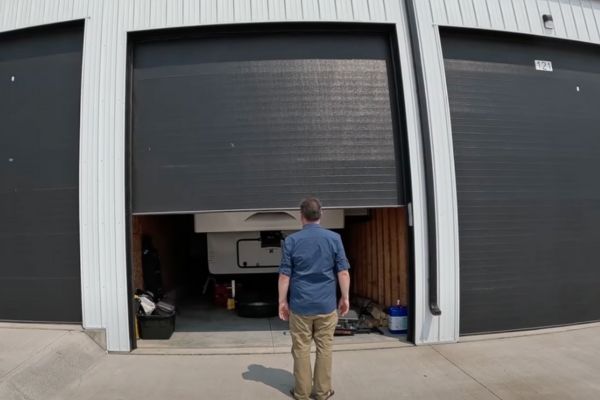
Proper RV storage keeps your camper secure, dry, and ready for the next adventure. With so many options—from uncovered storage to fully enclosed, climate-protected garages—the right choice depends on your budget, where you live, and how often you want to access your RV. In today’s video, Jason Epperson of RV Miles shares a practical guide to help you decide where and how to store your RV for peace of mind all year long.


Featured article
Why you should consider taking your RV back “home”

By Gail Marsh
“You can’t go home again.” That’s how the old saying goes. Recently, when my grandchildren asked about my childhood, I couldn’t help but smile. My years spent growing up on a small Iowa farm certainly had their share of heartaches. I still look back with gratitude and a genuine fondness for this wonderful area that, for 18 years, I called home. Questions about my “old stomping grounds” sparked a sudden longing inside me. I wanted to go home. Continue reading. Does Gail’s story spark a desire in you to “go home”?


Don’t take a break on your brakes!
Wonder what it would be like to have your brakes go out while you’re going down a long, steep grade? You might find out if your brake fluid is moisture-contaminated. Water in brake fluid boils and can wipe out your braking ability! Buy yourself a brake-fluid tester for less than $10 that warns you if there’s too much water in your fluid. Simply dip the tester into your rig’s brake fluid, and you’ll be able to see where you stand. Learn more or order.


Ask Dave
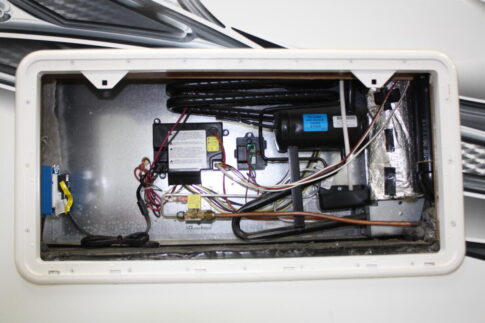
Why does it take several attempts for RV’s absorption refrigerator to light?

Read Dave’s answer.


Reader poll
Do you consider yourself to be a minimalist?
Respond here.


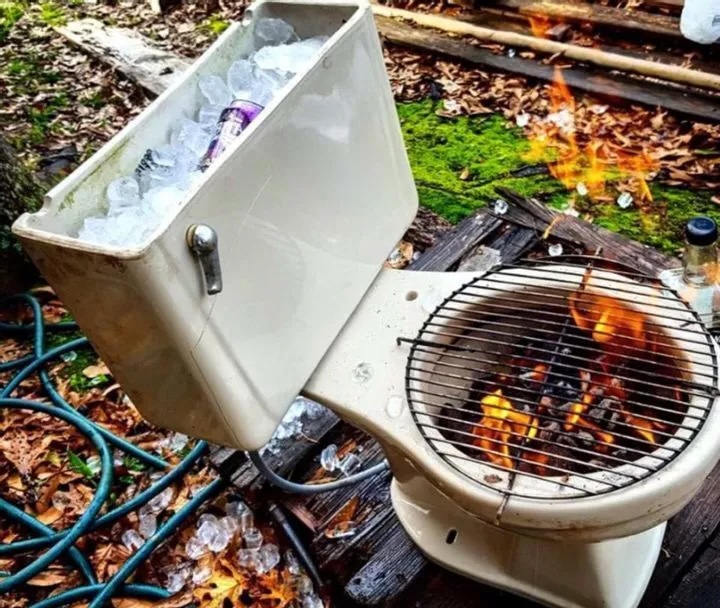
Toiletgrill
Just…. no. No, no, no!

THURSDAY THOUGHT: If today feels a little long, remember: Even the scenic route gets there eventually.


Quick tip
Keep the dust out of your RV

Taking your RV into a super-dusty area? Here’s a tip to help keep the dust out of the rig for the duration: Cover up any vent openings that connect the inside of your rig to the outside—the refrigerator and the water heater are examples. While you’ll have to leave the water heater turned off for this one, it may pay dividends. Cover the vents with cheap household air conditioner filters, and tape the filter on with heavy-duty masking tape. Be sure to pull the filter off the water heater before firing it up. You may need to use solvent to clean the tape adhesive, but it’s better than dust in your RV.


Website of the day

The Best Diner in Every State
Love a good ol’ classic American diner? We do, too. Check out Taste of Home’s list of the best diner in every state. If you’re familiar with any of these, do you agree that it’s the best? (This is a great list, but it is from 2024. So, before going to any of these diners, make sure it is still open!)


? MYSTERY PRODUCT OF THE DAY ?
This would come in handy for many activities like swimming, kayaking, hiking the Zion Narrows… or you could just use it in the bathtub. See what it is.


And the survey says…

We’ve polled RVtravel.com readers more than 5,000 times in recent years. Here are a few things we’ve learned about them:

• 53 percent always wear a watch.
• 49 percent always put the same toppings on their pizza when they order.
• It’s a tie! 50 percent of readers have spent a free night in a parking lot in their RV within the last year, and the other 50 percent have not.

Recent poll: What’s the biggest “sticker shock” in RVing today?


Trivia

Feeling constantly drained might not just be about poor sleep or working too hard. Researchers in Japan found that low levels of key vitamins—especially vitamin B12 and folate—may quietly contribute to fatigue and lack of motivation, even in otherwise healthy people.


Readers’ pet of the day
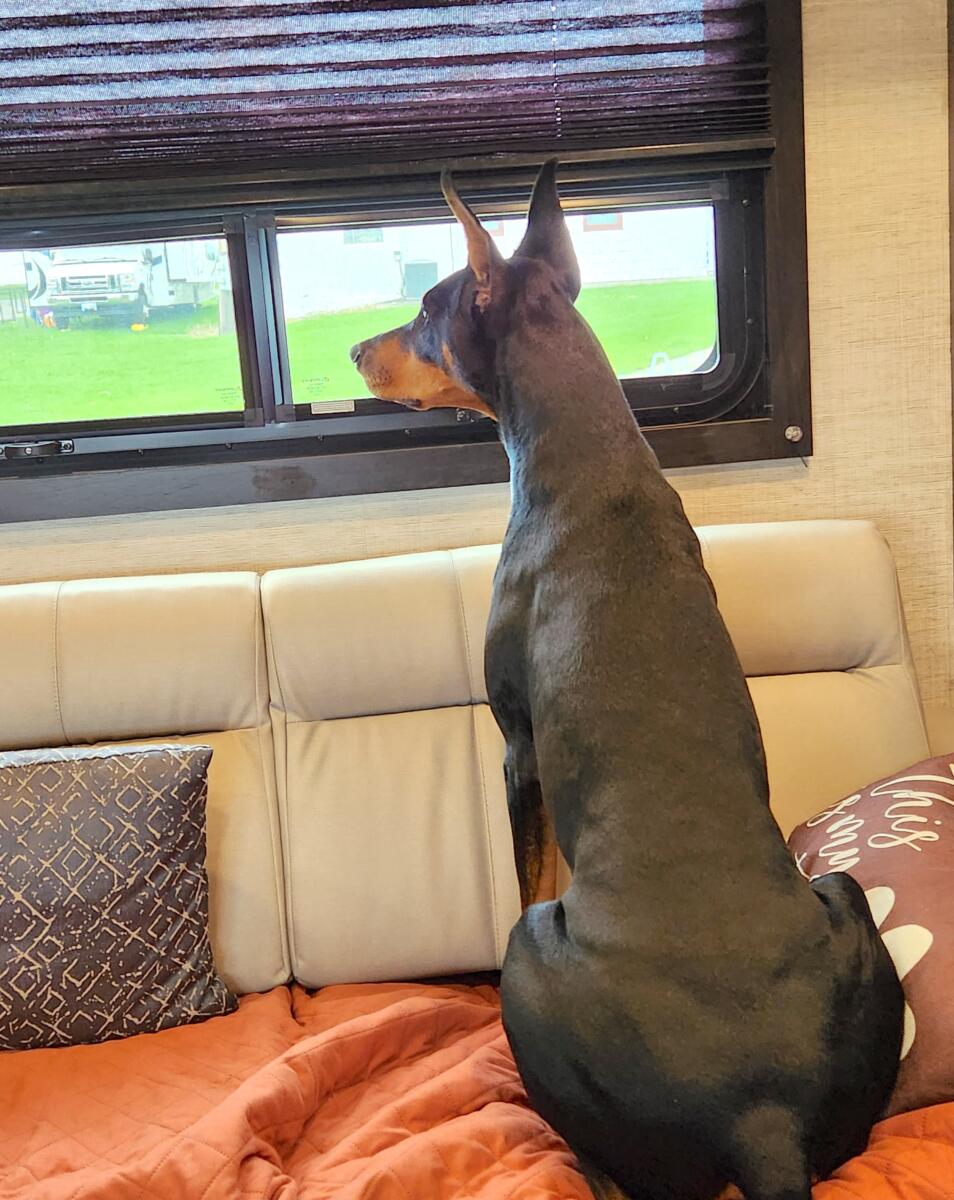
20260521 164645 6e06e76a85e3b6640ffd22b97f954bc3“We got our RV so we wouldn’t have to hotel it for dog shows and agility trials. Moxie (Doberman, 18 months) loves our house on wheels and enjoys watching everything going on outside our window.” —Janice Morton

Send us a photo of your pet with a short description. No blurry photos and please do not submit your photo more than once. Thanks!

RVing with Dogs group on Facebook. You’ll love it.


FREE IS GOOD! Is Michigan on your itinerary this year? Learn all about where to go, what to see, and what to do by clicking here to receive tons of info about Pure Michigan® online or by mail.


Leave here with a laugh

What do you call a sad cup of coffee?
Depresso.
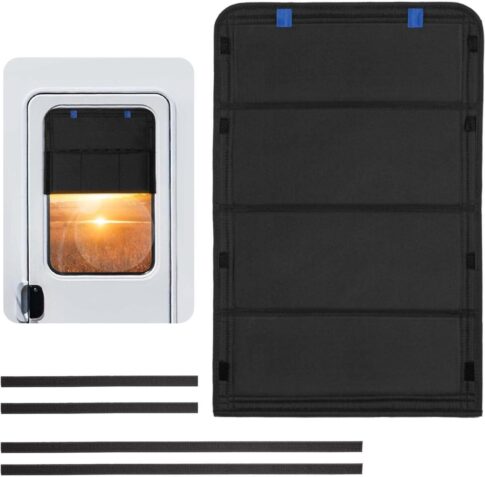

WindowshadeThe best window shade for your RV’s door
Block the light without blocking your view. This RV door window shade gives you full blackout when you want it—but unlike most shades, it folds up so you can enjoy the scenery when you want, too. Easy to install in minutes with no drilling, it helps keep your rig cooler, adds privacy, and lets you switch from “sleep mode” to “view mode” instantly. A simple, smart upgrade for better comfort on the road. Check it out.


Today’s weather forecast across the nation
THIS MAP UPDATES TWICE A DAY
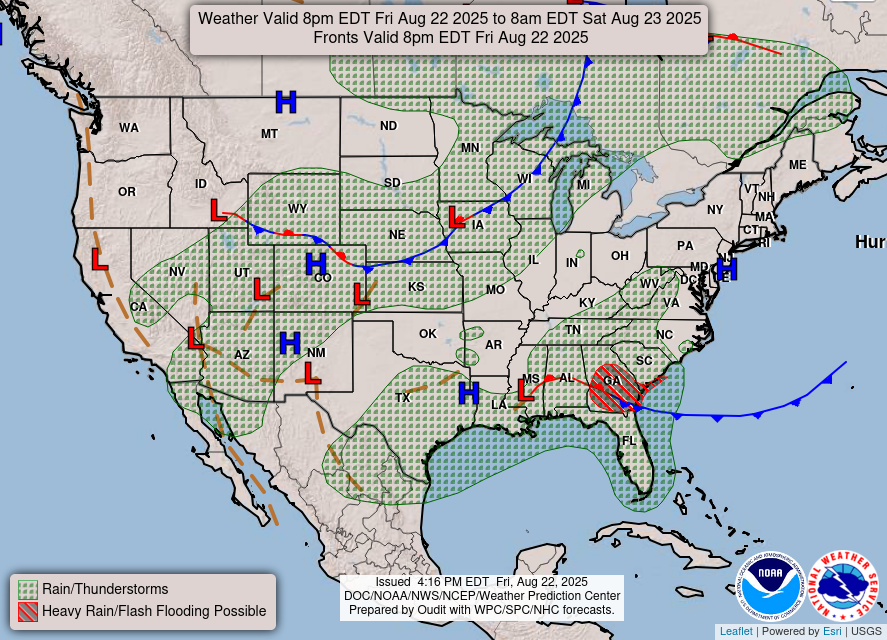
Visit Current National Radar Weather Map


Did you miss the latest RV Travel Newsletter? If so, read it here.
Oh, and if you missed the Latest News for RVers, make sure to catch up here.


If you shop at Amazon.com we’d appreciate you using this link. We get an itty bitty commission if you buy something, but they add up and help us pay our bills (most importantly our hard-working writers!). 


RVtravel.com All-Star Staff

Click here for information about our staff and how to contact us.

WHY WE ASK FOR DONATIONS INSTEAD OF SELLING SUBSCRIPTIONS.

Our policy on using artificial intelligence.

Why does it take several attempts for RV’s absorption refrigerator to light?

Dear Dave,
I have a Norcold absorption refrigerator. Sometimes when I turn it on to get ready to go on a trip, even when I’m trying to run it on AC power, it’ll keep telling me that there’s an issue with the propane. Eventually, after turning it on and off up to 15 times, it’ll finally start working. The last two times that it did that I was washing the coach and I may have gotten some water down the exhaust on the roof. Today when I tried to start it, it did the same thing again, and it was raining pretty good. Any idea what the problem could be? Any thoughts would be appreciated. Thank you. —Michael, 2018 Winnebago Vista

Dear Michael,
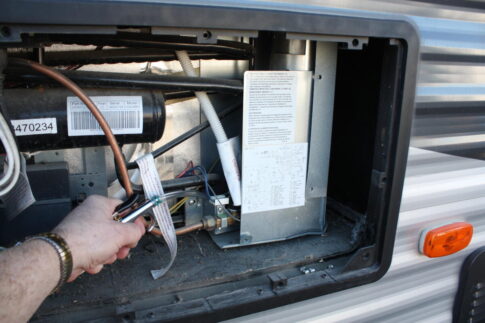
If it runs fine on 120-volt power, that means it is isolated to the LP function and not the control panel, cooling unit, or thermistor.

How the refrigerator runs in LP mode

When the unit is set to the LP mode and temperature set at the eyebrow board, the thermistor inside the unit senses temperature and sends power to the control module to start the process. The LP valve is opened and the spark ignitor (piezo) attempts to ignite and create a flame. If the burner assembly is dirty, the LP flow will be restricted. So I would start by blowing out the supply tube and the burner assembly.

Cleaning Burner Assembly

I like to use a blow gun with a 1/4” hose connected to the end, as the flexible hose can get into the tight areas. Make sure you wear safety glasses, as soot can fly everywhere.

Verify you are getting a spark coming from the metal probe of the spark igniter. If there is a hairline crack in the ceramic insulation, it will follow the crack to ground and not ignite. I have found times that the crack was hairline and after several attempts, the heat created made the gap close enough to get a spark to light. (I call them “gremlins”!)

Burner Assembly

Check the LP pressure

Next, I would suggest checking the LP pressure and make sure nothing else is trying to run on LP such as the water heater or furnace. The best way to test pressure is using a water column tester at a dealership. However, a quick test is to light one of the stove top burners, let it sit for a short time, then light another. If the flame of the first one drops significantly, your regulator might be getting weak. After several attempts by your spark igniter, there might be enough flow to start the refrigerator—another gremlin.

The next step is to verify if the flame does start at the burner assembly and then goes out. If there is no flame, it is downstream of the thermocouple. This is a device that verifies there is a flame and keeps the gas valve open. If it does not sense a flame, or is weak, it will shut off the gas so there is not a buildup of LP in the burner assembly.

Verifying these steps should help isolate where the failure is occurring and hopefully get the unit running quickly. Most of the time, it is a dirty or blocked supply tube and burner assembly, which is an inexpensive fix.


 You might also enjoy these posts from Dave 

DAVE HAS ANSWERED MORE THAN 1,000 readers’ maintenance and repair questions. Read a directory here. There is so much to learn!


Dave Solberg is a leading expert in the RV industry and the author of the “RV Handbook.”

HAVE A QUESTION FOR DAVE?

Send your inquiries to him using the form below.

Name
Drag & Drop Files, Choose Files to Upload

RVDT2929

18 ways to use ‘single-use’ items more than once

0

By Gail Marsh
Did you know that many so-called “single-use” items can often be reused—and even more than once, in some cases? Reusing not only means less trash going to the landfill, but it also means more money stays in your pocket. That saved cash can go towards fuel, food, and campground fees. So, let’s get to the savings!

Paper towel. If you used a paper towel simply for drying water off a clean item, you could reuse that paper towel. Just let it dry and put it to use again.

Dryer sheet. After using a dryer sheet for the laundry, you can reuse it to dust off your RV furniture and window blinds, shine your rig’s chrome faucets, or clean your laptop’s screen. In fact, here are 17 ways you can use a dryer sheet (and yes, they work!).

Parchment paper. Yes, you can reuse parchment paper. This baking aid can even be used over and over again. After each use, just fold the paper and put it away until your next baking day.

Wine cork. Once the wine is gone, save the cork to use as a fire starter. Watch this how-to video.

Swiffer duster. Did you know that the Swiffer duster can be laundered and reused? Yes, it can! Just wash it and let it air dry. The same goes for the Swiffer dust pad.

Plastic bread bags. Reuse these to carry picnic sandwiches, fruit, or snacks for your next bike ride or hike. Bread bags also work well for cleaning up after your dog.

Tennis balls. Reuse old tennis balls to protect your RV’s vinyl floors. With a utility knife cut an “X”  in each of four balls. Slip the tennis balls over the feet of your dining chair or TV table. No more scraped floors. You can also cut a tennis ball in half and use it to help hold and open a stuck jar or bottle lid. Here are even more ways to use tennis balls around your RV.

Aluminum foil. You can reuse aluminum foil to clean pots and pans. Just scrunch up a piece of used foil and scrub away.

Cardboard boxes. Reuse all of those Amazon boxes. Cut them to fit inside the back of your RV cupboards for added insulation.

Plastic ziptop bags. Rinse and reuse these bags over and over again.

Greeting cards. The paper used to make greeting cards is often quite durable. You can cut sections from a card and repurpose them into unique and colorful gift tags.

Bar soap. Eventually, that bar of soap will be used to the point that only a sliver remains. Here’s a great way to use all the soap slivers. Sew two washcloths together, except for a two-inch opening. Slip all of the soap slivers into the washcloth “pocket” and hand stitch the pocket closed. Use this self-sudsing bath mitt in your RV shower or outside near the water spigot for a washing station.

Two-liter soda bottles. Wash in soap and water. Let dry completely. Use the bottles to contain dried beans, macaroni noodles, rice, and more. [Fill using a funnel or rolled up piece of paper.]

Cardboard tubes. Don’t toss out cardboard tubes. Instead, use them to keep cords and cables under control, or stuff them with dryer lint and let them be your perfect fire starter. Here are even more ways to use them.

Aluminum pie plates. Once you’ve eaten the pies, wash the pie plates. Then cut one plate in half and staple the half piece to an uncut plate to form a pocket. Cover any sharp edges with duct tape. Hang the “pocket” and use it to store saw blades.

Milk jug. Cut the bottom off a milk jug and use it to scoop dog food, potting soil, etc.

Solo cup. Stand your cell phone inside a rinsed and dried solo cup. Make sure that the phone’s speaker is at the cup’s bottom to amplify your cell’s sound. This is an easy way to have background music for your picnic or other outings. Just be sure the extra volume won’t bother your RV neighbors.

Tissue box. When you run out of tissues, refill the tissue box with plastic grocery bags. The box will contain the mess and you can easily retrieve a bag when needed.

Can you add more ways to turn single-use items into multiple uses? Please do so in the comments below. Thank you!

RELATED

RVDT2929

Everything you need to know about storing an RV

By Cheri Sicard
Proper RV storage keeps your camper secure, dry, and ready for the next adventure. With so many options—from uncovered storage to fully enclosed, climate-protected garages—the right choice depends on your budget, where you live, and how often you want to access your RV.

In today’s video, Jason Epperson of RV Miles shares a practical guide to help you decide where and how to store your RV for peace of mind all year long.

Storing an RV at home: What matters most

Parking an RV at home is convenient, but it isn’t always hassle-free. Local laws or HOA rules may limit how long or where an RV can sit on your property. Some towns only allow it in the driveway for a few days; others require parking out of sight. Before you decide, check these:

• Local parking ordinances and HOA guidelines

• Whether your driveway or yard can handle the RV’s weight and size

• If you have a suitable concrete, grass, or gravel spot available

• If you’re prepared to lose the space for daily parking

Commercial RV storage choices and costs

Commercial storage facilities offer options for every need and budget. Choices include pull-through spots (easy to park), back-in sites, open lots, or fully enclosed garages. Some lots number each spot so your RV always has a place. 24/7 gate access, wide lanes, and multiple entry points make loading or picking up the RV much smoother.

However, not all storage locations are created equal. Safe storage typically means features like:

• Secure fencing and gated entry

• Surveillance cameras and bright lighting

• Keypad or code access, with unique or frequently rotated codes

Being in a low-traffic area and having a garage add safety, but code access isn’t perfect. Thieves look for easy targets, so any extra step—from hitch locks to cameras—can help deter them. Review photos online and visit in person, because rundown fences or neglected storage lots can mean trouble.

Surface options

Where you put your RV matters—a lot.

Concrete:

• Pros: Stable, lowest moisture, durable

• Cons: Higher cost, less common

Gravel:

• Pros: Cheaper, fewer puddles than dirt

• Cons: Some moisture, jacks can sink, rust

Grass:

• Pros: Cheapest, sometimes only choice

• Cons: Moisture from underneath can cause rust or jack damage

Covered vs. uncovered RV storage

Covered storage guards against sun, hail, and repeated freeze-thaw. But it’s not always available. Using an RV cover is another option—though fitting one is awkward. It may require extra hands and ladders. Cheap covers can flap in the wind and scuff your RV, or trap moisture underneath. If using a cover, choose a quality one. A simple, sturdy tongue jack cover can also prevent damage where weather hits hardest.

Enclosed RV garages offer unbeatable protection from storms, sun, mildew, even pests. Amenities like power for battery charging or running the fridge add value. The downside? Cost. Expect to pay up to $600/month for indoor storage, compared to $50–$350/month for an outside site. Space is tight—precision parking is a must, and sometimes steps have to be removed for room. Owners storing a valuable or sentimental RV may find the expense worthwhile.

Storing indoors also allows you to prep, clean, and organize out of the weather. Plug in for power to keep fridges cold or batteries charged. Solar setups can work for outdoor storage, but plugging in removes worries about cloudy days. Fully enclosed garages cut down on pests, especially compared to open outdoor spots. It’s another layer of protection against bugs and mice finding a home in your trailer.

Making parking and access easier

Wide drives, angled parking, and pull-through sites turn moving a big RV into a simpler task. Tight rows make it hard to use slide-outs or steps, especially if your storage spot is narrow. Removable steps can help, and clear lines or guides on the ground help line things up.

Accessibility tips:

• Look for sites with extra room to maneuver.

• Make sure you can access your RV whenever you need.

• Confirm there’s space to briefly open slides.

Finding the right location

Putting your RV close to home saves time and hassle, especially when prepping for trips. Balance cheaper prices farther away against repeated drives back and forth. Ask:

• How far are you willing to drive?

• Is it worth saving $20/month for a storage lot that’s an hour away?

• Do you have to load up and drive back home again multiple times?

Plan storage early

Desirable storage options often have long waitlists. Start looking when you shop for an RV so you’re not stuck with a spot that doesn’t meet your needs. Secure, well-lit, or enclosed storage can reduce your insurance bill. Ask your agent if your chosen spot qualifies for a discount.

Final RV storage tips

Think about these details before you decide:

• Surface quality

• Security features

• Proximity to home

• Accessibility

• Total cost

• Climate protection

Always check reviews and visit potential storage locations for the best fit. Finding the right storage ensures your RV is ready when you are—dry, secure, and easy to access for your next trip down the road.

RELATED

RVDT2929

Do you consider yourself to be a minimalist?

0

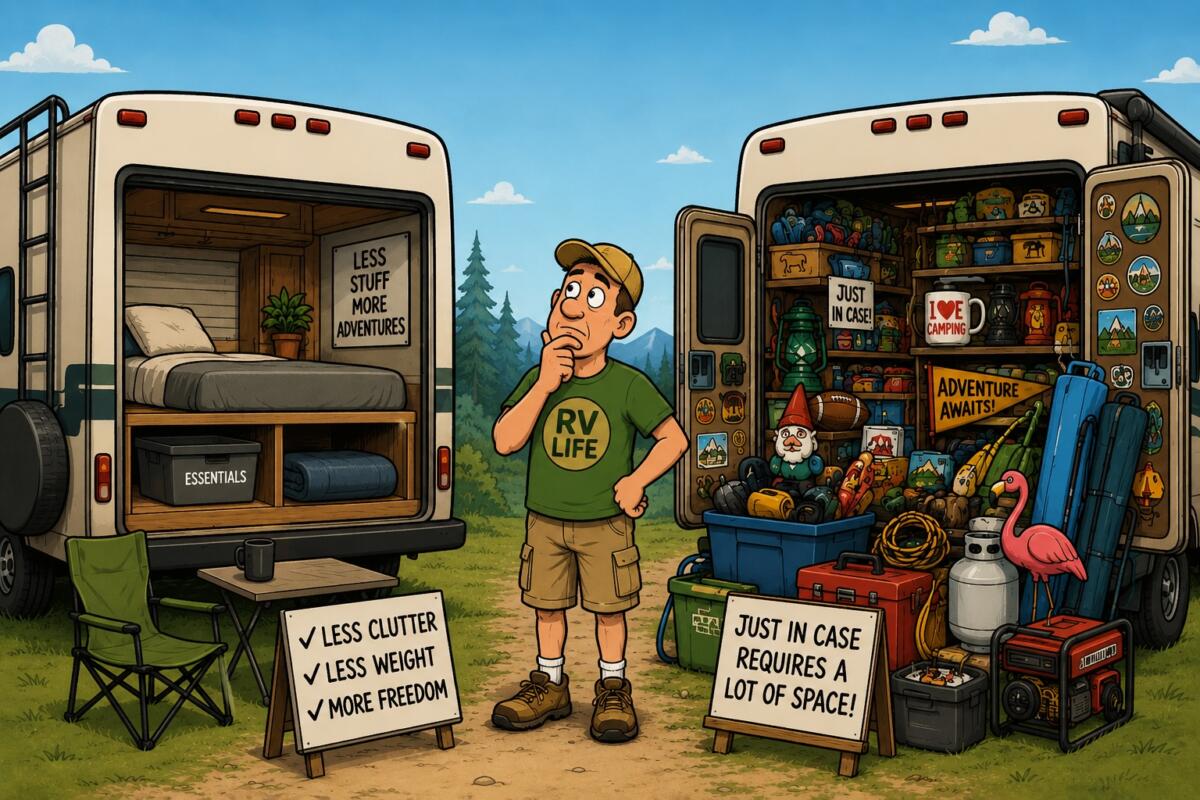
Take a look around your RV. How much stuff is packed into the cabinets, drawers, basement compartments, and storage bins? Could you hit the road tomorrow with half of it gone? Or do you prefer having everything you might need, just in case?

Minimalism has become a popular lifestyle in recent years. For some people, it’s about owning less, spending less, and focusing on experiences rather than possessions. For RVers, it can be especially appealing. After all, every square inch of storage space matters, and fewer belongings can mean less weight, less clutter, and less time spent organizing.

But not everyone is eager to embrace a minimalist lifestyle. Many RVers have spent years collecting tools, camping gear, outdoor furniture, kitchen gadgets, spare parts, hobbies, souvenirs, and all those little items that make life on the road more comfortable. Some would argue that being prepared is more important than being minimalist.

Of course, “minimalist” means different things to different people. One RVer’s minimalist setup might include only the essentials needed for travel, while another might consider themselves minimalist simply because they’ve managed to keep their belongings organized and under control. There is no official definition when it comes to RV living.

Some RVers discover they naturally become more minimalist the longer they travel. Others find themselves accumulating more gear with every trip as they learn what makes camping easier and more enjoyable. Both approaches have their advantages—and their storage challenges.

So what about you? Do you consider yourself to be a minimalist? We’d love to know. Vote in the poll below, and feel free to tell us in the comments why you are, or could never be, a minimalist. We’re curious (as always). Thanks!

LIKE TAKING POLLS? So do we! Did you know we’ve run more than 5,000 polls on our website over the years? Check ’em out! Have fun!

RVDT2929

RV makers are pulling back. What that could mean for RV buyers

The RV market outlook 2026 looked much brighter a few months ago. Now, some of that optimism is fading as manufacturers lower forecasts and reduce production schedules.

The slowdown could create opportunities for buyers. If dealers see traffic slowing and inventory building, they may be more willing to negotiate than they were during the post-pandemic RV boom.

According to a recent Reuters report, RV shipments fell 13.5% during the first four months of 2026 compared with the same period a year earlier. The RV Industry Association has also lowered its shipment forecast for the year as manufacturers adjust to softer demand.

Some manufacturers have already reduced production schedules. Reuters reported that Alliance RV has cut most of its assembly lines from five days a week to four.

For RVers considering a new purchase, the question is simple: Does a slower market mean better deals?

Why manufacturers are becoming more cautious

One reason manufacturers are worried is fuel costs.

Earlier this spring, oil prices climbed as tensions in the Middle East increased. Higher gasoline and diesel prices can make some shoppers think twice about buying an RV, especially a larger motorhome. More recently, fuel prices have eased somewhat, but concerns about travel costs remain.

The RV market outlook for 2026 looked much brighter a few months ago. Now, some of that optimism is fading as manufacturers lower forecasts and reduce production schedules.

The industry is also facing broader economic uncertainty.

RV sales have long been sensitive to the economy. When consumers become concerned about inflation, interest rates, or household budgets, large discretionary purchases are often postponed.

As a result, manufacturers are becoming more cautious about how many RVs they build and ship this year.

What it could mean for buyers

A slower market doesn’t automatically mean bargains, but it can shift some leverage toward shoppers.

“Slower sales could give RV buyers something they haven’t had much of in recent years: negotiating power.”

Historically, slower sales periods have given buyers more negotiating power as dealers work to move inventory. Buyers shopping for units already on dealer lots may find more flexibility on pricing, trade-in values, financing incentives, or add-on packages than they would during periods of stronger demand.

That doesn’t mean every dealer will be eager to discount. Inventory levels vary widely by region and by RV segment.

Still, buyers who are actively shopping may find conditions more favorable than they were just a few years ago when demand was surging and inventory was tight.

The road ahead

The RV market is not collapsing. Millions of Americans continue to camp and travel in RVs every year.

The RV market outlook for 2026 is clearly more cautious than it was at the start of the year. Manufacturers are scaling back production, shipment forecasts have been reduced, and dealers are watching consumer demand closely.

For buyers, that could create something many haven’t seen much of in recent years: a little more room to negotiate.

Sources
Reuters

RV Industry Association
GasBuddy fuel-price report coverage

RELATED

RVT1266b

Many Alliance RV models recalled for wiring fire danger

1

Alliance RV is recalling certain 2020-2026 Midwest Automotive Design Luxe Cruisers, 2021-2026 Ultimate Coach, G-55, 2022 Ultimate Entertainer, 2022-2024 Revolution, 2022-2025 Professional Series, 2022-2026 Ultimate Cruiser, Ultimate Limo, Patriot Cruiser, Ultimate Traveler, 2023 Signature, 2023-2024 Athletic Series, 2023-2026 Day Cruiser, Freedom, G-45, 2024-2026 Business Class, and Ultimate Weekender recreational vehicles. The ground wire may be undersized for the electrical system.

The undersized ground cable may overheat, increasing the risk of a fire, which could lead to injury or death. As many as 1,354 RVs may be involved in the recall, which was issued June 9.

Certain affected vehicles were manufactured with an undersized DC ground cable installed between the battery system and the Xantrex 3000 watt inverter. The installed cable is 2/0 gauge, whereas the intended specification requires a 4/0 gauge DC ground cable. As a result, the inverter DC ground circuit does not conform to the intended electrical system design specification.

Affected vehicles were identified through a review of production records and build configurations. The recall population consists of vehicles equipped with the Xantrex 3000 watt inverter system and the associated ground cable configuration used during a specific production period. Vehicles not included in the recall were not equipped with the Xantrex 3000 watt inverter system.

Warnings that a problem occurs

An overheating DC ground cable may result in improper operation of electrical components powered by the inverter. If excessive heat is generated, occupants may detect an electrical burning odor and, in more severe cases, observe smoke or flames.

Remedy

Dealers will inspect the configuration and replace the inverter ground cable as necessary, free of charge. Owner notification letters are expected to be mailed July, 6, 2026. Owners may contact Alliance customer service at 1-574-218-7165. Vehicle Identification Numbers (VINs) involved in this recall will be searchable on NHTSA.gov beginning June 22, 2026.

Alliance RV’s number for this recall is the same as the NHTSA Recall No.: 26V380.

MORE ALLIANCE RV RECALLS

RVT1266b

RV Daily Tips. Wednesday, June 17, 2026

America’s Original RV Newsletter. Since 2001
Issue 2928 • New issue every weekday


Today’s thought

“Sometimes your joy is the source of your smile, but sometimes your smile can be the source of your joy.”—Thich Nhat Hanh


Need an excuse to celebrate? Today is National Eat Your Vegetables Day!

On this day in history: 1885 – The Statue of Liberty arrives in New York Harbor.


Tip of the day
Burned by the plug: A wake-up call on shore power safety

By Russ and Tiña De Maris
A conscientious RVer had a scary situation. His 30-amp RV was plugged into a 30-amp-rated outlet. The family had been running the refrigerator and water heater on electric, and tossing in an occasional microwave oven use. The pedestal circuit breaker never tripped, but suddenly his son reported the shore power plug was smoking! Not only was it smoking, but the plug was in a meltdown crisis. Nobody likes a hot shore power plug. What happened to this RVing family has happened to other RVers. What gives?


Driving Palo Duro CanyonRV review
Brinkley Model Z 2900—Luxury fifth wheel that feels like home

The Brinkley Model Z 2900 packs a lot into 32’11”. With three slides, a residential look, and a long list of standard features, it feels much bigger than its footprint suggests. Its best trait is balance, because it combines towing-friendly size with the kind of layout and finish that usually show up in larger fifth wheels. For shoppers who want a fifth wheel that can handle weekends, long trips, and even multi-season use, this one checks a lot of boxes.


FAMOUS LAST WORDS: “We won’t need that.”


Article and video
Campsite stories—7 things you never want to hear

Campers know a trip can flip in one sentence. One minute the site is calm, and the next somebody says something that sends everyone sniffing the air, grabbing a flashlight, or blaming a tank sensor. Most campsite trouble starts with a harmless line, then turns a quiet evening into full campground drama. Uh oh… 


Sewer fitting grip help! Gadget to the rescue! 
If you find the bayonet mounts for your sewer hose connections are getting a bit hard to twist off and on (hate to say it, but it sometimes comes with age), here’s a tool that might help. An adjustable oil filter wrench, made to get a grip around automotive oil filters, can also provide a handy grip and plenty of leverage on the bayonet fitting of your sewer hose, and the termination cap as well. Here’s one we recommend.


Featured article
“Max psi” on tire sidewall. What does it really mean?

By Roger Marble
I know I have answered this question in the past, but maybe it was on an RV forum for a single-brand RV so not everyone has heard this. So here goes. Many, but not all, tires have the words “Max psi” followed by a number on the tire sidewall. I have no idea which lawyer wrote the requirement, but he or she didn’t understand how those words would be misinterpreted. Continue reading.


Ask Dave
Why does one RV air conditioner blow warm air while driving?

Read Dave’s answer.


Reader poll
Do you experience altitude sickness at high elevations?

Respond here.


Quick tip
Quick way to sanitize the public water hose connection

Worried about what the last guy may have done to the water hose connection at your site or at the filling area? Get yourself a bottle of “spray Clorox” and spritz the water tap threads before hooking on your own hose. 


Funny t-shirt of the day

Fixstuff
Comes in different colors and sizes. Learn more or order.

On this day last year…


Website of the day

The 10 Most Unique Places To Go Kayaking in the U.S.
If you have room in your RV for a kayak, we suggest you have one! Kayaking is a great way to see places you wouldn’t normally get to see. Check out these unique spots! (And if you don’t have a space for a kayak, what about an inflatable one? They’re great!)


Trivia

A long-overlooked organ may hold surprising clues to healthy aging and cancer survival. Researchers at Mass General Brigham used AI to analyze CT scans from tens of thousands of adults and found that people with healthier thymuses—a small immune-system organ once thought to become largely irrelevant after childhood—lived longer and had substantially lower risks of heart disease, cancer, and death.


? MYSTERY PRODUCT OF THE DAY ?
Pulling this out in the campground will be a big ol’ USA hit! Seriously, this should be brought out at every BBQ and gathering. How cool!


Readers’ pet of the day

Img 3271 7d36d8717d0f702dd9dfc98902867bab“Ryder (Australian Shepherd/Mini Poodle, age 3) is a true companion. Very family-oriented. Lots of energy and fun to have around.” —Richard Mazurek

Send us a photo of your pet with a short description. No blurry photos and please do not submit your photo more than once. Thanks!

RVing with Dogs group on Facebook. You’ll love it.


Leave here with a laugh

How do you know when a pun has matured?
When it is full groan.
(No comment.)


Today’s weather forecast across the nation
THIS MAP UPDATES TWICE A DAY

Visit Current National Radar Weather Map


Did you miss the latest RV Travel Newsletter? If so, read it here.
Oh, and if you missed the Latest News for RVers, make sure to catch up here.


If you shop at Amazon.com we’d appreciate you using this link. We get an itty bitty commission if you buy something, but they add up and help us pay our bills (most importantly our hard-working writers!). 


RVtravel.com All-Star Staff

Click here for information about our staff and how to contact us.
WHY WE ASK FOR DONATIONS INSTEAD OF SELLING SUBSCRIPTIONS.

Our policy on using artificial intelligence.

Why does one RV air conditioner blow warm air while driving?

By Dave Solberg
Dear Dave, 
I’ve just returned from Talladega, marking our second successful long distance road trip. On both trips we have run the generator and both air conditioner units to keep us cool. Both times while at road speed (55-65 mph) the rear air unit shows it’s cooling but warm air just barely blows out. Once we slow down or stop, it immediately returns to normal cold air flow. The front air cools normally. Have you experienced this? Is the wind on top of the coach combating the efforts of the fan and A/C? —Matt, 2018 Coachmen Sportscoach 404RB

Dear Matt,
You did not specify the make or model of the bedroom roof air conditioner. However, from what I can find on the used RV market, it looks like they used Coleman Mach 3. I would assume the front is the larger 15,000 BTU and the bedroom is 13,000 BTU. Both look to be ducted.

Since it blows normal cold air when you are stopped, it doesn’t seem to be the compressor or a coolant issue. The first thing I would look at is to make sure the evaporator cover is sealed properly and not allowing exterior air to penetrate.

Here is how the unit is designed to work

Warm, moist air is drawn from the inside by the fan that draws it across the evaporator coil. The coolant goes through cycles from liquid to gas and back which flows through coils in the evaporator fins and “flashes” the air. This draws out heat and moisture and sends it back to the ductwork inside the rig. All this should be sealed by an evaporator cover, typically a metal box that is insulated.

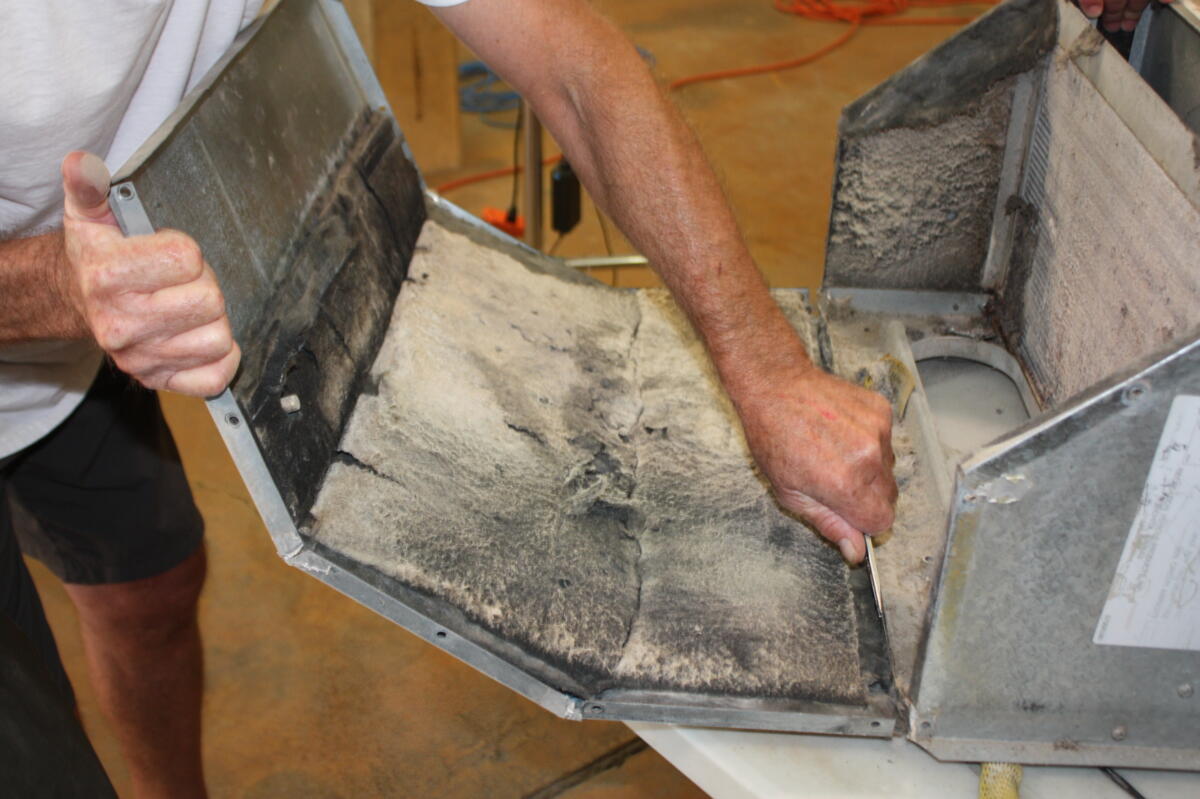
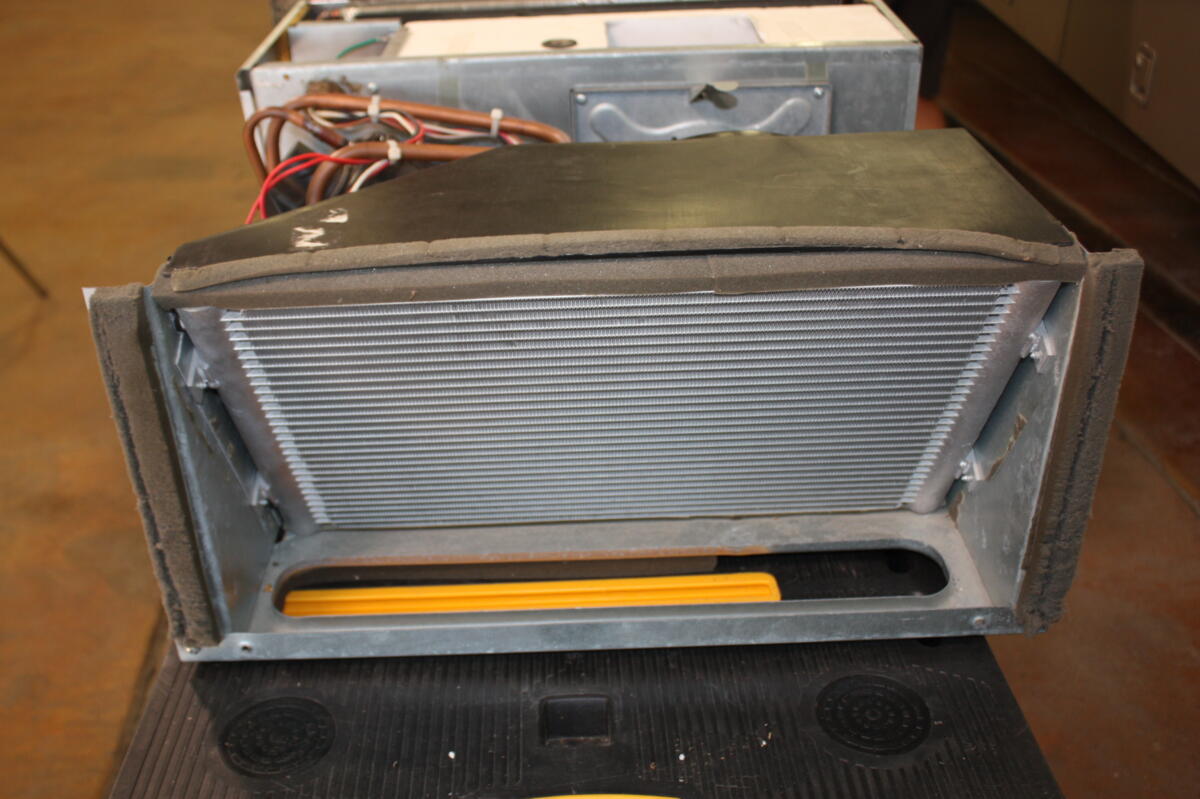
Here is a photo of one that we disassembled on a unit that had a clogged evaporator.

Air Conditioner Ev Cover
Air conditioner evaporator cover

If your evaporator cover is not sealed properly, or has a few loose or missing fasteners, it could be allowing exterior air to penetrate and create a whirlwind effect that would just blow exterior air inside the rig. You would need to remove the exterior plastic cover or shroud to inspect this.

Condenser coil

Another issue could be what is happening at the condenser coil in the back. As the coolant flashes through the evaporator, it flows back to the condenser fins and the back fan pulls in exterior air to cool the coils and the coolant before it goes back to the compressor.

Air Conditioner Condensor
Air conditioner condenser

The coolant can reach temperatures as high as 140 degrees. It needs to be cooled down to complete the “cycle” of changing from liquid to vapor and back again. If there is a blockage in the airflow or the fan cannot pull in exterior air, the coolant will not cycle and not be able to run efficiently.

Condenser fins

Check the condenser fins to make sure they are not clogged and are straight. Hail or branches can dent and bend the fins so they cannot draw air efficiently. These can be straightened with a knife or a fin comb available on Amazon here.

AC fin comb
A/C fin comb

Newer air conditioners have either the slanted condenser you see in the photo above, or redesigned covers or shrouds that protect the fins and draw air from the side and back.

If the fins are clear and the evaporator cover is sealed, it must be that the high air volume is creating a vacuum or void that is not cooling the lines. Check to make sure there is nothing installed around the air conditioner that might impede airflow.

An update from RV Products (Coleman)

I actually got a call from a technician at RV Products. He stated that all their air conditioners are tested in a wind tunnel to verify windflow/resistance. If there is something installed close to the shroud, it will create turbulence and slow the fan down. This in turn doesn’t cool the coils in the compressor head and allow the unit to work correctly.

MORE FROM DAVE ON RV AIR CONDITIONERS


Dave Solberg is a leading expert in the RV industry and the author of the “RV Handbook.”

Read more from Dave here

HAVE A QUESTION FOR DAVE?

Send your inquiries to him using the form below.

Name
Drag & Drop Files, Choose Files to Upload

RVDT2928

Burned by the plug: A wake-up call on shore power safety

8

By Russ and Tiña De Maris
A conscientious RVer had a scary situation. His 30-amp RV was plugged into a 30-amp-rated outlet. The family had been running the refrigerator and water heater on electric, and tossing in an occasional microwave oven use. The pedestal circuit breaker never tripped, but suddenly his son reported the shore power plug was smoking! Not only was it smoking, but the plug was in a meltdown crisis. Nobody likes a hot shore power plug. What happened to this RVing family has happened to other RVers. What gives?

Interestingly, the RVer had been using an electrical current meter just prior to the “smokin’ hot RV plug” experience, and it recorded the rig had drawn no more than 27 amps at peak.

Hot shore power plug—a contact crisis

What happened? Most likely this issue can be traced back to a contact crisis of the electrical kind. While the RV system itself was designed for 30-amp use, as was the power pedestal, it’s a case of the weakest link. The old “weakest link” illustration easily applies to RV electrical hookups. In this case, our friend may well have been the victim of resistive heating.

hot shore power plug
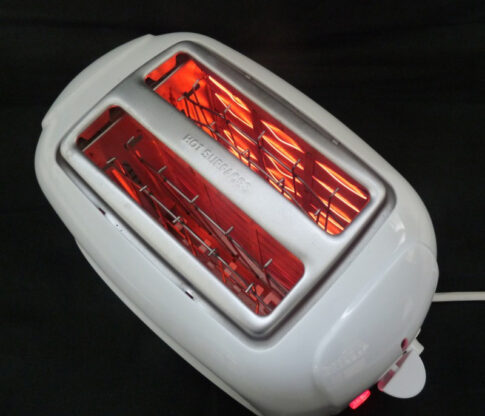
A positive example of resistive heating. Pfnicholls on wikimedia.org

You may not be familiar with the term, but you may experience the beneficial side of resistive heating at breakfast. Pop a piece of bread in the toaster, plunk the handle down, and, hey, presto! In a few minutes you have a chunk of toasted bread, ready to be smeared with gobs of butter.

Resistive heating works this way. When an electric current flows through a material, it encounters resistance. That’s a measure of how difficult it is for the current to flow through that material. The resistance causes electrons to collide with atoms, transferring kinetic energy into heat. Imagine all those little electrons bumping heads with the atoms of your toaster wiring. The result is perfect toast. Well, rarely, depending on your toaster. But that’s a subject for another time.

Of shore power plugs and RV park pedestals

hot shore power plug
Unhappy effects of resistance heating. This plug needs to be replaced immediately.

Resistive heating is great where you want things to heat up. But you don’t want things to heat up in your shore power connector, or the receptacle that it’s plugged into. Hot shore power plugs can often be avoided through proper maintenance. We’ve written before about how important it is to keep your shore power plug prongs bright and shiny. But what about the receiving end of that plug?

The typical RV campground power pedestal is a “whipping boy.” RVs come and go, and their owners cram their plugs into them, willy-nilly. The poor pedestal suffers the wear and tear speechlessly and, sometimes, if not properly protected, weather can get in and do nasty things to the connectors. Add to it, folks with RV power plugs that aren’t kept clean. That grubby connector can create resistive heating, damaging the receptacle. It’s a rough world.

So, along comes Mr. Unsuspecting RVer, who plugs his shore power plug into a damaged RV receptacle. If the power draw is low, he might never know it. But if pushing the upper limits—say running an air conditioner or multiple big-draw units (water heater, microwave oven, et al.)—then what is designed to easily carry 30 amps, by virtue of damage, just won’t do it.

Thermal resistance—those little electrons knocking heads—leads to heat where we don’t want it. It can actually destroy your shore power plug or, even worse, possibly catch fire. Hot shore power plugs are smoking shore power plugs. Smoking can be hazardous to your health.

Take a moment to look things over before you plug in

hot shore power plug
Check out the outlets in the pedestal. This one is brand-new–but look out for signs of melting, or suspicious “crudosis.”

What’s an RVer to do? When you arrive at your RV site, before you plug in your shore power cord, look. Look at your plug. Are the contacts bright and shiny? If not, get out the fine sand paper and buff them up. And look at the pedestal socket. Does it “look right”? No signs of meltdown, no black marks, no unexplained “crudosis”? If you see things that make you wonder, check back in with park management. If they can’t change out the receptacle, at best they should change your site assignment.

Alternatively, if there’s a 50-amp socket in the pedestal, you could use a 50-to-30-amp “dogbone” adapter to plug in your RV. It’s likely that the 50-amp socket is in better shape than the 30.

Watch out for hot shore power plugs. Check out yours, and take a close look at who it will be intimately associated with.

RELATED

RVDT2928

Campsite stories—7 things you never want to hear

By Cheri Sicard
Campers know a trip can flip in one sentence. One minute the site is calm, and the next somebody says something that sends everyone sniffing the air, grabbing a flashlight, or blaming a tank sensor.

That is the joke at the heart of The Camping Loop video at the end of this post. Yes, it’s humorous, but there’s also a lot of truth in there, like all good humor.

Most campsite trouble starts with a harmless line, then turns a quiet evening into full campground drama.

The phrases that start instant panic but inspire great campsite stories

1. “Does anybody smell propane?”
Few campground sentences kill the mood faster. The second someone says it, every conversation stops, everybody starts sniffing the air, and one self-appointed expert, usually a Carl, appears to explain regulators no one asked about. Half the time, it is nothing. Still, nobody relaxes until every hose, tank, and random storage compartment gets checked twice… and that’s a good thing.

2. “Where’s that water coming from?”
There is no good answer to this one. Campers always hope it is “condensation,” because that sounds cheap and harmless, even when a puddle is forming under the trailer. Then comes the flashlight, the dirt, and the awful thought that the camper has decided to start leaking hundreds of miles from home.

3. “That storm looks pretty close.”
One glance at the horizon can turn a whole campground into a weather panel. Suddenly, nobody knows where north is, but everybody has a forecast. The radar guy checks three apps, while grandma looks at the sky and gets it right.

Then the scramble starts:
• Rugs get rolled up.
• Bikes get tied down.
• Awnings come in fast.
• Lawn chairs become a rescue mission.

An hour later, the sun is back, and everyone inspects the damage like they survived a major event.

4. “The black tank says it’s full.”
This line starts with denial. Campers blame the sensor first, because RV sensors lie all the time. Still, nobody wants to gamble on this one, so the whole site starts debating whether to dump now or risk a terrible mistake later.

5. “What’s beeping?”
Around 2:17 a.m., one random beep can wake an entire campground. Then comes the flashlight patrol, the guessing, and the slow realization that the sound is somehow inside, outside, under the bed, and nowhere at all. Tip: The beep always waits until someone walks away before it fires again. (I have experienced this more than once in Quartzite.)

6. “Did you turn the fridge on?”
This question never comes up in the driveway. It shows up two days into the trip, usually right before lunch. Then the blame game begins, the drinks feel warm, the steaks are in trouble, and the hot dogs somehow survive like they always do.

7. “The wood’s starting to dry.”
That sentence sounds hopeful until the “seasoned” firewood smokes like a wet sponge. Soon, someone is fanning the fire with a paper plate, someone else is poking it with a stick, and a nearby fire expert starts talking about airflow. If flames finally show up, the night is almost over.

Why these are the campsite stories campers remember

Camping stays funny because something always goes a little sideways. The leaks, the beeps, the storm prep, and the bad firewood are the parts people retell long after the trip ends.

Remember, the worst sentence at a campsite often becomes the best story later.

RELATED

RVDT2928

Do you experience altitude sickness at high elevations?

20

Altitude sickness is a very common thing, especially for those who live at or closer to sea level compared to those who live at higher elevations. If you’re one of those people who live or spend the majority of your time closer to sea level, when you camp or hike at higher elevations, it might really get to you.

If you feel altitude sickness, you may have a headache, be dizzy, be nauseous, experience shortness of breath, be extra tired, have a hard time sleeping, or lose your appetite. In severe cases, you could even throw up. Yuck!

If you plan on camping at higher elevations this summer/year, make sure you read this first so you’re prepared.

When you travel to higher elevations, do you tend to suffer from altitude sickness? Do you have any remedies you could share with others in the comments? If so, please do. Thank you!

Oh, and if you do get sick often, this stuff is supposed to work well at preventing it.

Please leave a comment. If you do suffer from altitude sickness, do you know from experience at what elevation it kicks in?

MORE POLLS YOU’RE SURE TO ENJOY

RVDT2928