

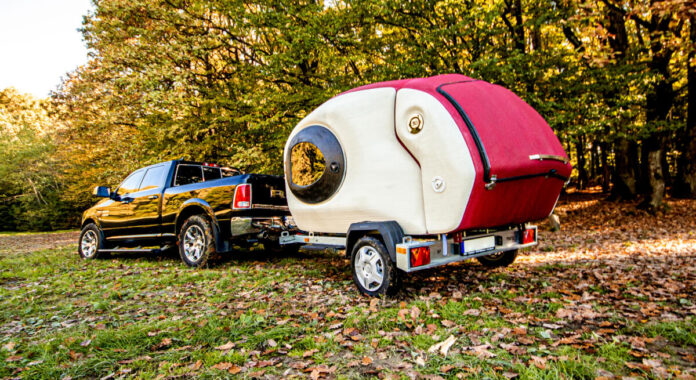
When it comes to building RVs, the idea of “stuck in a rut” conveys a basic idea. For ages, “stick and tin” was the order of the day. Build the sides of an RV with small, lightweight “studs” and cover it with aluminum siding, toss on a roof, and away we go. Then along came a new idea, one that’s been with us for a while. Build walls with an outside of fiberglass, “Styrofoam” in the middle for insulation, and paneling on the inside. Now a foreign firm challenges those ideas. A printed RV! Use 3D printers to squirt out on a giant scale a travel trailer using unthinkable materials.
Printed RV from composite materials

The Ukrainian–German company, LEMKI Robotix and Iscale3D, says it has come through with a breakthrough in large-scale 3D printing. Their DISCOVER 3D travel trailer is “printed” with a new composite material. The mixture is simple: Take 7,400 recycled polypropylene bottles and some fiberglass. Program the plans into a computer and, hey, presto! Out comes a travel trailer that looks kind of like a teardrop trailer gone wrong—or maybe it’s gone right.
The first printed RV, the DISCOVER 3D travel trailer, is already up for sale. Or you can rent it, assuming you’re in the area. Said to be suitable “for a family of three,” the rig is described by its designers this way: “Surprisingly spacious interior, cleverly optimized for maximum functionality. From the cozy sleeping nook to the efficient kitchenette and versatile storage solutions, every inch of this tiny camper is designed to enhance your outdoor experience.”
First printed RV “cozy” and lightweight
 “Cozy” indeed, with the sleeping nook six feet wide, a bit over seven long, and with headroom of five feet from floor to ceiling. Obviously not the dream of a full-time RV couple. But for a weekend outing, it could be just the ticket for some.
What else do we know about this little trailer? “DISCOVER 3D is equipped with autonomous batteries with the ability to connect solar panels, which ensures complete autonomy,” says a press release. “As a full-fledged ‘smart home’, it has all the sensors to monitor key parameters to control temperature, water level, battery charge, and other parameters. This approach makes it possible to create mobile homes for any climate zone.”
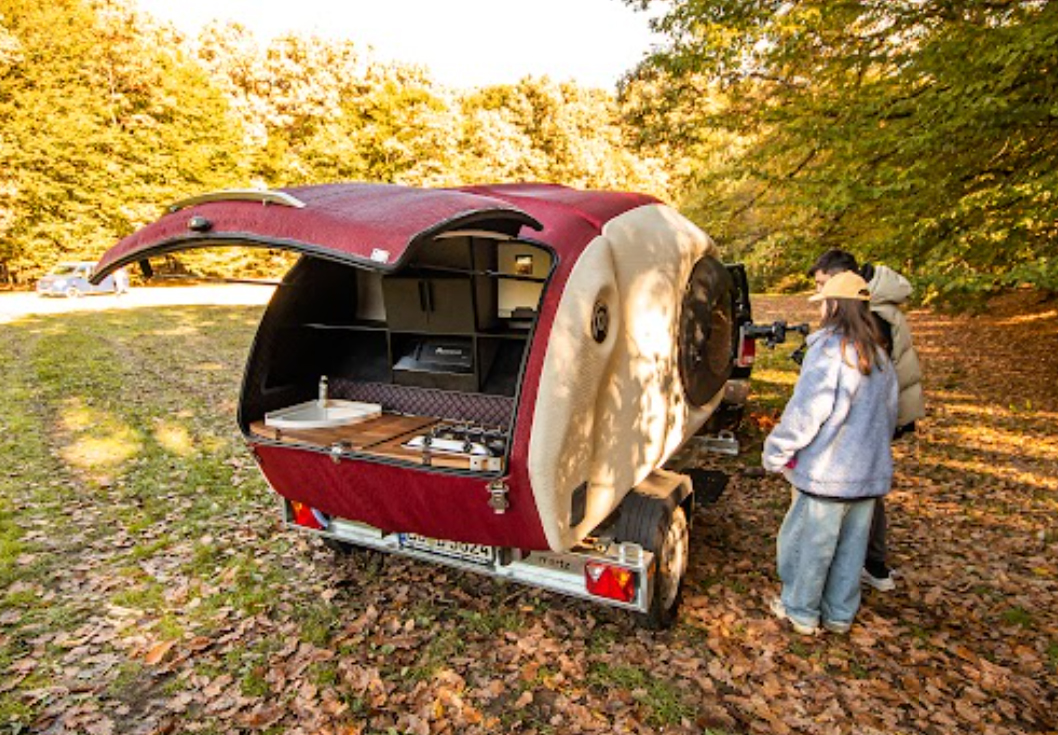
And what about weight? The “hull” scales in at a bit more than 550 pounds, and with running gear is said to weigh close to 900 pounds. And no, we don’t have any information regarding GVWR.
Intriguing future potential?
What intrigues is not the current product, but the potential for what an advanced-thinking RV manufacturer might be able to do with this technology, and the impact it could have on the environment. Scaled up to a trailer suitable for longer adventures, the number of bottles would certainly go up. And the company suggests motorhomes could be a potential “output” for the printer technology.
What about the technology? Would 3D printing improve the overall reliability of RVs? One would think at least the outer shell would be improved. Where it goes from there would have to be seen. And pricing? There’s no price tag to be seen for the DISCOVER 3D.
In any event, this new printed RV provides a fascinating glimpse into “what might be” for the future of RVing.
RELATED
##RVT1186b

This is “just the nuts!”
Keep this invention away from the aviation industry – Airbus, Boeing et al…… they’ve had enuf problems of late…. But ya’ gotta love the technology and the possible promises for the future.
I’m going to start gathering every discarded single-use water bottle I find while camping and save them for my next RV. Probably won’t take more than a couple of years with the number of those bottles I see thrown away. Even if all I can print is flat panels, I would only need 6 panels for a whole truck camper! Wonder if you could print honeycomb panels for added strength and insulation?
Absolutely on the honeycomb panels for insulation. They can be printed in 4’X8′ panels 24 inches thick and have the cells filled with high density foam and sliced 1″, 2″, 3″ thick in 4’X8′ panels for use in any construction process similar to plywood but with an insulation property like a Yeti.
If they can apply this to something bigger than a “teardrop” style camper – something that has actual room to stand up in, indoor cooking facilities, a bathroom, etc – I’ll be a lot more interested. Neat concept, though!
While this is a mixture of polypropylene and fiberglas, it will be interesting to see how the material holds up outdoors. Polypropylene is highly suscepitble to UV damage. There are various stabilizers, but not all are effective in PP…some are.
Net, before I bought a “water bottle” plastic camper, I’d really want to understand if or how the mixture used stabilizes the plastic for long term function in the outdoors.
Knowing how our U.S. RV manufacturers think, there might be enough stabilizer to get through the warranty period…maybe.
Thank you, Russ and Tina! Hmm, … looks too small to be of interest to me. Happy new year and safe travels! 🙂