

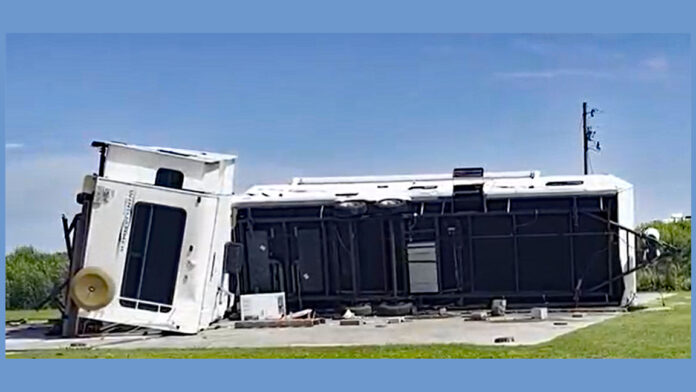
At least three RVs were “tossed like toys” in Cameron, Louisiana, on Tuesday, May 27. No, it wasn’t a tornado. In this case it was a gustnado that flipped the rigs—totally destroying at least one. What’s a “gustnado,” and can you protect yourself against one?
Gustnado: A “weak whirlwind’ that can lead to an RV disaster
A gustnado (short for “gust front tornado”) is a short-lived, weak whirlwind that forms along a gust front—the leading edge of cool air rushing out from a thunderstorm. Despite the name, it is not a true tornado because it doesn’t originate from the storm’s mesocyclone (rotating updraft). While the definition includes the words “weak whirlwind,” don’t let it fool you. The Louisiana gustnado proved that these winds can be RV-damaging, if not fatal.

Cameron’s gustnado was the offspring of a severe thunderstorm. The Weather Service reported that the gustnado touched down at four in the morning, blasting away with 80-mile-per-hour winds. Firefighters responded to the scene of the wreckage and pulled one injured person out.
What do we know about gustnadoes?
• Short-lived — Typically lasts a few seconds to a few minutes.
• Weak — Usually results in wind damage similar to strong straight-line winds.
• Non-mesocyclonic — Not associated with supercell rotation.
• Often looks like a small dust devil or dirt whirl, but can still be dangerous.
These facts about gustnadoes are what make them so dangerous. Tornadoes can typically be predicted by radar detection. Their rotating supercells (mesocyclones) are usually spottable in advance. Gustnadoes form along gust fronts—outflow boundaries of storms. They’re not associated with organized rotation aloft, and generally can’t be spotted by radar.
Gustnadoes form rapidly and close to the ground and usually have no visible connection to clouds aloft. They’re the radar equivalent of “no-see-ums.” And since they develop so quickly and don’t last long, there’s no way to sound a warning for people to take cover.
Thunderstorms a precursor

The Louisiana gustnado case does provide a measure of how to be on the lookout for these events. Doug Cramer, a warning coordinator meteorologist with the National Weather Service, was interviewed by KPLC TV. He told the station, “We had a severe thunderstorm warning on this segment of thunderstorms. It’s a good reminder to everyone in Southwest Louisiana and Southeast Texas that this type of damage can occur with severe thunderstorms; it doesn’t necessarily have to be a tornado,” Cramer said.
But don’t think gustnadoes are limited to Louisiana and Texas. Gustnadoes occur relatively frequently, especially in the central and southeastern United States during the spring and summer months when strong thunderstorms are common. They tend to form along gust fronts or squall lines and are often seen in areas like the Great Plains and the Midwest.
Severe thunderstorm warning? Take cover!
If you RV in these areas in spring and summer, you’d be wise to keep a weather warning radio on hand. Make sure it’s operating and tuned to the area where you’re staying. If a severe thunderstorm warning is broadcast, consider taking shelter.
Indoors:
• Go inside a sturdy building as soon as possible.
• Stay away from windows and glass doors, which could shatter.
• Take shelter in a small, interior room on the lowest floor—like a bathroom, hallway, or closet.
• Avoid garages, sunrooms, or sheds. These are often not reinforced and may collapse in strong winds.
In a vehicle:
• If you’re already driving, do not try to outrun the gustnado—it may change direction suddenly.
• If safe to do so, pull over and park.
• Stay inside the vehicle with your seatbelt on.
• Keep your head below the windows and cover it with your arms or a coat if possible.
• Avoid stopping under trees or near power lines that could fall.
Outdoors:
If caught outside with no shelter:
• Move away from trees and unsecured objects that could become airborne.
• Try to find a low spot like a ditch or depression, lie flat, and protect your head.
• Be alert for lightning and flooding if heavy rain is also present.
Statistics are cold comfort
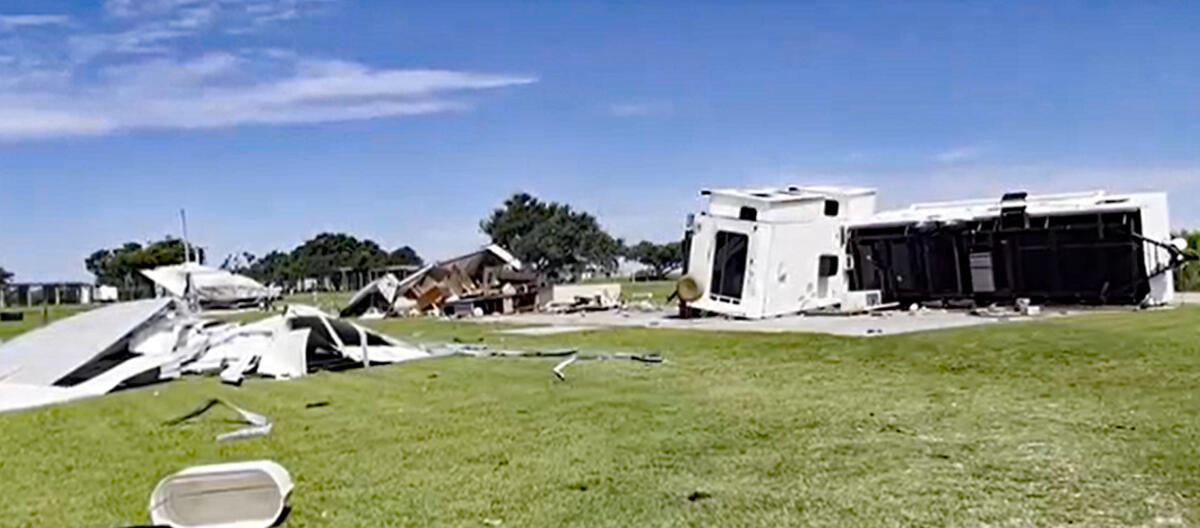
The U.S. experiences between dozens to more than 100 gustnadoes each year. Happily, most are so short-lived they don’t have the opportunity to create major damage. But if you and your RV get in the way of one, those statistics are cold comfort.
RELATED
- Essential windstorm safety tips
- Watch, see and listen as RV gets destroyed by freak hailstorm
- RV tornado safety tips: How to survive a tornado when RVing
RVT1211

They can sure come up with many new names for wind these days!
And then we have a friend on their 2nd Montana. He says he has far more poor workmanship fixes with his 2025 unit than he has made in repairs on his older Montana. He likes the better floorplan and features of the 2025, assembly quality not so much.
Sorry, wrong tab for the comment on the Montana. Meant for the review article.
Hi, Jim. If you want, go ahead and put your comment under the Montana post and I’ll remove these comments from the gustnado post. (I could copy/paste your comment in the correct spot, but then it would show it’s from me. Looks weird.) Thanks. 😀 –Diane
Lost an awning to a “gustnado” and gained a Motor home. Had the awning put back on and when the wife drove me to the dealership we bought a MH before leaving. Don’t ask why. Alright the wife fell in love with the 4′ long tub in the MH. Had that MH for 14 years and “upgraded” to a 40′ DP. In that now 7 years. She has been “banned” from the dealership by me!
Several years ago in Sept., I was burning some brush in my backyard burn pile when a dust devil whipped thru carrying hot embers up and over the trees. Terror tho’t was the neighboring farmers ripe wheat field! We have smaller dust devils and we do have severe thunderstorms (tomorrows forecast!), however I have never seen a gustnado. That would be scary in an Rv or anywhere with no warning or idea it could happen.
Thanks for the timely update and reminder about weather safety Russ and Tina! This is info everyone needs every day! Great article.
Fascinating! I never heard of such, Russ and Tina! Have a great day and safe travels!