

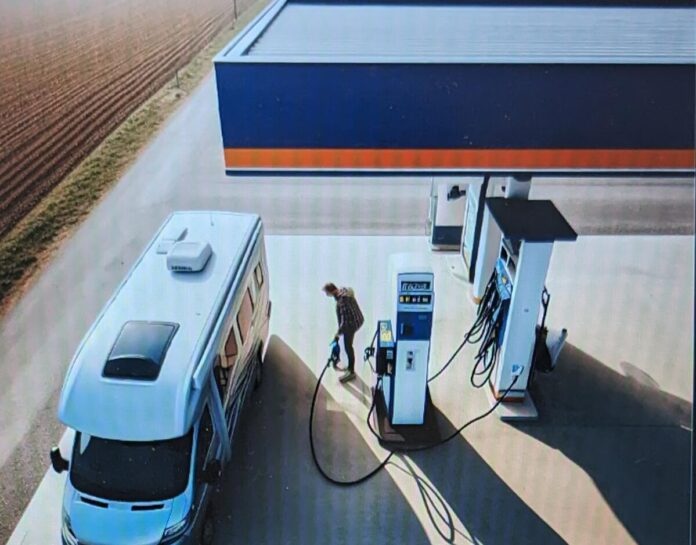
Ouch! Can you guess what kind of RV accident many people don’t know about, and perhaps even fewer folks know how to avoid? Ask any company that insures RVs and they’ll tell you that RV tail swing causes many, many accidents each year. We can all use some tips to avoid RV tail swing trouble!
Surprise!
A friend recently finished fueling his RV and pulled away from the station’s pumps. Suddenly he heard a loud, sickening crunch. He immediately braked and jumped out to investigate. The back corner of his motorhome was crushed. His RV tail had clipped a post positioned near the fuel pump. This tail swing incident cost over $30,000 in repairs. Yipes! Watch this video to see how an accident like this can happen.
Just what is an RV tail?
The tail of your RV is the distance from the rear tire to the back bumper. It’s that area of overhang behind the back tire, and every RVer needs to understand how their RV tail swings.
Right or left
Whenever you turn your RV, the tail will swing. The important thing to remember is that when you turn to the right, your RV tail swings in the opposite direction, or left. And when you turn your rig to the left, your RV tail will swing to the right. The swing is always in the opposite direction of your turn. This means that the tail swing is always on the driver’s blind side. This demands extra caution.
How long is the tail?
Every RV model is different. Generally speaking, a longer RV may have a longer tail swing, but it depends on the position of the rear wheels in relation to the rear bumper. The length of tail swing varies with how tight a turn is made, also, but don’t worry! I’ve got some tips to avoid RV tail swing trouble.
Prevention tips
- Opposite left. When making a left turn, check your right mirror for possible obstructions.
- Opposite right. When making a right turn, check your left mirror for any obstacles in the tail swing path.
- GOAL. If you aren’t sure, get out and look (G.O.A.L.), if at all possible.
- Rear camera. If your rig has a rear camera that displays both rear corners of your RV, use the camera to help you navigate.
- Copilot. If you are in a fuel station, parking lot, etc., with several obstacles, ask the copilot to get out and direct the driver. Use your cell phones or walkie-talkies to communicate.
- Out and away. If your rig is near a fuel pump, wall, fence, or other obstacle, it’s best to pull straight away and then turn in the direction of the obstruction. That way, your RV’s tail will swing in the opposite direction, away from the obstacle, avoiding a collision.
- Cautions. Tail swing accidents happen most often when the RVers are tired, in a hurry, unaware of surroundings, or distracted. Don’t drive if you are experiencing any of these conditions.
Stay safe!
Related:
Sign up for a weekly digest of my articles here.
##RVDT2295

Would have been more helpful of video showing a MH or a TT/Fiver vs a semi.
Check this out, Gil. (207) RV 101® – New RV Driver Skills Series – RV Tail Swing – Master Your RV – YouTube It may be of help to you.
Hi, Gail and Gil. When proofing your post, Gail, I added a link at the bottom of it to one of Mark Polk’s articles we ran awhile ago which included that video, and a couple of others.😉👍 Have a great day. 😀 –Diane at RVtravel.com
The other rule of thumb is that the amount of tail swing is up to half the length of the tail. So, if your tail is 8’ long, it can swing out 4’. If you stopped within 4’ of the post by the gas pump, you can hit it!
Why is the distance on an RV longer from the rear tires to the back end than on a tractor trailer?
I have seen motorhomes that actually have 12’ of coach behind the rear axle. Semi trailers have much less than that. Also it’s hard to turn a trailer that short due the length of the trailer between the the king pin and axles. In backing you can jackknife it and get tailswing. RV manufacturers should use longer chassis’s for larger bodies but don’t. Diesel pushers don’t have that problem because the chassis requires the longer wheelbase to support the drivetrain.
I don’t understand the comparison of a semi to a motorhome to begin with.
Semi trailers are from 48ft to 53ft they have sliding axles so as to distribute weight across the 5 axles. When slid all the way forward they have as much of swing as we do with our rv’s. RV’s are fixed axles so as to have correct pin weight. They say. But if you don’t load your gear correctly you can be over on axles or pin.
Same thing with a semi except they can slide axles or slide 5th wheel(to rvers hitch)to distribute weight. I know I’ve gone too deep for some. But with 61 years of trucking it’s natural to me. If I can be of further help let me know.
Drove a forward control school bus for a number of years. About 10′ from rear axle to end of bus. Made for some interesting times in small subdivisions. Especially illegal parking in the circle! Could turn them around on a dime and give back nine cents change. But watch that rear end!!!!
The transits and conventionals were worse – Not as much tail swing but did not have the turning radius of the forward control units.
OK, didn’t watch the video but agree with Gail’s points. My comment is a driver has to be aware of ALL the pivot points and where everything is going to move in any turn; going forward or backward.
Thank you, Gail! That is the good thing about truck stop fuelling stations; the correct path to follow after fueling is straight ahead for more than the length of our RV and towed vehicle. Given our overall length when stopping for fuel (56′) and that we run diesel, we always use truck stops. Lastly, we have the Open Roads fuel card, which gets us discounted fuel prices that move the price we pay for fuel nearer the price of a regular fuel station. 🙂
Avoid turning sharp. The common rule is 30% swing for the tail, i.e: 3′ tail = 1′ swing.
Also, be aware that a longer tail can cause handling problems for your toad (opposite tracking) and can cause fishtailing.
Been there done that, lesson learned.