

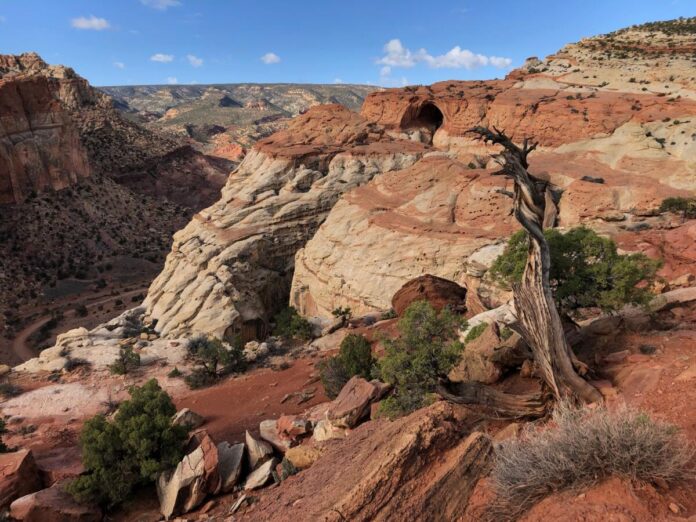
Utah’s two U.S. senators have put forward legislation that would change which vehicles are allowed on some Capitol Reef park roads. The proposal may also include other parks, as well.
This legislation is sparking a debate that matters for RVers, local businesses, and people who depend on park access for mobility.
Legislative language
The measures introduced by Senators Mike Lee and John Curtis would authorize the operation of off-highway vehicles (OHVs). This (pre-government shutdown) proposal would allow OHVs on certain park roads that are currently restricted or managed by the National Park Service.
Note: OHVs include vehicles like street-legal ATVs, side-by-sides, and dirt bikes.
The bill (filed as S.2970) lists specific Capitol Reef roads, such as Burr Trail, and would allow OHV travel on designated routes. The sponsors frame the change as clarifying vehicle rules and restoring access to rugged roads. You can read the proposal here.
Proponents’ rationale
Lawmakers backing the bills emphasize equal access. They contend the proposal will allow more Americans, including people with mobility limitations, to experience parks that are otherwise difficult or impossible to access.
The sponsors have tied this access argument to an “Outdoor ADA” approach (a push to make public lands more usable for visitors who rely on vehicles for access).
Proponents also point to recreational freedom and the reality that nearby public lands already allow OHV use. Opening certain roads inside park boundaries for visitors could expand options for families and small businesses that service off-road recreation.
“Americans with disabilities should never be shut out from the places that represent our national story,” said Senator Lee. “The mountains, canyons, and forests managed by the federal government are part of our shared heritage, and access to them should not depend on whether someone can hike ten miles or climb a ridge. This bill ensures that Americans with disabilities have the same chance to experience the beauty of our country as everyone else.”
Opponents’ rationale
Conservation groups, park advocates, and some outdoor recreation organizations warn the bills would undercut the National Park Service’s ability to manage resources and protect visitor experiences.
Concerns include louder noise levels, damaged land, disrupted wildlife, increased erosion near fragile formations, and harm to the dark-sky experience for many people.
Critics also argue that introducing OHVs, even if limited to certain roads, could set a precedent that weakens protections across the system. These groups point to the Park Service’s longstanding practice of limiting ORV use in most national park units and to recent actions defending sensitive areas from motorized overuse.
Economic and community views
Communities around Utah’s parks rely heavily on tourism. Fuel, groceries, campgrounds, guides, and outfitters all benefit when visitors arrive.
Recently, state officials have stepped up to keep parks functioning during federal funding disruptions because local economies depend on steady visitation.
Supporters of OHV access argue that opening more routes could bring more customers to rural businesses that sell parts, rentals, meals, and lodging.
Opponents counter that once a park’s character or natural resources are damaged, the long-term appeal that brings travelers could decline. Any damage costs fall on public managers and taxpayers.
What about you?
RVers should keep an eye on the text of this bill (S.2970) along with statements from both the National Park Service and local economic groups.
Which side of this issue do you support? Tell us (along with your rationale) in the comments below.
RELATED
- Coal mining could change what RV travelers see near Utah’s national parks
- The landscape is bizarre and time acts strange at Utah’s Fantasy Canyon
- New Utah law requires license for hiking and biking in wildlife areas
- Amazing experience at Utah’s Dark Sky RV Campground
RVT1231b

There are way too many ATVs in the forests and parks now. They are noisy and tear up roads and trails. We need more restrictions on them not less.
For National Parks, I would agree. For National Recreation Areas, which are managed by the NPS, I would suggest a more liberal approach for OHVs. One of the best examples IMO is the Lake Mead National Recreation area. Limitations on noise from boats, seems counter to recreating. Lake Mead is not an ancient glacial lake with rare fresh water species of fish, as an example.
Enjoyment of our shared recreation areas must encompass various forms of enjoyment, not just bird watching and petroglyph tours. It’s even in the name “Recreation Area”, similar to some of Utah’s recreation lands.
Happy trails 😎 ✌️
Cancel, you’re kinda right but my camping days in Government Wash ended when the inconsiderate started outnumbering the responsible users. Sadly, things only got worse to where it’s now closed to motor vehicles and no overnight camping. Given an inch, some take a mile and destroy the very things they escape to.
I think you are correct Vince. I would estimate that the majority of the problem lies with the lack of enforcement of people squatting in that area, and other areas. We are seeing a lot of the consequences of not enforcing existing laws in a variety of areas of society, currently. OHV use in recreation areas is one thing, squatting rights for meth addicts is another.
What’s sad Cancel is the frontline LEO’s would try to keep things in check but the courts dismissed the charges with such frequency that they eventually “quit wasting taxpayer money hauling people to Vegas just to see the charges dropped”. In fairness, I don’t know what the answer is.
I’m mobility limited and would love to be able to ride to places I can’t see otherwise. And it’s getting worse, just as I now have the time to go see these National treasures – after years of serving this Country to have the opportunity to do so.
It’s a reasonable proposal. OHV owners are tax payers too and shouldn’t be ostracized from enjoying nature.
Most of them are responsible stewards of the land as well.
Thank you for the news, Gail! This potentially presents a very interesting debate and associated lobbying efforts that are sure to be entertaining. I have no dog in this fight as I have an aversion to national parks and their associated crowds. Solitude seems too rare a thing in many (most?) of them. Have a great day and safe travels!
We ride our utv on many forest service roads and I don’t see them tearing up the roads. What I see tearing up the roads is jacked up pickups with big tires and 400+ hp engines and they are already allowed in the parks.
I live next to 80,000 acres of SE Minnesota State Forest land and Wildlife Management area. This unglaciated portion of the state, adjoining the Mississippi River valley, is very hilly with steep hillsides and valleys. I grew up hiking these hills before ATVs were a thing and the many remote old farming hill roads were pristine.
For some time now the State Forest land has allowed ATV/UTV/dirt bike usage while the WMAs do not. The damage on the SFs is incredible. Some trails so damaged they don’t even support ATV use anymore. Maintenance costs are expended, but they can’t keep up.
Be careful, Utah.
I don’t know the right answer, but it’s not a totally new idea; they allow ATVs in the NF around Brice Canyon NP.
As a Jeep off road enthusiast, I applaud more access to trails but unfortunately access without enforcement invites vandalism, unlawful dumping and destruction. If they open it up and walk away, my biggest fear is it’ll get trashed. To the flip side, if they lock it up and deny use, it’s hard to label it public lands, let alone a recreational area.
I generally agree. The public is not sensitive to the damage they cause, especially long term damage from short term activity.
On the other hand, over enforcement is becoming a problem. I’ve never met a mean ranger, but doesn’t mean they won’t exist.
Most off road vehicles just tear up land and fast. I learned that when my wife bought my son a quad. Then they ride them at high speed on road. Cops won’t chase them because they’re afraid if they get hurt, they’ll sue. In Pa the only enforcement is by the game wardens on state game lands. For the handicapped just have rentals of those wheelchairs with tracks. Trouble is some trails may have to be graded.