


Dear Dave,
I change the batteries in my smoke detector every year, but how do I know it is working correctly? —Bill, 2021 Grand Design
Dear Bill,
Thanks for the question and opportunity to provide an update on smoke alarm/detectors in the RV industry. Most RV owners simply change the batteries once a year—either after the new year or during daylight saving time. However, there is more to it than that.
Smoke alarms versus smoke detectors
Smoke alarms and smoke detectors are actually two different types of devices but are often used interchangeably. Technically, a smoke detector is a sensor that detects smoke and sends a signal to a central control device, which then activates a network of devices that sound the alarm. A smoke alarm is a stand-alone unit with the sensor and alarm all in one.
RVIA Code
The RV Industry Association (RVIA) requires a smoke alarm that conforms to the National Fire Protection Association (NFPA) 1192 Standard for recreational vehicles. Most RV owners don’t pay much attention to the requirements. However, it is important to not only properly maintain your smoke alarms but also stay on top of any upgrades or recommendations.
I obtained a copy of the standard from my contact at THOR, who is Vice President of Vehicle Safety & Regulatory Compliance and is on the RVIA board. You can download the entire document; however, the basic overview is the smoke alarms must have the following criteria and labeling:
- Manufacturer’s name or identification symbol
- Model, type, or catalog designation
- Date of manufacture
- Electrical rating of volts and amps
- The type of product such as “RV Smoke Alarm”
This was intriguing, as I was an inspector at Winnebago for a couple of years way back in the day, as they say, and also in quality control. I was checking every product to specifications and codes, and I remember just checking the model numbers. Once they were installed at the end of the line, the battery was installed and the “test” button was pushed to make sure it sounded the alarm.
Requirements for RV smoke alarms
According to the code, smoke alarms that can be installed in an RV must have the label “RV Smoke Alarm” visible. That means they must also pass a variety of tests such as humidity, ambient temperature changes, and sensitivity.
Additionally, the device must not produce a false alarm when subjected to air at 150°F, at least 72 hours at -40°F, and 10 days at 92% humidity at 142°F.
The device is also subjected to a corrosion test (salt spray), and a vibration test for 120 hours, which is the equivalent of driving an RV on I-80 across Nebraska!
During COVID and the supply chain issue, these alarms were not available. THOR actually purchased traditional smoke alarms and conducted their own testing, which passed the NFPA testing guidelines.
Also in the code are specifications for batteries. Those are in Section 89.1, General, and Subsection 89.1.3 and 89.1.4, which read as follows.
89.1.3 All batteries included with smoke alarms intended for use in recreational vehicles, commercial vehicles, or boats shall at a minimum have a published operational specification range of no greater than -18°C (0°F) and no less than 54°C (130°F).
89.1.4 Recommended replacement batteries shall also meet the temperature range.
New technology and advancements
Over 200 significant upgrades to residential smoke alarms took effect in June 2024. Here’s what to know about the new standards, and how they help homeowners.
The most notable improvements include better detection of smoldering and burning polyurethane foam (found in mattresses and upholstered furniture) and reducing false alarms from cooking.
According to the NFPA, the new improvements are designed to prevent owners from removing the batteries due to false alarms.
Nuisance cooking alarm detection
The new devices use more advanced sensors, or multi-sensors and algorithms, to better distinguish between cooking smoke and an actual fire. To do this, they analyze smoke for differences in particle size and gas concentration.
Smoldering and burning polyurethane detection
While new alarms are less sensitive to cooking smoke, they are more sensitive to other dangers, especially smoldering and fast-moving polyurethane fires. This is especially important because fire dynamics in homes have changed over the last few decades.
According to the NFPA, homeowners had approximately 17 minutes to evacuate their homes after an alarm 10 years ago. Today it is less than 4 minutes due to lighter synthetic materials that burn faster and hotter.
Since an RV has a smaller floorplan and lower ceiling height, escape times are much more critical, so detection needs to be faster.
According to the NFPA, smoke alarms should be replaced every 10 years based on the manufacturing date, or every seven years for combo smoke/carbon monoxide (CO) alarms.
However, if you are getting false alarms while cooking, you should replace the detector with the new-technology models.
The NFPA also recommends smoke alarms should be “tested” every month and not just by pressing the test button. The best method is to use canned smoke, which you can get on Amazon here.
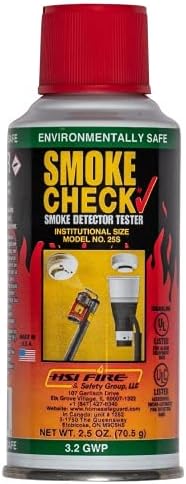
Key points regarding smoke alarms
So, the long answer (which I usually provide) is, yes, there is more to a smoke alarm than just changing the batteries. Here are some key points:
If your smoke alarm is more than 10 years old, it needs to be replaced with a unit that is RV Smoke Alarm certified. Here is one on Amazon.

If your smoke alarm is less than 10 years old, it is not necessary to replace the existing one with the newer technology unless you are experiencing false alarms.
You should only replace the batteries with ones that meet the NFPA 89.1.3 testing. That may be hard to determine as that information is not listed on the batteries that I checked and typically not on the packaging. NFPA advised to look for the UL1973 or UL9540, which I could not find, as well. However, on the Duracell and Energizer websites, it lists the operating temperature of 0°F – 130°F, so they would both qualify.
Do not take the batteries out if you are experiencing a false alarm. Check the unit with the canned smoke or replace it. The cost of a new smoke alarm pales in comparison to the cost of a new RV or, worse yet, the loss of life.
RELATED
- Escaping your RV in a fire: You have 20 seconds
- Fire extinguishers are not created equal
- How to tell if your fire extinguisher is in good working order
- The importance of smoke alarms in RVs
- The common causes of RV fires
DAVE HAS ANSWERED MORE THAN 1,000 readers’ maintenance and repair questions. Read a directory here. There is so much to learn!
Dave Solberg is a leading expert in the RV industry and the author of the “RV Handbook.”
RVDT2811

Great article Dave! I need to look into the newer smoke alarms as ours refuses to tolerate the cooking of wings in the air fryer and that does indeed drive a terrible habit of battery removal.
Canned smoke- boy I’ll bet that stuff just flies off the shelves. 🙂