

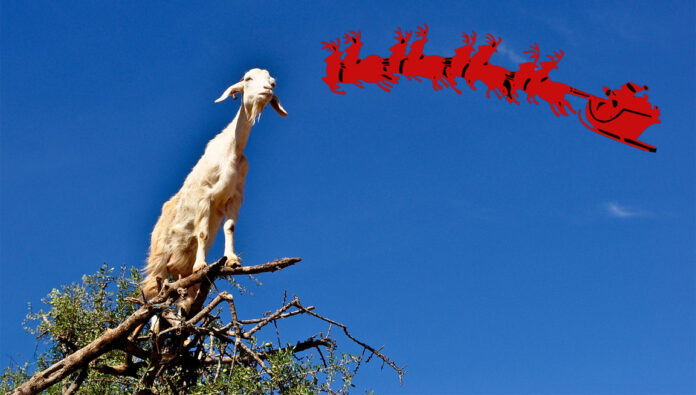
Every year, between 25 and 30 million Christmas trees are sold in the United States. That’s according to the National Christmas Tree Association. That’s great news for Christmas tree farmers, but just how do America’s trash collectors feel around New Year’s? Is there a better way in the world of Christmas tree disposal?
Christmas tree disposal for fish? Maybe not…
Some have heard that downed trees make for a great fish habitat. And the folks at the Michigan Department of Natural Resources are often asked if Christmas trees would help our finny friends. It’s a legitimate question for Great Lake Staters. After all, many of Michigan’s lakes once had woody habitat, such as a fallen tree, every 5 to 50 feet! This woody habitat is important for fish, turtles, frogs, herons, and other animals because it provides refuge from predators and opportunities to bask in the sun. It also reduces wave energy that erodes shorelines and encourages the growth of aquatic plants. Harder-wood trees with an open branch structure provide high-quality habitat.
So, dump this year’s tree to help next year’s aquatic life? Not so fast, says Michigan’s DNR. Christmas trees are classified as softwoods and are typically species such as balsam fir, Douglas fir, Fraser fir, noble fir, Scotch pine, Virginia pine, and white pine. These softwoods break down relatively quickly in aquatic environments. The dense branches on Christmas trees that are perfect for holding ornaments are often too dense for many fish to use as habitat.
Additionally, pesticides applied to Christmas trees, leftover decorations, and anchors used to sink trees may introduce unwanted materials into our waters. So, if you’re thinking about sinking that tree in your favorite lake for fish habitat, you’re urged to consider an alternative.
What’s the best way to get rid of it?
Create a brush pile on your property to provide habitat. Wildlife may use it for nesting or as a food source. Just make sure that the tree is pesticide-free and that you’ve removed all of the ornaments and other decorations.
Cut the tree into small pieces or mulch it to use in garden plots or landscaping, which will return nutrients to the soil. Depending on the type of gardening you’re doing and the type of tree you have, you may need to confirm that the tree is pesticide-free and that it won’t negatively affect soil composition for whatever you’re growing.
Give the tree to someone who has chickens or goats
 And our favorite? Give the tree to a friend who has chickens or goats. Chickens can roost on trees and goats love to chew on them. Again, make sure the tree is pesticide-free before allowing animals to use it.
Or recycle it
No friends with barnyard pals? Your other option is to recycle your tree through your municipality. Many cities and towns (including local Boy Scout troops) collect trees or have designated drop-off locations; these trees are usually turned into mulch.
##RVT1189b

That pine mulch will harbor termites. Commercial mulches may be treated or made from the tree bark to eliminate this problem.
In our area the local scout troop will collect the trees and put them in wooded areas to as wildlife habitats.
Our goats loved Christmas trees. However, one has to be careful. There’s no wiry ornaments left on the tree. If it’s heavy enough, it can work its way through the animal and kill it. Voice of experience.
To be clear, I mean, if the wire is heavy enough gauge, it can damage the goats internal organs.
Been artificial for decades now, no going back to real trees for us!
my Boy Scout troop used to collect trees to help the local volunteer firefighters train new volunteers in fighting blazes. We now have total professional firefighters who don’t depend on volunteers. That’s good for the general public, and for the people who used to have to put their employment and relationships second or third in order to serve as firefighters. With the population growth volunteer services aren’t a workable solution at all.
Make sure the tree is free of pesticides? You say that multiple times but give no way one can actually accomplish this. Why bother bringing it up?
Thank you, Russ and Tina! Our formerly-live Christmas trees are added to a spot behind the retaining wall above our house that is lacking depth. Christmas trees and chunks of tree trunks have all been added already and are in various stages of decomposition. Eventually the soil will deepen sufficiently and we’ll identify another spot on the farm that can do with more soil. Happy new year and safe travels! 🙂