

By Dave Helgeson
This is the third installment of a series on the many useful RV applications of Google Earth. In the first installment we reviewed the uses for Google Earth when deciding, in advance, what RV park or campground best suits your needs and preferences along with advance navigation clues/difficulties. The second installment covered using Google Earth/Maps to determine vertical heights (aka low clearances). In this installment we will look at using Google Earth/Maps for locating fuel stations that are RV friendly and looking at ingress/egress options.

Clayton H. asked this question in RVtravel.com’s Facebook group RVing Tips: “So one of the biggest issues hauling with a gas burner is finding gas stations that are large enough or have the pumps oriented in a way that allows for a truck and camper to get in. How do y’all handle that problem? Crew cab truck and a 39′ rig. It’s a bummer to get off the interstate and find out the only station at that exit is not set up to allow long trailers.”
Two necessary evils with RVing
Most will agree that there is no better way to travel than by RV. But most will also concur there are two necessary evils that come with the lifestyle. First is dumping the holding tanks. Second is fueling the motorhome or tow vehicle with an RV in tow. While the cost of fueling can be scary by itself, the thought of getting stuck in a fuel station or damaging your rig makes for nightmares. Those with longer RVs, tandem towing or towing a dinghy can experience a serious case of anxiety when the need comes to pull off the highway to refuel. This is especially true in an urban setting where open space is at a premium. Questions arise as to:
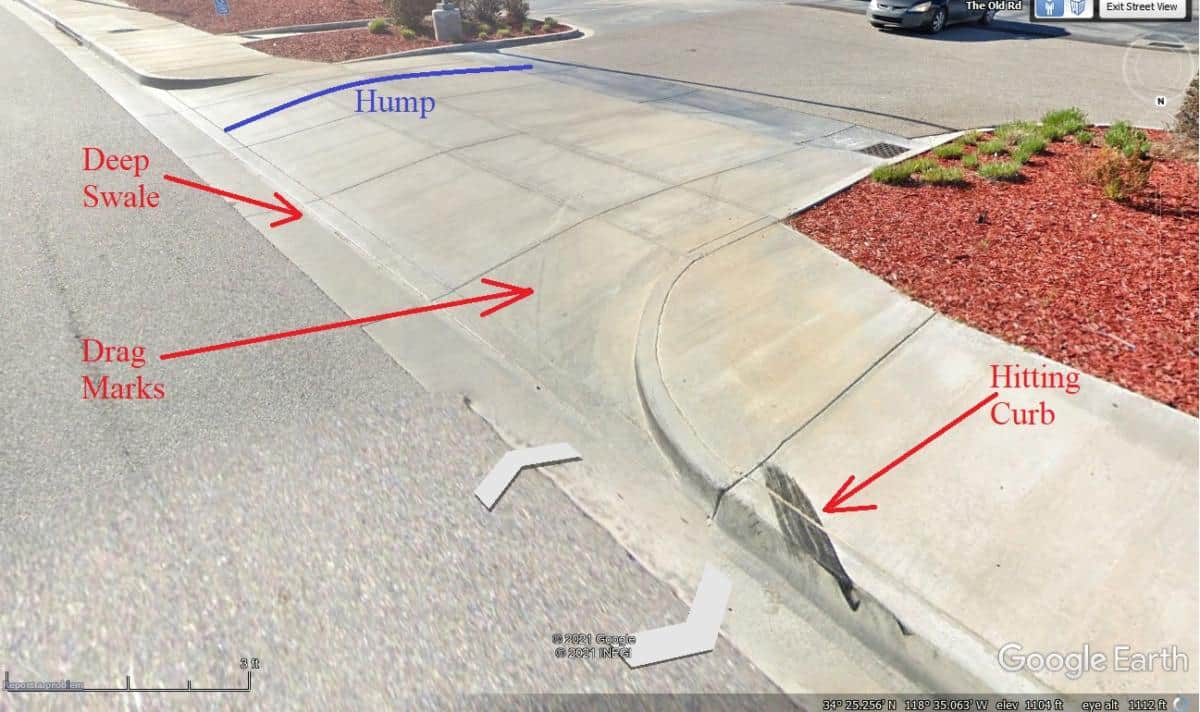
- What will the access look like into the station? Is there a curb cut in the sidewalk that will limit my swing? Is there enough room to swing in from the inside lane of a two-lane road? Or will I need to use the second lane to gain enough swing? How “humped up” is the curb/sidewalk, and will it cause me to drag the rear end of my RV?
- Are the fuel pumps in line with one another or are they each in their own pull through bay?
- Will I be able to pull straight out from the fuel pumps, or will I need to turn immediately?
- Is there a dedicated RV island I can use?
You can determine all this and more in advance using Google Earth
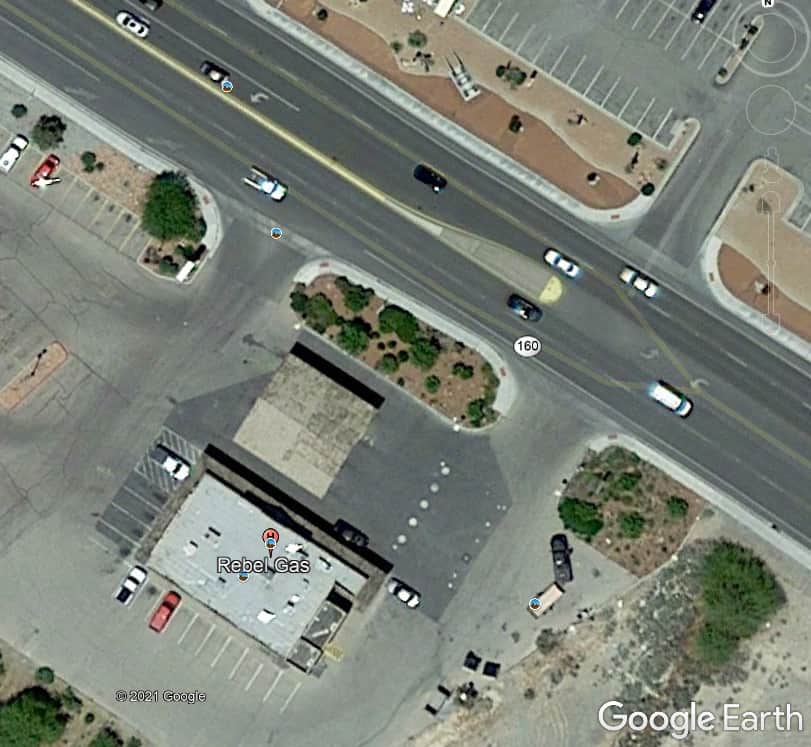
Using Google Earth Satellite View
Google Earth Satellite View provides you an advanced bird’s-eye view of the station. It allows you to see the entry/exit points, turn lanes, center barriers, drive lanes, canopy covering the fuel pumps, parking stalls and other useful information to plan your refueling stop. Occasionally you will even find a user-posted photo (indicated by a blue circle*) of the station providing even more information. You can even use the elevation feature* of Google Earth to determine gradients in and around the station. This is especially useful to determine how level parking areas are around the station in the event you want to take an extended break and want to know whether or not there is a level spot for your RV.
*These features are only found on Google Earth.

Using Google Earth Street View
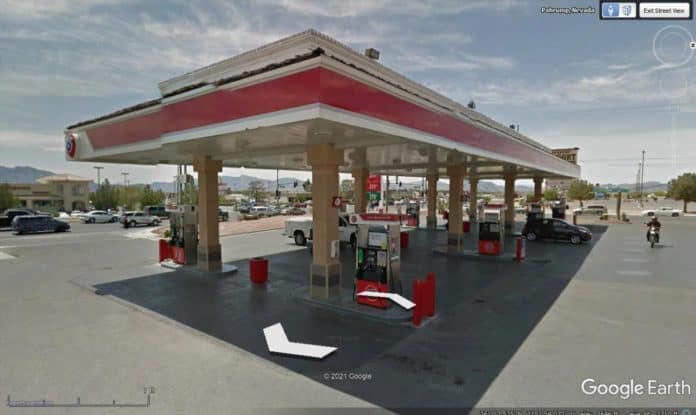
Google Earth Street View will allow you to view how the fuel pumps are oriented, if there is a dedicated RV island, distance between fuel pumps, etc. Most importantly, closely look at the swale (low place) and the dreaded curbs where you transition from the public road to the fuel station. Damage to the curb and asphalt seen via Street View is a clear indication of other big rig drivers’ mishaps and should be a warning to you.
Hopefully, these uses of Google Earth will take the anxiety out of not knowing what lies ahead at the next fuel stop – allowing you to enjoy RVing to the fullest.
Now if they would just invent an RV with self-dumping and self-rinsing holding tanks!
##RVT996


Good job pointing out the drag marks on the exit. One thing I hadn’t thought about. To help prevent dragging when you can, try to enter the street at an angle and not perpendicular to it. When I had a drop hitch for the TOAD I made a skid plate to protect the hitch.
I hate places that say ‘rv friendly’ then you get there to find out the store is right in front of the pumps. No way can you make the turn to leave if there are cars in the parking spots.
Does Google earth also show grade %? I know it shows elevation changes but someone was asking me if it shows how steep the grade is.
RVgrandma, Sorry I just saw your comment about grade percentage. The way I determine grade via Google Earth is by taking the elevation change between two points divided by the horizontal distance between the same two points. Example 50ft elevation change over 1,000 ft of length equals 5% grade.
Found street view a great tool for finding accessible diesel stations hauling our 40 ft 5th wheel on America’s back roads, off the beaten path. It can give you a sense of the height of the covering over the pumps and if your lucky where the green handled diesel pumps are located.