


Dear Dave,
Thanks for all your expertise! So much to learn, and I’d rather ask a question than not know. What is the best battery charger to carry for my Class A Safari Simba 36PCT. And should I carry one? My husband was the Boy Scout, and I like to keep the least amount of stuff around and have a backpack mentality. I appreciate your input! Happy trails! —Karen, 2008 Safari Simba 36PCT
Dear Karen,
Great question. I thought I would post this to see what our readers are doing!
I believe the best question is, “Should I carry one?” Your Safari already has a 120-volt powered battery charger with either the converter or a large inverter. When you are connected to shoreline power, the converter or inverter will provide 13.6 volts to batteries that are not fully charged, and 13.2 volts on a constant basis after that. So, if you do not plan to boondock or dry camp very much, carrying a stand-alone battery charger would be redundant. Plus, when you are driving, the engine alternator would be providing a charge to the house batteries, as well.
Carrying a 120-volt battery charger would not be necessary as you would need to plug it into a 120-volt outlet to charge the battery. Your converter would already do this.
Rechargeable battery jump starter
If you are planning to dry camp and do not have access to shoreline power, a portable rechargeable battery jump starter might not be a bad option. However, most of these that I have owned over the years did not hold a charger very long and were dead when I needed them for an emergency!
I had one model that I kept plugged in all the time to make sure it was fully charged when I needed it, but found it dead at that precise moment. What I found was that model was not intended to be plugged in constantly as the battery got overcharged and failed. A new battery was more expensive than a new unit.
So, it has been a guessing game over the years: Plug it in until it is fully charged and then wait for a few weeks, or months, and plug it back in. I have not needed one very often as I am not full-timing. I would tend to forget to plug it in and the game continued! One time my house batteries were dead while dry camping on the beach at the Padre Islands, and my battery charger was dead. So I started the engine, which provided enough 12-volt power to start my generator—which I believe your Safari also has.
“Smart chargers”
Something else to consider is that most of today’s “smart chargers” will not provide power to a deeply drained battery. I don’t know what the actual voltage cutoff is. However, we had a 2016 Thor with really sulfated Interstate batteries. The residential refrigerator drained the battery down, so I connected the battery charger and no voltage. I read the manual and found it is a reverse polarity safety feature. If the charger does not sense a certain voltage, it “thinks” the clips are touching and will not produce a charge to eliminate the arching or jolt you get when they touch. Sounds crazy, i.e., my battery charger won’t charge my batteries because they are dead! So we plugged the unit into a 120-volt outlet and let the new Progressive Dynamics charger do its thing.
NOCO Boost battery booster
I have been impressed with the NOCO Boost GB40 battery booster and have used it once for a dead car battery. We bought it for a trip to Colorado two years ago, knowing that we would be trying to start some collector cars for an estate auction. The unit does have a reverse polarity protection but also an override button. It claims to hold a 70% charge for one year. We charged it before leaving and it still jumped the old cars two weeks later. Thankfully, I have not had the opportunity to test it again! You can find it on Amazon here.
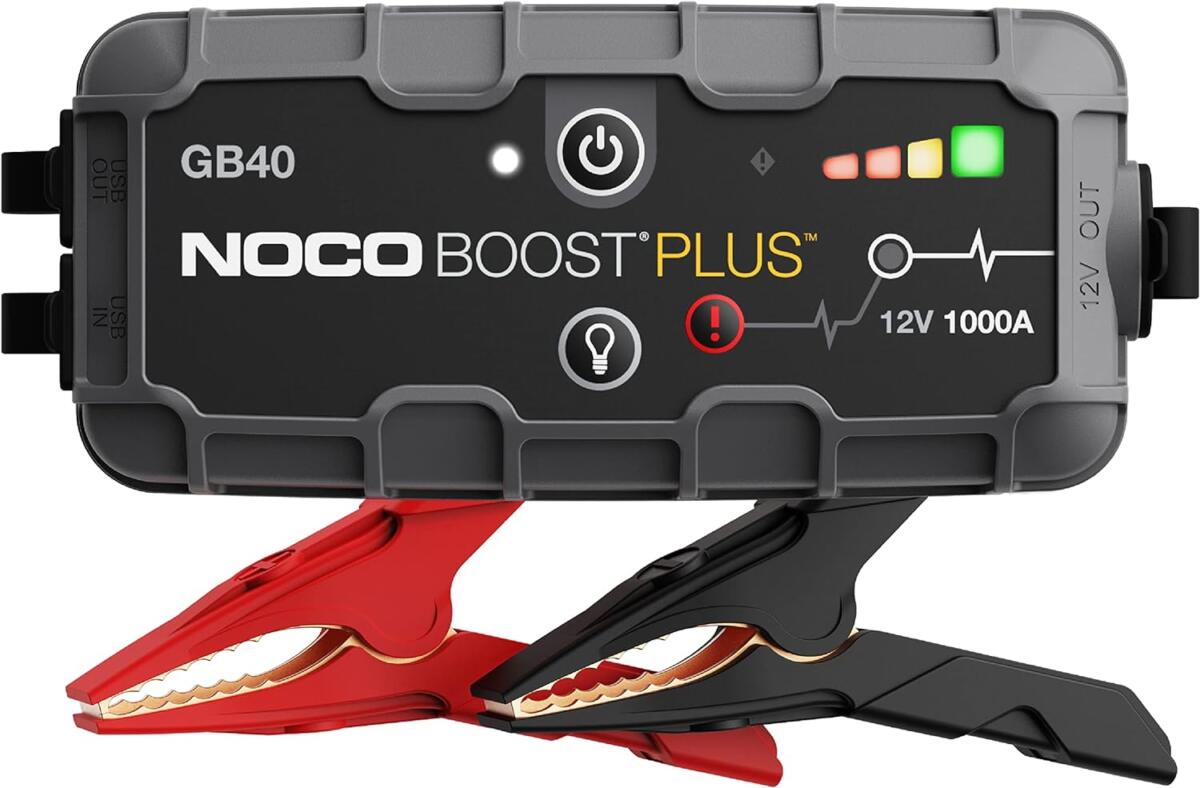
In my opinion, a battery charger might not be necessary but a battery booster might be handy. Let’s see what our readers think.
You might also enjoy this from Dave
My engine battery is dead in 3 days. How do I find the parasitic drain?
Dear Dave,
How about a hint on how to find a parasitic battery drain on the engine battery. I installed a knife switch to totally disconnect the battery from the RV. The engine battery will drain in about 3 days, low enough to not start the engine, if the RV is not being used. It’s a totally new AGM battery. —Tom
Dave Solberg is a leading expert in the RV industry and the author of the “RV Handbook.”
Read more from Dave here.
HAVE A QUESTION FOR DAVE?
Send your inquiries to him using the form below.
##RVDT2373

I had the same issue with an older battery pack jump starter. Worthless unless you kept it on charge. That said, they have come a long way.
I bought this one
(HOMPOW Car Jump Starter, 4000A Peak Jump Starter Battery Pack) From Amazon and it works great and it keep at 100% for months so far. I used it once to jump start house batteries in a tiffin gasser class A. The house batteries we’re too low to kick the inverter on, causing it to have no AC power even when plugged into shore power. I jumped it and all was good. Well at least until he was able to find why they went low to begin with. But that’s another story.
Hi Dave
I do carry the NOCO jumper starter when I go out dry camping, but have never needed to jump anything. However, what I like that is even better is the solar panels I installed on my Class A. Let the sun do the work!
Have a small trailer and I carry a portable 2500 generator to charge my batteries when boondocking. However, I do not charge the batteries through the trailer’s built in inverter because it is only 3 amps. Instead, I connect a 15 amp charger directly to the batteries from the generator. Charges the batteries 5 times faster.
Always use a trickle charger on my 2 12 volt engine batteries.
House batteries get charged while on shore hookup
But engine batteries dont keep the 13.6 charge while parked ( if we are going to be some where extended)
I have a Noco booster just like the one shown.
It comes in the motorhome, side by side, snow machines if I remember!, especially when on longer trips. Have not had to use yet in any of these, however have boosted things several times around the home.
One thing to remember as it is lithium, it doesn’t like the cold , so in cold temperatures, keeping inside a heated area, or warm up before using.
Charge does last a long time but like any other rechargeable, should be checked now and then
The older style jumper packs that use a lead acid battery are problematic.
The newer small ones use a lithium battery and use a battery management system to charge. The problem with most of these is they require the ‘dead’ battery to have a minimum charge.
The instructions that came with my AntiGravity brand says to connect it for 30 seconds before trying to start the vehicle, and NOT keep it connected for more than 40 seconds after the vehicle starts.
Our house batteries are charged via shore power (and/or driving). I haven’t seen a need for another AC charger. But I did purchase a lightweight true sine wave dual fuel (only use propane) 1800 watt generator that has both 120AC and 12DC outputs. The purpose is if we need to inadvertently do an extended boondock and can recharge our battery completely off grid.
Thank you, Dave! 🙂 We carry nothing extra because of the expense of a unit strong enough to jump our two coach batteries (e.g., $1200 at Amazon, https://a.co/d/aINOWWr). We will just have to wait for roadside assistance (Coach-Net) to arrive in the event that our coach batteries go dead. The AGM house batteries are charged and maintained by the inverter/charger of the RV. Thanks for your column and safe travels! 🙂
I always carry a Battery Tender with me. It is used to maintain the chassis batteries and coach batteries. My converter overcharges and boils the water out of my coach batteries when I am plugged in, so once they are charged I turn it off. Also the desulphating properties of the Battery Tender are a huge plus with battery longevity.
Being a former Boy Scout myself, I like to be prepared 😉 . We like boondocking as much as possible so we’ve configured our tow vehicle with AGM batteries and the RV with LiFePO4 batteries. We do have a NOCO jump starter (have used it a couple of times, it’s great!) but still keep a set of jumper cables in the toolkit. If that wasn’t enough we bring along a small (2400 watt) dual-fuel generator for 120V power; it’s rarely needed but when we do, it’s handy to have 🙂 .
I forgot to mention I have jumper cables in my Samurai and my Winnebago as you folks do…Got to keep on being Prepared!
What does a charger weigh? 1.5#? I carry one with my rig..I can use the genie if no shore power if needed…Never needed, but both a cubbie and Boy Scout here.
Until we got LiFePO4 batteries a standard charger for AGM’s worked fine for us.
When we purchased our LiFePO4 batteries we knew about the lack of charging with some chargers when the voltage is below 10v.
We purchased a Victron IP22 (30 amp) charger. It can be set to charge at whatever absorption, float, equalize, etc. you wish. We’ve killed our batteries twice in cold weather with the inefficient Dometic furnace and it had no problem getting our 200 amp battery bank recharged. The IP22 blows away any previous charger we’ve owned including a NOCO.
It’s also a very small charger. We have a Ford 400 watt inverter that came with our F150 and when the IP22 is set to 27 amps (30 amps is more than 400 watts) it will charge our batteries, so no need for a generator with us (we don’t need AC).