


Dear Dave,
Love reading RV Travel. I’ve learned so much! Please feel free to pass this on if you are unable to answer the million questions that I have.
My husband, Bob, and I currently own a small Passport Premier, 23-foot travel trailer. There are a few things that Bob wishes it had, and I have my own list. We’re thinking that when we retire, in 3 years, 10 months, 2 weeks and 3 days [but who’s counting?], that we’d like to look at getting a new travel trailer. We would like to take the next 2 to 3 years researching new RVs, and I am hoping you can help with some questions. They are in no specific order.
Quality. Thor Industries has 15 brands of campers under their umbrella. Using Keystone as an example, they have 23 lines of campers. Why then, since they are all “Thor” brands, isn’t the quality the same throughout Thor? It is my understanding that parts are all supplied pretty much by the same places, so shouldn’t quality all be the same?
What brands would you recommend we look into and why?
Sometimes we walk into a camper and it feels cheap. What do you look at as far as construction to make sure you have a good brand or a good unit? Seam, caulk by pipes, etc.? I have no idea. —Linda
Dear Linda,
Your initial question/s had so many parts that I decided, like eating an elephant, to break it down one bite at a time. Here is Part 1.
Quality
According to one of the definitions I found on the internet, “quality” is an assumed standard that is compared to others—which, unfortunately, sets the bar pretty low in the RV industry. I have found that quality is a very subjective word and am amazed at what people shopping for RVs will accept. Some people think solid surface countertops are better quality than laminate. However, solid surface material is simply plastic that is marketed better, in my opinion.
Yes, RV manufacturers buy most of the components from an outside source. However, it’s all about making the cheapest product sitting on the lot because most people do not take the time or effort to look deep into the furnishings. Instead, they get caught up in what I call the “WOW Factor” and look at full body paint, 6 slides, and 5 TVs! If we don’t look for the better residential features and the fit and finish, and just shop by price, most RV manufacturers will find any way possible to cut corners and have their unit sitting a few thousand dollars less than the one next to it.
Quality is subjective, in my opinion, as well. Take furniture, for example. Many manufacturers use particle board, paneling, and lightweight fabrics, which I compare to “Walmart”-style furniture. However, IKEA has great fit and finish of their products but still use very cheap materials—and some people think that is quality. I equate it to a shelving unit. If I need one that sits in the basement and just holds soap, for example, I’ll buy a cheap particleboard version, as nobody will see it. However, if it is going to be in the living room with a 200-pound TV next to fancy furniture, my wife will make me get an armoire!
Buyers have to demand better materials
Until buyers start looking for and demanding better materials—and are willing to pay for them—quality, as you are referring to, will be low-end.
Things I look for are aluminum framework, block foam insulation and interlocking joint construction, which are hard to see. If the construction is not shown in an exploded view in a brochure or marketing materials, they don’t want you to see it.
I also look at the framework of the cabinets to see if it is securely fastened or just soft wood with staples, and how much silicone and gimp can be found in the rig. When you start researching units like you would a home rather than a car or truck, you start to see the difference in materials and workmanship.
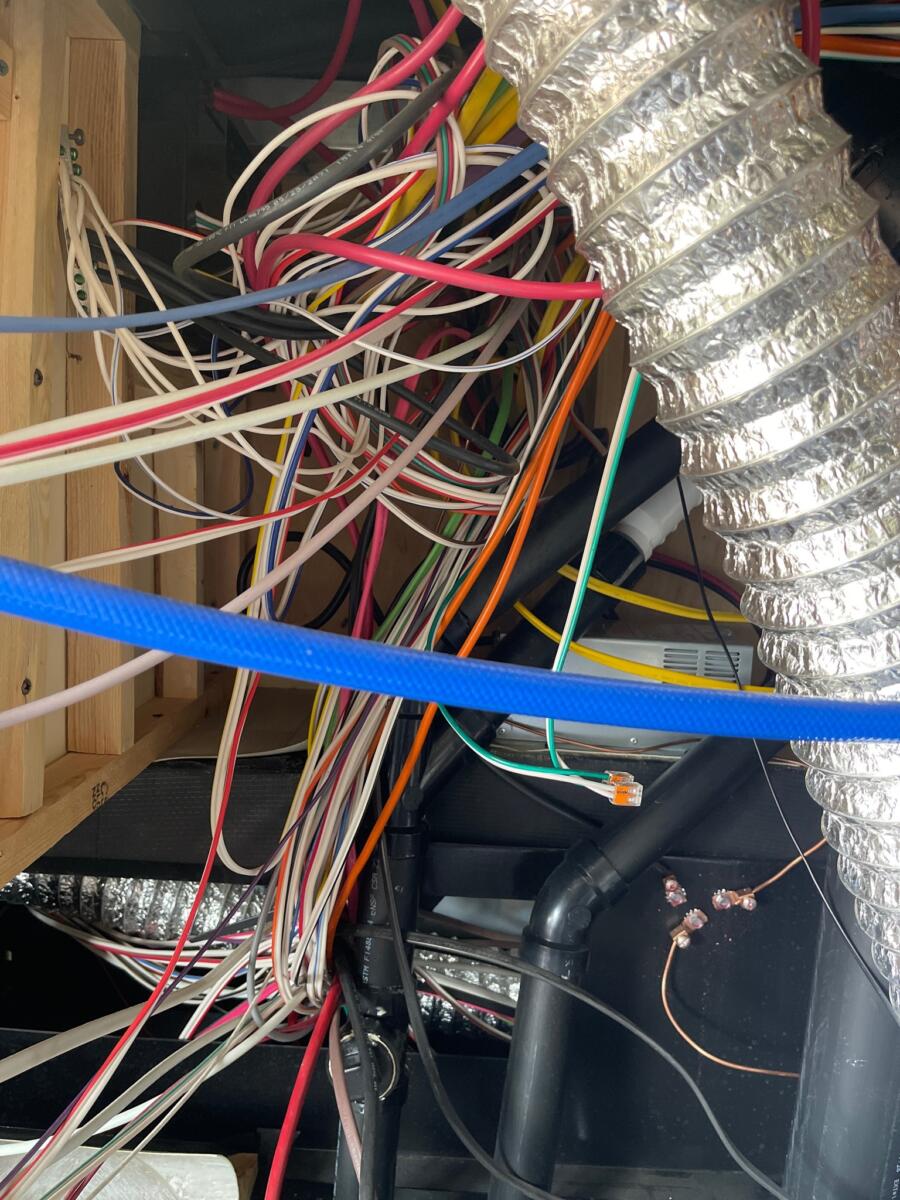
Here is a photo that was sent in recently by one of our readers. Not only is it a wiring nightmare, but look at the sharp edges of the hole in the cabinet to the left that the wires go through!
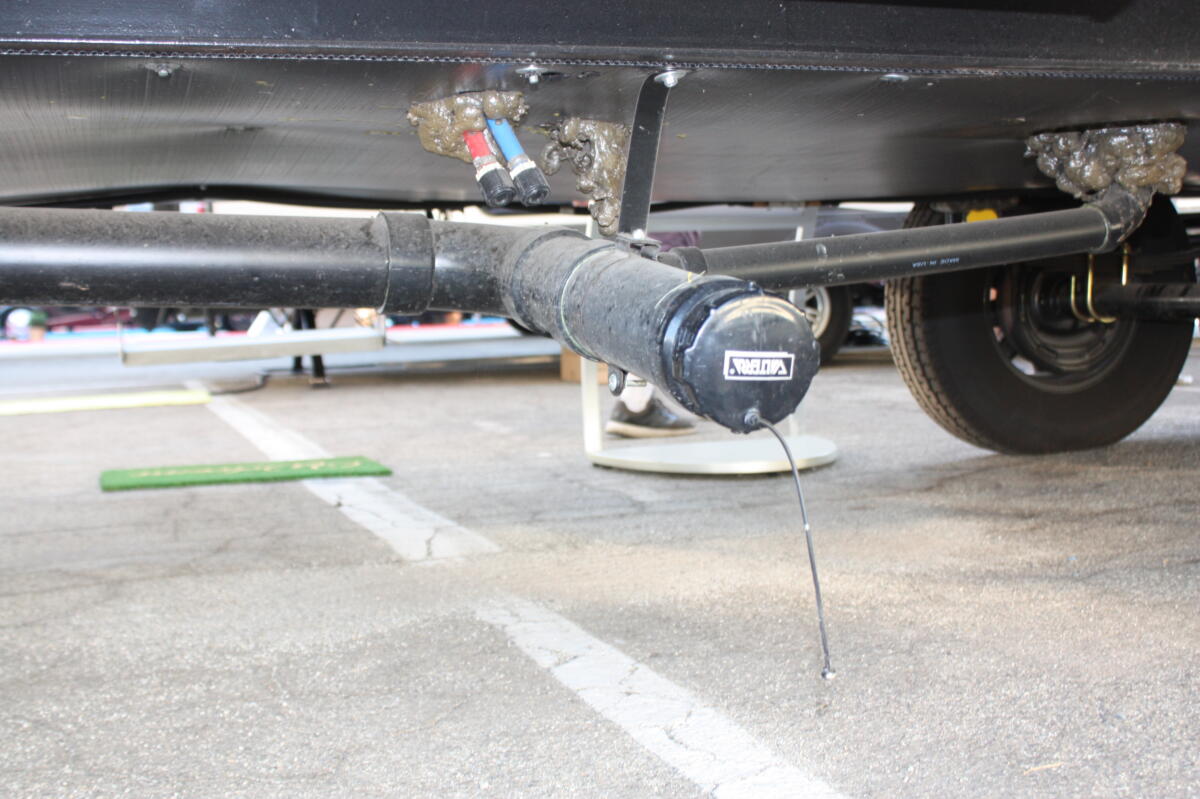
Another area that I look for is the amount of expandable foam used to seal holes rather than an engineered fit with grommets, such as what you will see underneath many of these units.
I don’t need tile flooring, marble countertops, or even solid oak cabinetry, but I do know what type of construction materials will hold up better. Just like a home, you can buy one that comes in two pieces on a trailer with cheap cabinetry and furnishings, or you can buy a $million custom home. Don’t shop on price alone, take the time to look for higher-line fabrics and flooring and ask the questions, i.e., don’t just take it for granted.
Just plan on more maintenance on a cheaper rig
And keep in mind, if I am going to use the unit sparingly, like a few weeks during the summer and occasional weekends, I won’t be shelling out $100K. I will put up with the cheaper materials knowing that I will probably need to do more maintenance on a cheaper rig.
Also, just like Keystone has 23 models and Thor has 13 different lines, many RV manufacturers have a good, better, and best—although the “best” lines are getting harder to find!
You might also enjoy this from Dave
Should I buy a new or used RV?
Dear Dave,
I’m not sure if this is your field or not but maybe you can steer me in the right direction. We’re looking to purchase our first RV and we plan to go full-time. I have read that it would be better to buy a used one versus a new one and get an extended warranty. Is this true? Thanks for your advice. —Brenda
Dave Solberg is a leading expert in the RV industry and the author of the “RV Handbook.”
Read more from Dave here.
HAVE A QUESTION FOR DAVE?
Send your inquiries to him using the form below.
##RVDT2367


I would recommend looking at Outdoors RVs and Northwood RV’s. Both sister companies.
Exactly…I have owned two ORV units both built like a brick outhouse. Can’t say as much for most other brands of “corporate cracker boxes”.
Even if my wife and I were buying new, we would visit dealer lots and walk through as many used units as possible. It becomes very clear what brands and models tend to hold up better. Just another piece in the puzzle.
Oh…and verify independently everything any salesman tells you!
Outdoors RV and any Arctic Fox will cost a little more…but will still be usable years later…can’t say as much for other “corporate cracker boxes”.
Great advice and very important, Mikal! 🙂 At one point in our research, I stopped by a dealership that had the make and model we ultimately bought a couple of years later. A salesman went with me to show it, but I ended up showing him how to use at least one of its features. That was eye-opening and I tended to let future salesmen drone on while I examined the rig at my own pace. Safe travels! 🙂
Thank you, Dave! I wish that I had read this 8 years ago, well before we bought our first rig. We did alright, as it happened, but, as you said, lower priced rigs tend to have more maintenance. Our “bargain” received a few “tweaks” at the factory service center before the warranty expired and we replaced the tires at four years. Otherwise it held up well, as has #2, so far. Thanks for this discussion, buying seminar, Dave! 🙂 Safe travels! 🙂
Northwood Manufacturing, makers of Arctic Fox and Nash, Oregon. Aluminum frame, four season construction and very well built. A little more expense but well worth it. We have a 2022 Nash 18 FM travel trailer. Smart engineering and layout.