

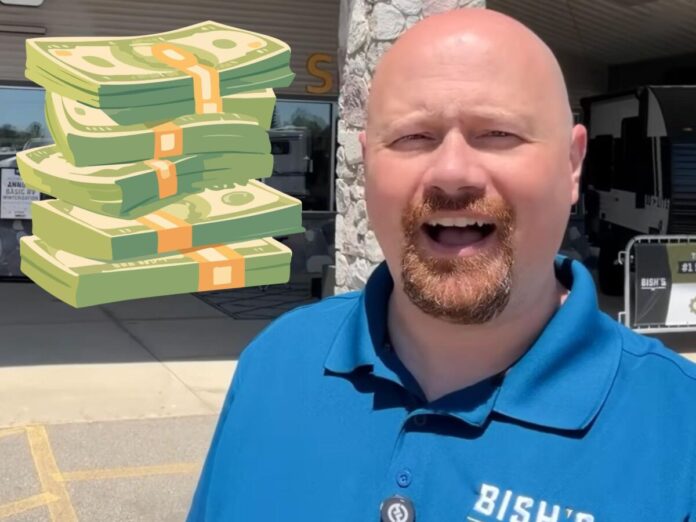
We all know that an RV dealership has to make a profit, but do we really know how? Todd Nuttall, president of Bish’s RV, laid out the process in plain language in the video at the end of this post from our friend, Josh the RV Nerd at Bish’s RV. Once we understand the moving parts, RV buying gets much easier to judge.
The first profit center is the RV itself
The most direct profit is the gap between the sale price and the dealer’s cost. That cost is not only the invoice. It can also include holding costs, marketing, employee pay, and service-related overhead tied to the unit.
So, when a buyer sees a sale price, that number sits on top of more than a factory bill. The final margin is whatever remains after those costs are covered.
Trade-ins can change the deal more than buyers expect
A trade-in has two numbers. The first is the trade allowance, which shows up on the worksheet or purchase agreement. The second is ACV, or actual cash value, which is what the dealer believes the unit is worth in a cash purchase.
That gap matters. If a dealer shows a higher allowance than the ACV, the buyer may feel better about the trade, but the dealer may simply be moving money from the sale price to the trade line. A $20,000 RV with a $15,000 trade allowance can be the same deal as a $15,000 RV with a $10,000 trade allowance.
A buyer can get ahead of this by checking NADA Guides, RV Trader, and Facebook Marketplace, then calling dealers to ask what they would pay outright for the RV. That “know before you go” step gives a rough cash benchmark before negotiations start.
Financing is not only about the monthly payment
Nuttall says that about 70 percent of new RVs registered in the United States last year had a lien on them. That means financing is normal, and lenders often pay dealerships a commission for sending business their way.
Still, a commission alone does not make the offer bad. The smart comparison is the loan term, interest rate, and any prepayment penalty. RV loans often run much longer than auto loans, with common terms around 144 months (12 Years) and some larger fifth wheels or motorhomes stretching to 240 months (20 years). A low monthly payment can simply mean a long loan.
Because of that, buyers should compare the dealership offer with a local bank or credit union and pick the terms that fit best.
Add-on products and upgrades are two more profit centers
After the sale terms are set, a finance manager may offer optional products such as an extended service contract, gap waiver protection, tire and wheel coverage, roof protection, or battery replacement coverage. These products can have value, but they also carry markup.
The easiest way to misread them is by focusing only on payment. If a product adds $7 a month on an 180-month loan, that is $1,260 total. If a package adds $32 a month, that becomes $5,760 over the full term.
The same basic math applies to installed upgrades. Solar, generators, lithium batteries, parts, accessories, and labor all include markup, and that is another way a dealership earns income.
The clearest RV deal is the one a buyer can explain back
Dealer profit is not the problem. Hidden math is the problem. When buyers understand margin, trade value, financing, and add-ons, they can judge a deal with a lot more confidence.
Make sure you watch the video to learn more.
RELATED
- You trusted a dealer to sell your RV— then it disappeared
- Why RV dealerships don’t always like independent RV inspections
- RV damaged during service, dealer won’t pay. What if this happened to you?
- The benefits of shopping at RV consignment dealers
- How to avoid RV dealer sales fraud
RVT1265
