


This segment of Nature’s Highways needs to address the elephant in the room… the Grand Canyon. In 2022, Grand Canyon National Park came in second as the most visited park in the U.S. (4.7 million), just edging out Zion but way behind Great Smoky Mountains NP.
The area’s numbers are impressive. Through the 1.2 million acres, the Colorado River carved the canyon 277 miles long, 18 miles at its widest, and over one mile deep. Three distinct areas define the park: Colorado River/Canyon Floor, North Rim, and South Rim. The South Rim attracts 90% of visitors.
Getting There
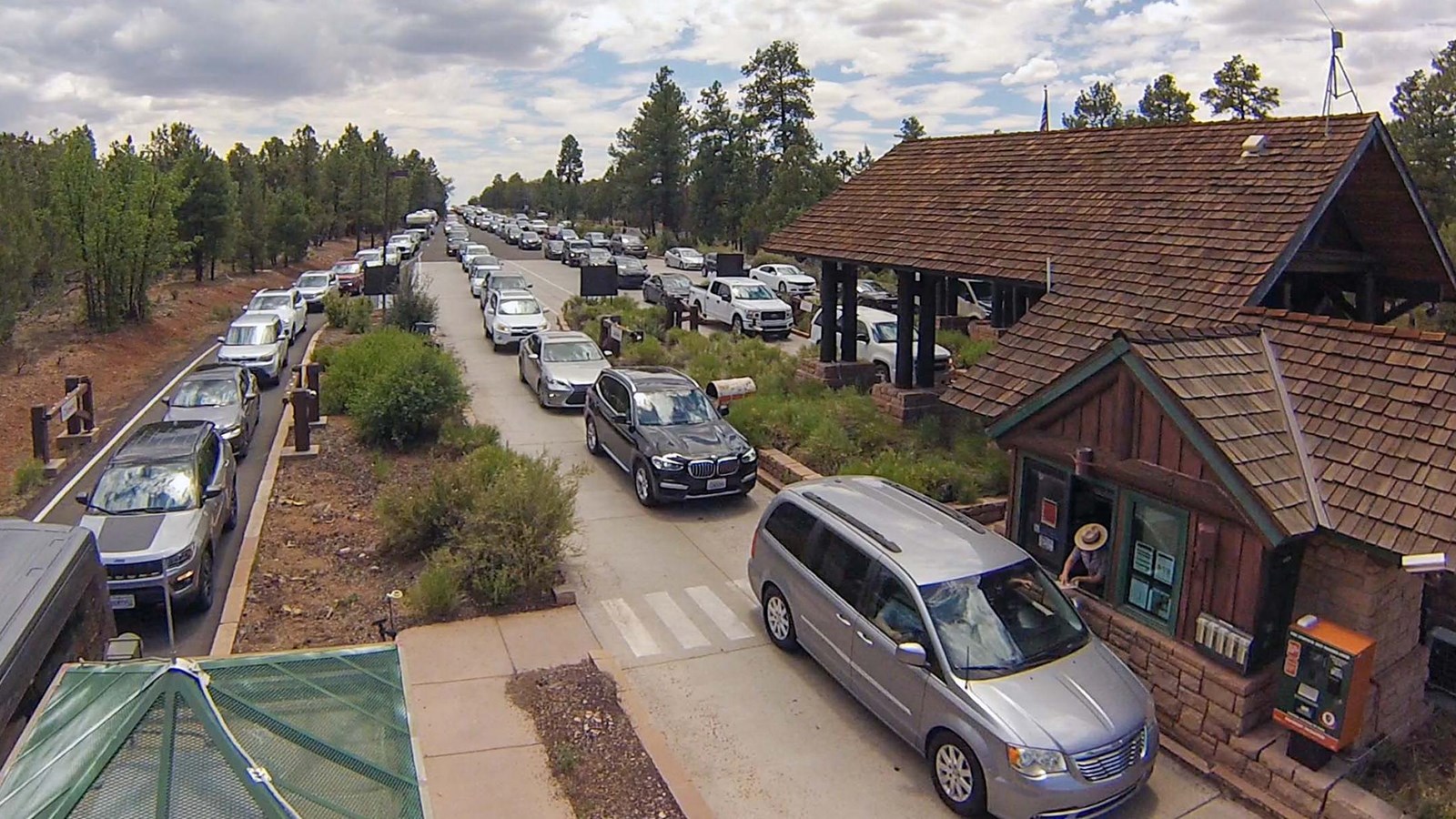
On IH-40 Exit 165 at Williams, AZ, the AZ-64 brings you up 59 miles to the South Rim Visitors Center. Keep in mind that parking is limited.
If coming from the north, Fredonia, AZ, to North Rim Visitors Center is 74 miles via US-89A to AZ-67, aka Grand Canyon Highway.
Staying in the park
Of the four RV campgrounds within the park, only one does not require reservations, Desert View at the East Entrance. Desert View offers no hookups, with a 30-foot limit on RVs. The two others on the south rim are Mather Campground, located in the South Rim’s Grand Canyon Village, and Trailer Village Campground, located in Grand Canyon Village. Both offer free shuttle bus service. Full hookups are available only at Trailer Village with a size limit of 50 feet. You can find details at the National Park Service website.
Due to the popularity of the Grand Canyon National Park, you should make reservations up to 6 months in advance.
You are there; now what?
Before you go, download the NPS app to your phone or tablet. This provides an excellent overview of everything you need to know.
Visitor centers
There are four visitor centers: GRCA (South Rim), Verkamp’s, Desert View, and North Rim.
- GRCA (South Rim). This is the main center located in Grand Canyon Village. It is closed on Tuesdays and Wednesdays. To get a sense of the park, watch the park’s 20-minute orientation film, Grand Canyon: A Journey of Wonder. Afterward, browse through the exhibits.

Grand Canyon Visitor Center on the South Rim. NPS/M. Quinn
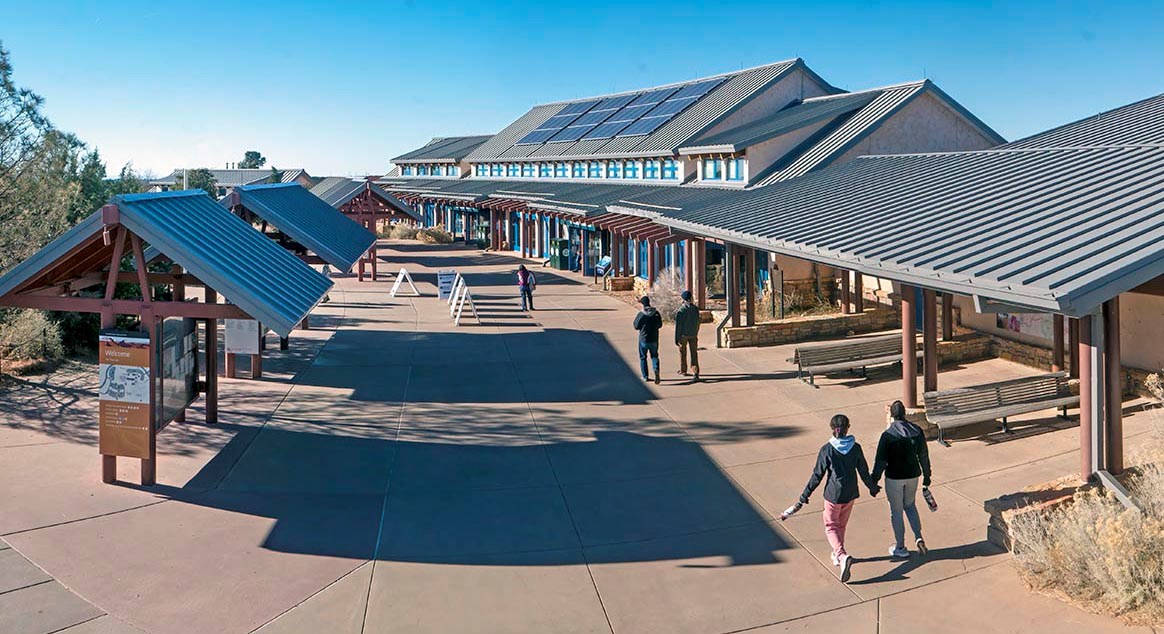
You can walk a short distance from there to Mather Point, the quintessential photo-op location. Be prepared for many others positioning for the same. Alternately, you might stroll a few hundred yards either way along Rim Trail—good views, fewer folks.
From here you can catch the free shuttle (Blue Route) through Market Plaza to the Village and Verkamp’s Visitor Center.
- Verkamp’s. Named for John Verkamp, who set up a souvenir tent for tourists in 1898 which the family later expanded into the present site. The center leads you through the history of the Village community. From here, walk out to the Trail of Time for a stroll through the geologic history of the canyon.
For a historical tour through the Village, open the NPS app to GRCA and select Self-Guided Tours, Full Steam Ahead. Begin at the train depot for a 1– to 2-hour walking audio tour.
- Desert View. The easternmost visitor center of GRCA presents a unique structure, the Watchtower. Originally designed as a rest stop for visitors, the site gives you a different look at the eastern part of the canyon, especially through the reflectoscopes. A few steps beyond one can gaze down the canyon to the Colorado River’s “Big Bend”, its sharp 90-degree turn from its southward course toward the west.
A few miles down the road finds the Tusayan Ruins and Museum dedicated to 10,000 years of cultural history of the Ancestral Puebloans.
- North Rim. Because this is the “other side” of the Grand Canyon, fewer than 10% of the visitors make it here. Those adventurous enough to travel up from the South Rim can expect a 220-mile trek. The closest town for supplies is Jacobs Lake, about 40 miles north. Kaibab Camper Village offers full hookups with pull-through and back-in sites.
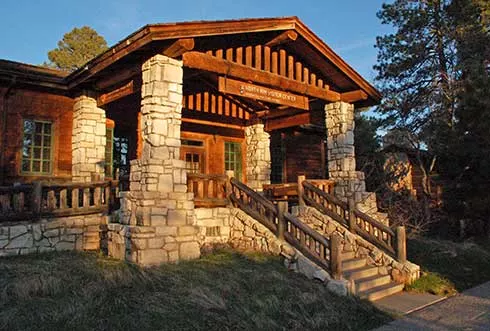
At an elevation of 8,000 feet, the views are no less amazing. From the lodge, make your way to Bright Angel Trail, a relatively easy half-mile round trip, though steep and narrow in places with an elevation gain of 200 feet. At the end, you can discover Bright Angel Point with Bright Angel Canyon to the east and Transept Canyon to the west. NPS offers an informational guide.
Hiking trails in Grand Canyon National Park
Grand Canyon National Park provides hikers with an array of trails. For the ultimate ease in hiking the South Rim follow the Rim Trail, mostly paved with a slight elevation gain. If you get tired or the weather changes abruptly, just hop on the shuttle bus for a ride back to the visitor center. If you are in good hiking shape, there are other trails ranging from 3 miles to 10 miles long. All are very steep and rated strenuous.
The North Rim offers more of a variety of easy to moderate trails. Cape Royal is an easy half-mile hike with a view of the Colorado River. Uncle Jim is a moderate five-mile loop with great canyon views.
Remember, always check with the rangers at the visitor center for trail conditions, wildlife spotting, and permits, if required.
Flora and fauna
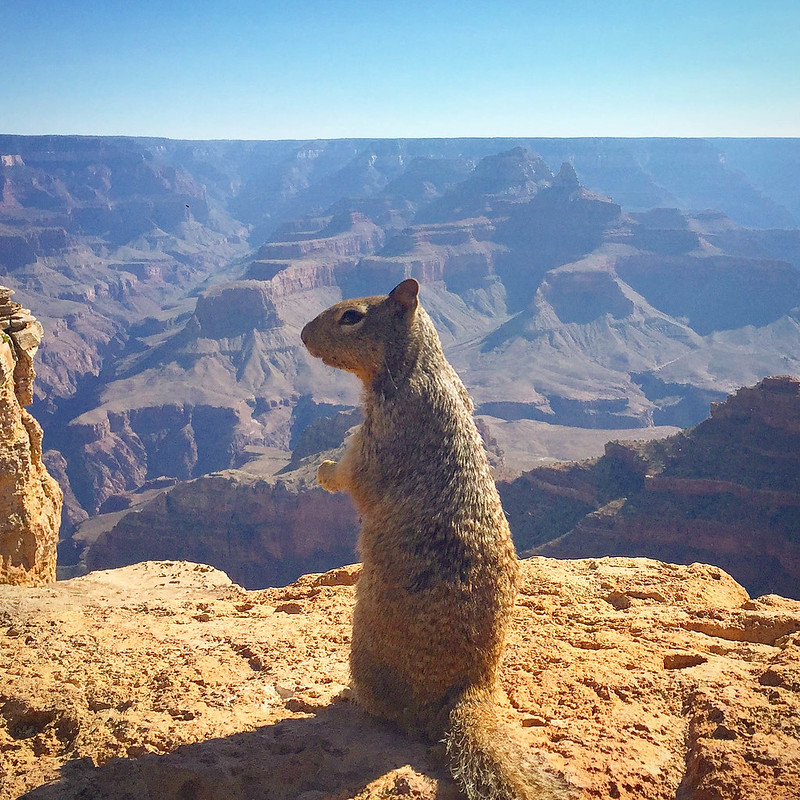
Because so many folks visit the Grand Canyon, encountering wildlife is uncommon. However, you can expect to be found by the most prevalent critter in the park… the rock squirrel. You do not have to look for them as they will find you, often begging for food. They may be cute, but they are still wild animals that can and will bite.
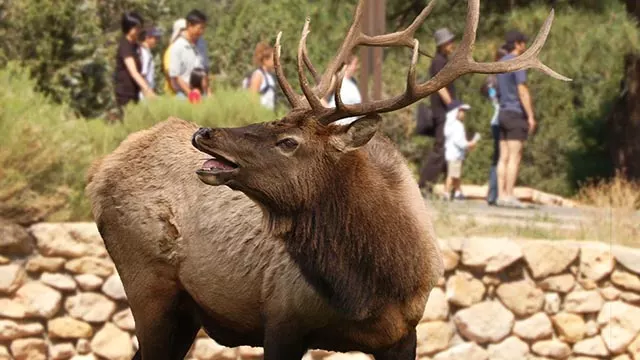
If hiking a trail, you may come upon a bull elk. These weigh upwards of 800 pounds with antlers as wide as five feet across. Look, but do not approach. If you hold up your thumb and cannot see the animal, then you are probably at a safe distance. They are most aggressive during rutting season from August to October. However, you are more likely to hear their bugle sound like rubbing metal on metal.
Looking skyward you will see canyon wrens and ravens. Both are very common sights. Actually, the raven is the smartest animal in the canyon. Be aware of any food left out as they are notorious thieves. Some are even known to unzip a backpack with their beaks.
If you catch a glimpse of a huge bird soaring along the canyon walls, congrats. You have spotted a California condor. Due to preservation activity, the population has grown from 22 in 1982 to more than 500 today. As of 2018, there were 90 birds in the wild Southwest population, including Grand Canyon National Park.
Ponderosa pines cover both the North and South Rims, ranging in elevation from 6,500 to 8,200 feet. They are most notable for the pyramid-shaped crown above an orange-red trunk.
Wait. What?!
Ponderosa Pines (Pinus ponderosa) can live up to 600 years.
Grand Canyon is the first step of our climbing the Grand Staircase–Escalante. In the following series, we will travel up the staircase, visiting Utah’s Mighty Five. Happy Travels.
RELATED
##RVT1128

Just like male elk can be very aggressive in the fall, female elk can be aggressive in the spring, protecting their young. Up in Jasper and Banff, they are more dangerous than bears.
When we did the ‘great National Park Tour’ upon our retirement we opted to visit the North Rim of the Grand Canyon. It was just after they opened the North Rim for the year. We stayed outside the park and had no trouble finding a campground. While the line to get into the park was still long and slow, it was nothing like the South Rim which is notoriously jammed. This was over 10 years ago and I would not want to try this again.
We visited the South Rim and stayed in one of the campgrounds there in 1999. It would have been in July and I don’t recall waiting in lines of any significance at all. There were empty sites available in the campgrounds. So glad we have most of the big NPs done. We do want to go back for the North Rim sometime.
Nowadays, we tend to visit the myraid of small, almost unknown, National Parks and Monuments. No crowds, sometimes being the only ones in a visitor center, and still very interesting, beautiful, and worthwhile things to see.
Make sure you visit the NPS website before visiting, to keep up on current closures, shuttle schedules, etc. There are also great maps of shuttle routes, walking or hiking trails. It has so much info, which may take some digging.
Desert View CG does now require reservations.
We visit each Rim for several days annually, and have developed routines to cope with busy times.
Thank you, Dale, for the comprehensive and well-written discourse on the Grand Canyon National Park. I look forward to later installments. Have a great day and safe travels!