


“RLOF” is the short-hand abbreviation tire engineers use for a tire with a Run-Low Flex failure.
In the past, this was one of the most common conditions found in tires submitted by customers for adjustment. The high volume of RLOF failures was the driver for the introduction of Tire Pressure Monitoring Systems (TPMS) in passenger cars and pickups with 10,000# GVWR or less. Most RVs exceed 10,000# GVWR, so it is up to the consumer to obtain this important safety tool and to learn how to properly program it for their particular vehicle.
Autopsy of an RLOF
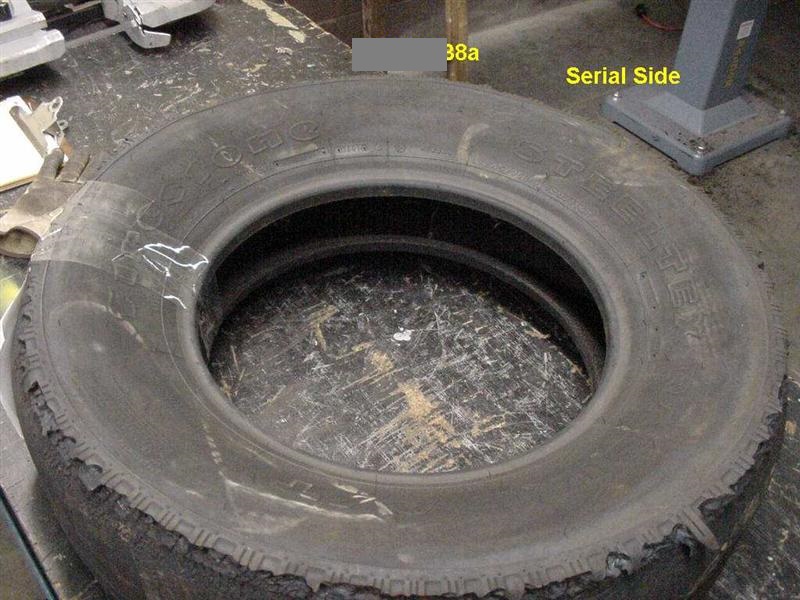
In the first shot, #38a, the tire sidewall looks OK but the tread is gone. Most people would simply call this a “blowout”. If you have read many of my posts or attended any of my lectures or training classes, you have learned that “blowout” is not a term used by people trained or knowledgeable in failed tire inspection.
The next picture, #38b, is the opposite sidewall. The DOT serial on this side does not include the data code, but here we can see more significant damage in this tire.

In picture #38c, below I have identified the location of special interest.

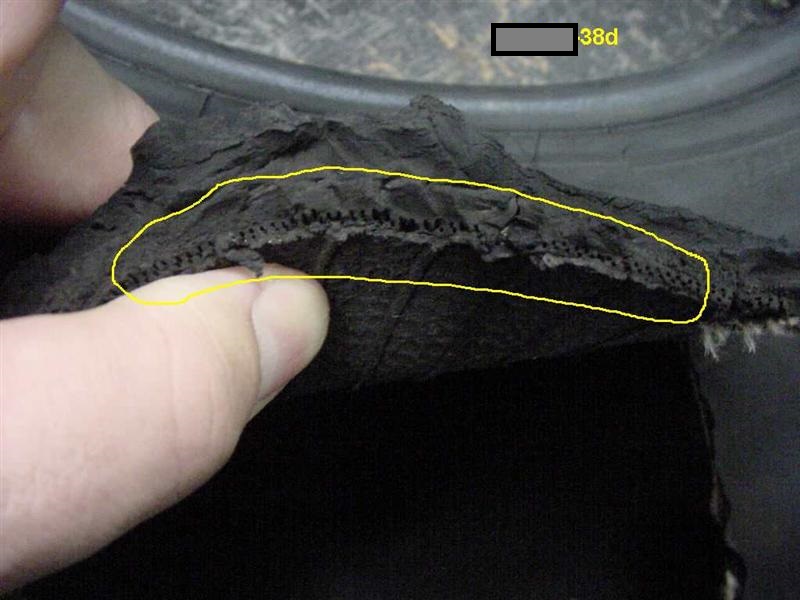
Peeling back the flap of the sidewall, we see in #38d, below, a number of black holes.
Tire inflation less than 10 psi
Each of these holes is the location where the polyester body ply was before the tire was driven at highway speed with inflation of less than 10 psi.
Failed polyester cords
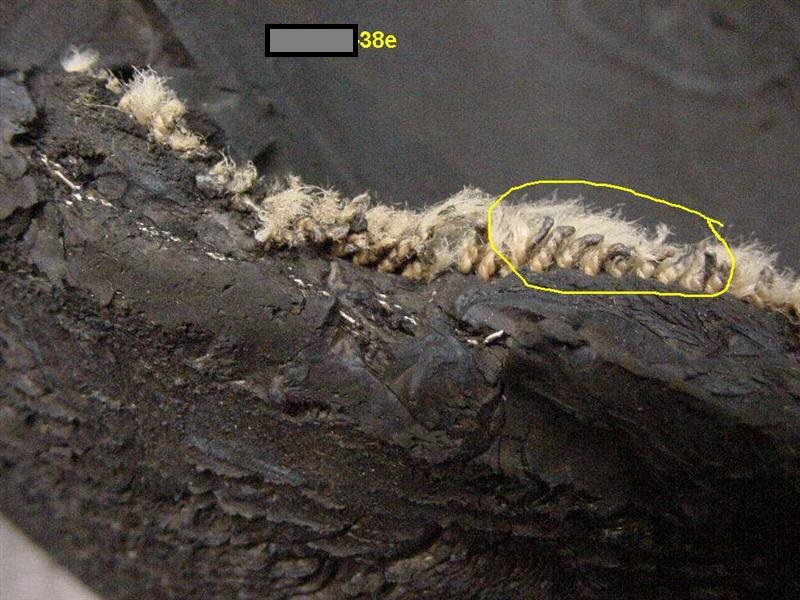
In #38e, we see the ends of the failed polyester cords. When poly is heated, it will first lose much of its strength and will even shrink. The next picture, #38f, is a close-up of the area circled.
What happened here is that the location with the highest heat (up toward the belt edge) started to shrink as it lost its strength so each cord “pulled back” away from the location with the highest temperature, leaving a hole in the sidewall rubber where the individual cords once were. Picture #38f is the evidence and proof that this tire was driven at highway speeds with inflation lower than 10 psi.
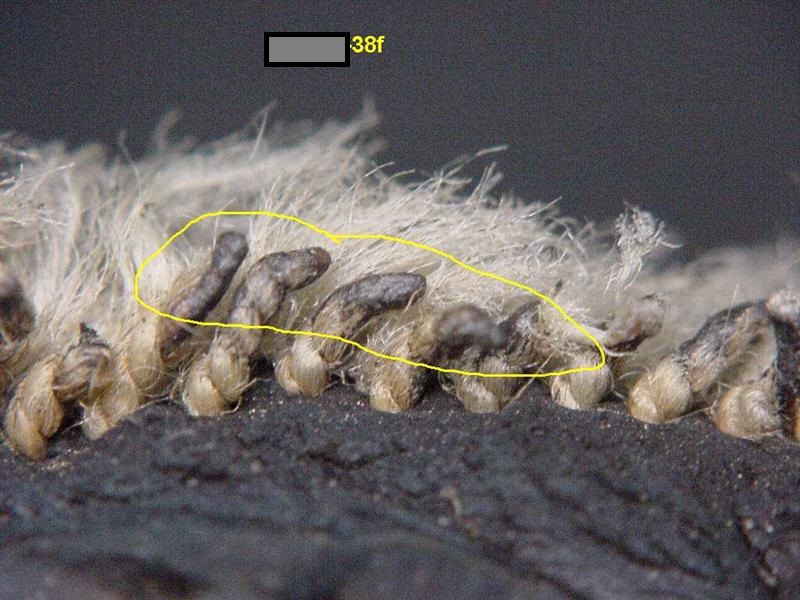
Each of those black blobs is the end of a polyester body cord. If you have ever purchased polyester or nylon rope and then cut it, one of the first things you probably did was to use a lighter flame to melt the cut end to prevent additional fraying. That nylon or poly turned into a hard blob. Polyester melts at 140°C (248°F) to 185°C (365°F), depending on the specific type of polyester. In general, the poly used in tires loses half its strength at about 300°F.
Tire sidewall tore open
After the poly melted, the sidewall rubber was not strong enough, so in a cascade of events the tire sidewall tore completely open. That allowed the tire to “flop around” and for the tread to detach from the rest of the tire.
In my career doing failed tire forensics I learned and then taught others what to look for to help us understand “why” a tire failed. There are numerous bits of evidence collected that eventually build a case for understanding the “root cause” for a tire to fail.
Roger Marble
Check out my Blog www.RVTireSafety.Net
Read more from Roger Marble on RVtravel.com.
##RVT1128

In 45+ years have only had 2 trailer flats and those were in movement. Both tires had punctures, one repairable the other junk because I couldn’t get stopped in time.
Had 2 friends who never checked their tires or inflation pressures and had flats every year.
I always checked my tires and changed them at least every 7 years but ended up more often because of the mileage we traveled.
Love the pictures and explanations. Great info! Thanks! 🙂
Thank you for the seminar, Roger!