

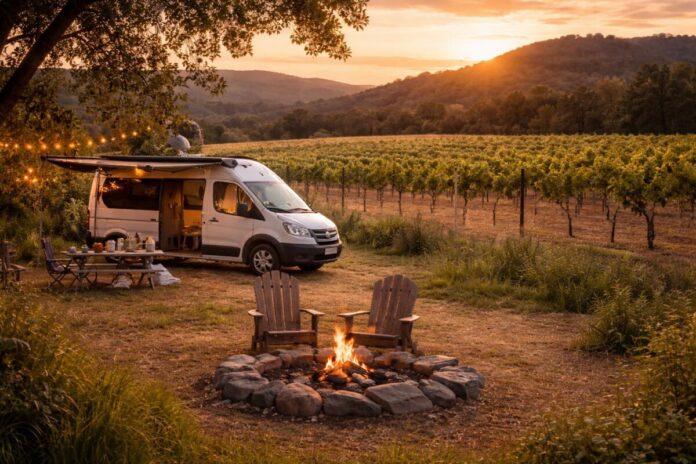
California agricultural landowners gained a new opportunity for income diversification on January 1, 2026, when the Low-Impact Camping Areas Act took effect. The law, formally Assembly Bill 518, allows counties to authorize limited, temporary camping operations on private agricultural land, creating a new category of rural camping that operates outside traditional campground permitting rules.
What the Low-Impact Camping Areas Act allows
The legislation enables farms, ranches, and vineyards to host up to nine temporary campsites on parcels of at least two acres, with a maximum density of one campsite per acre. Individual guests are limited to stays of 14 consecutive nights and no more than 28 total nights per calendar year at a given property.
Participation is voluntary at the county level. Counties that opt in are responsible for approving operators, maintaining registries of participating properties, and enforcing compliance with the law’s operational standards.
How the law changes campground permitting
A key provision of Assembly Bill 518 is its exemption from California’s Special Occupancy Parks Act, which governs traditional campground and RV park permitting. By removing that requirement, the law significantly lowers barriers to entry for agricultural landowners.
Traditional campground development often requires extensive environmental review, infrastructure investment, and ongoing regulatory compliance. The new framework allows small-scale operations to launch with fewer upfront hurdles.
Operating rules and baseline requirements
The Low-Impact Camping Areas Act establishes baseline operating rules intended to protect nearby residents, public safety, and agricultural use. Quiet hours are required between 10 p.m. and 6 a.m., and campsites must be located at least 200 feet from off-site residences.
Operators must comply with applicable fire, health, and tax regulations and meet basic standards for sanitation, noise control, and safety.
Counties that adopt the program are responsible for monitoring participating properties and enforcing compliance across their jurisdictions.
Competitive impact on campgrounds and RV parks
For established campground and RV park operators, the law introduces a new class of competitor: agricultural properties offering rustic, short-term camping experiences without the permitting burdens faced by commercial campgrounds.
The limitations on campsite numbers and length of stay position these operations as supplemental rather than direct replacements for full-service campgrounds and RV parks. Properties offering hookups, amenities, and consistent services retain a competitive advantage by emphasizing infrastructure, reliability, and professional hospitality.
Reducing campground crowding
Advocates argued the law could relieve pressure on overcrowded public campgrounds while providing new revenue streams for working farms. The framework is intended to support rural economies while keeping land in agricultural production and fostering connections between visitors and working landscapes.
Operational realities for new farm-based campsites
Industry professionals note that successful sites require more than regulatory approval. Proper grading and drainage help prevent water pooling, while level pads improve tent setup and guest satisfaction. Clear pathways and basic lighting reduce nighttime safety risks during quiet hours.
Fire safety is particularly critical in California. Baseline measures include designated fire rings, clearly posted fire rules, accessible extinguishers, and defined evacuation routes.
Portable restroom facilities can meet requirements for small operations but must be serviced regularly. Clear signage identifying property boundaries, hazards, quiet zones, and emergency contacts helps reduce liability and minimize conflicts with neighbors.
Administrative and pricing challenges
Digital booking platforms have become standard, allowing operators to manage reservations, collect payments, communicate rules, and reduce no-shows. Pre-arrival communication about amenities, access limitations, and expectations helps prevent disputes and negative reviews.
Pricing strategy presents another challenge for new entrants. Industry norms increasingly rely on market-based and dynamic pricing tied to demand, seasonality, and amenities. In many regions, weekend rates exceed weekday rates by 20 to 40 percent. Underpricing can undervalue the experience and attract guests who may not be well-suited to agricultural settings.
Opportunities for RV industry and agritourism
The law may create opportunities for RV dealers and manufacturers, as agricultural landowners seek guidance on site preparation, hookups, and equipment needs.
Farm-based campsites are well-positioned to offer add-on experiences such as tours, U-pick activities, and farm-to-table meals, increasing per-guest spending. Some operators report that campers become repeat customers for farm products long after their stay.
Looking ahead
Because county participation is optional, implementation is expected to vary across California. Some counties may move quickly to establish programs, while others may take a cautious approach.
Existing campground operators and RV park owners are monitoring local adoption to assess whether agricultural campsites become competitors, overflow partners, or referral options. Industry observers note that the success of California’s Low-Impact Camping Areas Act could influence similar agritourism legislation in other states, making farm-based camping an emerging segment worth close attention.
RELATED
- The rising appeal of farm stays for RV travelers
- California winter beach camping: 5 RV-friendly coastal spots
- California installing cameras to catch speeders in construction zones
- California bill could allow immediate RV demolition after tow
- How to maneuver safely around farm equipment
RVT1244b
“Underpricing can undervalue the experience and attract guests who may not be well-suited to agricultural settings.”
I guess I don’t understand that statement. How does lower (probably actually reasonable) pricing undervalue my experience? Also, if I look at a campground’s facility offering in advance and know what I am paying for, which I’m sure virtually all of us do, how would that make me not well suited for an agricultural setting?
High prices are what make things OK? 🤔
Basically people can price out individuals they don’t want to camp with.
In other words, they just legalized Harvest Host??(tm) Oh yeah, with an additional revenue stream for cities, counties and townships through their required licensing? What is given with 1 hand may be taken away with the other…What about the chances of corruption in politics? friends of friends being fast tracked thru the permitting system ?I hate to be a “Debbie downer” but someone has to ask the tough ?s
Sounds great! There are so many places in California that need more campgrounds!
You mean up until now, California did not allow private landowners to use their property as they see fit? I shouldn’t be surprised, but I am. What a control racket that is?
Thank you for the news, RV Travel, I wonder how this bears on Harvest Hosts? Does this make it easier for a farm to become a member location in the Harvest Host network? Does a farm within a county opting into this program and already a Harvest Host location have to upgrade its facilities to more closely resemble a campground? Interesting news, but seems to raise many questions? Have a great week and safe travels!
Thank you very much for the article, “California opens farms and ranches to camping under new law.” I will definitely start looking for places to stay next year. I hope most of the counties opt in AND that this idea catches on across the country. If I really like a place, I like to stay at least a week. (Sorry, Harvest Hosts).