

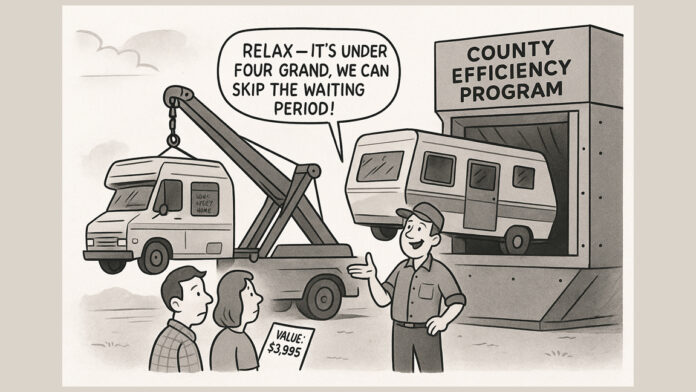
If you have an RV parked on a public street in Santa Cruz County, you might want to keep one eye over your shoulder and the other on the tow truck coming up the road. A new California RV towing law under consideration could let towing companies immediately demolish RVs and other vehicles they remove, skipping the usual waiting period.
Lawmakers say the current 15-day holding rule “discourages operators from towing—and undermines rules on abandoned and illegally parked vehicles.”
Santa Cruz County, California, RV towing law
Like many communities across California, Santa Cruz County and several of its cities have been clamping down on vehicles parked on public streets, especially those used as homes. The debate has turned into a flashpoint over how to handle homeless encampments and vehicle dwellers. Local governments and residents argue that the vehicles can be “magnets for crime and drug activity.” Advocates for the unhoused counter that these restrictions “target a vulnerable population with few other options for shelter.”
According to the county’s 2023 point-in-time count, about half of all unsheltered residents—roughly 700 people—were sleeping in vehicles.
Lawmakers: Low-value RVs cost more to store than they’re worth
The proposed change would make it far easier for tow operators to crush the very RVs they remove. Under current state rules, towed vehicles must be held for at least 15 days before being dismantled or scrapped. Santa Cruz County’s new approach would waive that waiting period for RVs valued below a certain amount—typically $4,000 or less—effectively allowing instant disposal. Lawmakers say that lower-value vehicles often cost more to store than they’re worth, making towing a losing proposition.
It’s a move that’s left some legal experts and civil-rights advocates uneasy. The American Civil Liberties Union stepped in last week, warning that the plan “could break state law.” The ACLU said the draft ordinance “does not give people enough time to get their vehicles back” and stretches the meaning of “inoperable” to include rigs that simply aren’t registered.
Faced with that warning, the county board of supervisors hit pause. Officials now say they’re reviewing the language to make sure it can withstand a legal challenge—but they haven’t set a timeline for bringing it back.
Not just a Santa Cruz County issue
Santa Cruz County isn’t alone. Smaller cities like Carlsbad and San Mateo have been stepping up ticketing and towing. And at the state level, Assembly Bill 630 would make it easier for officials to junk RVs worth less than $4,000 instead of auctioning them off—a move supporters say would cut costs. But critics warn that could unfairly target those living in older rigs.
Elsewhere, courts are throwing roadblocks in front of aggressive cleanup efforts. In Vallejo, a federal judge recently stopped the city from removing one woman’s shelter, ruling that forcing her out “with no options could violate due process.”
Others attempt “kinder, gentler” approach
Not every city is reaching for the tow hook. San Jose is trying a different tack, offering $2,000 to buy RVs and help people move indoors. Berkeley took it further, offering roughly $175 per linear foot for RVs, plus motel stays for both people and pets. The result: “36 people and 26 dogs moved into a motel, and only three of 32 vehicles stayed on the street.”
For Santa Cruz County, the road ahead looks uncertain. For RVers who value their rolling homes, the idea of a tow truck hauling off a rig only to crush it the same day may feel like a bridge too far. As officials review the proposed California RV towing law, many will be watching to see whether the final version protects property rights—or paves the way for more RVs to head straight from tow yard to scrapyard.
Source: Lookout Santa Cruz
RELATED
- L.A. closer to banning “vanlords” from renting junky RVs to homeless on city streets
- Los Angeles parking lot brings relief for homeless RVers
- Los Angeles tries again to control RV street parking
- Homeless swarm RV manufacturer’s lot, move into RVs, destroy many
- Reader turned away from Walmarts across the country. ‘The homelessness is staggering’
- A haunting encounter and a personal journey to confronting homelessness
- A City of Sedona plan for homeless parking has locals up in arms
RVT1234b


Outstanding idea, need other jurisdictions across the country to do same. So many of these I have seen in my area are in addition to being an eyesore, in some cases I believe they are a health hazard to the public. Would also like to add that this should apply to our public lands, again in my area the USFS and BLM lands are being destroyed by the occupants of said vehicles.
Unintended consequence: “Free RV removal and disposal in Santa Cruz”.