

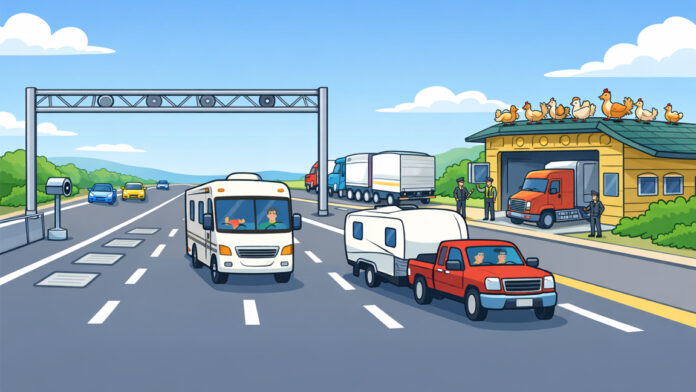
If you’ve spent any time on interstates out West, you already know the drill. The sign flashes “all trucks must enter,” semis line up, and RVers roll past on the bypass lane without a second thought.
That familiar roadside setup—known in trucker slang as the “chicken coop”—may be starting to change. And while RVers are still almost always exempt from weigh stations, the shift could make highway travel a little smoother for everyone.
What’s changing at the chicken coop
South Carolina is among a growing number of states testing virtual weigh stations. Instead of forcing trucks to pull off the highway and roll across a scale, these systems use sensors embedded in the pavement to weigh vehicles as they travel at highway speed.
If a truck appears overweight, enforcement officers get an alert and can pull only that vehicle in for inspection. Trucks that pass the screening keep moving. This is different than some existing “weigh in motion” systems, where an overweight truck must pull into a weigh station. No “coop” needed for this weigh-in-motion system.
The goal is simple: fewer forced stops, less congestion, and better targeting of problem vehicles.
“But RVers don’t stop at weigh stations”
That’s true—most of the time.
Privately owned RVs are generally exempt from weigh stations, especially in Western states where signage and enforcement tend to be clear and consistent. Motorhomes and tow rigs without commercial markings usually cruise right by.
But RVers still feel the ripple effects:
- Slowdowns as traffic approaches a weigh station
- Sudden braking when truck lanes back up
- Confusion when signage says “all vehicles over X pounds” or “all vehicles towing”
In parts of the Southeast and Northeast, RVers also report being waved into weigh stations—only to be waved right back out once officers confirm they’re not commercial. Even when exempt, that hesitation adds friction to traffic flow.
Why virtual weigh stations matter to RVers
Virtual systems don’t change the exemption rules for RVs. What they change is how traffic behaves around traditional choke points.
With fewer trucks required to exit the highway:
- Backup lines shrink—or disappear altogether
- Merging traffic becomes smoother
- The sudden stop-and-go near weigh stations eases up
In other words, RVers may not be stopping at the chicken coop—but they could spend less time crawling past it.
A familiar model for RV travelers
RVers already see a version of this in California’s agricultural inspection stations. Most travelers slow, get waved through quickly, and move on. The interaction is brief and targeted, not a long queue.
Virtual weigh stations aim to bring that same efficiency to truck enforcement—without pulling traffic off the road.
What to watch next
South Carolina’s system is still new, but transportation agencies nationwide are watching closely. If the technology proves reliable, similar setups could spread to other freight-heavy corridors.
For RVers, the takeaway is simple: no new requirement to stop—but potentially fewer bottlenecks, smoother highway driving, and less chicken-coop drama along the way.
Sometimes the most noticeable travel improvements aren’t the ones aimed at RVs directly—but the ones that quietly make the road work better for everyone.
RELATED
- Blowing in the wind: Truckers’ tips for safe driving
- Tips for safe driving around big rigs
- Study finds dashboard touchscreens reduce driving safety
- Changing driving habits could be early indicator of dementia
- What can I do to reduce blind spots when driving my older Class C?
- Tips for safe RV driving on snow or ice
RVT1248b

This isn’t new – it has been used in Virginia and several other states for twenty years.
Thank you, Russ and Tina, for the news. Sensors embedded in the roadway? Hmm, … sounds expensive. Guess increasing safety isn’t free, huh? Interesting to see if this gets accepted faster in states with harsh winters (likely resurface roads often), or those with relatively mild winters (once embedded, stays embedded for a few years). Have a great day and safe travels!
🤣 I read your comment too fast, Neal. I read it as, “Seniors embedded in the roadway?” (before I saw what you were commenting on). I hope you, Ginger and Weagle have a good night.🤗 –Diane
You must have had one of those sensory moments.
👍🤣 I think I was just getting too tired. Not to mention the fact that I need new glasses.🤓 Have a good night, Kelly.🤗 –Diane
As we get older our mind reads what it wants to, but not what is really written.
True. Not a good thing, especially when I’m proofreading everything at RVtravel.com at 79 years old.🫣 But new glasses might help a little.🤔 Have a great day, Bob. 😀 –Diane
Nothing could be better for we RVers than having to also weigh our rigs. I see so many tail-heavy tow vehicles out there. This might finally get the message across that cargo carrying capacity is pretty important.
You’ll never see a Subaru or Jeep tow another trailer ever again if they would just enforce weight stickers for RVers.
While I appreciate this, the real issue is the 18 states that still have laws on the books that require RVs over 26,000 pounds to enter the weight stations. A few states even say that you must be weighed once when entering the state, i.e., it is your responsibility to find and be weighed at a station. When you do enter a weigh station, you get the irritated wave on most of the time or the coop rooster who doesn’t know what your GCVW limit is. Mine is located in the very back of the RV in a closet. There is also the problem of some manufacturers exceeding axle limits. I am nose-heavy by a few hundred pounds, and there’s nothing I can do about it.
Weigh stations still have a valuable role to play with truckers. Most weigh stations have a LOT of truck parking. With the addition of a security guard that frees up many spaces for taking trucker’s required rest breaks.
Although simply weighing one’s RV, especially a towable, yields valuable information, trailer weight alone isn’t enough. To do the job properly takes time…hitched weight, unhitched weight, and several other weights to determine whether one is within safe weight limits. I only go into weigh stations that are not active, but the scales are still operating in most cases. I don’t advise getting in the mix of semis waiting their turn…you might get a rude comment or two thrown your way. 😄
Im surprized that the fee hungry states do not require RVs to pull in and get weighed as a source of revenue.
Don’t give them any ideas Tom, LOL
While they are at it SC should fix their roads as well especially I 95
I see many RVs and towed vehicles that seem to be over weight, that poses as much a danger as over weight trucks. It would be a nightmare with so many different manufacturers and models to keep track of but an overweight rig is still a safety issue.
Could there be another benefit for RVers? In highly rural non-ag areas, public weigh stations are all but non-existent. Even when towing a single-axle TT with a SUV, the combo may not exceed road limits, but can exceed safety limits. Doing so impacts not only the owner but the surrounding traffic. Perhaps at some future point, RVers might be able to purchase a reasonable cost display giving an axle by axle weight readout (and remembering the last weight reading) while driving? [Nope, a driver shouldn’t be distracted by trying to read axle weights while driving, but if the display is pre-loaded with axle maximum weights, sound an alarm? Otherwise the driver can read at the next stop.]
I have never encountered an issue with truck weigh stations causing slowdowns or creating a dangerous situation. When I see one coming up, my feeling usually is along the line of good, that’ll clear up some traffic and thin out the long line of trucks in the right lane.
Having travelled all the western states and provinces, and from Florida to Alaska, I have seen only once a sign that read “RVs Exempt” for an upcoming weigh station. I have never stopped and never had an issue.
This is one issue I’m still unsure of as a new RV owner. I will be starting in California on I-40 all the way through to OKC. That’s 5 states alone, never mind the states going north on I-35. So should I be stopping (versus needing to) just to be safe? My RV is a class C with a weight of about 14,000 pounds.
No.
Just roll on by no need for stopping!