

By Libby Riddle
University of Montana News Service
GRAND TETON NATIONAL PARK – The famous Grizzly 399, also known as the “Queen of the Tetons,” was killed last fall in a vehicle collision outside Grand Teton National Park. According to the U.S. Fish and Wildlife Service, she was the latest of 51 grizzly bears killed by vehicles in the Greater Yellowstone Ecosystem since 2009.
In response, researchers at the University of Montana are employing novel methods to study how signage in the park and wider areas can influence driver behavior and reduce these mortalities.
Leading this work in the field was Miranda Foster, a UM graduate student in Parks, Tourism and Recreation Management. The Missoula native studied environmental analysis and art as an undergraduate, which made her an ideal candidate to lead this interdisciplinary research.
“A lot of the time signs are like Band-Aids,” Foster said. “They address the need when it arises. But you’re not reaching the full potential audience without using design.”
“In our field, people have been studying signage for a long time,” added Will Rice, UM assistant professor of outdoor recreation and wildland management at the W.A. Franke College of Forestry and Conservation. “But they’ve really just focused on the words and not how those words are presented.”
To elevate the design aspect of the research, Rice brought in longtime collaborator Jeremy Shellhorn, a professor of design at the University of Kansas known for his work on the national park typeface. Shellhorn’s expertise allowed the team to translate design theory and research on visitor behavior into compelling signage.
The effect of signs
Armed with funding from Joe Ricketts’ Jackson Fork Ranch, the team designed an experiment to determine which messages and signage designs had the greatest effect on reducing vehicle speeds through a known grizzly bear corridor.
“In a roadside setting, you only have a couple seconds to take in a message, and research shows that visual cues really help that message stick in a short amount of time,” Foster said.
To test a sign, they placed it where drivers would see it as they initially entered the corridor. One hundred meters past the sign, they placed a vehicle classifier – a device often used to monitor traffic flow which measured the vehicle’s speed, the type of vehicle and other metrics. The combination of this classifier and another placed at the end of the 3.7 km corridor allowed researchers to measure the initial impact of the sign on driver behavior and see if that slower speed was sustained throughout the corridor.
“The unique thing about this study is that we were able to control for all these different variables,” Rice said. “We had really high-quality data on weather, time of day and all the information from the vehicle classifier, including things like following distance and number of axles. It was very controlled from a social science perspective.”
Not easy designing signs
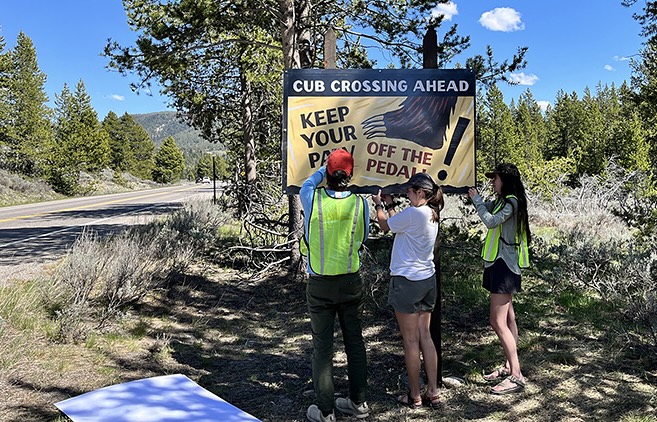
Designing the signs was also labor intensive. Shellhorn brought a 5-foot-wide printer in the back of his car so signs could be designed and printed in the field. This allowed Rice, Shellhorn, Foster and undergraduate field technician Pam Murcia to refine each design based on the previous days’ data and on-site observations. This on-location design process was the first of its kind.
“We were quickly able to get rid of some of the designs that would have been really hard to evaluate from a desk,” Foster said. “We had this one where it was supposed to look like a bear was holding the sign. But we realized that from a certain distance you could only see the bear’s hands, which looked kind of terrifying.”
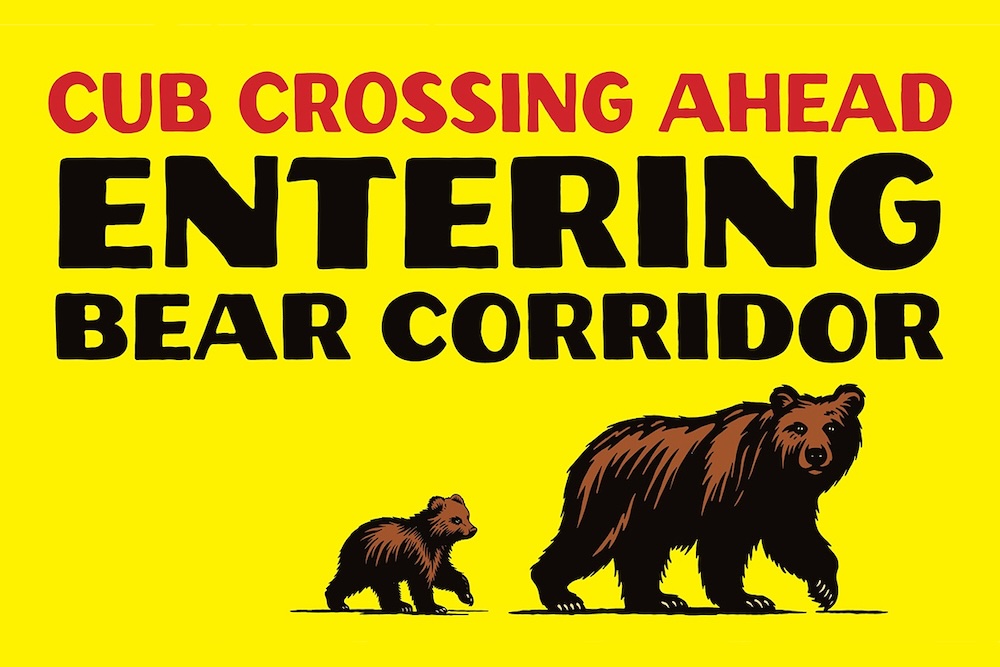
There are some standard rules for designing signs – such as using yellow to denote warnings – but the researchers were able to experiment with different combinations of colors, images and texts within those guidelines. Some signs closely resembled existing signage in the park while others used new illustrations or more vernacular language.
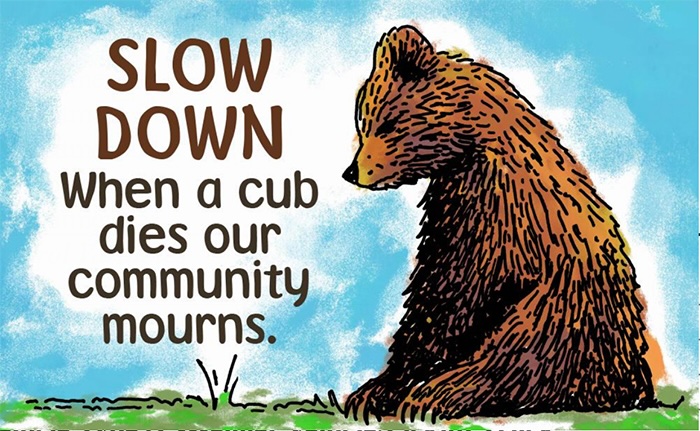
“We wanted to make sure the imagery matched the type of message,” Foster said. “We had one sign that read, ‘When a cub dies, our community mourns.’ For that one, we chose colors relating to sadness and used a storybook-style illustration and font. But for a quick attention-grabbing sign – ‘Caution! Cub crossing ahead!’ – we used bright red and yellow.”
The most effective sign
The “sad bear” illustration was one of their most effective signs, reducing the odds of speeding at the start of the corridor by 35%. Meanwhile, the cub crossing sign had the greatest effect on reckless drivers in the corridor.
“Based on our model, that sign reduced the number of reckless drivers – people driving 15-plus mph over the speed limit – by four to seven people per day,” Rice said. “And that’s significant because these are the folks most likely to hit a bear.”
Rice, Foster and Shellhorn produced several composite signs based on the most effective designs from this study and a parallel study on roadside behavior around bears conducted at Togwotee Pass. These designs were well received by the National Park Service and other agencies.
“I think some of these behaviors are so ingrained and really resistant to change, so people are excited to see some data that shows these behaviors can change,” Rice said.
The success of this work inspired Rice and Shellhorn to start the Conservation Communication Collaborative, or the CC Co-Lab for short. The new co-lab combines their decades of expertise and the results of these studies to create research-driven signage that encourages responsible recreation and land stewardship in parks across the country.
Though she was simultaneously conducting separate work for her master’s degree, Foster acted as the third investigator on the Grand Teton and Togwotee Pass studies, leading the implementation of both projects in the field.
“Miranda was amazing and deserves a ton of credit for what she did with these projects,” Rice said. “In terms of pulling this off, the success of these two paired studies is really a testament to her and her promise as a scientist.”
Foster recently published the Togwotee Pass study as lead author and hopes to publish the Grand Teton study later this summer. In the fall she’ll begin a doctoral program with UM’s Wilderness Institute, working on wilderness policy and communication.
“Art and design are incredibly influential in our daily lives,” Foster said. “They’ve been shown to improve our capacity for learning and create bridges between language and cultural barriers. To fail to utilize that tool in management would be a waste.”
This important research is part of the Jackson Fork Ranch-University of Montana Research Project, a multiyear collaboration to study biodiversity in the Greater Yellowstone Ecosystem.
RVT1221b

Very interesting…thanks for this
“A picture is worth a thousand words” comes to mind. Remember the Burma Shave signs? Not pics – but memorable and with excellent messages. Also, the X signs noting the death of someone in a traffic crash. Impact advertising with positive results. We will probably also have to include the standard road traffic warning signs to avoid state liability.
Thank you, RV Travel, for sharing this wonderful study. After several weeks of driving in British Columbia, Yukon, and Alaska, I am disappointed to report that “everyone” drives faster than the posted speed limits. Canadians seem to do it less than U.S drivers and to exceed by smaller amounts. But, my time driving Alaskan roads is much greater than the time driving Canada’s roads; spurious conclusion? Would love to see incentives changed to result in typical drving speeds approximating the posted limit. Have a great weekend and safe travels!
Maybe they should paint designated crosswalks with flashing lights for the bears. Since bears have giant paws, of course the crosswalk activation buttons will have to be oversized too. Also, larger print on the signs directing the bears to the crosswalks would be needed so the bears could see them from far away and therefore not jaywalk. Problem is, someone will see this and say, “Yeah, that’s what we need to do to save the bears!”
Deer seem to follow the signage guidelines best… however, antelope and moose less so. Perhaps bears are smarter than the average moose.