


Dear Dave,
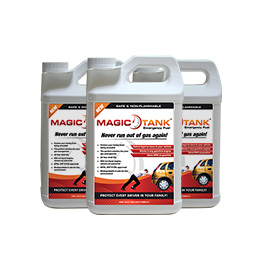
What’s your opinion of a product called “Magic Tank”? Recently, a very smart guy I know told me about Magic Tank. It’s an emergency fuel replacement, a stable petroleum distillate that appears to perform just like gasoline, but can be carried more safely in the vehicle and stored for up to 10 years without degradation. It appears to be approved by all the government agencies that approve such things and can even be mailed to you by the manufacturer.
I read several reviews as well as the Safety Data Sheet and they all seem to corroborate all the claims made in the manufacturer’s advertising. It’s not cheap, you wouldn’t want to use it instead of gas, but the idea of putting a couple containers of Magic Tank in the RV’s storage area sounds a lot safer to me than the containers of gasoline I usually carry when I head into the middle of nowhere. Here’s the manufacturer’s website.
I look forward to your evaluation. —Judith, 2018 Coachmen Freelander Elite
Dear Judith,
Since I have been driving, which has been many years, there have been dozens of “snake oil” products that have come and gone. I remember JC Whitney having magic pills that will give you 50% better gas mileage. And then someone had the bright idea of placing magnets on the side of the fuel tank to get better performance. None of them worked.
My research on Magic Tank
I am not saying the MAGIC TANK Emergency Fuel is snake oil, just that I have not heard of it or used it—so I did some research.
It claims to be a petroleum derivative that comes from gasoline but is not flammable. I don’t see how this could work as the entire principle of an internal combustion engine is “combustion” from a flammable explosion—which is the gasoline and air mixture.
It claims to have taken out all the flammable components of gasoline to make it safe to carry in your trunk. Plus it has a 10-year shelf life.
Reviews
I found several sites with reviews on the product. Most stated that it worked as described; however, the engine needs to be warm when it is put into the tank. The negative reviews mostly seemed to complain about the cap seal being defective, and the smell that came into the car was horrible.
It claims to provide 91 octane and is EPA approved. It also claims to be approved by the National Fire Prevention Association (NFPA), but shows no documentation or certification on the site.
However, both ABC News and CBS tested the product and posted a YouTube video that it did work. You can find the ABC News post here. (Note that it is from 11 years ago.)
And the CBS article (from 12 years ago) is here.
It used to be sold at Home Depot and presumably other locations, including on clearance at Kroger grocery stores, but is no longer sold there.
It seems too good to be true; however, most of the reviews do state the product works.
Out of business?
However, when you click on the “buy product now” tab on the Magic Tank website, it takes you to a website that looks very suspicious (it’s an online game in Indonesia).

Also, MapQuest shows the Magic Tank LLC location is permanently closed.
I have to admit I have done the walk of shame, walking on the side of the road with a gas can. I personally have taken my uncle’s advice when I was young. He stated, “It doesn’t cost any more to keep your tank full than almost empty.”
I wonder if the “very smart guy” has recent intel on the product or if that was from a long time ago. And how recent were the reviews, as most that I found were very old.
Let’s see what others have to say about it, or if anyone knows if it’s still being sold. It may be a moot point, if it’s no longer being produced or sold.
You might also enjoy these posts from Dave
- How to safely store fuel in a portable container
- RV generator shuts down; only starts with starting fluid. Fuel pump?
- Fuel nozzle shuts off before RV’s gas tank is full, but never at Buc-ee’s. Why?
DAVE HAS ANSWERED MORE THAN 1,000 readers’ maintenance and repair questions. Read a directory here. There is so much to learn!
Dave Solberg is a leading expert in the RV industry and the author of the “RV Handbook.”
HAVE A QUESTION FOR DAVE?
Send your inquiries to him using the form below.
RVDT2851

Magic Tank Fuel costs $40.00 a gallon.
I mean absolutely no disrespect but in what world does it make sense to spend $40.00 for a gallon of fuel just in case you forget to spend $3.00 for a gallon of gas in the next 10 years?
Oh. Would love fuel at $3.00. $4.21 in Washington and rising. $5 diesel. But that’s sounding a lot better than $40/gal.
Not to further your pain but gasoline is currently at $1.96 a gallon 125 miles west of us in Newcastle, Oklahoma. Here in Tulsa, it’s $2.20 for gas, $3.39 for diesel at our corner Murphy station. If you really want a kick in the gut, GasBuddy is reporting gasoline at $1.86 a gallon in Houston. And yet we’re heading West in our RV here shortly….LOL
Hope you’re not heading to California. Where I live (North Bay Area) diesel just went to $6.99 at our local Chevron…gasoline to $5.35.
Yikes! Thanks for the head’s up Charlie. We are indeed headed toward California. Looking at Panamint Springs in Death Valley. Lots of abandoned mining camps in that neck of the woods. We’ll top off in Nye County and carry jugs but I’m pretty sure we’ll contribute to the local fuel economy before all is said and done! Stay safe out there sir!
Basic physics says this is a scam.
A friend claimed to have gotten his car to a gas station by pouring a bottle of cognac into the tank when he ran out of gas. Why would you not buy gas if you had the money for a bottle of cognac is another question. My theory is that the tank is never really empty, the level of the gas just drops below the pick-up, so anything that raises the level of the gas will allow the car to run for a little while longer, as long as it doesn’t reduce the vaporization/flammability of the gasoline too much. Then when you fill the tank whatever you added will be diluted enough that the car will still run, hopefully.