

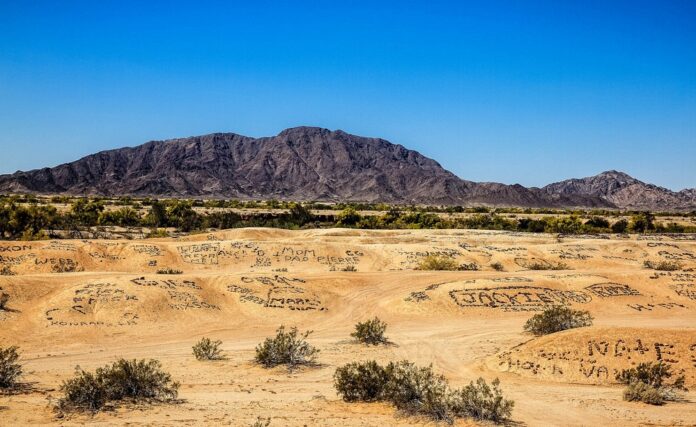
The Valley of the Names sits in the stark and unforgiving desert near Winterhaven, California, just west of Yuma, Arizona.
In this vast stretch of desert sand, you’ll discover a bit of history along with memorable nostalgia. If you listen closely, you can almost hear echoes from the past.
A bit of history
During World War II, the area now known as the Valley of the Names took on new importance as part of the Army’s Desert Training Center. General George S. Patton Jr., the first commanding general, ordered camps and airfields built here in the early 1940s. “Young Camp,” as it was called, readied U.S. troops for fighting in North Africa.
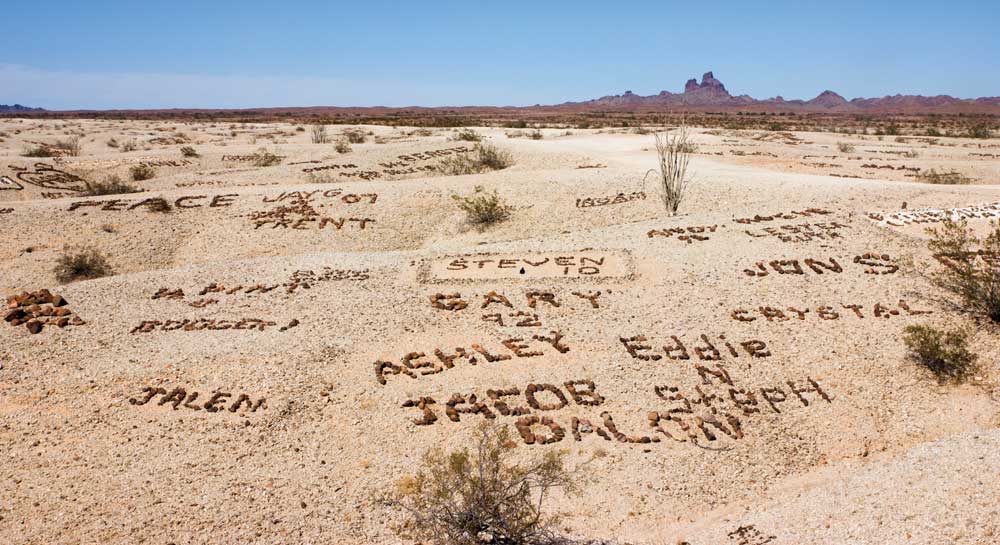
Camp conditions were less than optimal. Reports say that troops were allowed only one canteen of water each day. That water had to suffice for drinking, cooking, and washing. Daytime temperatures caused blistering conditions inside the Army tents, so many soldiers preferred the surrounding desert as the nighttime cooled. In the evening, with little else to do, soldiers arranged dark rocks to form names, symbols, and messages to reflect their thoughts, hopes, and feelings. These incredible images still remain today, some more than 80 years old.
Today
Today, there’s little evidence that these 1.4 million acres of stark desert were once home to the world’s largest military installation. After the war ended, the military relinquished the area to the Department of the Interior. Now the Bureau of Land Management (BLM) manages the large desert region, now known as The Valley of the Names.
If you visit The Valley of the Names today, you’ll find that many visitors have continued to arrange dark rocks into names, dates, initials, and little memorials.
Volunteers periodically clear storm debris and reset rocks that get displaced.
Watch a fascinating video overview of The Valley of the Names here.
Getting there
The Valley of the Names lies on a stretch of public land in the BLM Yuma Field Office recreation corridor.
To get to the valley, take Picacho Road from Winterhaven and bear left at the fork onto Barney Oldfield Road.
Remember that the route is mostly dirt and gravel with loose sand. Four-wheel-drive vehicles are recommended. Also keep in mind that summer temperatures can be brutal. Plan your visit to avoid the heat.
Nearby things to see and do
If you want to turn the Valley of the Names into part of a bigger desert loop, there is plenty nearby. The Picacho Trail is a 14-mile ride with rocky terrain and loose sand, which makes it a good match for off-road explorers.
Mittry Lake adds camping, birding, boating, fishing, kayaking, and wildlife viewing, while Senator Wash South Shore offers gravel beach access, drinking water, showers, and camping beside the reservoir.
Where to stay
For RVers looking for a base camp, three solid spots stand out.
- Imperial Dam Long Term Visitor Area is the classic boondocking-style option north of Yuma on the California side of the Colorado River. Long-term permit options and RV use are allowed.
- T.K. Jones Campground and Boat Launch is the more developed choice, with about 125 RV sites, a boat launch, and a 14-day stay limit.
- Senator Wash North Shore is another good fit if you want a quieter reservoir setting with secluded camping areas, gravel beaches, and nearby dump station access.
You should go!
Visiting The Valley of the Names takes a bit of effort and desert common sense. Follow route directions carefully and use a reliable vehicle that’s equipped to take on the desert terrain. Bring plenty of water and be ready for heat with sun-protective clothing and sunscreen.
Treat the rock displays like fragile public-land art. Do not move, remove, or rebuild the stones already in place. The BLM recommends that you not bring your own rocks into the area. In addition, do not disturb the existing rocks along the route in order to preserve the habitat for native animals and plants.
Have you visited The Valley of the Names? Tell us in the comments below.
MORE YOU MIGHT LIKE:
- A visit to the incredible National Museum of Military Vehicles
- How it Happened: You can thank the military for the drive-thru window
- Arizona Museum pays homage to Navajo WWII Code Talkers
- Military campgrounds offer a great opportunity for many RVers
- Check out this unique ex-military Unimog RV conversion
RVT1264


Thanks Gail. An interesting place and article!
The Anza Borego Desert was also used for training by Patton’s troops. We explored there about 50 years ago and found some shell casings.
Been there, it’s worth the effort. Go in the winter, you’ll enjoy it more. Can’t imagine being one of those poor soldiers…
We were workamping in Sans End RV park fall and winter 2016 and discovered many things in the area then. We’ve got many, many pictures from then. We didn’t have a working Jeep at the time, so we did all this with my wife’s front wheel drive Ford.
My father-in-law was sent out there during WWII to train for the North African desert, THEN, he was sent to Germany. Oh well!
That falls under the oxymoron of “Military Intelligence”! I know it well – I was combat infantry.
My dad was sent there to train for the North African front. Instead he was sent to the Aleutions. I used to think it was “military intelligence” but after reading The Thousand Mile War I realized it was part of the secrecy and misdirection intended to throw the Axis powers off the scent of their ultimate destination.
Thank you for the fascinating information, Gail. What a “cool” story. No, never been there. Doubt that we will, given the age, health, and anticipated longevity of our mothers and our typical distance from this location. In any case, have a great week and safe travels!