


By Russ and Tiña De Maris
Hop in your motorhome and never buy gas or diesel? That will soon be the reality in Europe – for those who buy a WOF Iridium EV motorhome. We wrote about the zero-emissions rig (with a bit of apprehension) last December. At the time, Iridium was just getting ready for an unveiling at a German trade show. Our inability to get particularly excited about Iridium was tied to effective range-between-charges: a wishy-washy 124 miles.
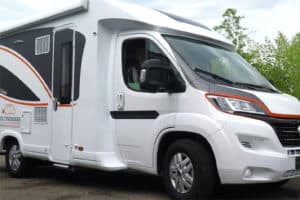
Apparently Iridium’s designers heard the despairing cries of those of us on the big continent, where one may take a day to cross a state, to say nothing of visiting a foreign country. This year, Iridium rolled onto the floor at the Dusseldorf Caravan Salon, featuring something a little closer to reality – a range of 249 miles. Granted, that need for frequent charging stops would put a serious crimp in most American RVers’ style, but at least things are headed in the right direction.

According to a story on curbed.com, the Iridium EV isn’t much on bling; but for the planet-conscious, that probably isn’t a major drawback. While the exterior of this Class C electric looks pretty sleek, the interior is starkly sterile. Still, you’ll have a shower, dry bath, galley, and – if you don’t miss snuggling – a split double bed. Modern enhancements provide Bluetooth connectivity and a built-in navigation system.
While the RV portion of this rig comes from WOF, a European camper van builder, the get-up-and-go comes from ElektroFahrzeuge Stuttgart, or EFA-S. The latter firm has prior experience in making bigger vehicles go electric.

Delivery service UPS has had about 200 of its delivery rigs converted to electric by EFA-S. One of the bragging points that Iridium makes use of is getting away from the stop line. Synchronous electric motors, unlike gas or diesel engine technology, is ready with full torque from “stop.” No spinning up to speed – step on the “gas” and you’re down the road.
Although 249 miles is a reasonable-sounding range, we do wonder a bit. The motorhome’s lithium ion phosphate batteries don’t just wait around to take a charge from a grid electric system. They also rely on a Kinetic Energy Recovery System, meaning, when you slow down, the motors provide braking to the rig and send power back to the batteries. On long highway stretches, we wonder just how much of the kinetic energy is there to be converted to juice for the batteries? Will 249 miles be the real, practical range of the rig – or something much less when out on the highway?
Want to find out for yourself? There may be a couple of slight roadblocks. One depends on your pocketbook. The 249-mile-range Iridium EV is the top-of-the-line motorhome, with a top-of-the-line suggested retail price of $219,000. Too much? Well, the price for the not-so-long-range Iridium, with a claimed range of 186 miles, is a modest $188,000. But, sad to say, at this point Iridiums of all flavors will only be available in Europe when released next year.

Sounds nice and it is a step in a long long way to go. Consider where you can charge it, how much will that cost, how long will it take. etc? And I wonder if that 249 or 286 mile range is with a headwind? Unlike airplanes who lose a bit of speed – Rv’s are ground bound and have to overcome the wind effects with more power being required. Hmmmm?
You also need to consider where that electricity comes from (mostly burning coal), the environmental cost of mining lithium, and disposing of the batteries at the end of their 10 year life.
Anyone with any illusions this is the future is dreaming, like all EV’s this is a rich mans toy today and a long wayyyy into the distant future. I do not know one person who owns only an EV. There will be some but very few.
I prefer no less than 350 or more than 450 miles per driving day. I also prefer a little space and my 41′ 5er is just right with 5 slides.
The content about kinetic recovery doesn’t make sense. Regenerative braking returns a portion of your kinetic energy instead of converting it to heat, but NOT braking at all is more efficient, not less. Wind resistance, on the other hand, will harm mileage at greater speeds.
The naysayers said the same thing about cars. The way new developments in batteries are progressing in a couple years I think you will see some real R Vs. Semi trucks are coming out now with 400 plus range and 80,000 lb. payloads. Every year more electricity is being produced with renewals. Gas is on the way out. Not to mention that daily maintenance would be plugging in, no oils filters gas or radiators.