

Last week, we shared that two RV supplier giants had announced that they were in merger talks, and I scoffed at the fact that the government may not really care. Well, it turns out, I was wrong. Mike Lee, Chairman of the Senate Judiciary Committee on Anti-Trust Competition Policy and Human Rights, has sent a letter to the CEOs of both LCI (Lippert’s parent company) and Patrick Industries raising concerns.
In the letter, Lee wrote,
… [A] transaction combining these companies would create a supplier of considerable scale across multiple component categories critical to RV manufacturers, which warrants close scrutiny. Combining two firms that together account for significant shares across multiple RV component categories would increase concentration substantially across those markets.
Section 7 of the Clayton Act prohibits acquisitions where the effect may substantially lessen competition or tend to create a monopoly. Where manufacturers have fewer sourcing alternatives, the merged firm could gain leverage to raise prices or reduce output. These higher prices will ultimately be passed on to consumers in higher RV prices. Reducing rivalry between the two most significant firms in this space may diminish incentives to invest in research and development or to expand product offerings in response to customer demand.
Supply chain resilience in the RV industry depends in part on the availability of independent and competing suppliers.
Consolidation that reduces redundancy in the supplier base may increase vulnerability to disruptions, particularly during periods of economic volatility, demand shocks, or raw materials constraints, conditions the RV industry has experienced acutely in recent years.
A single combined supplier controlling critical component categories across the OEM base represents a serious risk to the supply chain.
What analyses have your companies conducted, independently or jointly, regarding the competitive effects of a merger?
Lee also asked, “Have any RV manufacturer customers raised concerns about the potential competitive effects on a merger?”
As we wrote last week, not a single RV industry decision maker wanted any part of being quoted in an article—the size of the merged company does give them unrivaled power. Lee gave the two companies until May 5 to respond.
 RV sales are noticeably down
In other news, RV sales are low. How low? The RV Industry Association’s March 2026 survey of manufacturers found that RV shipments are down by 13.9% this March compared to last March, and overall shipments for the year are down 12.1%.
Interestingly, truck campers seem to have bucked this trend, with an increase of 6.4%, as have Class B RVs. But the big jump is for Class C RVs, with a bump of 21.6%. Even better, park models are up by 23.8%. So where’s the big drop? Right in the heart of the market—towables of all sorts.
 Check your gas and the price

The Environmental Protection Agency (EPA) has made a change that allows up to 15% of your gasoline to be ethanol this summer. Fuel is typically blended differently in summer and winter. However, in light of the spike in fuel prices, the agency has allowed this change to help fuel prices.
The problem is that not all vehicles are designed—or even approved—to run on fuel with high ethanol content. On top of that, ethanol delivers less energy (so you may see reduced performance or fuel economy), and it evaporates faster than gasoline.
Ethanol is cheaper, but it’s also less energy-dense, which means poorer performance in some vehicles. So, check the numbers at the pump this summer. Be sure to check if your vehicle is even certified by the manufacturer to operate with this high of an ethanol percentage.
However, with fuel prices sky high, Russ and Tiña De Maris reported that this could trigger a higher cost-of-living increase for those taking Social Security.
Trivia
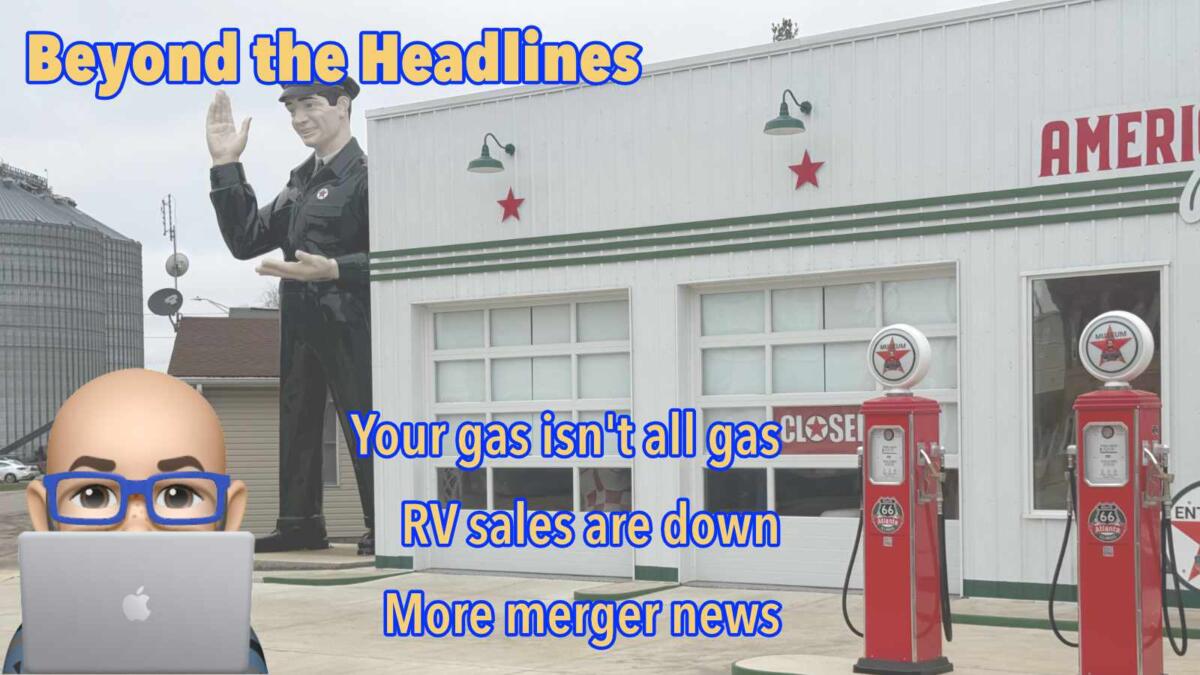
Don’t expect a prize or anything, but comment below if you know where the photograph was taken in the hero image for this article. Well, the prize is that you share a piece of knowledge and my undying admiration. How’s that?
To see all recent news for RVers, click here.
RVT1259b


We were just there! Atlanta, IL….it’s the American Giants Museum. The inside was closed, but it was still cool to see, and we hit Chubby’s across the street for a beer. 😉 A great Mother Road stop.
Very nice! Yes, that’s the American Giants museum alright in Atlanta, Illinois.
If you’re curious, we did an interview with the curator a while back which you can hear or watch here.
Tony, great update on the EPA changes in ethanol blending but let me add something that many might accidentally overlook:
Most generators SHOULD NOT RUN fuel with more than 10% ethanol. In fact, many generator manufacturers (including ONAN) recommend NO ethanol as ethanol attracts moisture and can corrode fuel system components.
Oh very good point. I hadn’t even thought of generators.
When they added 10%, my mileage went down between 15-18%. Burning just as much real gas, but I was “Green!” 15% ethanol? Can’t wait! My vehicles all run on N/A fuel. They have their own memberships to A.A.
Gas is refined to 80 octane. Gas needs an octane booster, used to be lead. Oil companies tried MBTE, which causes cancer. Now lowest cost, safe, abundant ethanol brings octane up to 87, 88, 93 levels needed by engines. Brazil uses engines designed to run on E-85, from sugar cane and corn.
If there were a lower cost, safer octane booster, gas companies would use it. But there isn’t any. And ethanol causes engines to pollute less, creating a cleaner burn.
But…ethanol is less energy-dense and so you get less power and, as A1 H posted above, consume more fuel. It also can cause damage to fuel lines and other components in cars not designed to run on higher concentrations of ethanol including some collectible cars but also some older modern cars.
Brazil has been using ethanol for many years as you stated but the vehicles are specifically plumbed to run on it.