

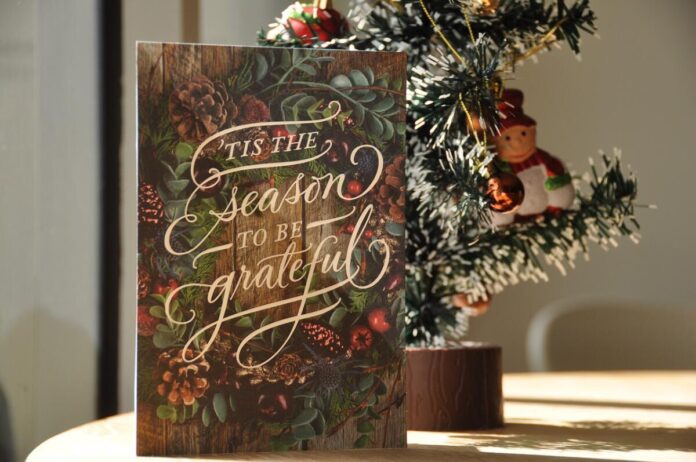
By Gail Marsh
Each year, Christmas sneaks up on me and I’m sending out Christmas cards even after New Year’s Day. Mailing Christmas cards is a time-honored tradition and one I’m not willing to abandon—even if my cards arrive well after Christmas is over. Thinking about my yearly procrastination got me to wondering about the history of sending Christmas cards.
England
Picture this: It’s 1843, and a man named Sir Henry Cole is swamped with holiday correspondence. With the hustle and bustle of the season, he finds himself overwhelmed and longing for a way to send festive greetings to his loved ones without drowning in the sea of letters. (I can relate. Can’t you?)
Enter J. C. Horsley, an artist and friend of Sir Henry. Together, they concoct a brilliant idea. Why not create a single, beautifully designed card that could convey Christmas greetings to all their acquaintances?
The first commercially produced Christmas card was born in 1843, featuring a heartwarming scene of a family raising a toast. Though initially met with mixed reactions, the idea of exchanging holiday cards gradually caught on, paving the way for a beloved tradition.
The history of Christmas cards in America
Fast forward to the latter part of the 19th century, and the Atlantic Ocean becomes a bridge for the Christmas card tradition to cross over to the United States. Inspired by their English counterparts, Americans embraced the idea of sending festive greetings in a tangible, visual form.
Louis Prang, a German immigrant known as the “father of the American Christmas card,” played a pivotal role in popularizing the tradition in the U.S. In the 1870s, Prang began mass-producing affordable, colorful cards featuring festive illustrations, appealing to a wide audience. These cards often depicted scenes of flowers, plants, and children.
As printing technology advanced, the Christmas card market flourished, offering an array of designs and sentiments to suit every taste. The cards became a means to connect with distant relatives and friends during the holiday season. They fostered a sense of warmth and togetherness.
Homemade Christmas cards became popular in the 1910s and 1920s. These cards were often adorned with ribbons, foil, buttons, and other add-ons. Because of their delicate nature, handmade cards were often delivered in person rather than sent through the mail.
Today’s Christmas cards feature a wide variety of illustrations and greetings. On a recent shopping trip, I saw Christmas greeting cards with pictures of everything from the Nativity to Currier and Ives winter scenes to Santa addressing Christmas cards as he sits on the beach!
Did you mail Christmas cards this year? Tell me by voting in the poll below.
RVT1240
We send only to close friends and relatives now. Maybe 10-15. And these are always themed cards with a personal message written inside. Used to be over 25. The cost of postage now is one reason we backed off.
Plus, some friends and family are no longer with us.
We have a couple ‘relatives’ that send the post card type with full pictures of their family every year.
I don’t consider these a “personal” greeting, but just a mass mailing!
We do most of our Christmas cards at church. The church has mail boxes set up that folks can drop off cards, and pick up. Saves the postage for better things.
Actually, I’m just now making them to get them out this week. Yep, late again.
We stopped sending cards many years ago. Not only is the postage prohibitive, but it is a tremendous waste of paper. How many trees are cut down to feed this tradition?
I can see sending something to someone who lives far away and you’ll not see during the season, but many people send them to EVERYONE, even people who live in the same town or next door who they will probably see anyway. What a waste. I would rather see live trees than cut them down to send someone a picture of one.