

By Greg Illes
We were up on the North Rim of the Grand Canyon, boondocking out in the Kaibab Forest at around 8,500 feet elevation. It was October, and the nights were regularly dropping into the 30s (F).
 Our stock cabin heater, a standard Suburban 30,000 BTU fan-driven beast, had long since been sidelined in favor of a small propane heater. Oh, we still used the “big heater” for warming up the coach in the morning or after long absences. But the “little heater” was very nice at maintaining the cabin temperature. At first we used a Mr. Heater, but later moved up to a 10,000 BTU free-standing unit. It was made with two ceramic panels that glowed red-hot at full tilt. Even later, we mounted that heater on a cabinet.
But that chilly October night, the little auxiliary heater simply would not stay lit. Not even its pilot would stay lit, sputtering and flickering and dying until we finally gave up. We spent that night listening to the noisy fan go on and off, and thinking about all the wasted propane being blown out the side exhaust (used to vent combustion gases).
After the trip, I did some research on these ubiquitous ceramic heaters. I discovered that the design of these units has an inherent limitation, and that they simply cannot be relied upon to operate anywhere above 4,500 feet elevation. It’s a little complicated and slightly technical, but stay with me here …
Essentially, the safety-oriented ceramic-heater design will not allow the heater to function when oxygen levels drop – as they do with rising elevation. Normally, the combustion process produces carbon dioxide (CO2). But at low oxygen levels, in a “burner” style design, reduced oxygen causes the creation of carbon monoxide (CO), a deadly gas. Not good.
The “blue flame,” or open-flame, heaters are a different variation on the ceramic style, but their combustion technique also limits them to 4,500 feet or less. The specs vary slightly among manufacturers – if you can find the specs at all, that is. Calls to manufacturers about altitude were often met by dumb silence.
More research revealed that only one type of heater would work at high altitudes – the catalytic type. Catalytic heaters don’t actually burn propane, they catalyze it. The consequence of this is that there is NO possibility of catalytic heaters generating CO. As a result, their design does not require oxygen sensors, and they will operate independently of oxygen density.
CERAMIC vs. CATALYTIC vs. OPEN-FLAME vs. FORCED-AIR
At that point, I thought I had it knocked. Just buy a different heater, one with a catalytic design.
Then I found out that true catalytic heaters – suitable for RV use – were:
- Made by only one manufacturer – Camco “Wave” series
- Cost almost 3X as much as higher-power ceramic/flame heaters
Ouch. No competition, captive market.
But, oh well. Out here in the mountainous West, less-than-4,500-feet excludes thousands of square miles of great space to explore. So I bit the bullet and bought a Wave-8.
Fabulous! It worked anywhere, at any altitude, giving off copious silent heat at nearly 100% efficiency. I mounted it on a swivel panel on that same cabinet, so we could direct the heat where we wished. Opening a window slightly to provide oxygen and vent water vapor, we were truly happy campers …
Until about two years later, after maybe 6-8 months of actual use. Then it started getting temperamental and going out. Within a few nights, it quit completely. Ugh. Back to Mr. Noisy again.
Back home, I called up Camco and talked to a Wave technician. Had I been scrupulous about keeping the catalytic screen covered when not in use? Yes. Had I spilled or sprayed anything against it? No. Was I giving it good propane? Yes. From west of the Mississippi?
HUH – WHAT?
Yeah, I heard him right – it turns out the propane in the Western states is contaminated (intentionally) with a lubricant that eventually ruins the catalyst in the Wave catalytic heaters. No mention of this whatsoever in the product literature (of course). And nothing that can be done about it either, according to the tech. They are “working on it.”
I’m now faced with a crummy choice – buy a cheap ceramic heater that will last indefinitely but won’t work at altitude, or buy an expensive catalytic heater that has to be replaced every few years. (Actually, only the catalytic element has to be replaced, but the cost is nearly the same as a new heater.)
Well, I really hate that noisy forced-air heater, and I’m not going to be camping exclusively at low elevation – so I’m stuck with the short-life catalytic for now. Maybe somebody at Wave will figure it out? I won’t hold my breath.
So here’s a quick summary of my multiple years of experimentation: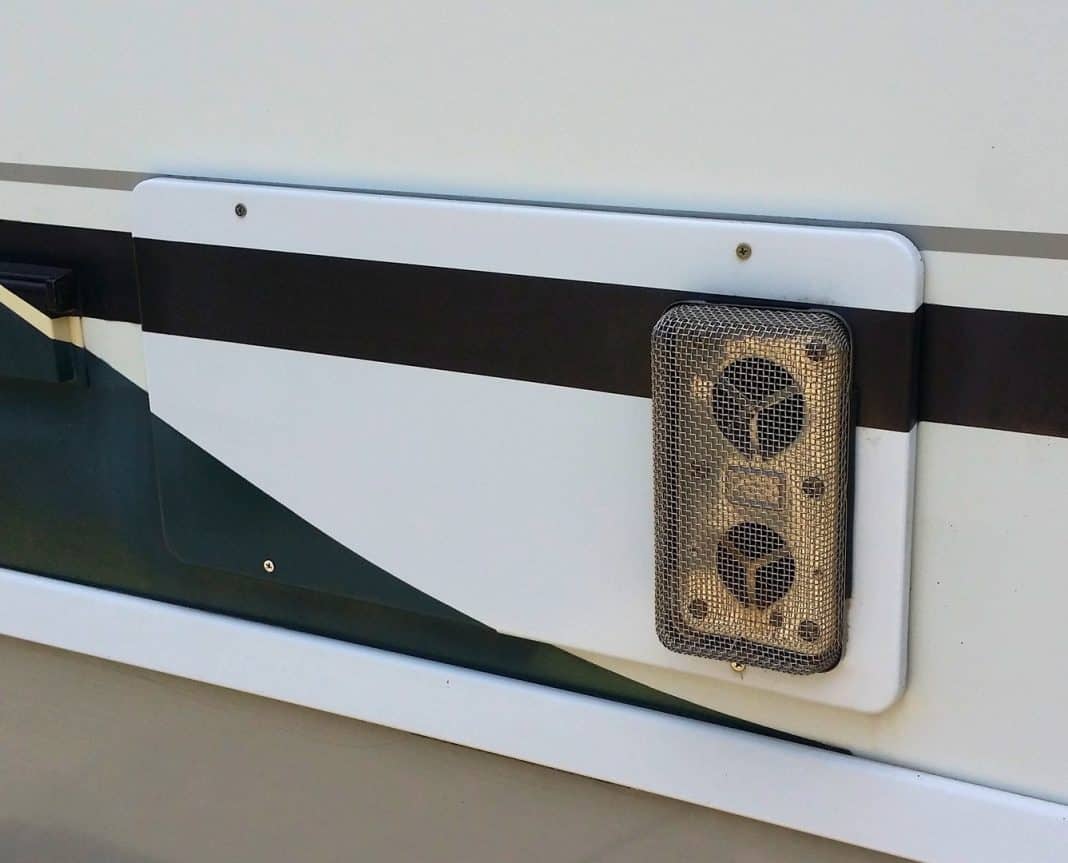 FORCED-AIR
- Standard on virtually all RVs, thermostatically controlled
- Big, heavy, expensive (but built-in and well-hidden)
- Heats the cabin very quickly, much faster than portables
- Noisy
- Battery hog (8-10A) – can drain batteries overnight
- Propane hog – 70% efficiency at best, much heat is exhausted outside RV
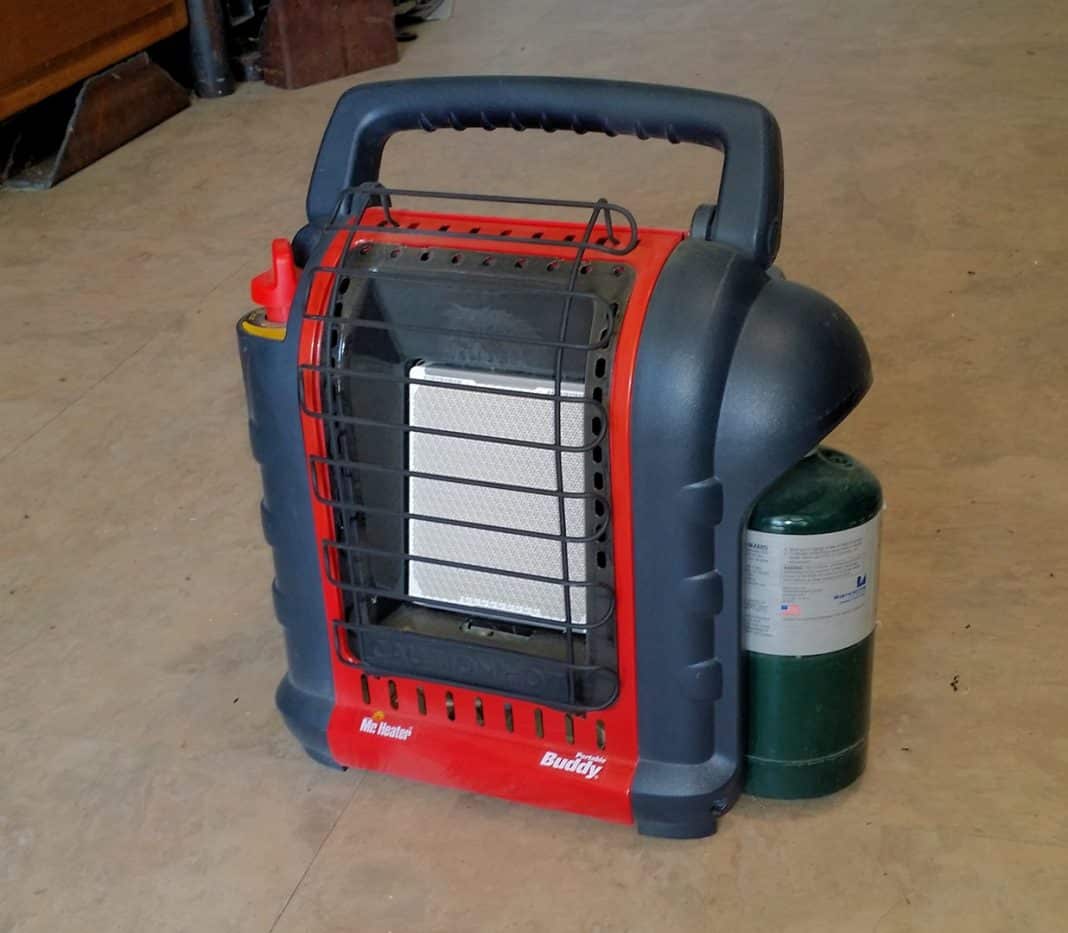 CERAMIC or BLUE-FLAME
- Inexpensive substitute for forced-air heater
- Available with thermostat
- Uses NO battery current
- Nearly 100% efficient
- Generally long-lasting and trouble-free
- Available in portable and wall-mount
- Intermittent or non-op at >4,500-feet elevation
- Can produce carbon monoxide
 CATALYTIC
- Much more expensive substitute for forced-air heater
- Thermostat not available
- Uses NO battery current
- Nearly 100% efficient
- Operational to 12,000 feet elevation
- Cannot produce carbon monoxide
- Must be covered when not in use, susceptible to dust/dirt/spills
- Configurable to free-standing or wall-mount
- Fuel contamination (western states) requires periodic replacement
As you can see, the choice is not always clear, or easy. But I hope this rundown helps you shortcut your learning curve, and/or maybe explain some mysteries you’ve yet unsolved. Good luck staying warm.
Greg Illes is a retired systems engineer who loves thinking up RV upgrades and modifications. When he’s not working on his motorhome, he’s traveling in it.
##RVT854 ##RVDT1447

Interesting comment about propane contamination in the west.
We have owned and used a wave 6 since 2003 with no problems even without covering it and with plenty of western propane run through it. It was made by Olympian before Camco bought them. Don’t know if that made any difference but just say’in.
Interesting that this article and others like it never mentioned that forced air heaters provide heat to isolated spots in the RV that would be subject to freezing during cold weather. Free-standing heaters do not provide this heat only heating the living area.
That’s why, when the temp is going to drop significantly below freezing, we run the forced air furnace shortly before going to bed & then again first thing in the morning to heat up the basement & water tank compartments, but use the Wave heater during the night for efficiency.
We lived on the South Rim of Grand Canyon at 7,400 feet for 16 years. We have a blue flame wall mounted heater that has never given us a problem other than needing a new thermocoupler now and then. For about the last 8 years we were there, we also used a Mr. Heater Little Buddy. Never a problem with it also. These 2 were used in the shoulder seasons (spring and fall) to give us quiet heat. We had to use the noisy furnace in winter. We also used the blue flame heater at 8,500 feet in the Big Horn Mountains of Wyoming one summer (nights get cold even in summer there) without any problems. We always have at least one roof vent open.
We would like to know more about this statement “propane in the Western states is contaminated (intentionally)”. Could you please elaborate?
On the Waves is it not possible to just replace the catalytic panel?
My understanding has been that the factory will not send you the mat material for self replacement. They insist on replacing it at the factory, probably for liability reasons.
There are thousands of us using the Camco Wave heater. We need clarification on why the Western states contaminate propane with a lubricant.
I also have a Wave 6 that is 8 years old and has hundreds of hours of use from sea level to over 8500 ft. 95% of the propane we buy is in the west. We’ve never had a problem.
I’m sorry, but I can’t provide any more information on the contamination issue. I was given this information by a technician at Wave, and I have not pursued it any further. If anybody is curious please feel free to call Wave for more information.
And for certain, if Wave has solved this issue I would be very happy to hear about it.
AquaHot
Or Oasis
We too have been using an Olympian Wave 6 since 2000, mostly in the west with no problems. We do keep it covered when not in use.
WHAT ..a great piece and thanks to all that have commented ..RV’ers are special people and I am so glad to be part of this traveling brothers & sisters since Dec.1977 when the wife and two young daughters bought our first RV trailer and hooked to our quiet new Lincoln Continental 4 dr and headed to Florida west coast for Christmas from Maryland with the girls as I was already into my Naval Air career 15 years and it was a near disaster adventure as our first short trip recommendation was ignored and not smart for sure..But thanks to the RV people along the way ..we are still traveling RV’ers and will never quit until can’t drive anymore..USN{ ret.} 30 years..The heating info was outstanding ..Thanks
About 20 years ago I bought a Martin ceramic heater at the market in Yuma, AZ. I didn’t have any trouble with it until I tried using it in the mountains here in Utah. It would not stay lit. I called Martin and they told me it was designed to operate efficiently at sea level and was told to open a window. It still wouldn’t stay lit.
I had it tapped into my gas line inside the trailer with a long hose so I could move it around.
One day I did a stupid thing to try to use it in my garage with a portable tank without a regulator and ruptured the diaphragm.
I took it to a local repair shop and was told that they could repair it and tweak the air supply as they had done for some heaters at a local ski resort at 9000 feet. They did the repair and I have not had a problem at any elevation since.
We bought a Mr. Heater Buddy, a small, ceramic heater. It produces enough heat for our Class B, and is quiet, etc. We liked it —but— it uses a one-pound bottle that only lasts for five hours on the low setting. Not enough for heat all night. Theoretically, we could have it plumbed into the coach’s propane system, but I was unwilling to make that (probably expensive) move; we don’t spend a lot of time in real cold weather.
I haven’t found any reference to intentional lubricant in LP, but it sounds like a simple gas filter would catch whatever contaminants are the issue. Depending how much contaminant there is, it could be done with a disposable inline filter or an empty-able “dryer” type filter cup.
There IS often contamination (dirt, excess odorizer, etc) in LP, which it’s why there’s always a drip tee or filter on home appliances – not sure why RVs wouldn’t follow the same need.
Good day, Mr. Illes.
We full-time at 9000’± in Colorado, and use a Dyna-Glo Construction Heater. No problems thus far (1 season) other than the tip-over sensor failed. (It was replaced at $0 cost by Dyna-Glo.) We, too, leave a window partially open for venting.
Regards,
Michael
I’m skeptical about this lubricant claim. I searched out some HD-5 propane specs online, including the California state spec, and there is no mention anywhere of a lubricant.
I’ve been using a Buddy Heater and Big Buddy since shortly after they came out around 2000. They have been used extensively in the Ca Sierras and the Rocky Mts at elevation of 8,000’-11,000’ over the years. I’ve heard of the altitude issue from other people and the instructions do state for use under 5,000’. I have never had an issue but it is critical to keep the ceramic element as lint and dust free as possible during non use. I have replaced the Buddy ceramic element once and the primary element on the Big Buddy once each.
There is one more option I use frequently: A Yamaha 2400 is generator and a small portable electric ceramic heater. A person burns fuel any way you go, but gas for the generator is often cheaper than propane in small towns, readily available and chargest batteries while running the electric heater.
I use the generator evening and morning, and the forced air at night when in cold weather. I have a Bigfoot camper, and stay completely toasty.
Great combo, but quiet time is an issue with generators.
Very good article! Learned a lot about propane heaters in a short, concierge article. Thanks
I have used ceramic or blue flame heaters for years at over 7000 ft. elevation with no problem.
I live at 5,000 foot elevation and my Heater Buddy works fine. I don’t use it in the trailer though.
Greg should check out an Espar D4 heater. It burns kerosene or diesel fuel and has and available high altitude kit. Uses 12 v very efficiently. Has a heat exchanger. Uses outside air for combustion. Variable output. Made in Germany and used around the world.
Catalytic heater CAN produce carbon monoxide. The reaction is the same as for combustion: Gas and oxygen react to produce carbon dioxide and water. Just as for any combustion reaction some carbon monoxide will be produced. If a catalytic heater is starved of oxygen or if the catalyst is fouled the rate of carbon monoxide production could increase with potentially deadly results.
There seems to be a lot of confusion about this on the internet.
I’m using Camco Olympian and I felt that It quites good. It is its capability to heat up my RV fast. Even though this is only intended to be used as a secondary heat source, it works great in a motorhome as it provides 4,200 to 8,000 BTU. And it doesn’t make much noise.
You are asking for trouble by using any supplement heater
How about oil filled electric heaters? I use one to maintain temp in my hatching and brooder facility.
You would think that after all these years a manufacturer would come up with an efficient heater. I think after they made the crap they now sell and install they sent home R&D. My stick home has a 90+ efficient furnace,why cant rv’s?
We are very happy with the Alde system in our Cirrus 920 truck camper. It is a hot water system instead of forced air. The boiler heats coolant using propane and/or 1 or 2 1000 watt electric heading elements. A small pump circulates the heated coolant to convectors (radiators) throughout the camper, including the basement to protect the tanks from freezing. It is also a continuous water heater for domestic hot water. It is extremely quiet, efficient, and keeps the camper very comfortable.
My main objection to Buddy or catalytic heaters is the condensation on the windows. Even with good ventilation my windows fog over when I run the heater for long periods of time. I do enjoy the personal hot spot my buddy heater provides.
Has anyone tried the Cheap Heat. I have seen it advertised as a unit that is added into your units duct work, that will not interfere with the functionality of your propane heater, but is run on electricity.
I do not believe this to be true. People have died from these heaters. This is why a vent needs to be open and I would have co2 and low o2 sensor
Greg, we’ve had a Wave 6 for 9 years, spent most of our time in the western US, but have traveled coast-coast in Canada & the US.
It has never failed & like you said, it provides quiet, comfortable heat.
If it ever does fail, I’d have a new Wave 6 tomorrow.
Good old small wood stove fits the bill in a bus conversion I would assume could be nicely modified to a TT or large class A. Solves the elevation issue. Like to know if anyone has done this heat conversion and the outcome.
Hi Greg, I had a similar problem with contamination (oil) from the hose on my Buddy heater. Mr Heater says that you need to use a filter on the heater because the hose emitts oil from the rubber. Something to do with the manufacturing process of the hose. Perhaps this very filter used on the catalitic heater would remove the contaminates from the propane.
You guys need to look at the Catplat heater. It addresses all your cat issues, elevation,thermostats, reliability, servicing.
http://www.ventedcatheater.com
There is a filter made to remove those lubricants from the propane do that you don’t ruin your heaters. It attached to the hose after the tank and before your heater. Just Google propane inline filter.
The Plat Cat is a catalytic heater that has a thermostat.
Thanks, John. I Googled “Plat Cat” and came up with “Plat-Cat™ Platinum Silicone Cure Accelerator is an additive designed to accelerate the cure time of Smooth-On platinum silicone rubber products…”🤔 So, you’re apparently referring to The Platinum Cat heaters, which are “Unique automatic thermostatic controlled fail-safe 12Vdc power vented catalytic heaters.” Here’s a link for those who are interested: http://www.ventedcatheater.com/product-profile Have a good night. 😀 –Diane at RVtravel.com