

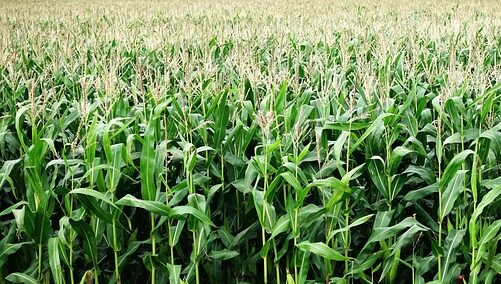
If you’re camping in the Midwest right now, you may well be surprised at how tenaciously summer is hanging on. I’m talking about heat and humidity. Record temperatures continue to plague my home region. In short—it’s hot. Really hot!
Add in the humidity, and staying inside your RV seems like the best option for Midwest campers. Now, to make matters seem even worse, we’re told that corn sweat is adding to the oppressive humidity!
Never heard of it
I grew up in Iowa on a farm, and while we had numerous corn fields on our farm, I had never before heard of corn sweating. Just goes to show that there’s always something new to learn—even for an Iowa “corn country” gal like me!
Sticky heat
“Corn sweat” is an amusing term for a process that makes summer in the Midwest even stickier. It refers to the water vapor released by corn plants during a process called evapotranspiration.
Just like how humans sweat to cool off, plants, especially corn, release moisture into the atmosphere to maintain their internal functions.
How much sweat?
During the hottest months, corn fields can release an astounding amount of moisture. You might want to sit down. It’s that amazing! An acre of corn can emit around 3,000 to 4,000 gallons of water per day. Yikes! This additional humidity can significantly raise the overall moisture content in the air and make already hot days feel even muggier.
While corn is not the only crop that contributes to this, the Midwest’s extensive cornfields make a noticeable difference in local humidity levels, particularly during heat waves, like we’ve seen.
Good sweat
Interestingly, while “corn sweat” can be uncomfortable for those living near the fields, it’s a sign of healthy crops. The plants are efficiently pulling moisture from the soil, ensuring proper growth and photosynthesis. For farmers, this is good news for their harvest. For everyone else, it can mean heat indices that feel much higher than the actual temperature.
Blame corn
So, if you’re currently RVing in the Midwest and feel like the air is extra sticky right now (corn-growing season,) you might have those sprawling fields of corn to thank (or blame)!
Are you RVing in the Midwest now? Tell us in the comments below.
##RVT1173b

Who knew? Ending corn sweat invention will make someone very wealthy. Get busy college labs – i.e., NDSU!
What you are talking about here is “evapotranspiration” rather than sweat. Agronomists calculate the water loss & use this info to understand the water requirements of the crop. With my 3 years in college & the 32+ years I spent out in the fields I have never heard that crops “sweat” & contribute to the relative humidity. Certainly if you were furrow irrigating or using sprinklers to irrigate a crop the humidity there in the field could be a little higher, But once one was a ways away there wouldn’t be a noticeable higher humidity reading.
“Evapotranspiration” and “Corn sweat”
Perhaps just 2 more “Newspeaks” for the updated and approved climate dictionary not dissimilar but certainly less catastrophic sounding than “Atmospheric River”, “Bomb Cyclone” and “Polar Vortex”. All 3 of which have been around for millions of years, just without need of scary weatherman labels.
I guess “Corn Sweat” is more scary than “Evapotranspiration” It sure did sweat all down my chin when I had sweet corn on the cob last night.
Spot on, cancel, as usual.
Back at you Tommy.
If you google “corn sweat”, you will find articles on it, so I guess that is what some are calling it now. I know it is real as I spent high school and college summers detasseling corn. Always more humid in the corn rather than out in the open. Also hoed beans, but they only came up to my knees.
We’re making all preps for getting underway from our summer property in Pine River, MN. Two weeks and counting. Early voting is on 20 Sept at the Cass County courthouse here. Corn sweat? We have lake evaporation here with a body of water about every mile in any direction.
Pine River. I haven’t heard that, in many years. Spent many summers there in the 70s and early 80s. My grandparents lived on one of the many lakes in the area. Beautiful country. I spent a few Christmas holidays there. A bit cold. Lol
Thank you, Gail! 🙂 No, safely once again ensconsed in the hills of East Tennessee and enjoying unseasonably cool weather. 🙂 Interesting. Does the humidity benefit the corn? That is, when the moisture content of the air increases, are the plants more productive, more bountiful? Thanks again, have a great day, safe travels, safe stays! 🙂
So how long has corn been grown in the Midwest?
Mexico 7,000 years, Midwest 1,000 years.
https://www.ndsu.edu/pubweb/chiwonlee/plsc211/student%20papers/articles11/A.Shanahan1/History.html
Cows fart and methane gas contributes to decreasing the ozone layer. Corn sweats and the humidity goes up. If one gets a goose it might lay a golden egg. It’s a wonderful world!
Next big cash crop, corn sweat. Let’s put the Chinese on this one for sure. Food staple? World drought relief? New fuel? Energy source? Addition to the periodic table? Satellite power? Medical weight loss? Environmental scourge?
Addition to the periodic table…. hahaha 😆 😂 🤣😅 that’s freakin hysterical. Hahaha
Thanks Ken. LOL HAHAHA
Great! More ammunition for Climate Cultists.
Where does that water come from? In many areas, from aquifers that are like bank accounts being run dry.
“The Ogallala Aquifer, the vast underground reservoir that gives life to these fields, is disappearing. In some places, the groundwater is already gone. This is the breadbasket of America—the region that supplies at least one fifth of the total annual U.S. agricultural harvest.”
I’m swearing off corn immediately.
Corn actually gives off 3,000 liters of oxygen per hour. Let’s hear it for photosynthesis! So we have a bit more humidity, I’ll take a more oxygen.