

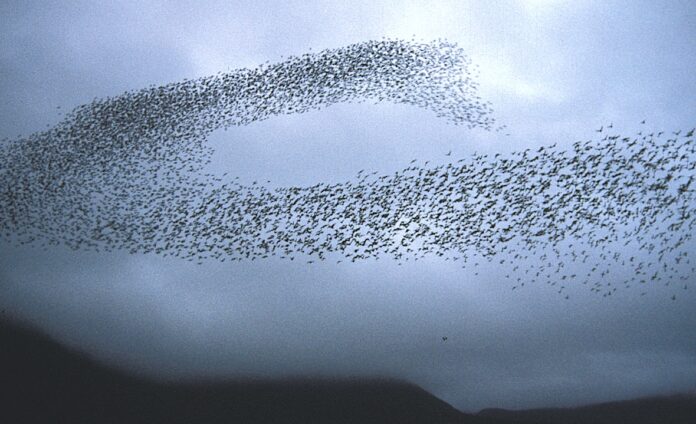
Have you marveled at how a flock of birds can fly together in the sky, moving poetically like a giant black cloud? Why don’t they bump into each other? Who would think it’s because they’re ambidextrous.
Flocking, the collective motion of many individuals as a whole, only works if each individual can stay in perfect balance and avoid favoring the left or the right side, University of Oregon (UO) research shows.
It’s one reason why in nature flocks will eventually fall apart. They can only sustain for so long when conditions aren’t ideal. Beyond swooping chimney swifts or swarms of ants, flocking theory also helps scientists understand other kinds of collective movement, like how cancer cells or bacteria divide and spread.
UO physicist John Toner has studied flocking for decades. His research has helped show that movement is a critical aspect of flocking. A crowd of people standing in a field can’t all point in the same direction—but if those people are moving, they can align to move in the same direction.
His latest work, published in the journal Physical Review E, brings in the influence of handedness, or an individual’s tendency toward the right side or the left side.
Handedness
Most things in nature have some degree of handedness. It’s one reason why people lost in the woods will find themselves going in circles, even if they swear they’re going straight, Toner said. A tiny bit of bias towards one side or another, amplified over many steps, sets one on a curved path.
At the microscopic level most molecules have a handedness, too. For example, DNA’s double helix spins to the right in most cases. This handedness affects the way cells divide, bacteria spread and proteins move throughout the body.
To understand how handedness influences flocking behavior, Toner and his colleagues repurposed a mathematical equation often used to predict crystal growth.
A flock will only stick together if each individual is ambidextrous, or has a perfect balance of left pull to right pull, his calculations suggest.
“It turns out that even the tiniest bit of pull to one side will eventually disorder the flock,” Toner said. “So what will happen is the guys over here will get out of sync with the guys over there. And if you look at the flock as a whole, you’ll find creatures moving in all different directions, so there’s no coherent motion left.”
Why flock numbers may remain consistent
The study assumes the flock is “Malthusian,” that its overall numbers remain consistent because individuals are constantly being born and dying within the flock. While on the surface this seems more complicated, Toner notes, it actually makes it more straightforward to map mathematically because it removes fluctuations in the flock’s density from the equation.
The work is theoretical, but Toner next hopes to test it through computer simulations—and hopes that experimental researchers might put it into practice.
“I’m doing this work because I’m following my curiosity,” he said. “But inevitably, as often happens in science, things you study just out of curiosity wind up having all kinds of applications.”
MORE POSTS ON NATURE AND WILDLIFE
- Nature: Alligators are surprisingly smart, can even know their name
- Spring encounters turn dangerous as wildlife moms protect young
- Get ready to smile! The 2025 Comedy Wildlife Awards are here
- Bison safety: If a bison does this… RUN!
- Another Yellowstone tourist gored by bison
- Humorous public safety video laughs at ‘tourons’
- Strange wildlife sightings happening across national parks
- Don’t approach these cute little fellows. They’d like to eat you!
RVT1269
