


This question about LP tank recertification came from our RV Repair Tips & Tricks Facebook page and it has generated quite a debate with over 350 comments:
My mother-in-law is looking at a camper and this is the propane tank. I was wondering if you guys had any advice.
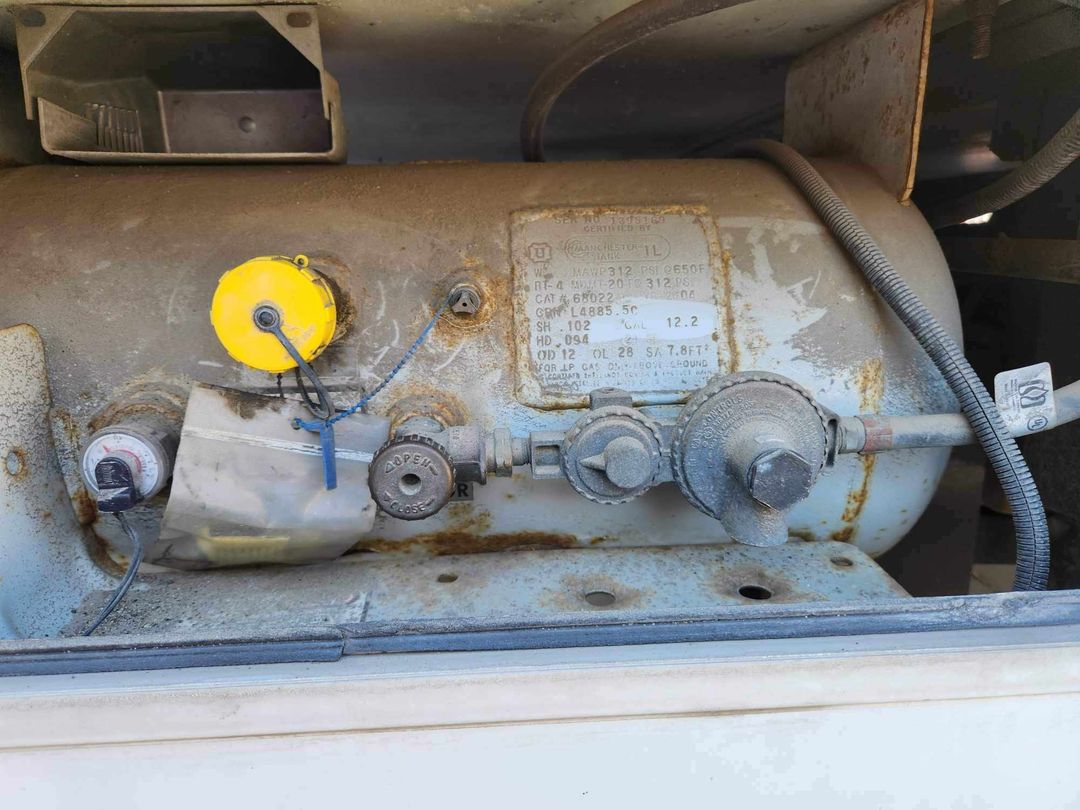
I’m being told that I can’t get it filled up, but I wanted to know what other people thought. —Matthew
From Dave: I’ll post some of the comments that came in response to that inquiry. However, as you can tell from the over-400 comments, you really need to be careful when it comes to advice in social media!
For all propane related questions, I go to the experts: Trey Selman from RV Safety & Education Foundation (RVSEF); Marshall Brass, which makes the fill valve; and Bob Mangas from Manchester Tank. (And, yes, that is really his name!)
Tanks vs. cylinders
There is much confusion in the industry when it comes to LP containers, so a little clarification is needed to start with. The portable containers used in travel trailers, 5th wheels, and even residential grills are classified as DOT cylinders, and they are removable. The permanently mounted containers used on motorhomes are American Society of Mechanical Engineers (ASME) tanks.
DOT cylinders
According to the Code of Federal Regulations for DOT Requalification of Propane Cylinders, 49 CFR 180.209(e), DOT cylinder types 4B, 4BA, 4BW, and 4E must be recertified 12 years after the manufacture date and then every 5 years if requalified by visual inspection. However, according to RVSEF, if the recertification is done by a proof pressure test, then the recertification is 10 years. The type of cylinder and manufacture date is stamped on the upper bracket.

ASME tanks
According to Manchester Tank and RVSEF, ASME tanks used on motorhomes are made of a thicker metal component and do not require recertification, rather visual inspection for excess rust and pitting, loose or missing brackets, and damage.
For more specific information, visit the Code of Federal Regulations for DOT Requalification of Propane Cylinders here.
Overfill Protection (or Prevention) Device (OPD)
Since propane can expand in the container, an OPD valve has been required that prevents filling the container more than 80 percent, which leaves room for expansion. DOT cylinder regulations went into effect in October 1998, and featured a triangle valve handle to identify the new valve.

ASME tanks on motorhomes have had a 20 percent limiting valve since 1983 and do not require the triangle handle.
Here are some of the comments from the Facebook site:
“If it’s beyond 10 years from the manufacturer date they can’t fill it.”
“I tried to get my old one Inspected but the propane place said if you don’t smell gas and then it’s good. They aren’t known to go bad unless you put a hole in it.”
“Lol. I’m using a home tank with a 1956 manufacturing date, no problem filling it!”
”It needs recertification after the date on the tank is expired. In Texas, not sure about your state.”
“These comments are the perfect example of internet advice.”
“Clean it and take it to be recertified.”
“Get an adapter and fill it yourself.”
” Tanks age out and need to be replaced or recertified.”
Conclusion
These are just a few of the over-400 comments so far. You can see why it’s important to consult an expert, as there is a bunch of confusion and misinformation out on social media. Some of the confusion comes from within the industry, as the NFPA 58 lists 7 years; however, that is just for the DOT cylinder. According to my sources, it is listed that way as they have not updated their information since the 2020 change!
So, why would this be refused by a fueling station? First, all employees that will be filling any propane container must be certified. Sounds good on paper, but have you seen the kids at the local Ace Hardware store? I have witnessed several old-style DOT cylinders being filled that did not have the triangle OPD valve. We all know that good help is hard to find. Actually, any help these days is hard to find. So we end up with employees that get to interpret what should and should not be done in many cases.
My guess is whoever looked at this tank either interpreted that it needed to be recertified or it did not have the OPD valve as the handle is round. According to my sources, this tank does qualify for filling as it only has surface rust and the manufacture date is 2004. They did recommend getting an LP system pressure test before purchasing to ensure all the hoses, regulator, and connections are in good working order.
You might also enjoy this from Dave
Should I cover my RV’s gas tanks for the winter?
Dear Dave,
I’m using a cover to protect my travel trailer for the winter. Is it okay to cover the gas tanks too? —Jennifer
Dave Solberg is a leading expert in the RV industry and the author of the “RV Handbook.”
Read more from Dave here.
HAVE A QUESTION FOR DAVE?
Send your inquiries to him using the form below.
##RVDT2243


Thanks for this one. Need to look at my DOT tanks. Not even worried about the ASME tank.
In my experience, it’s sometimes hard to find the build date on trailer tanks. They do not all look the same, and it’s a crap-shoot when you go to get them filled. Some ‘trained experts’ can find the date and some can’t. When I finally found the real date I circled it with a Sharpie marker to make it easier for all to see.
Thank you, Dave. Both our RVs have been all-electric, so propane dos and don’ts are largely unknown to me. Thank you for this discussion and information. I am slowly learning about propane with respect to RVing. Oddly enough, our sticks-and-bricks DOES have propane for our grill and a fireplace. Thanks again! 🙂
Yes I was reading some of those comments on FB, kinda scary on some of the answers! My question was WHO told him it couldn’t be filled. After reading what Dave had said about un-trained non certified employees its easy to understand. Like Dave said its hard to get good help these days!
Snoopy
Portable tanks old like mine is? Just go to a place that exchanges tanks and get the freshest by date you can find. It will be filled ( funny if you call 15# filled )but now that tank is yours to take anywhere to be filled. Anyone working with propane should be aware that asme tanks don’t need certification
I have a 1999 Lance slide in camper with 2 7-gallon propane tanks. Never had a problem filling them until somebody actually looked at the manufacturing date, they were 20 years old.
I was told they could not be filled. I delt with a large propane company through work and they could recertify them. They inspected the tanks and replaced the valves. Cost me less than $200 for both tanks with propane. Good for 5 more years.
Cost for 1 new tank $250.
I check my ASME tank myself and have spray painted the bottom which rides close to the road with derusto paint.
Looks great after all these years….(;+)………
If travelling to Canada, be aware the rules there are different. 10 years from date stamp, not 12 and visual recerts are not recognized. The tank has to be hydro tested and a new valve fitted. 99% of the time a new tank is cheaper.