

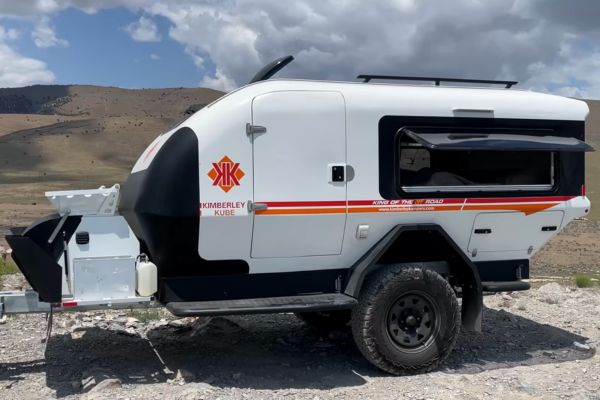
For a lightweight, basic, hard-sided camper, let’s take a look at the Kimberley Kube. In the video at the end of this post, we get a tour from the team at ROA Off-Road, accompanied by Kimberley Kampers’ owner, James.
The Kimberley Kube is built for campers moving up from roof tents and small tent trailers, but who still want real off-road gear. The result is a compact camper that feels much bigger than its footprint.
Why Kimberley built the Kube
Kimberley Kampers spent 32 years building canvas campers, but the Kube moves away from fabric. James said that shift came from changing weather demands, especially in the U.S., and from younger buyers who want comfort without towing a big caravan/trailer.
It also lands in a smart middle ground. At 17’4″ long and a little over 6′ wide, the Kimberley Kube stays compact, easy to tow, and easy to store, while still giving campers a place to sit inside when the weather turns.
A lighter trailer with real off-road hardware
At about 2,500 pounds, the Kimberley Kube is built to tow easily. Its tapered nose and tail, shaped with help from an American aeronautical engineer, cut drag by up to 20 percent compared with a square trailer. Kimberley says that can trim fuel use by 7 to 8 percent, which matters even more for EV towing.
Underneath, it keeps classic Kimberley hardware: a hot-dip galvanized laser-cut chassis, independent trailing arm suspension, and vented disc brakes with electronic-over-hydraulic control. The pod is a single-mold fiberglass body bolted to the chassis. Outside, sliders double as steps and quick side seats.
Inside, it feels bigger than its footprint
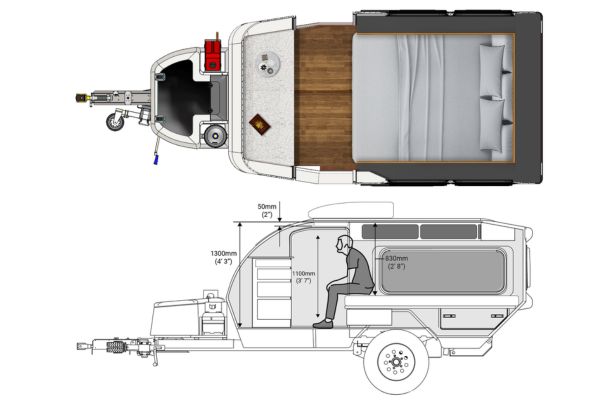
The cabin is where the Kimberley Kube separates itself from most teardrops. Big wraparound windows, privacy shades, and bug screens bring in light and airflow, while the low-clutter layout keeps sight lines open.
A king bed converts into a futon-style lounge, and the bed can be made from outside through the side windows.
Storage is better than expected, too. There is a 130-liter front-loading fridge that opens from inside, a slide-out table for meals or work, overhead aluminum cabinets, and a large drawer under the bed.
Power, four-season use, and a kitchen that works
The front box starts with a 460Ah heated lithium battery and can grow to 920Ah. It also gets DC and AC charging, solar input, and a 2,000-watt inverter.
Diesel heat and hot water come standard, and a 12V air conditioner is an option.
Kimberley also paid close attention to U.S. weather. Most plumbing stays inside the cabin, the tanks are insulated, and heater elements help stop freezing. Inside, aluminum cabinetry, acrylic tops, and recycled PET insulation help hold temperature with less power use.
The U.S. version is wired for 110V at the factory, and buyers can choose natural or gray interior finishes.
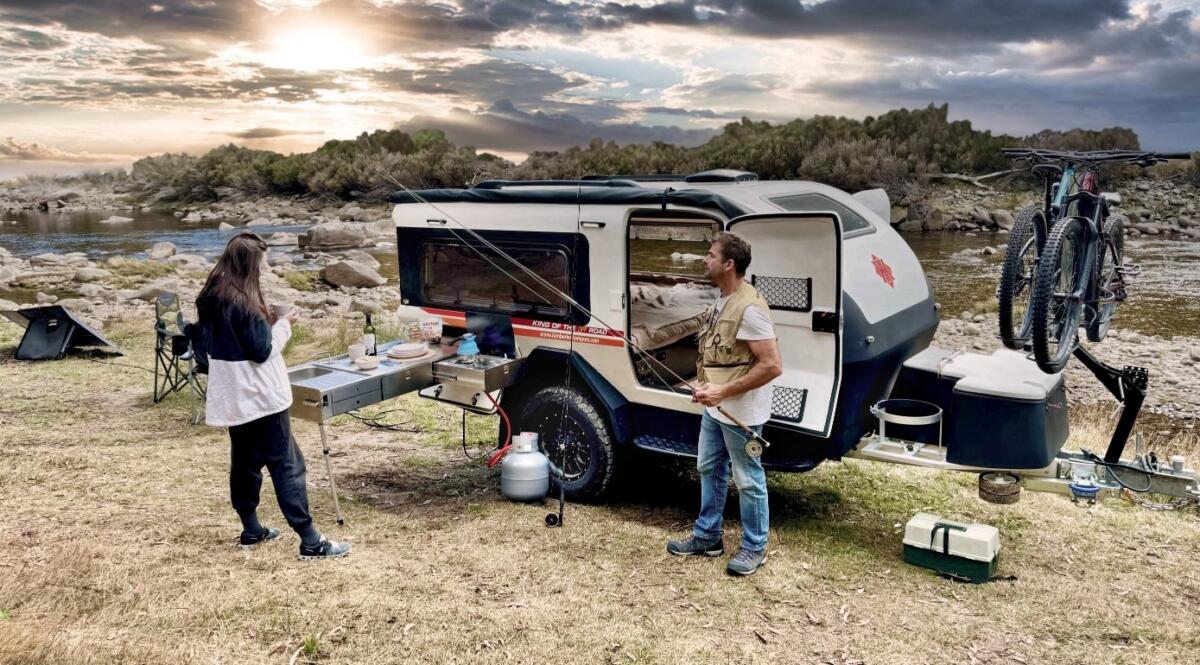
Outside, the long slide-out galley is one of the Kimberley Kube’s best ideas. It includes a stainless worktop, hot and cold sink, filtered water, drawer storage, and a raised breakfast bar that opens up the whole cooking area.
Final thoughts
The Kimberley Kube feels closer to a compact hard-sided overland camper than a basic teardrop. It keeps the tough chassis, adds real insulation, and makes camp life easier.
For singles or couples who want off-road range without towing a large trailer, that mix is the point. The Kimberley Kube stays small, but it does not force campers to live small.
This Australian camper is now available in the U.S. Get more details here.
MORE LIKE THIS:
- New teardrop-sized trailer has wet bath with stand-up shower
- This PinDrop teardrop trailer fixes small camper frustrations
- Huh? Why does a teardrop-type trailer need a big screen TV and fireplace?
- 2026 Keystone Springdale Mini 1200BT—Tiny, but workable… for some…
RVDT2921
