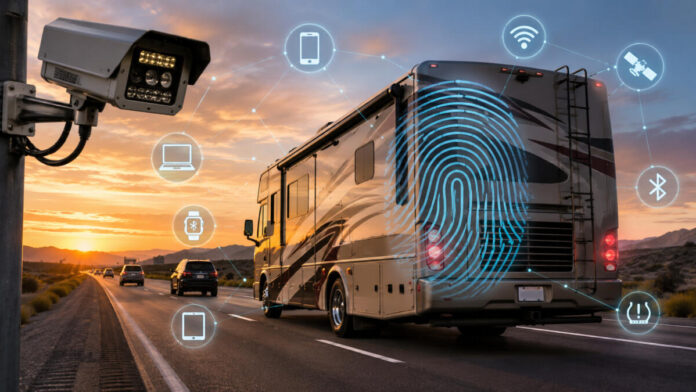
For years, automatic license plate readers have done exactly what their name suggests: capture license plate numbers and compare them against databases used by law enforcement and other agencies. But some companies are now trying to do more than just read license plates.
But tech company, Leonardo, says its SignalTrace™ can connect a vehicle to the collection of phones, tablets and other electronic devices traveling with it, creating what the company calls an “electronic fingerprint.”
That’s one reason some RVers are paying attention.
Leonardo, a company known for license plate reader technology, says its SignalTrace™ system collects identifiers associated with Bluetooth, Wi-Fi, RFID and other wireless technologies and correlates that information with license plate reader data. It says the process creates what it calls an “electronic fingerprint” that can help distinguish one vehicle from another.
Leonardo says SignalTrace can operate alongside license plate readers or independently at collection sites. The company also says the system captures device signals but does not decrypt or read the contents of devices or their communications.
For RVers, it raises an obvious question: How much information is your rig broadcasting as it rolls down the highway?
Why RVs may stand out
A typical passenger vehicle may carry a phone or two and perhaps a smartwatch. An RV often carries far more connected equipment.
Many RVs travel with multiple smartphones, tablets, laptops, smartwatches, and tire pressure monitoring systems. Add on Wi-Fi hotspots, Starlink equipment, streaming devices, smart televisions and connected infotainment systems.
Leonardo’s product literature specifically references signals from smartphones, Bluetooth devices, RFID tags, vehicle components and Wi-Fi equipment.
“Many RVs travel with multiple smartphones, tablets, laptops, smartwatches, tire pressure monitoring systems, Wi-Fi hotspots, Starlink equipment and other connected devices that may create a distinctive electronic profile.”
Taken together, those devices may create a distinctive collection of electronic signals moving with the vehicle. Leonardo says SignalTrace can recognize groups of devices that frequently travel together, identify recurring movement patterns and use those patterns to create what the company calls an “electronic fingerprint.” The company says that information may help investigators recognize vehicles or individuals of interest even when a license plate number is unavailable.
According to Leonardo’s marketing materials, SignalTrace is designed to identify patterns among those signals and connect them with license plate reader information. Leonardo says the technology can help investigators associate vehicles with recurring electronic identifiers, potentially providing additional leads when license plate information is unavailable or incomplete.
What we know—and what we don’t
The existence of SignalTrace is not in dispute. Leonardo publicly markets the product and describes its capabilities in company literature.
Leonardo’s public materials describe the technology’s capabilities, but they do not identify agencies currently using SignalTrace or provide information on how widely it has been deployed. Independent reporting has likewise noted that deployment details remain unclear.
It’s also important to separate manufacturer claims from demonstrated results.
The available information does not show that law enforcement agencies can track every phone, tablet, or connected device. Nor does it establish that all vehicles are being monitored through this type of system.
Instead, the technology appears to represent a new direction in vehicle identification—one that attempts to supplement license plate information with electronic data collected from devices near a vehicle.
Privacy questions are likely to grow
Privacy advocates have long raised concerns about automatic license plate reader networks because they can document where vehicles have traveled over time.
Systems that attempt to connect vehicles with electronic identifiers are likely to generate additional debate.
Supporters argue that such tools can help investigators locate stolen vehicles, identify suspects and solve crimes. Critics question how much information should be collected about people who are not suspected of wrongdoing and how long that information should be retained.
Those debates are likely to continue as vehicle technology becomes increasingly connected.
Why RVers should care
Nobody knows yet whether SignalTrace will become a common law enforcement tool or remain a specialized technology.
The bigger story may be what it says about where vehicle technology is headed.
Modern RVs are carrying more connected technology than ever before. As vehicles become rolling networks of phones, hotspots, sensors, and internet-connected devices, new technologies are emerging that attempt to use those signals as investigative tools.
For now, SignalTrace appears to be less a story about what law enforcement can already do everywhere and more a glimpse of where vehicle-tracking technology may be headed next.
SOURCES
Leonardo SignalTrace product page
Leonardo SignalTrace product sheet
The Drive
CarBuzz
RELATED
- Does today’s technology enhance or detract from the RV experience?
- GM technology aims to identify older motorists no longer fit to drive
- Who will decide when to hang up your RV keys?
- Slow left-lane drivers beware: New law could land you in jail
- Blowing in the wind: Truckers’ tips for safe driving
- Driving safety: What we’ve learned from highway mishaps
RVT1266b