


Dear Dave,
I’m looking to purchase this Class A with basement A/C. Do you know of problems with this system? I know the option didn’t last very long. Thanks for the info. I read your column every day. —Robert, 2004 Winnebago Itasca Suncruiser
Dear Robert,
The Itasca Suncruiser features what Winnebago called TrueAir, which is a dual compressor air conditioner that is mounted in the basement rather than on the ceiling. It was designed by Coleman, with is now Airxcel, and actually Thor back in the 1990s.
I had the opportunity to see the test unit that was installed in a Winnebago SuperChief at the Good Sam Rally in Sedalia, MO, back in about 1990. We were conducting the Motorhome School for the event and it was over 100 degrees during the entire week. Two Coleman technicians were at the rally with the prototype and it was a cool 70 degrees inside the unit! That unit had some bugs to work out, though, as one compressor was mounted in the front overhead cabinetry and was really noisy and had condensation issues.
Central air conditioning system
Coleman perfected the design and Winnebago introduced it in the Vectra in 1993 as a revolutionary new central air conditioning system. The dual compressors were located in an exterior compartment. The first generation was in the middle with a plenum* that ran up inside the coach between the sofa and the kitchen countertop. [*From Merriam-Webster: plenum: an air-filled space in a structure, especially one that receives air from a blower for distribution (as in a ventilation system).] It was wrapped with “disco-like” mirror strips and was not received very well by the public due to the space it took up.
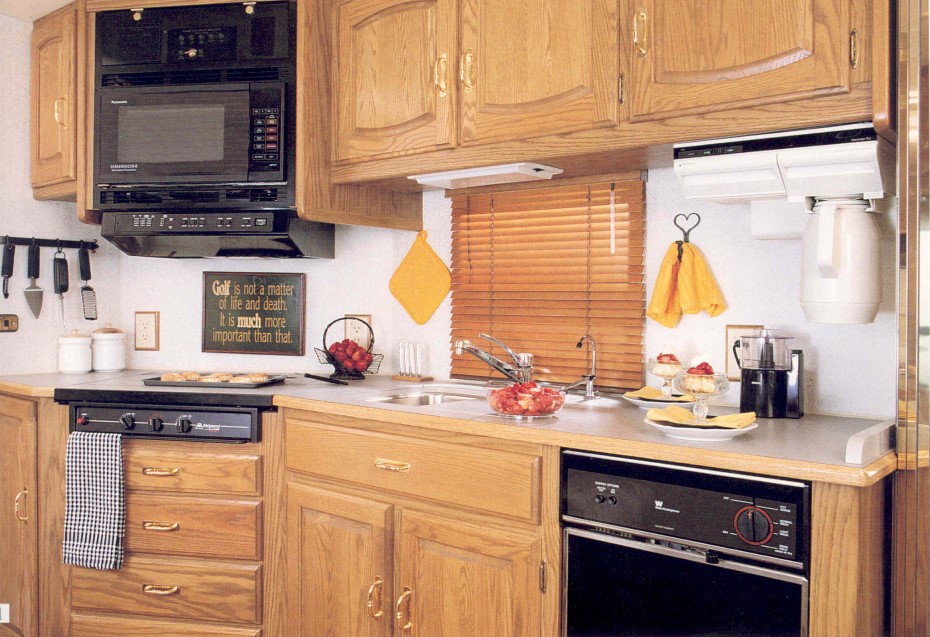
Here you can see the gold mirror stripes to the very far right of this galley photo from the 1993 Vectra brochure. The concept was good and the technology was cutting edge, as it ran 25% more efficiently than traditional roof-mounted compressors. It was a true “central air” system ducted in the roof.
My parents actually owned one of these for several years and loved the concept. They just did not like the loss of a storage compartment on the shorter 33’ model. Somewhere between 1996-1997, the units were moved to the rear compartment with the ductwork going up through the back cap.
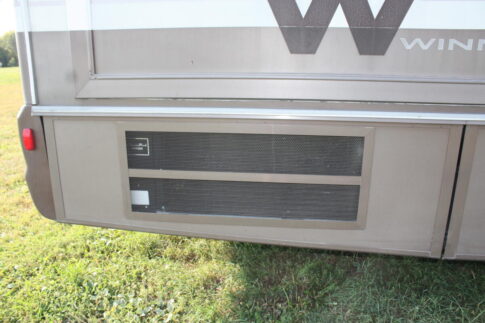
This design was not offered on all units, as there were design issues with the ductwork and other floorplan obstacles.
Cutting-edge technology
As I stated earlier, the technology was cutting edge. However, it was not well-received by the buying public due to many misconceptions. Many thought the condenser coil being open to the outside would draw exterior air and distribute it throughout the coach. This meant that exhaust fumes, campfire smoke, dust, and other smells would come into the rig—which was not true. The condenser coil is the same design as the roof-mounted, which draws exterior air through the coil to cool the “flashed”, very hot coolant running through the copper tubes. Then the air is exhausted out and never gets into the coach, just like the roof air conditioners.
Noise issue
The next issue was the noise at night, with the compressor being directly underneath the bed. We conducted actual decibel readings comparing the noise at the bed level with the lower-mounted compressor versus the roof-mounted in the bedroom. The TrueAir version was actually quieter.
And finally, the biggest complaint was the elimination of the storage unit. This was especially true on some of the diesel pusher units that had no storage in the back due to the engine. The TrueAir took up some valuable cargo space forward of that.
In my opinion, the 2004 Itasca Suncruiser, along with it’s identical twin, the Adventurer, were some of the best-value motorhomes on the market. The TrueAir was an outstanding design. What really killed it was the competition using the misconceptions for sales propaganda, which is common in the RV industry. And even though I took the Winnebago “blinders” off a long time ago, I doubt you will find a better-built unit on the market.
You might also enjoy this from Dave
It’s 89 out and my RV’s air conditioner only “cools” it to 86. Help!
Dear Dave,
My air conditioner is working and blowing cold air but can’t keep up with outside temperatures. Both compressors seem to be working. I just had the Freon checked and that’s good. We are camping now, and the outside temperature got to 89 and the thermostat in the camper said 86. The unit didn’t turn off all day until about 10:00 at night, when the outside temperature dropped. I’ve also changed filters and cleaned the condenser. Any suggestions? —Tim, 2006 Winnebago Adventurer 37
Dave Solberg is a leading expert in the RV industry and the author of the “RV Handbook.”
Read more from Dave here.
HAVE A QUESTION FOR DAVE?
Send your inquiries to him using the form below.
##RVDT2279

This was interesting, Dave. Thanks.
I believe you meant condenser when you were talking about the evaporator.
You are correct, I went in and made the change. Thanks for the catch, there was a loose nut behind my keyboard yesterday!
We had two different Winnebago motorhomes with Tru Air: A 2002 and 2007 39′ Journey DPs.
Tru Air (AC & Heat Pump) was head over heals above roof mounted ACs!!! More efficient, more quiet, one house-style 14×20 filter that was easy to change, and no big holes in the roof or AC units getting hit by branches or water draining down the sides. We absolutely loved the system!
The problem with them now is if they break down. From my reading of comments by those that have them, it is hard to get anyone to work on them and parts can be an issue. An AC “guy” might work on it, but the owner may need to remove it…not an easy chore.
Too bad…they were the best!
Actually they are designed the same as the roof air models so service and parts are identical. I believe this past couple of years it has been difficult to get service or parts for anything!
Thank you, Dave! I met a guy with a Winnebago who had this type of air conditioning. He raved about it. We were all tailgating at a football game, so the reduced storage was no problem. I don’t know how much he traveled in it, but he did make me jealous. At the time, we had a 43′ DP and losing a storage bay would not have been a deal breaker. In our current 36′ DP, one less storage bay would be acceptable, depending on which one. Thanks again and merry Christmas!
Check out RV with Tito on YouTube. He just did a full conversion on his. Involved but interesting!
https://m.youtube.com/watch?v=ylhBT67JqdM
Yes Dave, I have the basement air in our 1994 Vectra 34′. It is a marvelous system!! Quiet, super efficient, so far trouble free. The filter is a standard size house filter and under the couch. We love it. Set it and forget it! No black streaks down the sides or drips over the entry or windows. It does take a bay. I put a piano hinge on the mirror panel which covers the duct to the ceiling – stores a lot of long type stuff vertically. Flags etc. I would prefer it be located more to the rear for weight and balance as ours is aft of the first forward street side compartment.
I believe some of the Alpha See Ya motorhomes had central air. Check out “Liz Amazing’s” 2005 coach with central air here: https://www.youtube.com/watch?v=jVn4sZ3ODF8
We are the original owners of a 2004 Suncruiser 35U – 160K miles, 49 states, 9 Provinces, 30 MLB fields. The Coleman basement A/C has kept us comfortable through many summers in AZ, TX, FL to NYC to Halifax. Actually had no issues with the actual heat pump so far (knock on wood) but loads with the thermostat in the hall. Replaced it 3 times after total failures, had to do some minor rewiring this last time – and all 3 thermostats read 4 degrees higher than the actual temp. Still traveling in it. Agree with Dave’s last paragraph.