


I recently read a series of posts on an RV forum that focuses on trailers rather than motorhomes. The focus was on “what brand” tires to get when replacing the current tires. There were a number of posts such as: “I like XYZ brand because I use those on my car.” Or “ABC brand is best because they have ‘stiffer’ sidewalls.”
As a Tire Design and Forensic Engineer, I felt that all the posts were missing the point, as none were focused on “tire durability.” In my opinion, tire durability should be at the top of the Feature list when shopping for RV trailer tires. This is due to the relatively high failure rate of tires in trailer use.
But I understand the difficulty is knowing which brand or type tire is going to be most durable.
Interply shear
A couple of years ago I was hired as an “Expert on tires in RV application” by a law firm that was involved with a nationwide class action lawsuit. This gave me the opportunity to examine tires from a few different tire companies.
The condition of concern is called “interply shear”. You can learn more by reviewing these posts on that topic.
What I was able to observe was that tires that included a “cap ply” over the top of the two steel belts in the tread area had smaller cracks or separations between the two steel belts. This indicated longer tire life before there was a failure of detachment of the steel belts.
The challenge facing RV owners is to learn which tires have a cap ply, as this is seldom a feature that is mentioned in sales literature.
In my opinion, the best you can do is to inspect the material list molded on the tire sidewall and see if the list mentions an additional layer or “ply”. Here is an example of the information that I suggest you look for.
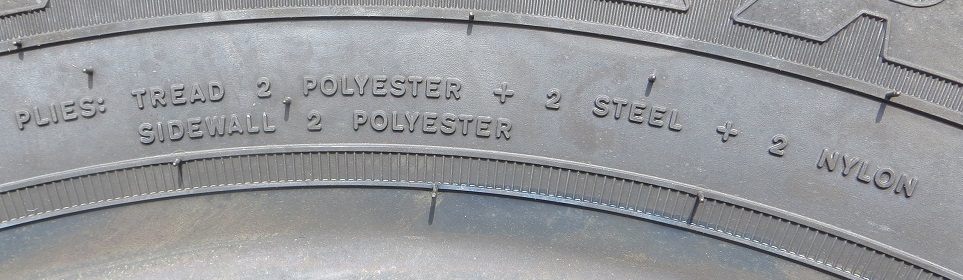
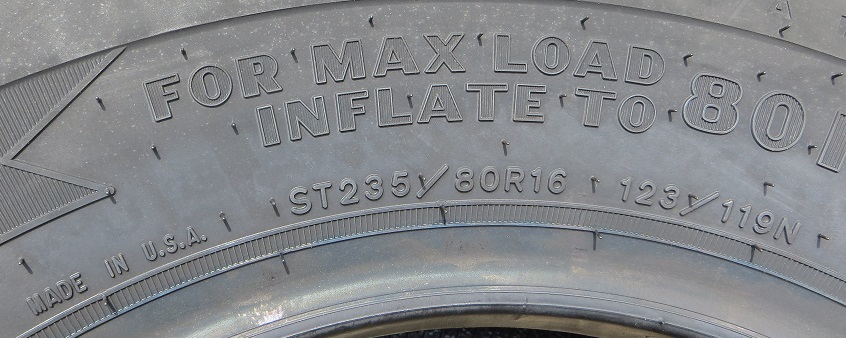
As you can see, the subject tire is an ST-type tire and lists 2 ply of polyester in the sidewall + 2 ply of steel + 2 ply of nylon in the tread area.
Note that some companies may use materials such as rayon or aramid instead of nylon. I believe that all three of these materials will provide similar improvements in tire durability.
Roger Marble
MORE ON TRAILER TIRES
- Must I use ST tires on my travel trailer, or can I use LT-type?
- What is the proper inflation for my tow vehicle and RV trailer tires?
- Do you need to balance RV trailer tires?
- Uneven wear on trailer tires may not be due to defect
*****
If you have tire questions, check out Roger’s Blog as well as his posts on RVtravel.com. There are hundreds of posts covering everything to do with tires.
If you still have a question for Roger after searching the above posts, send your inquiries to him using the form below.
RVT1228

Roger, we know “interply shear” can result in the separation of belts in a radial tire. Thank you for some information on tires that better resist this. Could you also please provide information on road conditions and driving behavior can cause this? As I understand it, single-axle trailers are more immune.
Driving behavior. Max speed of 65 mph. ALWAYS run TPMS. Confirm TPMS is working at least once a year test as I covered in this post https://www.rvtravel.com/have-you-tested-your-tpms Inflate to +10 psi over the minimum PSI in your tire Load Inflation table.
Roger, besides trying to find ST tires with more plys, how can a person find and secure the newest tires. In other words, not buying a new tire today that was made a year ago, or even more.
I don’t know of any specific outlet of tires that can always provide the newest tires. If you deal with tire stores run by the tire company then you will be more likely able to get newer tires and the tires you get will more likely to have been stored in better warehouse. The best you can do is ask about tire production date and confirm by reading the DOT serial. 1 year or less would be fine. I would not buy tires more than 2 years old if possible.