


Dear Dave,
I own an Entegra Coach 2025 that the manual says an anode rod is not required. I would like to install a Magnesium anode rod for hard water. Will it cause any issues? —Janet, 2025 Entegra
Dear Janet,
If your manual states an anode rod is not required, most likely you have an Atwood water heater, which does not have one due to the design of the tank itself. Suburban does require one to be a sacrificial metal for minerals in hard water.
Atwood water heater
This is the description Atwood has in its service manual:
The Atwood water heater tank is constructed of a core of high strength aluminum. The interior of the tank consists of a 15% thickness of type 7072 aluminum (pure aluminum and zinc) that is fused to the core during the rolling process. This material protects the tank from the effects of heavy metals and salts found in waters throughout the country. It is anodic to these heavy metals and acts much like an anode in a steel glass-lined tank except it will last much longer.
There is also no need to replace an anode on a yearly basis.
Flushing the tank on a regular basis has been found to be helpful in insuring the best performance of your water heater and adding to the useful life of the tank. For flushing instructions see your owner’s manual or contact Atwood for a copy of our recommended procedures.
Suburban water heater
Here is the description of the function of the anode rod in the Suburban service manual:
ANODE PROTECTION – WATER HEATER
Each Suburban water heater is equipped with a replaceable anode rod. The sacrificial anode equalizes aggressive water action providing cathodic protection for the tank. The anode rod is a very important factor in tank life and should only be removed for inspection or draining. Replacement of the anode rod is recommended when consumption or weight loss is greater than 75%.
With regular inspection and replacement of the anode, tank life can be greatly extended. Frequency of anode replacement will vary depending on the water conditions and usage.
Sediment on the bottom of the tank forms a layer of insulation between the gas burner and the water. The sediment slows heat transfer and overheats the tank bottom. Overheating weakens the steel and damages the glass lining, shortening the tank life. In addition, it lowers the energy efficiency of the tank.
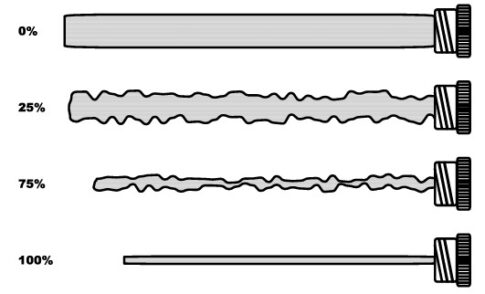
OPERATING THE WATER HEATER WITHOUT THE ANODE VOIDS SUBURBAN’S LIMITED WARRANTY.
Why not to use an anode rod in an Atwood tank
You should not use an anode rod in an Atwood tank as it provides no benefit and is a waste of money. In addition, and more importantly, it will create a reaction to the minerals in the hard water called galvanic corrosion and may cause the metal of the drain plug to seize to the threads of the tank.
You might also enjoy these posts from Dave
- RV’s water heater pressure relief valve drips. Should I replace it?
- My RV’s water is scalding hot. Can water heater be adjusted?
- How to tell if water heater pressure relief valve has gone bad
- Replaced RV’s on-demand water heater; why no hot water in sink?
- Is there a 120-volt-only water heater that will replace my LP-only Suburban?
- Water leaks under kitchen sink when using water heater on LP. Dealer can’t fix it!
- My RV water heater will run on LP most of the day then stops. Any ideas why?
DAVE HAS ANSWERED MORE THAN 1,000 readers’ maintenance and repair questions. Read a directory here. There is so much to learn!
Dave Solberg is a leading expert in the RV industry and the author of the “RV Handbook.”
RVDT2718

The newer Dometic (they bought Atwood) heaters (mine was manufactured in 2021) do not use a water drain plug (inner threads), they use a water drain cap (outer threads). So far as I have been able to find, no one even makes a cap style anode rod.
The flip side is replacement nylon caps are hard to find and expensive. I still suggest buying and storing a spare. If your cap is cracked or lost you will have to bypass the heater or go without water.
Hi Dave I really don’t know what you mean by 15% thickness that is fused to the tank! Also The Aluminum Alloy is 99% aluminum & 1% Zinc! I know it works but when I was in the Navy as a Machinery Repairman I made tons of Zinc anode rods for the salt water cooling pumps in the engine rooms! Zinc anodes are used in electrolysis as sacrificial anodes to protect other metals from corrosion. I suppose they work the same in a RV hot water tank!
Snoopy
Snoopy,
The 15% reference was directly from the Service Manual, not my definition. I don’t know the dynamics of all the metal reactions, just that Suburban has a different tank and uses an anode rod while Atwood uses the tank as the catalyst? There has been much debate regarding the longevity of the Atwood with Suburban claiming the tank fails faster without a rod, however Winnebago has been using them for years and I have not seen or heard of any data showing that.
PS. Thanks again for your service!
“…may cause the metal of the drain plug to seize to the threads of the tank.” Dave: I understand the Atwood tank drain plug has to be plastic or nylon – not metal, due to the galvanic action of the metal plug and tank drain threads. ?