Send a photo of your RV and a 150- to 200-word description of it, how and where you use it, and what you like or don’t like about it, to Diane (at) RVtravel.com . Be sure to include your name(s) and hometown, or if you’re a full-timer. (These are posted in the order received.)
The RVs of RVtravel.com readers and how they use them
Issue 64; Posted Oct. 22, 2016
From Guy and Bev Stickle, Vancouver Island, British Columbia
We pull a 2013 27-foot Fox Mountain (Northwood) travel trailer with a 1996 Dodge Diesel 3/4 ton. This picture was taken during a six-week vacation to Baja, Mexico, in 2014. Now that we are retired, we plan to spend four months in the Baja this winter.
We have added two big solar panels with an inverter and have not needed our generator since. The Fox has so much storage we can’t fill it all, but one thing we did change was to swap out the rocker recliners for a sofa that we built ourselves. The chairs were awkward, taking up too much room, and we wanted a space big enough for our dog to relax with us.
We bought the Dodge brand-new in 1996, and at one month old we broke her in on the beaches of Mexico during a 10,000-kilometer (approx. 6,200 miles) adventure with our kids. Now she has 400,000 worry-free kilometers (approx. 250,000 miles). Her heart is still as strong as ever and we wouldn’t leave home without her.
From Wayne and Debi Caldwell, Belen, New Mexico
Attached is a photo of our 1998 Dodge Ram 2500 with a 5.9L 24-valve turbo diesel that has almost 265,000 miles on it, which we’ve owned for 15 years. It’s shown pulling our newly acquired 2001 Crossroads 32-foot All-American travel trailer (our “cabin”) the day we bought it.
We purchased this Crossroads about two months ago from the original owners. They took exceptional care of this RV and ordered and bought it (as far as I can determine) at the factory. It has a single 14-foot slideout, loveseat sleeper, 4-chair dinette, 8-cubic-foot refrigerator, microwave, large shower, separate toilet room, queen bed, Honda E-2000i generator, Hensley Arrow hitch, Hensley McKesh mirrors, and many more things they left with the trailer.
For its year, it is extremely nice and comfortable. We’ve had to do a few minor repairs and made a few changes/upgrades. I really like the separate toilet room, but I don’t like the small size of the toilet room. We love that this RV only sleeps four, except for when we have our three grandkids with us (but we improvise). This Crossroads is very nice — nicer than we ever thought we would own and only because the previous, and only, owners made us an absolutely fantastic deal that we couldn’t pass up.
We’ve only taken it to the Manzano State Park Campground, three miles outside of Manzano, N.M., two times. The last was this past Columbus Day 2016 weekend with our three wonderful grandchildren and two dogs, but we plan to drag it to so many other places over the next several years.
By Chuck Woodbury I am an optimist. When problems happen, I immediately figure out how to deal with them. If a boulder blocks my path, I simply figure a way around it.
Other people — and I have known many — stand at that same boulder and complain: “Woe is me, there is a boulder blocking my path.” They stand there and complain to all who will listen. These people, pessimists, waste much of their lives identifying problems, complaining.
Here’s an example: Most of us have walked a dog on a leash. Some dogs (lets say Dog 1) follow ahead of us at the pace we set. The dog savors the smells of the dogs that have passed before him, enjoying the journey. The other dog (Dog 2) tugs at his leash as hard as he can in an effort to go faster, which doesn’t do any good. He chokes himself with every step and exhausts himself.
So let’s say the dog owners and their animals are walking down two sides of a street. They start at the same time, walking at the same pace, on their way, say, to the general store. They arrive at the same time, as do their dogs. Dog 1 had a leisurely walk, enjoying the sights and smells along the way, enjoying every step. Dog 2, tugged at his leash all the way, choking with each step, his effort wasted, yet he arrived at the same time as Dog 1 .
People go through their lives in similar ways. The optimist enjoys his life journey, looking instinctively at the bright side, and knowing, yes, there will be problems, but simply dealing with them routinely as a part of life.
The pessimist find obstacles everywhere, complaining endlessly about his misfortune. In the end, one person has enjoyed his life journey, the other has found it fraught with obstacles and frustration.
Portable Buddy
With a larger heating surface, fold-down handle, swivel-out fuel connection, and an easy-start four-position control, the Mr. Heater Portable Buddy sets the new standard for portable radiant heating comfort. With its low-oxygen shut-off and tip-over safety shut-off systems, this heater provides safe, reliable heat anytime, anywhere.
How Much Heat Do You Need?
You can calculate the amount of BTUs required by using the following method: Measure the space’s dimension to determine cubic feet. (Length x Width x Height = Cubic Feet). Subtract the outside temperature from the desired inside temp to determine the temperature increase.
If you have measured temperature in Fahrenheit, calculate the required BTUs with this formula: (Cubic Feet x Temperature Increase x .133 = Required BTUs) If you have measured temperature in Celsius, calculate the required BTUs with this formula: (Cubic Feet x Temperature Increase x .2394 = Required BTUs).
Mr. Heater Portable Buddy Features:
Two heat settings: 4,000 & 9,000 BTU/HR
Fold-down handle reduces storage space
Four position control with built-in Piezo igniter off and lo/hi heat settings
High temperature wire guard
Swivel regulator for easy LP cylinder and hose installation
Large durable porcelain-coated heating surface directs radiant heat over wider area
Low-oxygen safety shut-off (ODS) and tip-over safety shut-off
Ceramic burner tile mounted with shock absorbing insulation for durability and easy replacement
Camco’s Reversible Awning Leisure Mats measure 6 x 9 feet and are made of high-quality mold and mildew resistant material, are easily cleaned, and come in green, blue, burgundy, and brown.
Included are rust-resistant grommets on each corner and ground stakes to keep them in place. Durable edging helps prevent the mat from fraying. The lightweight mat folds up for storage, making it easy to bring along RVing, camping, or to any outdoor event. They are also great for sprucing up the appearance of your deck or patio, or using as a tent pad.
How it Works
The Reversible Awning Leisure Mat easily unfolds to cover the ground wherever you may be. At an RV park or campsite, it is great for helping to keep feet clean, thus preventing dirt or sand from being tracked into the tent or RV. The breathable material won’t suffocate grass and can be hosed off to remove loose dirt and debris before storing. Simply fold the mat compactly for storage.
If you own a travel trailer, watching this video might hurt. Motorists traveling behind a travel trailer watch in horror as the RV gets slammed by a gust of wind and flips on its side out of control, whipping its tow vehicle 180 degrees. The message here: If the wind is strong, pull over and wait for it to calm. And the other message: Never, ever, allow passengers to travel in your trailer (or other towable).
Many RVers swear the lifestyle actually improves their health. And there is something to be said about less stress, a change of scenery, fresh air and sunshine — all of which are associated with RVing. Nevertheless, RVing is not a magic elixir of life and, face it, something is pretty likely to happen sometime that requires doctoring.
Anymore, “going bare” or living without health insurance is risky business. We’ll assume that most of you have health insurance, or are contemplating getting into a plan. Here’s what you need to look for when you’re an RV traveler.
If you’re Medicare eligible: There’s “straight” Medicare, which means you’ll usually pay around 20 percent of your health-care costs, and Medicare picks up the balance. Anywhere you travel, if the doctor or the hospital takes Medicare, you know what you’re in for.
If you’re thinking about a Medicare advantage plan, wherein you have an intermediary health insurance company, things can get a bit trickier. If in your travels you need health care, you’ll need to make sure that your insurance company will let you see them, and that the provider will accept the insurance. But don’t drop it at that! We had an experience that illustrates the pitfalls of a Medicare advantage plan.
Last summer we were traveling in the Northwest when Russ got an “ugly” on his leg. He called the health insurance company’s consulting nurse line, and was advised he really should be seen. The company was kind enough to even suggest the name of an urgent care center near where we were traveling. We called in advance, gave the name of our insurance, and were told, yes, they accepted that insurance. We asked again on arrival for the appointment and, yes indeed, they accepted it. After the appointment, we paid a regular co-payment, and gave them a copy of the insurance card.
That was two months ago. Earlier this week, along comes a bill from the urgent care center — asking for full payment. It seems that while they “took” the insurance, we were not in the “network” area for the insurance. We’re stuck with the bill. It never dawned on us to ensure that the center was “in the network.” Once our deductibles for “out of network” care are paid up, then we would have seen the insurance company step in and pay a good chunk of the bill, but we’d never been to an out-of-network provider before. Upshot: Read the fine print in your contract.
For those who have a Medicare supplemental policy, wherein you pay a monthly premium for the policy, and once you’ve met your annual deductible, the insurance company pays everything else — you’re good to go. All you need when traveling is to ensure the medical provider accepts Medicare, and you can go basically anywhere in the U.S. without fear.
Many full-timing RVers will tell you there’s nothing better than a mail order pharmacy. Of course, if you’re traveling quite a bit, it will take a bit of finesse to coordinate the arrival of your medications with that of your RV. You can use the post office “General Delivery” service for companies that use the postal service for delivery, and from our experience, most do. An alternative is to have your prescriptions filled at a chain outfit like Walmart. We’ve sometimes had a prescription sent to a given Walmart on our planned route, only to have the plan blow up. Then it’s a simple matter to ask the Walmart pharmacy near where you find yourself to have the “script” sent on to that pharmacy instead.
Part of looking after your health on the road means putting yourself in the driver’s seat — not only of your RV — but of your own care. For those who’ve been “spoiled” by having a health care system that looks after them, reminding them of checkups, keeping their medical records, etc., you may need a change of mind-set. Without a “regular” doctor or health system, you’ll need to make notes on the calendar as to when to have lab tests down, checkups accomplished, and prescription drugs refilled.
Part of this self-care means keeping track of medical records. If you don’t already do so, be sure that when you have laboratory work done, get a copy of the results for yourself. Some “chain” labs will let you set up your own Internet-accessible system to look up and print those lab results. If not, insist you get copies and either carry them with you, or scan them and keep them on file with you on your computer.
The same is true for radiology records. Have you had an MRI or CT scan? Ask the provider for a copy — they’ll deliver it to you on a CD or DVD. Keep these with you as you travel — you may find they’re needed in the future. The same is true for dental X-rays. If you need to see a “tooth doc” on the road, having these may save time and money.
And what about a complete list of the drugs you take, including the amount and “size” you take. And a list of any allergies you have. This information is best kept with you in your wallet. If you haven’t thought about it, now’s a good time to fill out an Advance Medical Directive and a Living Will. These legal forms direct doctors as to what kinds of care and treatment you’ll accept, and any that you won’t. A Living Will spells out just what your wishes are if you’re faced with being put on life support equipment. Do you want to have “everything possible” done to keep you alive (with the associated costs), or would you rather be taken off life support if your condition were “medically hopeless.” These are tough decisions to make, but taking the time to think them through with the counsel of loved ones can spare you and those same loved ones a lot of trouble down the road.
How do you find health care on the road? If you’re looking at a minor but worrisome issue, urgent care centers are great. Usually the co-payment for a visit here is less than for an emergency room. They can handle all sorts of problems, and if they’re out of their element, they’ll know where to refer you. Your insurance company may have a consulting nurse advice line — a 24-hour hotline with a live RN who can tell you if you’re worrying too much, or too little.
Even folks with chronic health conditions find the RVing lifestyle can be compatible. Liz writes of her experience as a kidney transplant patient. Regular medication and laboratory work is essential for her. “I did labs on the road, even in Canada and Mexico. The mail-order pharmacy sent my meds to our mail drop and they forwarded them to me. Never had a problem in five years of full timing.”
Yep, all of us have our share of ailments. With a little planning and effort, most of them can come along for the RV ride. No sense in staying home and stewing if you don’t need to.
Looking for a way to make a few dollars during your RV excursions? Need a little exercise — or does your ATV or dirt bike? Here’s an interesting way to put it all together: meteorite hunting.
Photo: NASA
As an RVer, how often have you sat around the campfire at night under the open sky and watched for “shooting stars”? We know those little streaks of light across the night sky aren’t really stars, but rather small chunks of space-traveling rocks and minerals blazing away in the heat of entry into earth’s atmosphere. The chunks that survive entry and land on earth are meteorites.
There are people who will pay good money for meteorites. How good? Sold by weight (in grams — 28 of those grams to an ounce), even common iron meteorites fetch 50 cents to $5 per gram. More scarce stone rocks can call for $2 to $20 a gram, and really unusual space rocks can fetch fabulous amounts as high as $1,000 a gram. Wow!
Photo: NASA
So how do you find a meteorite? Looking for space-generated rocks can be like looking for a needle in a haystack. Get rid of as much “hay” as possible and the meteorites will stand out easier. That means location. In open, non-rocky desert areas or dry lake beds, a stone lying about is an immediate suspect. The same is true for ice or snow fields.
What makes a meteorite stand out from common earth rocks? What scientists call a fusion crust on the meteorite, formed when the rock heated up from friction while flying through earth’s atmosphere. Most often this gives the outer surface of the rock a black layer (a few are lighter). Meteorites are not usually symmetrical or spherical like river rocks. You probably won’t find many with rough or sharp edges, as the edges are often smoothed by the friction of atmospheric entry.
A few other giveaways for meteorites: They often have more mass than typical earth rocks, feeling “heavier for their size.” Since they often contain metal, a magnet will often be attracted to them. Some meteorite hunters will drag strong magnets behind their vehicles while driving through the desert.
Think you’ve found a meteorite? It’s always good to document your find. Take pictures of the rock “in situ,” or right where you found it. Have a GPS? Record the exact coordinates of your find.
Once you have your suspect meteorite home, there are several “home tests” you can do to judge your rock. A simple series of tests is presented on meteorite-identification.com. If you still think you’ve got a meteorite, there are commercial and university labs that will check out your find. Google search “universities that will examine meteorite” for example, and look for a school near you.
Think you’ve got a special rock-hunting bug? Said by many to be the “bible” of meteorite hunting, look up O. Richard Norton’s book, “Rocks From Space.”
Stories like this don’t just happen. It takes a skilled staff to produce the high-quality journalism you deserve, and we rely on voluntary subscriptions to keep us going. If you appreciate this kind of content, please support RVtravel.com by pledging your support today. Even a one time donation of $5 to $10 is appreciated. Thank you.
With Labor Day behind us, the snowbirds are beginning to shiver in their skivvies and plan for their winter travels. While this is not a complete list, already many of the big Quartzsite happenings are posting up their dates. Here’s a partial calendar of activities – and remember, if you’re a boondocker, September 15 marked the opening of the winter season on Bureau of Land Management Long Term Visitor Areas.
R&T De Maris photos
Why not make your own plans to get away from the cold country – before you get snowed in?
October 1, 2016 – March 31, 2017
Tyson Wells Market Center Swap Meet
October 31, 2016 – March 1, 2017
Quartzsite Market Place Street Fair
November 1, 2016 – April 1, 2017
Rice Ranch “Yawl Come” Show
November 2016 – April, 2017
Grease Wood Swap Meet
1st Sunday December thru March
Off-Road Swap Meet – QIA, 9 am – 1 pm
January 1 – February 28, 2017
Desert Gardens Int’l Gem, Mineral & Jewelry Show
January 2 – January 15, 2017
Prospectors Panorama
January 6 – January 15, 2017
Tyson Wells Rock & Gem Show
January 18 – 22, 2017
51st Annual QIA Pow Wow Gem & Mineral Show
January 20 – 29, 2017
Tyson Wells Sell-A-Rama
January 21 – 29, 2017
Quartzsite Sports, Vacation & RV Show (The Big Tent)
February 3 – 12, 2017
Tyson Wells Art & Craft Show
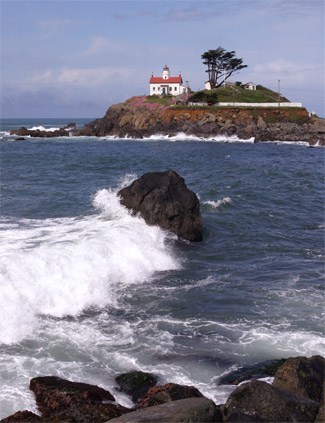
The Battery Point Light may not be the most dramatic or breath-taking lighthouse on the Pacific Northwest coast; it is, however, a lovely place to pause on your road trip along Hwy. 101 when you are traveling through Crescent City in northern California.
The lighthouse is very picturesque on a small island just off shore. If you arrive at low tide, you can stroll across the road that leads to the lighthouse grounds where there are beautiful 360-degree views. And, it’s free.
Battery Point Light 707-464-3089 577 H St, Crescent City, CA 95531-3743
The next time someone asks you to smile for a photo, go ahead and frown. No big deal!
I was in a Costco today in Eugene, Oregon stocking up on supplies. The first place I always head to in Costco is the book section. In most stores, the selection is half what it was five years ago. In some stores it’s even smaller. But in Eugene, home of the University of Oregon, there were a lot of books. I could tell immediately I was in a university town.
A few software programs were offered, right next to the books. I could hardly believe what I saw promoted on the package of Adobe Photo Elements 15. Nowadays, it seems, if you take a photo of someone with a frown, no problem! The software will turn it into a smile!
Look at the photo of the child. Weird.
It seems wrong to me. It seems dishonest. A smile is a smile, a frown a frown. Besides, I think something is wrong with the before and after photo of the boy. The first photo doesn’t really look a frown to me. I don’t like this new software.
Dear RV Shrink: We have met a lot of wonderful people in our travels. We seem to keep track of each other on social media and meet up over the years whenever our paths cross. It’s been great up until now.
Recently, one couple decided they wanted to travel with us exclusively. They never asked if we would mind; they just started stalking us in an RV way. At first they would ask where we were headed and just show up; now they are wanting our itinerary and suggesting we share meals together.
My husband doesn’t want to confront the situation. He finds it awkward. I am insisting we break it off with them, and get back to our own life on the road.
How should we handle this? —Uncomfortable in Atlanta
Dear Uncomfortable:
Traveling together has many dimensions. Many people find it compatible, but it has to be mutual. It sounds like your dilemma is not.
Your situation was born out of a desire by just one of the parties wanting to hook up, without so much as a discussion about the ground rules. You need to confront them with your feelings about the arrangements they have developed without your consent. You may lose them as friends, but eventually that is going to happen anyway if you struggle through this until you can’t take it anymore. It would be better to be up front with your feelings and hope they understand.
One of the funniest parts of Bill Bryson’s book, “A Walk in the Woods,” was about this very situation, only on foot. An obnoxious woman who talked with confidence to hide her insecurities hooked up with Bryson and his hiking partner, Katz, uninvited. They tried everything to ditch her without hurting her feelings. Finally, they decided to walk really fast, get a few miles ahead of her, then jump off the trail at the next town and hope she would pass them. Then they felt bad and guilty, and worried about her. They find out later from other hikers she has been bad mouthing them as fat, lazy old guys. Then they felt bad they felt guilty.
So don’t try to ditch these people by telling them you’re going one way, and go the opposite. You will feel guilty and they will bad mouth you.
Have an adult conversation, and explain you are not comfortable traveling with them all the time. Tell them you need more alone time to do your own thing.
If they take it badly that is their hangup, not yours. —Keep Smilin’, Richard Mallery a.k.a. Dr. R.V. Shrink
I was poking around on Google Earth today, checking out the road between Eugene and Florence, Oregon. At first, I didn’t think much of all the brown spots on the satellite view of the thick forest. Then it hit me! These were areas where the forest had been clear-cut by loggers.
Clear-cut logging takes every tree. There is nothing left, as you can see in the photo. Clear-cutting is controversial. Loggers say it’s important to create certain types of forest ecosystems and to promote select species that require an abundance of sunlight or grow in large, even-age stands. Clear-cutting is also a way to create farmland.
Clear cut area near Eugene, Oregon. Photo by Calibas from Wikipedia Commons.
Environmentalists criticize clear-cutting as destructive to water, soil, wildlife and atmosphere, and recommend the use of sustainable alternatives.According to Wikipedia, “clear-cutting has a very big impact on the water cycle. Trees hold water and topsoil. Clear-cutting in forests removes the trees which would otherwise have been transpiring large volumes of water and also physically damages the grasses, mosses, lichens, and ferns populating the under story.”
Clear-cut areas are replanted. Twenty years later the trees may be 30 or 40 feet tall. But you can tell these “farmed” forests: The trees look like big bushes, sometimes in rows if you look closely. They are not as beautiful or inviting as a natural forest.
To me, clear-cutting is just plain ugly. U.S. 101 through Washington’s Olympic Peninsula goes right through many clear-cuts. Every time I drive this road I recall when I spent two days on assignment in Mount St. Helen’s red zone a few months after the volcano’s eruption, when the forest was blown away or leveled by the force of the blast. Some clear-cut forests look much the same.
There’s a lot more to this story, and I am no expert. So, just saying. . .
We use cookies to ensure that we give you the best experience on our website. By continuing to use our site, you consent to accepting cookies. We NEVER have or will sell reader's data. For more info, please see our privacy policy page.


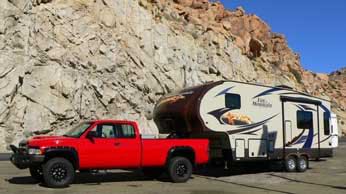 We pull a 2013 27-foot Fox Mountain (Northwood) travel trailer with a 1996 Dodge Diesel 3/4 ton. This picture was taken during a six-week vacation to Baja, Mexico, in 2014. Now that we are retired, we plan to spend four months in the Baja this winter.
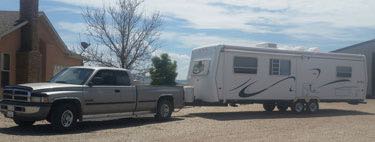 Attached is a photo of our 1998 Dodge Ram 2500 with a 5.9L 24-valve turbo diesel that has almost 265,000 miles on it, which we’ve owned for 15 years. It’s shown pulling our newly acquired 2001 Crossroads 32-foot All-American travel trailer (our “cabin”) the day we bought it.
 I am an optimist. When problems happen, I immediately figure out how to deal with them. If a boulder blocks my path, I simply figure a way around it.
 Here’s an example: Most of us have walked a dog on a leash. Some dogs (lets say Dog 1) follow ahead of us at the pace we set. The dog savors the smells of the dogs that have passed before him, enjoying the journey. The other dog (Dog 2) tugs at his leash as hard as he can in an effort to go faster, which doesn’t do any good. He chokes himself with every step and exhausts himself.


 But in Eugene, home of the University of Oregon, there were a lot of books. I could tell immediately I was in a university town.
 Look at the photo of the child. Weird.
 We have met a lot of wonderful people in our travels. We seem to keep track of each other on social media and meet up over the years whenever our paths cross. It’s been great up until now.
