
Home Blog Page 2161

Highway Hostesses: Cleaning gas station restrooms across America

By Chuck Woodbury
PUBLISHER, RVtravel.com

Before we traveled with our RVs, most of us traveled in cars. If you are older than 65, you likely recall long road trips with overnight stays in motels that were actually called motels — not hotels or motor inns or other fancy names.
And what you also remember are those times as you rolled past Burma Shave signs in your Ford Country Sedan that you needed to respond to the call of nature. This was expressed most urgently by little freckled-face Billy, who would wait until his bladder was about to burst before yelling, “I GOTTA GO!” to which Mom would say, “Billy, you will have to wait,” to which Billy would say, “But, Mom, I’ll pee my pants!”

Today such a crisis means locating a McDonald’s, convenience store or maybe a rest area if you happen to be on a road important enough for such a public luxury. But back in the olden days, it meant stopping at the next “service” station.

In the late ’30s the average service station restroom was suitable for only the most germ-defying motorist — no place to “rest” for sure, especially for the dainty ladies. It was a filthy never-never land of bacteria and brake fluid, a home for the motoring brave, but mostly the desperate.

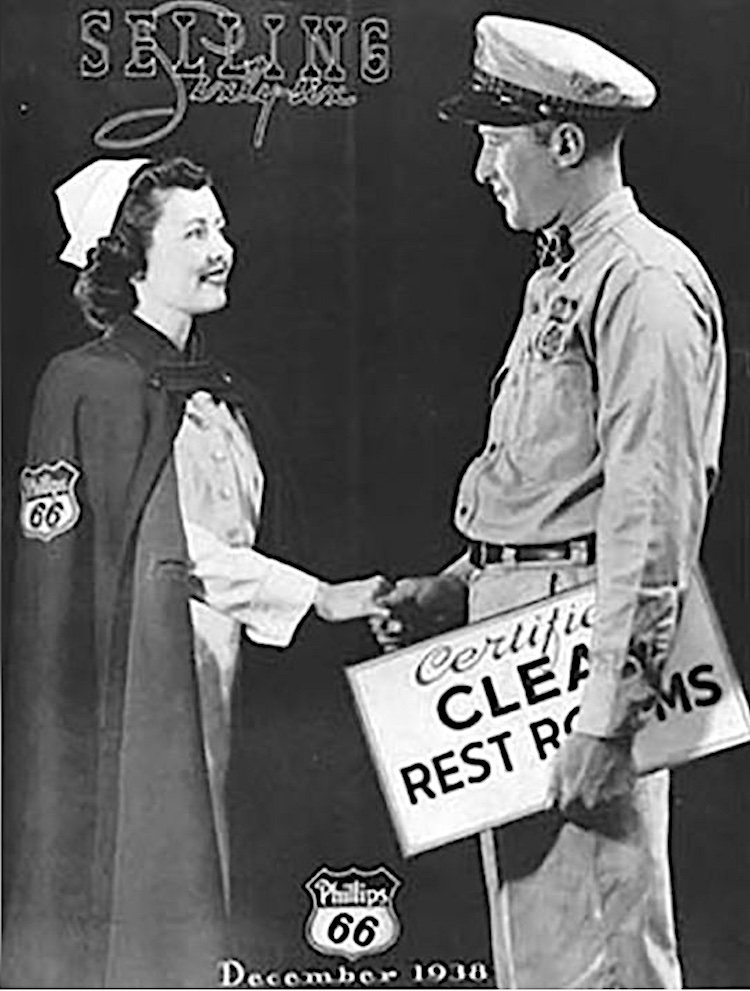
But businessmen, always seeking a competitive edge, wisely figured that if they built a cleaner restroom, the motoring public would come. Phillips 66, for one, went a step further: It hired a brigade of perky, traveling nurses, outfitted them in capes, and sent them adrift in cream-colored Plymouths to sling Lysol from coast to coast. These caped crusaders of cleanliness were dubbed Highway Hostesses. Their goal: “Hospital Clean Restrooms.”

HIGHWAY HOSTESSES would visit each of Phillips’ stations at least once a month. At each stop they would inspect potty rooms as well as provide suggestions about how the station could be more appealing to motorists, especially the “feminine motoring trade.”

On the highway, a hostess would stop to provide assistance when she found a car in trouble. This could range from summoning help to repairing a mechanical defect to rendering first aid. During the summer, a Highway Hostess would carry ice water to refresh thirsty travelers.

These 20th century Florence Nightingales of the road actually performed some heroics. One helped save a child from drowning. Another administered first aid to five members of a Negro baseball team that had rolled its car near Kansas City.

Thankfully, we RVers of today carry our potties with us, so we needn’t mingle with unfamiliar bacteria. This is a very good reason to travel by RV — especially a motorhome where you can simply walk back from the cab to do your thing while Dad or Grandpa tries his best to avoid potholes.

##RVT1125

In search of the right BBQ grill

0

By Greg Illes

I’m a compulsive fixer and tweaker, and I will confess to also being a BBQ fan. Not a fanatic — I don’t have a fancy apron or wall full of tools and sauces. But I love that charred, smokey steak or drumstick hot off the grill. I can usually be coaxed to cook up some savory stuff in almost any kind of weather.

So it’s no surprise that I am captivated by BBQ grills. My last home project was to build in a 42-inch stainless beast on my deck. But, alas, such a monster is useless away from home, traveling in my RV.

For RVing, I simply MUST have my grill — a propane unit for easy deployment and clean up. I’m definitely not a BBQ purist; I’m more of a convenience kind of guy.

So, for many years now, I’ve shopped and researched, bought and owned an array of portable BBQ grills to accompany our many RV excursions. As my wife will readily testify, I’m one of those guys who can’t leave “okay” alone — a constant seeker of greater perfection. Each BBQ would get some special attention, a modified propane feed, a special stand, whatever. But inevitably they all ended up with “fatal” imperfections that I couldn’t redesign or fix.

One grill didn’t fit well in my storage compartment. I bought another that turned out to be awkward to clean. Yet another heated up unevenly, the next was really poorly made — I was getting really frustrated.

Finally, I bought an expensive stainless-steel model with a cast-iron heat spreader, and I thought I’d found that elusive “perfect” grill. I used that grill for a couple of years, but it also had a nagging flaw. It was heavy, over thirty pounds, and dragging it out of a low-slung cargo bay was threatening my aging back.

ALL THIS TIME I’d been cooking up pretty decent grillings with my sequential collection of “deficient” BBQs. But no matter — as any perfectionist knows, there’s satisfaction and joy to be found in both the quest and the prize.

Of course, my long-suffering wife simply rolled her eyes (she’s very good at that) anytime I complained of the latest deficiency. Which simply made me struggle all the more to explain why we needed a different grill — again.

When the pricey grill started to wear out, I once again Internet-ed for a new grill. It had to be compact, lightweight, even-heating, not too expensive, wind-tolerant, and so forth. Impossible? Never give up.

Currently, I’m the happy (for now) owner of one of the cheapest BBQ’s out there, the kind with two halves that clam-shell together. Flaw #1 was a loose handle that got very hot. That was an easy fix with some hardwood and long bolts, and now it’s cool to the touch and solid. The unit is light, cooks well, and doesn’t seem to mind a stiff breeze across the campground.

I know myself well enough to predict that something will turn up to invalidate this grill, too. I just have to use it for a while to find out what’s wrong with it.

Greg Illes is a retired systems engineer who loves thinking up RV upgrades and modifications. When he’s not working on his motorhome, he’s traveling in it. You can follow his blog at www.divver-city.com/blog.

##rvt746

Women RVers: Positive thoughts

0

By Malia Lane 

I received an email from a woman the other day saying she admired my “guts” in getting out there as a solo woman in a 36-foot RV and towing a car, to boot.

She said while she has always wanted to travel like I do, she just can’t imagine really doing it. Besides not having loads of money, she suffers from depression and just can’t make herself take even the baby steps I always recommend. She doesn’t see the point since her past experiences have taught her there’s really no point because she’s doomed to failure no matter how hard she tries. She said she wishes she believed in herself in the same way I do.

I wrote that after full-timing for more than five years I had proven to myself that I could do it even though it didn’t happen in exactly the way I would have preferred. No use in even talking about my many unrealistic expectations.

I went through some hardships at one point in my travels that made it hard for me to sometimes even get out of bed, much less greet the day with any kind of enthusiasm. I indulged a defeatist attitude for quite a while, even thinking about giving up RVing because it was just not realistic or affordable for me anymore. I’m the first to admit that hearing platitudes like “think positive” feels trite and unachievable sometimes. At times I just want to slap people and tell them they just don’t understand the way I feel and the problems I have are so much worse than theirs.

Regardless, when I really put myself in the imagined position of truly giving up my dreams before I have seen even half of what I want to see — I finally decided there’s no chance for success by continuing to indulge the worst side of myself and my most negative thinking. I’ve come to believe that sometimes you really do have to just “fake it till you feel it.” And I do believe the energy you put forth is what’s going to come back to you. I don’t think God rewards those who just lie around feeling sorry for themselves.

SO I SURROUND MYSELF with positive thoughts, whether they feel like pointless platitudes or not. I look at inspirational pictures on Facebook and I meditate on them and what it would mean to my life if I really lived that way.

No matter how much they upset me, storms are bound to cross my path and disrupt what I thought I’d be doing at any given moment. A life without rain is not only unrealistic – it’s not even possible. Life on earth itself would not be sustainable for long without it.

There’s always something you think you can’t do or someone you think is better off or better equipped than you are. Your belief doesn’t make it true. One of my all-time favorite quotes is by Helen Keller. She had more than her fair share of obstacles to overcome. She said: “When one door of happiness closes, another opens; but often we look so long at the closed door that we do not see the one which has been opened for us.”

And my last piece of advice: Don’t shut the door on people in your life who want to help and support you. I believe that friends are quiet angels who lift us to our feet when our wings have trouble remembering how to fly.

Malia has been a solo full-time RVer since 2001 and still loves the lifestyle and sharing her experiences. Her website Malias Miles provides tips on campgrounds, destinations and other topics related to RVing.

Buying a new RV? Be sure to check the tires!

0

By Chuck Woodbury
Editor, RVtravel.com

Last month while attending an RV show I met an RV industry veteran who told me a horrifying story. We were discussing the poor quality of some RVs. I told him I was disappointed with what I had seen on many low-price, entry level RVs. “Let me show you what I mean,” I said, and I led him into an inexpensive fifth wheel trailer. “Press against this wall,” I said, and he put his hand on the interior wall. The wall pushed in: the paneling was about a quarter inch thick. “Sit on the bed,” I said. He sat. “It’s like a box spring without a mattress, right?” He nodded.

Screen Shot 2016-04-11 at 1.05.51 PMBut, really, I wasn’t telling him anything he didn’t already know. He had spent most of his professional life in the RV business — first as a manufacturer, later in sales. In between, he had worn about every hat. He was fully aware of how RVs are manufactured — some with great care, others as fast and cheaply as possible. I asked him, “What would you advise an RV buyer about where to begin to check an RV’s quality? What’s the first thing a person should inspect?”
His answer caught me by surprise. It would never be the first thing I would check. He said, “I’d tell them to start from the ground up — with the tires.” The tires?

Tires are far from created equal, he said. And that’s when he dropped a bombshell. “I know of one trailer manufacturer that buys its tires from China for $8 apiece. In my opinion, anyone who tows a vehicle with those tires is jeopardizing the safety of himself and his family.”

Later, as I walked through the show, I paid attention to tires. Most brands were familiar, but some I’d never heard of. Most looked great, often with the aid of a fresh coating of black tire paint.

My RV-veteran friend didn’t name the company that imported the cheap tires, nor the brand name. I didn’t ask. It’s been a long time since I bought a new RV. Would I “kick the tires” early on in my inspection of a new RV, especially if it were an unfamiliar make? I don’t know. But I can tell you, it wouldn’t be the first thing I’d do.

Perhaps the practice of putting cheap tires on RVs is rare. I’d like to believe that’s true, and my guess is that it is.

Whatever the case, the message I’d like to leave with you today is that everything on an RV that you plan to buy is worth inspecting carefully. I believe my friend had an excellent point — starting with the tires should be the very first thing. Could it be that if the tires are a respected brand name, we can assume that the manufacturer doesn’t take other shortcuts where it’s important to safety? That would make sense to me.

The good and the bad of attending an RV show

0

By Chuck Woodbury
Editor, RVtravel.com

RV shows can be a good place to get a good deal on an RV. But most often, you can get the same price back at a dealership a week later. Salesmen at RV shows get “spiffs” on RVs they sell at a show. These are cash bonuses for making sales. As a result, they have an extra incentive to sell you something right there and then.

Anyone in the market for an RV should be aware that a salesman has this extra motivation to close a deal “now,” and not “later.” Some will make promises and claims that may not be entirely true. As an RV show progresses, the buzz among dealerships is how many sales each made. “Did you hear that XYZ dealership closed 20 deals?” one salesman will ask another. Numbers matter, both for profits and bragging rights, and sometimes buyers are the innocent victims.

Still, great deals are available. My advice to a would-be buyer is pretty simple: always “sleep” on any offer. Never make a decision based on the emotion of the moment. And never buy an RV without having already researched a make and model thoroughly. It’s much too easy to “fall in love” on the show floor without knowing the facts: an RV that looks good may not be so good upon closer inspection. To me, buying an RV you just found, right on the spot, is like rushing to the all-night wedding chapel with someone you met at the tavern at 1 a.m.

At RV shows, never buy with no money down. Some RV dealers are now pushing this option. And except on very expensive motorcoaches, avoid financing it for 20 years, which can make monthly payments look downright cheap. I consider either of these practices to be poison.

Buying a motorhome with a price of $70,000 with zero down and interest of 6.9 percent, results in a monthly payment of $538. Affordable? Not really. The catch is that those “low” payments extend for 20 years! Do you think that a modest-priced rig will last that long? No way! But once you drive off the dealer’s lot, your rig is now a used RV and its value dives faster than a nuke submarine. At the end of three years, if the owner wants to sell it, he will still owe $64,577: of the $19,368 in payments he has made thus far, $13,963 went to interest. If the RV has depreciated by a third at the end of three years, that means the RV is worth $46,900. If the owner wants to sell it he will have to come up with the difference between what he owes and the RV’s value — which means he will have to PAY someone $17,677 to take it off his hands. In RV financing lingo, this situation is known as being “upside down.”

“A fellow came to me recently whose payments were $690 a month,” a salesman at an RV show told me. “He had lost his job and couldn’t make his motorhome payments anymore. He wanted to know how much he could sell it for. I told him, but it turned out it was $10,000 less than he owed on it.”

It happens every day. The moral of the story: Put as much down on a vehicle as you can afford and avoid loan terms that will likely last longer than you will. Such financing is fine for a home, which normally appreciates. But it seldom works on an RV, which loses value every year.

And, for the record, an RVer who buys a $70,000 RV with zero down and finances it for 20 years at 6.9 percent — and keeps on paying for the life of the loan — guess how much he will pay all together? How about a total of $124,245, of which $59,245 will be interest.

All that said, I believe that RV shows are most valuable as a place to see hundreds of different makes and models of RVs in one place, whether you are in the market to buy, or simply want to see what’s new. They provide a wonderful opportunity to talk to a lot of people — salesmen, other RVers and even factory representatives. Free seminars on various RV subjects are almost offered and are worth attending.

And one more tip if you plan to attend an RV with the intent of buying: be sure to pay close attention to how much weight an RV can hold and tow (in case of a motorhome). It’s very easy to overload a vehicle, and that can be dangerous.

RVing is more than just a hobby

0

By Jim Twamley

Most RVers I meet are enthusiastic about RVing. We come from all walks of life and have one thing in common… we love RVing. Some outsiders would classify us as “RV hobbyists” but what they don’t know is RVing is a lifestyle and spills over the boundaries of hobby-land. In 1940 Ernie Pyle wrote, “A hobby has a way of running out. You  play it for a long time, and then its power to beguile you begins to fade, and finally you have to pretend to play, so as not to be ashamed of the thing to which you once threw your passions.”

Veteran RVers don’t look at their RV and say, “That’s my hobby.” Rather, they see their RV as a magic carpet taking them to new destinations, a mother ship providing opportunities to visit and explore diverse landscapes, a time machine opening a window on the vistas of history. You can’t do that staying in the neighborhood, where life demands a more predictable routine.
In the RV lifestyle every day is an opportunity to visit a place previously unknown, a chance to witness things yet unseen, to embrace the adventure around the next corner.  Along the way you make new friends and create an encyclopedia of memories.

Vivian Grybko is a widow from Kansas who began traveling as a full-time RVer after her husband died. I asked her how many close friends she has in the RV community and she said, “More than I ever had when I was living in one place for many years.”

It never ceases to amaze me when RVers pull into a campground they have an instant kinship that allows them to get to know each other right away. Throughout our years of RVing my wife and I have made many wonderful friends who share our enjoyment of travel. Whether you RV two weeks a year or all year long, you know RVing is much more than a hobby, it’s an ongoing life enhancing experience.

Getting the most out of your RV

0

By Jim Twamley

I intend to RV till I die. I don’t want to drive my RV across the finish line in showroom mint condition; rather, I want people to see a well-loved RV with the battle scars of adventure.

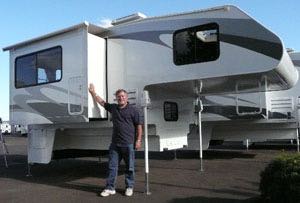
To get the most out of RVing you need to ask yourself an important question. What are the things you enjoy doing most? If it’s off-road pursuits, then you’ll want to consider a toyhauler for packing gear to your favorite destinations. If it’s hunting and fishing, perhaps a truck camper loaded on a four-wheel drive to get into those out-of-the-way places. With these interests, you can’t be the type to worry about scratches and dirt; besides, a little mud tells me you’ve been having fun!
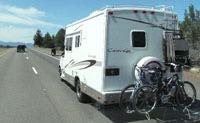
If you enjoy sightseeing at state and national parks, a smaller motorhome might be the way to go, providing access to many beautiful locations with campsites too short to accommodate larger rigs. If water sports, hiking and biking are your hobbies, you may want to carry a kayak on your towed vehicle and a bike on your motorhome ladder. Who cares what you look like going down the road? When I see rigs like this I say to myself, “Now these folks know how to squeeze enjoyment out of life.”

I properly maintain my RV but I don’t allow it to interfere with my primary purpose which is to travel and explore. So you won’t find me out washing and waxing every week. Instead, look for me on the hiking trail, the museum or the wildlife viewing area. An RV is a great deal of fun all by itself, and at its best when it takes you where you most want to go.


Replace your RV porch light with one that’s motion activated

0

Porch lights are helpful not only as a deterrent to unsavory types that might seek to liberate you from your possessions, but they are also a safety and convenient part of your RV. They light up your entryway for night time access, your campsite when it’s dark without having to look for a flashlight, and for identification of who is knocking at your door after dark.

Screen Shot 2016-04-11 at 11.12.38 AMBut if it sometimes annoys you when your neighbor leaves his porch light on for hours when away from his rig just so he will have light for a minute when returning, and which directly in your eyes and destroys your night vision when stargazing, then your neighbor may have the same annoyance from you doing the same thing. You can correct this un-neighborly annoyance (and save battery power) with a motion-activated porch light.

The Fulcrum Motion-Activated Cordless Light detects movement up to 25 feet away with a range of 100 degrees, and activates a bright floodlight that stays on for 30 seconds after motion has ceased. Its powerful 42-lumen light features six super-bright LEDs and built-in photo cells that prevent daytime activation. The Motion-Activated Cordless Light is weather resistant and installs easily without an electrician — ideal for crime deterrence and personal safety.

Features:
• LEDs have 100,000-hour life
• Light rotates to illuminate target area
• Photo cell prevents daylight activation saving battery power
• Cordless, no electrician needed
• Mounting hardware included
• Requires 4 C batteries (not included).

My shower is one of my top five favorite RV things

Chuck Woodbury
Editor, RVtravel.com

I was thinking about my RV shower today as I basked in my home shower, soaking up the warmth. A shower is on my top five list of things I appreciate in my motorhome. The others are the kitchen, bed, toilet and heater.

In April, 2004 I explored part of Alaska in a rented RV. I was not able to use the on-board water system for fear of freezing it. So I had to search for showers. Mostly, I found them in laundries, where you can wash your clothes and yourself at the same time. But I did not like searching for showers because it delayed my morning ritual of a shower, then coffee, then consciousness.

The shower in my motorhome does an adequate job, although it can be frustrating while boondocking when I have a limited water supply. Then, I turn the water on only when washing and rinsing — unsatisfying in the chilly wintertime.

Sometimes I use a campground shower. In some parks, especially public ones during the winter, the often-unheated rooms are perhaps 40-50 degrees with ice-cold floors. So the idea is to undress super fast, soak yourself with hot water, and hopefully warm up as you clean up. About half the time this works. But sometimes the shower only operates in a straight stream. In that case, where you point the shower head determines which part of your body is warm and which part freezes.

Other possible situations when using public campground showers in the winter include:
•Undressing, then discovering there is only cold water as you stand there shivering.
•Running out of hot water with the shampoo still in your hair.
•Needing to deposit quarters to keep the water flowing. If you only have four quarters and five are needed, you spend the day coated with soap slime.
•Having to wait while another person hogs the shower.
•Getting dressed after showering with clothes that took a bath while you took a shower.
•Enduring the guy in the shower stall next to you who coughs, hacks, gags and spits. Just as bad is the guy in a nearby toilet who emits horrid gasses and makes terrible groaning noises that could be confused with the process of dying.

I wish I did not need a shower every day. Yes, I can get by and survive, but I feel dirty. In all my life, beginning when I was, say, 12, if I figure 10 minutes a day in the shower, then I have spent close to 3,500 hours — about 14 days — spewing hot water upon myself.

RVers are not hoarders.

By Chuck Woodbury
Editor, RVtravel.com

Have you seen the TV program “Hoarders?” It’s about people with a compulsion to hoard just about everything. Nothing gets thrown away. According to the program, three million people in America qualify as “hoarders.”

Horders’ homes become so cluttered that the residents can barely move. One episode profiled a Phoenix woman whose condo was so filled with stuff (mostly junk) that the largest available space to eat, watch TV or simply relax was on one double bed in the living room. Her two kids’ bedrooms were too packed for them to even reach their beds, much less sleep there. And so they slept on couches in the living room.

I don’t think many RVtravel.com readers are hoarders. This newsletter is read mostly by avid RVers — those who travel a lot throughout the year. More than half of you travel at least two months a year. More than a third of you travel four months or more. About 12 percent live in your RVs full-time.

I believe one of the best feelings associated with RVing is the freedom we experience when we are away from all our “stuff.” Before we head out on a trip, we pare down what we need to a bare minimum. Those 20 pairs of shoes in our home closet get cut down to two or three. We bring six favorite shirts and leave 60 others at home — same with jackets — one or two instead of the dozen at home. Our big stereo system shrinks to a pocket-sized iPod or iPhone. Our bulky family picture albums are digital, viewable on flickr.com in cyberspace.

It’s impossible to be a serious hoarder when you spend much of your time in an RV. Even though I am not a hoarder myself — pretty much the opposite: I love the simplicity of my life in my RV where my collection of “stuff” is a fraction of what it is back home. As I have said before, if my home in Washington were to burn to the ground while I was traveling with my motorhome, I wouldn’t lose much that I would ever miss: What matters most to me would be in my RV. What about you?

Celebrating nearly 30 years of RVing. What’s next?


By Chuck Woodbury
Editor, RVtravel.com

Originally published in March, 2010

I’m 62 years old. Some people think I’m 100. The reason is that I was in my 30s when I started traveling by RV and writing about my travels. At age 40 I began seriously traveling by RV writing for my on-the-road newspaper Out West. Back then, people thought I was much older because most people who traveled with motorhomes were senior citizens. “We’re Spending our Children’s Inheritance” was the leading RV bumper sticker of the era followed by “Grandma and Grandpa’s Playhouse.”
Some of those readers still follow me through the RV Newsletter.

I recall one man in particular, Ernie Herring, who was in his mid-90s when he first subscribed to Out West. He wrote me often with great wit. When he turned 99 I told him I wanted to attend his 100th birthday. But I never heard from him again. The thing I remember most about Ernie was where he lived: The town was Leisure World. But on his return address labels it was “Seizure World.” Ernie made me laugh even before I opened his letters.

SO HERE I AM NOW, closing in on 30 years since I started seriously exploring America by motorhome. Someone who had known me years ago was asking about me the other day in an RV news group: “Is he still around?” I suspect he figured I had moved to Seizure World myself.

You know, when I was 30, single and trying to figure out what to do when I grew up, I began a personal journal in which I tried to understand why I was so restless. After a few years it became clear that I had a very deep and basic need to travel. Not take bus tours: I needed to roam — to take road trips — to see, at my own pace, what was around the next corner. I determined that I needed to carve out a life that would allow me to do just that. The only way, I concluded, was to write and sell my stories to magazines. So, with a small, mechanically challenged motorhome and a manual typewriter (at first), I hit the road. And for nearly three decades now, off and on, I’ve continued.

These days, only months away from when my only child moves 3,000 miles away to attend college in New York, I am obsessed again with the divine prospect of taking long, leisurely RV road trips without neglecting my “little girl” back home.

Now, I just have to find a nice lady to go with me.

(UPDATE in 2016). I found her!

When people discovered the world through postcards


By Chuck Woodbury
Editor, RVtravel.com

Go back 100 years. Just imagine: there were no RVs and only a few primitive cars with few roads to travel. There was no television or movie theaters. Hardly anybody owned a camera, and the handful who did shot in black and white. There was no Travel Channel or fancy travel magazines.

So wherever you lived, the rest of the world was an unknown, mysterious place.

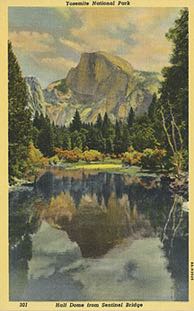
Then, right around the turn of the 20th century, postcards appeared. They became popular after they were distributed at Chicago’s Columbia Exposition in 1893. In 1908, 677 million were mailed.

The first postcards were in black and white. Then hand-coloring was added. Imagine what it was like to receive a postcard 100 years ago, when there were very few ways to see faraway places. I bet those cards were treated as treasures.

I bring this up because I found a box of old postcards the other day. I especially like the colorized ones from the ’40s and ’50s.

Now fast forward 100 years. Nobody needs postcards anymore. We email digital photos from our laptops, post them on Facebook, or send them via text messages. We’ve seen every corner of the world in living color on TV and websites, in movies, on YouTube and in newspapers and magazines. Our neighbors return home with blow-by-blow videos of where they traveled.

I quit sending postcards years ago. I made an exception last summer in Germany when I mailed one to my daughter. By the time she received it a week later I had emailed her dozens of digital photos and video chatted with her live on Skype. I felt no need to send her a card saying “Having a good time. Wish you were here.”

For decades, postcards introduced the world to many people. Today, they are curiosities. I bet tourist shop merchants don’t sell many today like the old days. Do you still send postcards when you travel?