I’d like to tell you a brief story about the most famous American to travel by RV. Yet most people never knew he did. During his life, he was one of the best-known men in the world, and for perhaps a decade THE best known. With his RV, he and his wife could escape from the masses and find solitude. The man was famed aviator Charles Lindbergh.
In the 1940s, automaker Henry Ford learned that Lindbergh was looking for a travel trailer. Although Lindbergh wanted to buy one, Ford insisted he take one he had bought for a museum. It has since been described as a “huge brown elephant” on wheels. A week later, Lindbergh hooked up the trailer to his car and drove off. He and his wife Anne traveled in it off-and-on for the next 15 years, a place where Anne could write in peace. Today, the trailer is on display at the Henry Ford Museum in Dearborn, Michigan.
RAWLINS, Wyo— Today, at the Carbon County Museum, I checked out the display of Big Nose George Parrot, the only man in American history to be turned into a pair of shoes. His name was actually George Manuse. He was lynched in 1881.
George in better days
George was a rustler with a big nose, hence his name. Somewhere along the line, he met up with the James Brothers, Jesse and Frank. Along with a guy named Dutch Charley, they decided to rob a train. They probably would have robbed a bank, but back then Wyoming had more trains than banks. Today, of course, they would have robbed a mini-mart.
So, they hopped on their horses and headed off for a lonely stretch of train tracks, where Big Nose convinced the others they should mess with the tracks to derail the train. “Then it will be a breeze to stick ’em up,” he probably said, or something like that. And the other guys probably said, “Good idea, Big Nose.”
Well, as they were fidgeting around with the track, lo and behold, a Union Pacific foreman in a hand car came pumping around the bend. The outlaws hid. The eagle-eyed railroad man, however, noticed that someone had been fooling with the track.
George as he appears today in the museum, including the shoes made from his skin!
“Suspicious” he probably mumbled, because he knew something was definitely up. So he rode ahead like crazy, where he instructed the approaching train to hit the skids. The railroad guys informed the law, who rode out to apprehend the would-be train robbers.
Bad idea, because Big Nose and his boys blew away two of the lawmen.
The James Brothers, of whom only Frank was reportedly involved in the attempted heist, decided the heck with Wyoming, and off they rode.
Dutch Charley and Big Nose split up. Charley was apprehended first, in Montana, and brought back to Wyoming where he fessed up to his deeds, figuring honesty was the best policy. Bad decision, because the locals were so mad they strung him up on a telegraph pole. Bye bye, Charley.
Big Nose George got caught next. He, too, confessed — but it didn’t do him any good either because he was sentenced to hang. In jail, however, he tried to escape, failing, but beating up a guard in the process. The local boys got wind of this and stormed the jail, hauling Big Nose over to the telegraph pole in front of Fred Wolfe’s Saloon, where they lynched him, probably getting stiff drunk while George just got stiff.
BUT THAT’S NOT THE END to George’s story. A young doctor named J.E. Osborne took possession of George’s body. The first thing he did was make a death mask of his face, which you can see in the museum. Second, he sawed open his skull to check out his brain to see if it was different than a good person’s brain. It wasn’t.
Next, he had George skinned, and sent the skin to a Denver tannery. “Make me a pair of shoes, and leave on the nipples” he instructed. Well, he got the shoes, but not the nipples. The shoes are also in the museum.
Then he took what remained of George and put him in a whiskey barrel, which he buried. In the 1950s, construction workers digging for a new building found the barrel and the bones of Big Nose George.
Dr. Osborne wore his George shoes all the time, especially to special occasions. He eventually became a state big shot and was even elected governor. Some people say he wore George to the inauguration ball.
The top of George’s skull, meanwhile, became a “brain bowl” for Dr. Lillian Nelson, Wyoming’s first female doctor. For years she used it as a doorstop.
Dr. Osborne’s shoes and George’s sawed-off skull are in the Carbon County Museum, which is in downtown Rawlins in an old Mormon church. Admission is free.
I was incredibly lucky to visit the day that photographer Craig Pindell and historian/writer Larry K. Brown were photographing George for the archives of the Wyoming State Museum. After they were done, they put the shoes and skull back in the normally closed-up glass case. When they weren’t looking, I managed to cop a feel of the shoes, which are two-toned. They’re skin color on the front and brown in back — kinda like saddle shoes. Only the soles are made of cow leather. And they are very worn, proving that the doctor wore his George shoes a lot.
I rubbed the shoes. I figured they’d be flimsy. I was shocked that they were very sturdy like they were made of cow leather. George’s skull, meanwhile, felt like bone, no surprise there.
That’s the story of Big Nose George. If you are in Rawlins, check him out. The museum is located at 904 West Walnut Street. A new location is planned (as of April, 2016) so call to be sure you’re headed to the right place (307) 328-2740.
This originally appeared in Chuck Woodbury’s “On-the-road” newspaper Out West in 1997
It’s early April, 2016, and the RV Internet is a-buzz with gossip, rumor, and (fearful) speculation concerning a soon-to-be-released regulatory revision from the HUD government agency. A quick search for “HUD RV” will turn up plenty of threats and worries.
Quick summary: the rule benefits RVer’s and does not restrict residency. Here’s why:
HUD is an acronym for Housing and Urban Development (you can read its mission statement here). As you can see at its web site, HUD is responsible for many aspects of housing regulation in the U.S, too many to summarize here. But in particular, one of HUD’s areas of authority is the setting of construction standards for housing.
Recently, HUD published a rule-making proposal in which the wording was perhaps a tad obscure. The regulation has to do with using RV’s and “tiny houses” as residences, and required some placarding to the effect that the units were not intended for permanent residency. The full text is available here, but few will have the fortitude to read through it – or understand its intent and implications.
The rule sponsored a fire-storm of reaction from people who thought their RV’s would become “illegal” under the revised regulation. But it was a false alarm. In fact, some of the furor even seems to have been promulgated for sensationalism’s sake.
The rule is endorsed by the Recreation Vehicle Industry Association (RVIA) and should not be a cause for RVers’ worry.
Detailed Discussions – We have limited space here, but you can read much more about the ruling and its background in some other articles.
One of the better reviews of the whole fracas can be found in the excellent Snopes site, where (with their usual diligence), the writers explore details and concerns surrounding the regulation. You can read that here to get a thorough understanding, and we’ll summarize things below.
Another important communication to review is the statement by the RV Industry Association (and others) enthusiastically endorsing the HUD regulation.
And here is another very readable analysis from RV Dreams, with some additional references, providing more clarification and insight.
So what’s all the fuss about? Essentially, the confusion – and concern – arose from the wording in the regulation. The phrase “not intended for” permanent residency was never intended to indicate “not permitted for” permanent residency. In fact, the regulation is an important exemption for RV manufacturers, which permits them to create their products independently from the restrictions for fixed housing. In particular, the rule is intended to differentiate RV “housing” from mobile-home housing. This is why the RVIA is not only supporting the rule, but actually participated in drafting it.
OK, but what about safety? HUD, and the RVIA, are trying to more explicitly draw the line between fixed and mobile habitats. HUD is clearly responsible for regulating the quality and safety of fixed homes (including mobile homes) – and RVIA is, and wants to be, responsible for similar issues on RV residences.
So can you still live full-time in your RV? This is, and always has been, largely a local-regulation issue. Across our vast country, there are an equally vast number of regulatory variations on who can live where, and in what. If you look carefully, regulation seems always to be a matter of where the RV is parked – not how long (or permanently) anybody has been living in it. And realistically speaking, what conceivable government agency is going to try to keep track of how many days any of us spend living in our RV’s? Even Big Brother doesn’t have that many resources.
On balance, it’s easy to see that there have been some over-reactions to the ruling. Some may even have been intentional, for the sake of hits and clicks on a website. But clearly, the support of RVIA, and analyses by objective reviewers, shows us the actuality of the situation.
LINKS SUMMARY
For easy reference, here are the links mentioned above in the article text.
Greg Illes is a retired systems engineer who loves thinking up RV upgrades and modifications. When he’s not working on his motorhome, he’s traveling in it. You can follow his blog at www.divver-city.com/blog.
I’ve never heard any RVers complain about having too much storage space in their rig. Usually the complaints are more likely to be the odd shapes that some things come in, making them hard to store efficiently, or their odd shape takes up too much room in already over-crowded drawers and cabinets.
Like pots and pans with long handles, or those big spaghetti pots that nothing else nests into. Or colanders, with their odd upside down volcano shape. Well, Progressive International just made a nice step in resolving the odd sized cooking utensil’s unwieldy shape.
This colander performs all the same functions of a standard colander, but folds down to ⅓ its original size, taking up less space on the shelf or in the cabinet. Specially designed hole pattern in the base of the colander allows water to drain quickly and easily – just like a regular colander. Rigid design allows colander to stand on its own yet still folds easily for storage. How cool is that?
If you’ve never had your RV waste valve leak, break, or freeze in the open position, you’ve likely never thought about the need for a quick fix.
But consider these situations: (1) You park in your campsite and start setting up, which includes attaching your dump hose. But you discover that your valve is leaking onto the ground. (2) You discover a crack in the existing dump valve causing it to leak. (3) You’re ready to break camp and try to close your dump valve and it won’t close, freezing in the open position.
In all the examples above, your options are limited to (1) Not using either your gray or black water tanks, which effectively prevents your RV full of campers from using the toilet, shower, or sinks, or (2) Heading straight for the closest RV service center and a big repair bill, not to mention the end of your camping trip.
However, if you are a forethinking RVer you will have a Valterra Twist-On Waste Valve in your parts box, enabling you to make an instant temporary (and in many case, permanent) fix/solution and to continue your camping trip uninterrupted.
Valterra’s T58 Waste Valve is a 3″ Twist On where you simply twist the new valve onto your current waste valve bayonet fitting and eliminate a messy replacement or expensive service.
Waunakee, WI, Nov. 23, 2015 — When it comes to embracing transparency, no government enterprise fails more miserably than traffic enforcement. Police departments and municipalities resist disclosing the number of tickets they issue for fear of branding their communities as speed traps. And local courts routinely reduce speeding charges to non-moving violations to avoid sharing ticket revenue with the state.
Since it’s nearly impossible to find out how many speeding tickets are written in a given state, the National Motorists Association (NMA) looks at the presence of speed traps to gauge a state’s propensity for revenue-based traffic enforcement.
Using data from its website, The National Speed Trap Exchange, the NMA has identified the worst states for speed trap activity throughout the country. Speed traps typically combine arbitrarily low speed limits with heavy traffic enforcement designed to generate ticket revenue. Speed traps often spring up in the same locations where the issuance of tickets continues unabated, indicating that the enforcement action has no meaningful effect.
Rather than emphasize overbearing traffic enforcement that doesn’t change driver behavior, authorities should focus on setting speed limits based on the speeds people actually drive. Studies repeatedly have shown that setting speed limits this way results in the safest driving conditions.
The Speed Trap Exchange uses crowdsourcing to identify the specific locations of thousands of chronic speed traps throughout the United States. Information about each listing is enhanced with commentary from users, and site visitors can vote on whether they think a location is a speed trap or not.
The Methodology
To develop the rankings, the NMA compiled the number of speed traps reported over the last five years-November 1, 2010 through October 31, 2015-by state. Those totals were then indexed to the number of road miles in each state. Normalizing the data this way accounts for differences between states and allows more meaningful comparisons from state to state.
The Results
Table 1 below shows the top 20 Worst Speed Trap States based on total number of speed traps added over the last five years, with Texas, California, Florida, Ohio and Georgia taking the top spots. Table 2 shows the top 20 Worst Speed Trap States based on number of speed traps per 1,000 lane miles. Hawaii, New Jersey, Rhode Island, Massachusetts and Maryland emerge as the top offenders. (Click here to see the rankings for all 50 states.)
“These results reveal which states are the habitual offenders when it comes to ‘Policing for Profit,'” said NMA President Gary Biller. “They point to a need to reform the traffic justice system for greater accountability with less emphasis on generating revenue and more on public safety.”
Getting rid of mold is never fun, especially when the process involves bleach. Shurhold’s Moldaway is an effective bleach alternative, containing no bleach or chlorine products, and is safe on all colors as well as most fabrics.
A scientifically formulated, powdered, oxygenated cleaner, Moldaway can be used on a variety of materials, including vinyl, canvas, plastic, carpeting, interior and exterior cushions, and wood. It easily removes stains associated with mold, mildew, algae, dirt, food and drink.
This versatile product is also great for cleaning drains in sinks and showers before putting an RV in long-term storage. A scoop of Moldaway goes into each drain with a cup of water. Rinse out after letting it work for a few minutes. Designed for RV use, Moldway will deodorize drains without harming the piping. It will also help clean the sump container by oxygenating the sump water, killing mold and mildew spores and other bacteria without bleach.
A 12 ounce jar of Moldaway costs about $16 at Amazon.com.
Information obtained from press release and manufacturer website
You’ve heard this before (most likely by the person responsible for food preparation). There is never enough counter working space in an RV kitchen.
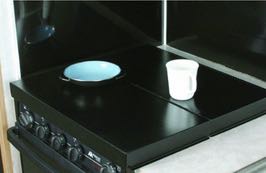
But if your kitchen modus operandi is prep work first followed by cooking, you can add valuable working space by covering your stove top with a working surface. Your RV chef and sous chef will love it. RVtravel.com editor Chuck Woodbury travels with a 24-foot Winnebago View, with limited counter space. “It about doubles the space I have to work with when I’m not using the oven,” he says.
The Camco RV Black Universal Fit Stove Top Cover also protects and hides burners in addition to adding counter space in your RV – and the cover acts as a splash guard between burners and wall when folded back.
You can flip up one side to use two burners or fold and store it away compactly when you need all four burners. Made of 20 gauge steel with powder-coated finish.
Features:
Stores compactly
Made of 20 gauge steel
Protect and hide burners
Adds counter space in the RV
Acts as a splash guard between burners and wall when folded back
Amazon is selling the stove top cover in black (almond and white also available).
Musty odors can accumulate when recreational vehicles are closed up. The MaxxFan Standard model ventilation fans from MaxxAir Ventilation Solutions, with reversible fan option, efficiently draw in fresh air and also remove hot, stale air.
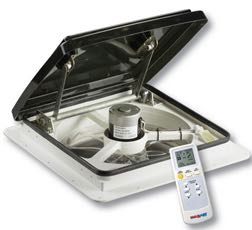
MaxxFan Standard fans are available in remote control or manual lid opening models. Sturdy and durable twin lid-lifting arms ensure smooth and safe operation with no lid fluttering during high winds or when the RV is traveling.
A powerful, fuse-protected 12V DC ball-bearing motor with built-in thermal protection operates a 12″, 10-blade fan to circulate over
900 cu. ft. of air per minute. An easy-to-clean ceiling keypad lets users choose any one of 10 fan speeds, as well as control thermostat, air intake and exhaust functions.
The flush-mounted fan fits any standard 14″ x 14″ roof opening, and closes securely for a low-profile appearance. When the lid is closed, the MaxxFan also operates as a ceiling fan, a MaxxFan exclusive. The interior insect screen removes by rotating the four retaining knobs, so no tools are required for cleaning.
MaxxFan Standard Model 4000K features a white manual open lid. Model 4500K features a smoke-colored electric opening lid and comes with a hand-held remote control with easy-to-read LCD screen. The fan answers commands pressed on the remote by emitting an audible beep. All MaxxFan remote control models also include backup keypad controls at the ceiling, another MaxxFan exclusive.
The 4500K model comes equipped with a handy rain sensor that automatically closes the lid within seconds of detecting rain. The rain sensor’s sloped mounting prevents false triggers and helps water wick away faster.
Each MaxxFan Standard model comes with all necessary mounting hardware. Waterproof molded mounting holes facilitate installation of compatible MaxxAir fan covers.
MaxxAir offers a two-year warranty on each unit, with a lifetime warranty on the lid. Available from Amazon.
People are not always what they appear to be. I’m referring here to full-time RVers. You think people are residents of a particular town and then you start talking to them and you learn they are living and traveling full time in RVs.
Susan and Jack Girdis
Several years ago, as I left the library in Brookings, Ore., I made a remark about a woman’s cute little dog. I thought it was a spaniel. It turned out it was a mutt. “He cost me a bundle,” she said, and I asked why. She said it was because it was part poodle, so it didn’t shed. “People with allergies will pay a lot for a dog that doesn’t shed,” she explained. Her dog, for example, cost $350. We kept talking. I asked if she lived in Brookings. She said that she and her husband did, but in a fifth wheel trailer. Gas cost too much for them to travel, so they were staying put.
The next morning, in Crescent City, Calif., I knocked on the door of a small motorhome with European plates: you don’t see many RVs from across the sea. It looked a lot like my Winnebago View. The owners, a retired English couple, told me they had been touring North America for more than two years in the 27-foot motorhome and three years in Europe before that. They were only two weeks away from flying home, and their motorhome would follow along. Once it arrived in their county of Kent, they would live in it full time. I asked them if living in an RV full time was unusual in England, and they said it was. They said that while in North America the trickiest problem was getting health insurance.
Later that afternoon, I was taking a picture of the beautiful lighthouse in Trinidad, Calif. A couple was also taking photos. “Are you professional photographers?” I asked, and they said no, it was just a hobby. “Are you from around here?” I asked, and they said, “Oh, no, we’re full-time RVers.” It turned out that Jack and Susan Girdis were in the area to care for Jack’s elderly father, who was in ill health. “It’s nice to be able to be with him, but to sleep in my own bed at night,” Jack said.
Soon, my wife and I will hit the road again. Even though it’s not the ideal season for traveling, our summer has been consumed with tasks and projects, so we’re RV-deprived at this point.
Most folks think of “camping” in terms of lofty trees, babbling brooks, hikes in the deep forest. We like those places, for sure — but we also have a love for something almost diametrically opposed to the charm of a wooded campsite: the desert. We probably travel to the desert even more than we go to the mountains or seashores that are closer to our central California homestead.
Most people who are unfamiliar with desert travel are a bit puzzled. Why in the world would you want to go there? There’s nothing there! Well, yes and no. There is certainly not much in the way of woods and streams (although many surprises can be found). But the very essence of nothingness can, in itself, be part of the appeal much of the time.
In its central character, the desert provides an empty, open, vast space that is paralleled only by the open sea. There is quiet, there is room to think, and there is time and an undemanding environment that let the mind and spirit wander. There is no place on earth that is, for us, more conducive to personal peace than the enormous expanse of the desert.
And enormous it is. In the southwestern United States, there are vast expanses of desert terrain. Much of it is dry and nearly featureless; some is strikingly beautiful, such as the lower areas of Utah and Canyon Country, and the incredible spring wildflower blooms in the eastern Sierra Nevada.
THE DESERT IS ALSO EASY TO ACCESS. Most of the desert southwest is freely available to the traveler via Bureau of Land Management (BLM) access. Old ranching and mining roads crisscross many areas, making exploration simple and attractive.
There are also times and places where there is truly something there in the desert. For example, far to the east in Nevada, among the dry sage and rabbit brush, is a miles-long riparian environment, complete with kelly green cottonwood trees and gurgling streams, that follows the drainage from the top of Great Basin National Park. Down in the Anza Borrego Desert, spring ocotillo cactus blooms color the landscape like an artist’s palette. And always, somewhere on the flank of a mountain ridge line, there’s a splash of green clinging jealously to a spring seepage. History buffs and casual explorers will also enjoy the many human artifacts left over from mining days gone by.
There are certainly times of year when desert travel is not so appealing. Summer months at lower elevations can be devastatingly hot, with temps over 100 F common for weeks or months on end.
For a dyed-in-the-wool desert rat, it’s hard to convey the beauty and serenity of such a land which, initially, seems so abrasive and unattractive. Perhaps I’ve done a decent job in these few paragraphs, and you find yourself tempted to try out a desert foray sometime.
Greg Illes is a retired systems engineer who loves thinking up RV upgrades and modifications. When he’s not working on his motorhome, he’s traveling in it. You can follow his blog at www.divver-city.com/blog.
One of the most-asked questions from my non-RV friends is, “Isn’t it awful lonely traveling around in a motorhome?”
It’s a somewhat ingenuous query that always makes me smile, but I try to answer seriously, in a way that the novice can understand as a takeaway from our conversation. Fact is, my wife and I meet more people, and we meet more-interesting people, and we have more time to spend with them, than when we are at home. I guess I should preface this by saying we spend only a small part of our time in striped-pavement RV parks; we don’t journey from parking space to parking space. Most of the time we are out in USFS or BLM camps, state or federal parks, or just out-and-out boondocking.
The photo shows a chance conversation between my wife and a Santa-looking fellow doing road-repair work one morning near our camp in a state park. We had a choice to hunker down and wait for the noise to stop, or go out and chat up the man who was “disturbing the peace.” He was a great guy, been working the county roads for a dozen years, and had plenty of things to say about the region, his job and life, and the state of the U.S. in general — just like most folks.
Whether it’s a local working man/woman, a fellow traveler, a camp host, a park ranger, or any of hundreds of other types of people encountered on the road, it seems there’s always an opportunity to share joys, experiences and even heartaches as well.
There was the camp host at a Nevada site who was recovering from a triple whammy of Lyme disease, awful divorce and financial near-ruin. All he had was his trailer and his regained health. He was one of the most cheerful, engaging people I’ve ever met. There was the Swiss couple touring the Grand Canyon who wandered into our camp late one evening. There was the water/power worker in Lone Pine, loving his job working in the outdoors and checking stream flows. There was the couple from Australia, traveling around the world in their expedition vehicle.
SOME OF THESE FOLKS were brief encounters and some remain our friends years later. All of them bring something unique to our lives (and hopefully we do also to theirs) — a glimpse into other worlds, places and attitudes — an expansion of mind and spirit that is so indispensable to us gregarious humans.
After pondering the “why” of this for a while, I realized there are some subtle factors involved, both human and geographical, that make traveling so much more engagingly social than home life. Firstly, there’s time. Time to pause, time to relax, time to stroll the camp, as we do almost every morning and evening. Time to simply stop and chat. It’s amazing how little time there seems to be at home, with projects and schedules and appointments.
Secondly, there is commonality. At home, we seem to meet with people who are also absorbed and busy — but on the road, the people we meet are of a similar bent. They have time, too. And then there’s diversity. Road folks are from all over the place. We meet people from all walks of life, from countries around the world, and with jobs or careers we didn’t even know existed.
Yes, every once in a long while we run across a dud, but it’s so rare I can’t even remember the last time it happened. Basically, everyone ends up enriching our own lives in some overall fashion. Everyone we meet is interesting in one way or another. Every one we meet teaches us something about the world, the region or life, from another perspective.
So for us, being on the road is the antithesis of loneliness — it’s a grand gathering of fellows, each with something to share, and it is invariably a rich, rewarding experience for us every time we go “out there.”
Greg Illes is a retired systems engineer who loves thinking up RV upgrades and modifications. When he’s not working on his motorhome, he’s traveling in it. You can follow his blog at www.divver-city.com/blog.
We use cookies to ensure that we give you the best experience on our website. By continuing to use our site, you consent to accepting cookies. We NEVER have or will sell reader's data. For more info, please see our privacy policy page.


 I’d like to tell you a brief story about the most famous American to travel by RV. Yet most people never knew he did. During his life, he was one of the best-known men in the world, and for perhaps a decade THE best known. With his RV, he and his wife could escape from the masses and find solitude. The man was famed aviator Charles Lindbergh.


 It’s early April, 2016, and the RV Internet is a-buzz with gossip, rumor, and (fearful) speculation concerning a soon-to-be-released regulatory revision from the HUD government agency. A quick search for “HUD RV” will turn up plenty of threats and worries.
 Like pots and pans with long handles, or those big spaghetti pots that nothing else nests into. Or colanders, with their odd upside down volcano shape. Well, Progressive International just made a nice step in resolving the odd sized cooking utensil’s unwieldy shape.
 But consider these situations: (1) You park in your campsite and start setting up, which includes attaching your dump hose. But you discover that your valve is leaking onto the ground. (2) You discover a crack in the existing dump valve causing it to leak. (3) You’re ready to break camp and try to close your dump valve and it won’t close, freezing in the open position.
 Since it’s nearly impossible to find out how many speeding tickets are written in a given state, the National Motorists Association (NMA) looks at the presence of speed traps to gauge a state’s propensity for revenue-based traffic enforcement.
 Getting rid of mold is never fun, especially when the process involves bleach. Shurhold’s Moldaway is an effective bleach alternative, containing no bleach or chlorine products, and is safe on all colors as well as most fabrics.
 But if your kitchen modus operandi is prep work first followed by cooking, you can add valuable working space by covering your stove top with a working surface. Your RV chef and sous chef will love it. RVtravel.com editor Chuck Woodbury travels with a 24-foot Winnebago View, with limited counter space. “It about doubles the space I have to work with when I’m not using the oven,” he says.
 MaxxFan Standard fans are available in remote control or manual lid opening models. Sturdy and durable twin lid-lifting arms ensure smooth and safe operation with no lid fluttering during high winds or when the RV is traveling.

 Most folks think of “camping” in terms of lofty trees, babbling brooks, hikes in the deep forest. We like those places, for sure — but we also have a love for something almost diametrically opposed to the charm of a wooded campsite: the desert. We probably travel to the desert even more than we go to the mountains or seashores that are closer to our central California homestead.
 It’s a somewhat ingenuous query that always makes me smile, but I try to answer seriously, in a way that the novice can understand as a takeaway from our conversation. Fact is, my wife and I meet more people, and we meet more-interesting people, and we have more time to spend with them, than when we are at home. I guess I should preface this by saying we spend only a small part of our time in striped-pavement RV parks; we don’t journey from parking space to parking space. Most of the time we are out in USFS or BLM camps, state or federal parks, or just out-and-out boondocking.