Home Blog Page 2165

Rocky, the weird cat I was forced to adopt

By Chuck Woodbury
editor, RVtravel.com

I once traveled with a cat. His name was Rocky.

Rocky was forced upon me in a campground in Grand Junction, Colorado where I had met up with a reporter from the Denver Post who was writing about my newspaper Out West.

The reporter and I traveled around the countryside for a day. I gathered stories and reporter Pat O’Driscoll asked me questions. That evening we drank beer by a campfire and talked about journalism, newspapers, and probably women. Back when I was younger, when I got together with guys we talked about women: now we talk about ailments and our respective surgical procedures.

The cat, a gray tabby, was homeless. He was hungry. So I fed him lunch meat. Of course, that made me his new best friend. So while Pat and I talked by the campfire, the cat sat nearby and stared at me. “More lunch meat, Mister,” he would say. His name was not yet Rocky. His name was still Stray Cat.

The next morning Pat stopped by my campsite to say goodbye. He handed me two shopping bags. Inside: a litter box, kitty litter, cat food, a collar and a leash. “You need to take the cat,” he said. I said “no way.” But I gave in. He suggested Rocky for a name, after the Rocky Mountains. That was fine with me, and Stray Cat didn’t care as long as I fed him.

Checkout time was soon upon us. The newly dubbed Rocky Cat followed me into the motorhome in search of lunch meat. I slammed the door. Hah! He was trapped! The engine roared. I drove toward California.

Rocky was a cat possessed. He leaped at the RV’s door, occasionally attaching his claws to its screen. Where he saw “freedom” I saw wasting money replacing the screen. At rest areas, Rocky scanned his surroundings through crazed-cat eyes and then wanted back into the motorhome. We made it back to my then-hometown of Sacramento. No longer moving, Rocky was happy again.

I tried another trip with Rocky, just for a weekend. He went crazy. Next trip, a long one, I boarded him. It cost me $250, which was more than I paid for campsites. This was not working out.

I began a search for a new owner. My father took him, but reluctantly, and only with an “opt out” in the arrangement. Rocky liked his new life in the Sierra foothills where he could catch an occasional lizard.

But he soon developed an annoying habit that drove my father nuts. He began to “meow” with every step he took. He never shut up. The solution was to remove his legs (just kidding!) or attach a muzzle. My father found another one: Pawn the cat off to someone else. And that’s what he did.

I never saw Rocky again.

Needless deaths on the RV highway

By Chuck Woodbury
editor, RVtravel.com

This was originally published in January, 2012

There was a terrible traffic accident last week. A rented motorhome with 13 people on board blew a tire and then veered off the highway into a tree. Two people were killed and nine injured. Two of the passengers were thrown from the vehicle.

The group was headed to the BCS Championship football game in New Orleans.

For all those people and their families, this was horrible, a nightmare. I feel terribly sad for all of them.

But I am also a little angry — because whoever organized this trip did not pay attention to the safety issues of carrying that many people in a single RV. How many seat belts do you suppose were available? Maybe six? But no way were there 13! And how much did all those people weigh? How much of their own stuff did they pack along? I bet a lot! I’m guessing the motorhome was overloaded. That’s asking for trouble.

NO WAY SHOULD ANY MOTORHOME ever carry 13 people! My guess is that most of those on board never considered weight issues or that there were not enough seat belts. So, as they traveled down the highway, probably laughing and having a great time, a front tire blew, and a few seconds later, mayhem! So sad. But so preventable. . .

Have you ever wondered why we harp so often about safety issues in the RV Travel Newsletter? That accident is why. Part of our mission is to let our readers know that RVs, which mostly bring us great happiness, can turn into weapons if we aren’t careful. They can kill us, our families, our friends, and innocent people who are at the wrong place at the wrong time.

Do yourself a big favor and visit Walter Cannon’s website RVsafety.com. Read the articles there. Bookmark the site. Attend one of the non-profit organization’s conferences. And watch this video, too, which shows how to react if you blow a front tire (in an RV or any other vehicle). Maybe what you learn will save your life and/or the lives of others.

Be smart! Be careful! Be safe!

##rv123-05-16

I miss my darkroom!


By Chuck Woodbury
editor, RVtravel.com

Written in January, 2012

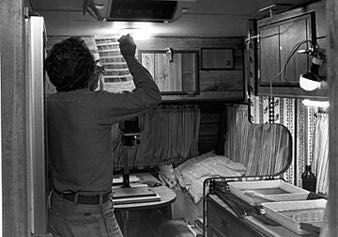
The photo is of me in my first motorhome printing black and white photos in my portable darkroom. I snapped the photo in the late ’80s with a self-timer, back when I was roaming the rural West as a freelance writer.

I believe I have shown you this picture before. But with Kodak’s bankruptcy announcement last week, I got to thinking about my “film” days.

I loved that darkroom. It was cheap with no frills. But it did the job.

With it, I could send my stories, complete with photos, from just about anywhere. I was too impatient to wait until I returned home, and, truth be told, I needed to get paid fast because I was usually on the brink of financial collapse. Besides, printing photos was good entertainment in those days without a TV, and before the Internet was invented. At first, I wrote with a manual typewriter (torture!).

I would typically set up the darkroom once or twice a week, providing I could find a dark campground. All I needed was an electric hookup. Having running water was nice, but not necessary beyond a gallon to mix with the photo chemicals and later for a quick rinse of the prints.

I’d work into the wee hours of the morning, often marveling at how, in the middle of nowhere, I could print photos for newspapers and magazines. As I worked, I would sip cheap beer, listen to my Walkman, and sing like a giant canary. I remember being very happy. My neighbors would have never guessed what was going on next door.

SOMETIMES AFTER PRINTING for a couple of hours, I’d step outside to stretch. It would be dark and dead silent. I’d glance back at the motorhome, which was pretty in the night with the dim orange glow of the safe light visible through the open door. I would feel great joy knowing I was living my dream of being a writer on the road — going where I wanted, when I wanted, and choosing my own stories.

These days, I have a laptop computer and an aircard so I can access the Internet. I have a cell phone, TV, iPod and iPad. For entertainment I can watch a DVD, or video chat with friends and family. There’s no more darkroom: with my digital camera I can snap a photo and share it with the world in a few minutes. Same with videos.

I love being on the road as much as ever, and I love the new technology. But I miss my darkroom.

A terrific hobby for RVers: photography

By Chuck Woodbury
editor, RVtravel.com

Last week I told you about the portable darkroom I once carried with me in my motorhome. What I didn’t tell you was how much fun it was to take photos back then (and now, too).

If you are looking for a creative hobby while traveling, consider photography. A small point and shoot camera or even an iPhone is all you need. An instruction book on basic photography techniques will help.

I love to take photos of all things odd and funny. As I head down an unfamiliar road, my eyes are darting left, right, up, down, everywhere — on the lookout for something “different” — a funny business slogan on a sign, an unusual mailbox, or perhaps a giant statue of a steer high atop a restaurant (“Steaks served here”). In Woodland, California I snapped a photo of City Hall along with the street sign out front, “Dead Cat Alley.”

I am always looking for strange looking animals — most often fake ones — like the photo above of a T-Rex that appears to be intent on terrorizing a town. Actually, it was a statue in Vernal, Utah. A small sign in front said, “Welcome to Vernal.” To snap my photo, I walked down the street a few hundred yards and used a telephoto lens to make the dinosaur appear large and menacing. It remains one of my very favorite roadside shots!

Not far away, a far friendlier looking dinosaur stood in front of the Motel Dine A Ville (now gone). Today, the dinosaur welcomes visitors to Utah’s “Dinosaur Land.” Years ago, local high school students with bows and arrows would occasionally take target practice on the defenseless beast.

I will drive out of my way to photograph anything that’s the “World’s Largest.” I have stopped several times in Winlock, Wash., for example, to photograph the “World’s Largest Egg.” In Brunswick, Missouri I proudly photographed the “World’s Largest Pecan.”

Occasionally, a photo simply presents itself, like the friendly chipmunk that showed up at my campsite in the Lassen (Calif.) National Forest. The little fellow demanded Cheez-Its. This was back when I fed wild animals (naughty me). Looking at the photo of this cute little guy peeking over my coffee mug always makes me smile.

For many years now I have carried a small, inexpensive point-and-shoot camera. It’s all anyone needs these days to take interesting travel photos. Most people, I have observed, photograph mostly scenery on their trips, most of which will bore their friends and have little interest to the photographer years later. My advice: take pictures of friends, family, interesting people you meet — and maybe keep an eye out for offbeat stuff. A funny photo can make people laugh just as much as a good joke.

“RVing” versus “camping”

By Chuck Woodbury
editor, RVtravel.com

Many years ago, I wrote about how the terms RVing and camping differ.

RVing, I suggested, is a good term to describe traveling with a comfortable recreational vehicle with most, if not all, the comforts of home. RVs for “RVing” would include big fifth wheel trailers and travel trailers, and most class A motorhomes. The Monaco Monarch motorcoach pictured here, for example, would be used for RVing but not camping. People who travel in a luxury RV like this do not “camp.”

Camping, on the other hand, is practiced with smaller RVs that are meant for weekend outings and family vacations. RVs are typically small travel trailers, pop ups (like in the photo), truck campers and modest-sized motorhomes, say, 25 feet or less. Of course, camping doesn’t require an RV — a tent or a sleeping bag will do. Some tent campers would argue that anyone who travels with an RV is not camping.

By my definition, campers prefer to stay in national forests, state parks or no-frills RV parks, especially those that offer many family activities. They spend a lot of time outdoors — by the campfire, fishing, hiking, swimming, dining at a picnic table. RVers, on the other hand, prefer cushier places — usually with full hookups, often staying in one place for weeks or even months at a time. Those in the largest RVs — the bus types, for example, often opt for posh RV resorts, which are like country clubs. These people “live” in their RVs not “camp” with them.

The readers of RVtravel.com are both campers and RVers. I think their common denominator is a love of traveling, whether around the country or simply down the road for a weekend getaway. No matter what size RV they travel with, they enjoy the freedom of going where they want, when they want — away from things familiar. Those with young families enjoy the time camping affords them to be together. Kids love camping; I sure did when I was a little guy.

I am more of a camper than a RVer, but like many of you, I can be an RVer one day, a camper the next. I can’t imagine myself in a big RV. My favorite campsites are in national forests and state parks. I enjoy utility hookups when available, but I’m usually fine without them. I think of my RV as a rolling cabin. I bet RVers with large RVs consider their rigs more like rolling condos.

Want a good night’s sleep? Then don’t camp here!

By Chuck Woodbury
editor, RVtravel.com

You want a peaceful night’s rest? Then don’t camp by railroad tracks.

If you’ve been RVing for long, you know that’s no joke. Many RV parks are located right along the rails — it’s cheap land. I once thought years ago that every KOA was by a railroad track. That’s not true, but many are — and not just KOA’s.

My worst RV “train” experience was in Pismo Beach, Calif. The RV park was tidy — lawns cut and manicured, well maintained buildings, and far enough off the road so little traffic noise. Perfecto! I backed into a site right up against a 10-foot hedge. I could not see what was behind it, but no problem: I didn’t care. I just needed a piece of flat earth to call home for 18 hours to do some writing and get some sleep.

Twenty minutes after I arrived, the earth shook. And shook. And shook. Yes, there were train tracks right behind that hedge! And I mean directly behind — perhaps ten feet or so! That put me about 18 feet from the trains. Luckily, there was no street crossing nearby, so at least there were no loud horns.

Despite the trains, I decided to stay. Other nearby campgrounds were full or nearly full and I was too lazy to unhook and move.

DO YOU KNOW when you are half-asleep how sounds can startle you, and how your imagination can play tricks? Well, when the trains rolled by that night — about every half hour — I would panic. I would think, “That train is going to derail right into my RV and I will be dead!” I would hear a train approach in the far distance, and then it would be closer, and then it would be RIGHT UPON ME, roaring — shaking the earth and my puny motorhome. I waited for the impact — the terrible instant when I would be crushed like an ant. Death! If I were a little boy I would have put my blanket over my head, but alas, I learned at about age 35 that blankets are no help keeping away monsters, or in this case, derailed trains.

So that was the game my mind played with me as I lay half awake, half asleep. The night was long. It was terrible. But, as you have likely concluded, I survived.

The fact is, train traffic is a well-kept secret of the RV park industry. In RV directory listings for campgrounds you’ll learn about the good stuff — “pool, game room, shaded campsites, WiFi, clean bathrooms, ice cream socials, fishing lake, etc.” What you will not read is this: “Enjoy loud, disruptive sounds and feel the earth shake as diesel locomotives roll by your campsite day and night.”

So here’s some advice: Before you commit to staying at a particular RV park, check it out on Google Earth: you should be able to see any railroad tracks from the satellite photo. Or, call the park and inquire if there are tracks close by (busy highways, too). If so, ask if there are sections of the park away from the sound and rumble (there usually are). If so, make your reservation. Otherwise, find another park. If you wear a hearing aid, then maybe this is no big deal — just turn it off and consider the rumbling a gentle massage.

Do campgrounds cause cancer?

By Chuck Woodbury
editor, RVtravel.com

I wrote this in February, 2012

Do California campgrounds cause cancer or birth defects? Well, maybe so. No kidding!

If you see the sign pictured here posted at your favorite RV park, then forget about all your fears of the past — bears eating you or a tree falling on your RV in the middle of the night. Forget about a propane tank exploding in the RV next to you. Forget about a madman with a hatchet breaking down your door at midnight demanding Oreos.

No, don’t worry about these things. Worry about cancer! Or giving birth to the creature pictured to the left! That’s what camping might do to you these days!

California’s Proposition 65, also known as the California Safe Drinking Water and Toxic Enforcement Act of 1986, requires businesses, including campgrounds, to post “clear and reasonable warnings” if specified chemicals exist that are known to cause cancer, birth defects or other reproductive harm, according to Debbie Sipe, president of the California Association of RV Parks and Campgrounds.

“The State of California publishes a list each year of these known chemicals. If any are located in your place of business then you are required to post this sign,” she said.

The occurrence of any of the following, says the state, could cause reproductive harm, birth defects and cancer: second hand smoke, campfires, engine exhaust, pool chemicals, cleaning supplies, pest control and RV holding tank products. And the list goes on. And on. And on.

Is there any place in the modern world that does not have at least some of these present? I think I need a sign for inside my motorhome.

“California’s Proposition 65 is enforced through civil lawsuits and as a result is becoming the next wave of “drive-by” lawsuits,” said Sipe.

So, presumably, if some day you get cancer or give birth to a kid with three eyes. . . then blame it on that RV park where you stayed five years before. Go ahead and sue. It was the campfire!

Oh, we live in a silly world!

Add a temporary outside water faucet to your RV

There are times when you might want an outside water faucet to attach a hose to, fill a water bucket, or wash hands. But the only faucet connection is in use supplying water to your RV’s water source.

faucet737Camco’s outside water faucet solves that dilemma with a lightweight plastic faucet that attaches between your water supply and your RV, and also allows your water hose to hang straight down without kinking where it enters your RV.

With the extra faucet you don’t have to shut off the water, disconnect the water supply hose, connect the outside hose, then reverse the process when you are finished. Also, it doesn’t deprive your RV of water while you are disconnected.

The faucet can also be used as a pressure relief valve when disconnecting your water supply from the RV.

You can find the faucet at Amazon.

Protect your awning from sudden wind bursts with a tie down

You return from just a brief trip to the store, or a short hike, only to find that the sudden williwaw that blew through your campground while you were gone wrapped your awning over your RV’s roof and bent the arms beyond repair.

It can happen in mountainous areas where sudden winds cascade down from the mountain tops, or in the desert when a sandstorm quickly erupts nearby, raises havoc, and as quickly passes by leaving localized destruction.

It’s easy to think that you will always see these events coming and be there to roll up your awning. But until you are caught away from your rig, it’s hard to imagine what damage can fall upon your home-on-wheels. But it doesn’t have to happen this way.

With a simple tie down system, you would have survived the windy blasts with little or no damage. The tie down also provides peace of mind while you are away from your rig. It is not always convenient or considered that a wind will blow through so you ignore rolling up your awning whenever you leave your rig.

Valterra Products Happy Hook Awning Tie-Down fully rotates awning tube to keep fabric tight, preventing the flapping in a wind that causes the damage and can rip the fabric. Simply unhook the line for quick take down when its time to roll up the awning. It also keeps the tie-down pressure on the main support and eliminates separation of awning fabric from RV side wall.

You can find the Happy Hook on Amazon.

Easily turn your photos and slides into digital images

By Chuck Woodbury
Editor, RVtravel.com

Before the digital age of photography, we used film. Oh, how things have changed! If you’re like me, you have countless photos, negatives and slides that are sitting in drawers or albums. Here’s a way to turn those old images almost instantly into digital files, which you can then store on disks or print on your computer or an instant photo machine at a store.
In my case, I have thousands of photos I took during my years traveling the West as a roving journalist. I shot mostly black-and-white photos then, printing only a fraction of them, most in my small motorhome with a portable, bare bones enlarger. Today, the negatives of those photos are stored in plastic sleeves in countless three-ring binders. And there are a dozen binders with color slides, too.

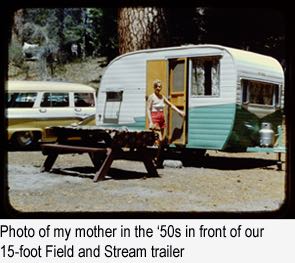
When my parents died, they left me at least a couple thousand color slides from birthdays, holidays and our family vacations. The photo below is an example.

One option to convert those negatives and slides into digital images is to use a commercial service. Costco does it cheap. But you have to wait days or even weeks to get the images back.
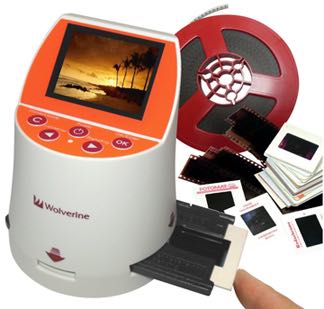
Now, there’s the Wolverine F2D Mighty 20MP 7-in-1 Film to Digital Converter, which you can use to create digital images from film, both black-and-white and color slides, and even from single frames of old 8 mm home movies. No computer or software is needed.

It’s about the size of a large coffee mug, is simple to use, and sells for about $140. To use it, simply insert a slide or negative into the device, push a couple of buttons and that’s it. You can preview your negatives before scanning them on a 2.4-inch screen. That’s nice because it’s often hard to “read” a negative. The device can store up to 40 images internally or thousands on an SD card. The photos are scanned at 20 megapixels — overkill for most of us who plan to print the photos at 8×10 inches or smaller. Once the photos are digitized, you can print them or store them on CDs.

I have been having a wonderful time going back through my binders and boxes of old photos and slides, scanning many that would have probably just been forgotten.

The Wolverine converter is available at Amazon.com, where there is also a lot of information about how it works. I give this product five stars out of five.

Easily add support for entering and leaving your RV

Do you or another member of your camping party need a little help or support in climbing the steps into and out of your fifth wheel?

Even if you don’t feel that you need any help, a hand support can help prevent slips or falls as well as providing more stability.

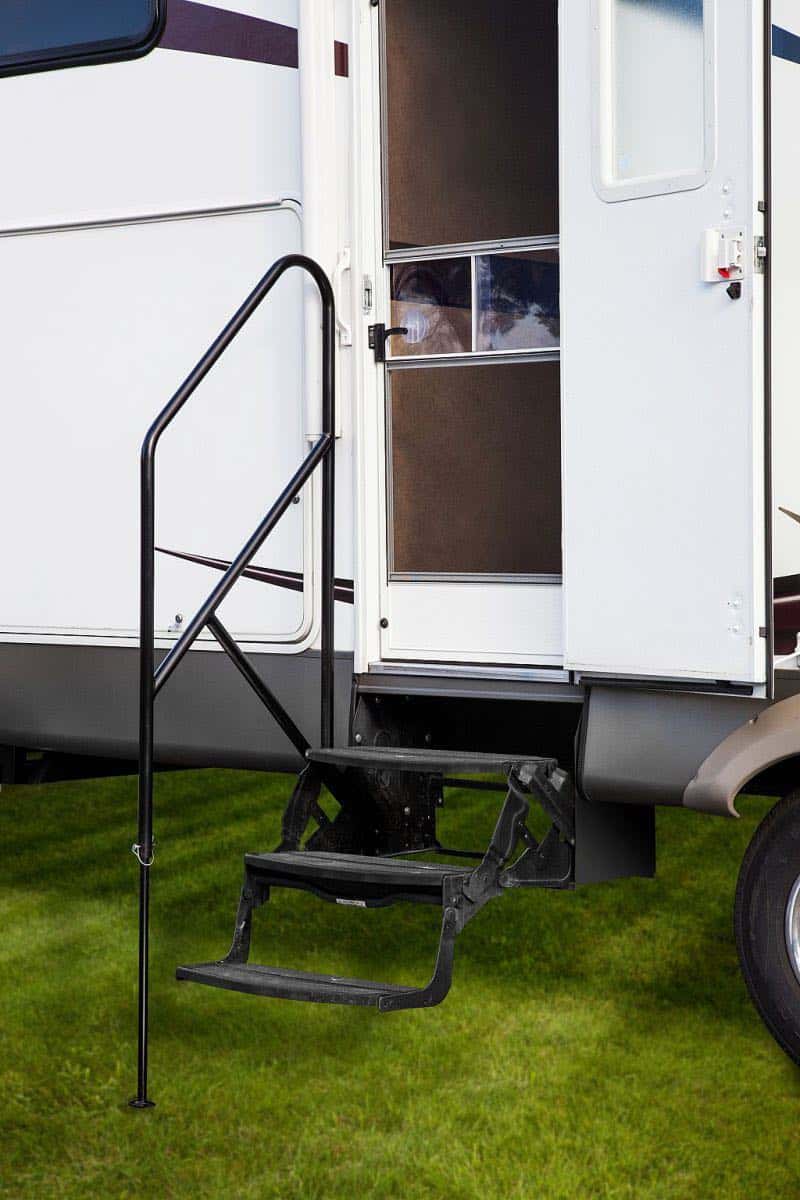
The Stromberg Carlson Rail Mate removable handrail is designed to give you superior support for safely entering and exiting your RV. The Rail Mate is easily removable to store during travel, sets up in just minutes, and is lightweight and easy to install.

Designed for most triple and four-step manual entry steps. Handle is 38″H x 25″D. Front leg extends up to 37″ with assorted pre drilled holes. Made in the USA of steel with corrosion-resistant finish.

Look at the Rail Mate Installation Instructions to see how easy it is to install yourself.

You can find the Rail Mate at Amazon.

Tools for RVers: Rivet guns

By Chris Dougherty
Certified RV technician

Many RVs have riveted components including aluminum siding, moldings, hinges, latches, screen doors and more. Rivets are actually pretty easy to work with once you get used to them, and can be carefully removed using a power drill and the correct-size bit.

To replace the rivets, a rivet gun and a supply of rivets are required. Rivets commonly come in steel and aluminum, and I keep a supply of each so I can replace the rivet with the same material as came out — in other words, use aluminum with aluminum and steel with steel.

Pop rivets have different sizes in diameter and length to hold various thicknesses and weights of material. This is why having a selection is such a good idea, so you can likely have the size you need on hand. Some RVs like some of the older Fleetwood motorhomes use special rivets and are best found through a specialty hardware supplier or RV dealer or service center.

Rivet guns come in a variety of sizes, up to large double-handled units for large steel rivets. I have two rivet guns: a small handheld Arrow unit with three interchangeable bits, and a pneumatic gun which I use for the big jobs when I have hundreds of rivets to replace.

Amazon has a selection of rivet guns and rivet kits, from small to large, all in one place. Most home centers will carry the smaller handheld guns, but are usually limited in selection.