I am planning a two-week road trip for later this summer, most likely from my home in Washington to Southern California and then back.
So I pulled out a map last night to figure out my route. The coast route is always tempting — it’s so beautiful — but last night I kept thinking about U.S. 395, which travels east of two magnificent mountain ranges, the Cascades and Sierra, on the western edge of America’s outback.
Out there, in the little-populated areas of Washington, Oregon, Nevada and California, the Frontier West lives. There is more “west” there than over the mountains to the west: city-slicker SUVs are replaced by pickup trucks, espresso stands by coffee shops, and computers by cowboys. The air is so crisp, clean and clear you can’t get enough of it. It’s especially fragrant after a rainstorm, when the aroma of sagebrush is better than any perfume.
IF YOU HAVE NEVER TRAVELED in these parts, I urge you to do so. U.S. 395 is one of the greatest north-south routes in the American West. With the exceptions of Spokane and Reno, most settlements along the way are too small for stoplights. It’s wide open spaces — ranch lands, pine forests and Great Basin desert — “daydream country” as you drive. Views of the Sierra mountains in northern California rival those of the Grand Tetons in Wyoming. Away from cities, the Milky Way looks like a giant cloud spread across the night sky. On a warm evening, grab a pillow and lay on your back on a picnic table or even on the roof of your RV and get lost in the heavens.
With rare exceptions the traffic is light and there are plenty of campgrounds, most on public lands. This route does not get a lot of publicity, but I’m telling you, it’s spectacular!
I love this photo. I snapped it a long time ago somewhere in New Mexico. It was along a rural highway. Just down the road was the small, tacky souvenir shop with the snakes. The store sold the regular stuff — jackalopes, toy Indian drums, assorted tee-shirts, snow globes, and scorpions preserved for eternity in clear plastic paperweights.
As I recall, there were a couple of glass cages with the live rattlesnakes. It was an utterly unremarkable exhibit. But after driving 150 miles through mostly nothing, it was cheap entertainment and an opportunity to use a bathroom, probably dirty but better than a bush by the road (I was in a car at the time, not my RV with its clean, comfy restroom). Far from the crowds, along a little traveled highway, there were no McDonalds to pause for a meaningless experience with sameness or a McBathroom.
My guess is that today there are perhaps only a third of those old Ma and Pa roadside tourist places. They sell the same stuff as in the old days except today it’s made in China instead of the USA or Japan. Personally, for reasons I cannot explain, I keep acquiring new, but not at all improved, scorpion paperweights. It’s one of my faults.
You very rarely find such low-budget tourist attractions along today’s Interstates. That’s where most of us now travel because we are in a hurry to get from one place to another as fast as possible, and the kids in the back seat are playing video games anyway, so who cares what’s outside in the real world?
I don’t have a profound point to make to sum up. I guess I mostly just wanted to show you the picture.
By Chuck Woodbury editor, RVtravel.com Originally published in July, 2011
My original essay back in 2011 sparked more than 100 comments from readers.
The idea was this: Why don’t some RV parks offer $10 a night “no-frills” camping for self-contained RVers (only) who just want a place to sleep — no hookups, no use of the restrooms, pool or WiFi, and no use of their generators? They can stay for one night only, after 6 p.m., and they must be gone by 8:30 a.m. As is, thousands of these RVers stay for free in a Wal-Mart parking lot, a rest area, truck stop or other place.
When I first wrote about this, I received letters from several RV park owners, who said they could not afford to offer a $10 campsite. They listed reasons that basically boiled down to “how could we distinguish the $10 campers from those paying the going rate?” They explained their need to cover their overhead: there were restrooms to clean, pools and a dump station to maintain, WiFi to pay for, etc.
Frankly, their responses were predictable.
It’s a whole lot easier to maintain the status quo than to change. A combination lock on restroom doors would keep the $10 campers out. With no password, they couldn’t use the WiFi. Few of them would want to use the pool anyway: they’d just want to park and sleep. Charge them $5 to dump.
Put the $10, self-contained campers in a corner of the park or overflow area with a self-pay box like at Forest Service campgrounds. I bet 98 percent of them would play by the rules. And some of those folks would return again if they liked the park — paying the going rate next time to stay awhile.
IF I WERE A CAMPGROUND OWNER I would ask myself, “Is it really THAT hard to provide a $10 no-frills service?” I would then address the problems and see if they were insurmountable. If I knew that every night there were 20 RVs down at the local Wal-Mart, I’d try my best to lure some of them my way. I could dispatch an employee there to put a flyer on their windshields: “Next time stay with us in a safe, secure place for $10.” And provide them with a two-for-one coupon for the next time they’re in town.
If five of them stayed a night for 200 nights a year, that would put an extra $10,000 in their piggy bank with no effort. I bet some of those folks would buy a quart of milk at the campground store. And if 10 percent of them came back once a year paying the full rate, that could add another $35,000 to the pot.
Almost all of the comments were in favor of the $10 idea. A few RV parks responded, claiming that RVers would abuse this budget offer. Some said they didn’t want “these cheapskates, anyway.”
One owner said that even if a password were required for entrance to the restrooms — which would only be provided to full-price campers — the no-frills RVers would “just follow someone else in.”
DO YOU THINK ANYONE would ever open a convenience store if they were afraid an occasional customer would steal something? Do you think book publishers would ever publish a book if they were paranoid that someone might borrow it from a friend and, heaven forbid, “not pay to read it?!” Do you think anyone would open a multi-screen movie theater if they thought someone might sneak into a movie without paying?
This “no-frills deal” is not right for destination RV parks where campers come to stay and play. But it will work for some parks along an Interstate or other busy highway where dozens of transient RVers hole up in a nearby parking lot rather than pay the campground $30 or more for services they do not need.
Better than Wal-Mart, hands down, but not worth $30 to $50 when all you need is a good night’s sleep!
There is a golden opportunity here for owners of RV parks by the highway who currently watch the local Wal-Mart lot fill up every night while half their sites remain empty. They don’t understand that $10 is better than zero when there is virtually no extra cost to them beyond setting up a dedicated area with a self-service check-in box. Heck, some of these budget RVers might like what they see and return one day at full-price. Instead, the park owners worry that someone will sneak into a restroom and cost them the price of a toilet flush.
Do you remember when Motel Six opened for $6 a night while everyone else charged two or three times more, and how Motel Six prospered? Or how about Southwest Airlines? It got you where you wanted to go for a whole lot less than the competition and prospered right out of the gate.
Any RV park that sets up a $10 self-service, no-frills area in his or her park can expect that I, for one, will publicize the heck out of it. The other parks can go ahead and ignore this great opportunity and continue to fume about all those freeloaders down at Wal-Mart.
The RV park owners dub the Wal-Mart RVers cheapskates. I call those “cheapskates” smart: they just saved $30 or $40. And if they put that money in the bank, collect interest, one day it turns into a whole lot more.
No, staying in a parking lot is not “camping.” But we’re not talking about that here. We’re talking about sleeping in a self-contained RV without paying $5 an hour to do it.
I received a message last week from a woman named Louise Schlosser who was horrified that a New York RV park did not supply toilet paper or paper towels in its restrooms. “The greeting on the restroom door was No toilet paper supplied,” she wrote, adding “Camping has reached a new low.”
My first reaction was to agree with her. In this troubled economy it didn’t surprise me that an RV park might resort to such a drastic (and stupid) cost-cutting measure.
I decided I should call the park for an explanation. Frank Scotti, the owner of the Blue Jay Campsite at Tupper Lake, answered the phone. “That’s right, there is no toilet paper in the restrooms,” he said, not hesitating for even an instant.
He and his family have owned the RV park since 1960. In all that time they have dealt with all kinds of campers, most considerate and respectful. But not all of them.
The Scotti family has successfully tweaked its marketing efforts through the years to attract a good crowd. Today, said Frank, “they’re like family.” The drunken weekend party goers of yesteryear have been mostly eliminated. Ninety percent of the campers these days are well-behaved “regulars.”
BUT THERE ARE BAD APPLES, and that is why there’s no toilet paper or paper towels in the restrooms. Too many times, kids stuffed the toilets with paper just to watch them overflow. The park’s well and sewer system could not deal with the excess usage. Scotti received permission from the local health department before discontinuing the restroom paper. Still, that has not stopped the vandalism. Right now he’s trying to locate a “Phantom Pooper,” who regularly uses a shower stall instead of a toilet. “We think it’s a visitor, but we don’t know for sure,” he says. “I lose sleep at night thinking about it.”
Talking to Frank Scotti, you instantly realize he’s a good guy with the best interests of his campers in mind. You understand why the “No paper” signs are posted on the restroom doors. I’d do the same.
It saddens me how people can be so disrespectful, so malicious. Thankfully, these creeps are few and far between. But they sure do mess things up for the rest of us.
I am on vacation in England. I was traveling the A11 highway this week north from Cambridge to an abandoned American air base in Attlebridge, now a turkey farm, where my father was stationed as a B-24 bomber pilot in 1944 during World War II.
About 20 miles before arriving I spotted a road sign for “Combat Paintball.” I thought of today’s youths and young men “playing war” there and then reflected on the men who decades earlier faced death doing the real thing.
A B-24 Liberator
My father, Charles M. Woodbury, Jr. (I’m Charles the third), didn’t talk much about his time at Attlebridge with the 466th Bomb Group until the last 10 years of his life when he opened up — so much so that at times I turned a deaf ear. He died in 2008.
About a month ago, I had the opportunity to fly in a B-24 on a tour stop in Seattle. It was a remarkable experience that made me realize how difficult my father’s task must have been. Besides risking life and limb each time he flew, the Liberator was too noisy to talk in without shouting, it was a beast to fly, and at 20,000 feet during a mission the non-insulated cabins could dip to a bone-chilling 40 degrees F. The guys had warm clothing, but it was often inadequate to keep them from half-freezing to death — and the average mission was seven hours!
A tiny chunk of the runway I’ll take home with me
I spotted the Attlebridge runway through several rows of trees. I soon arrived at the end of the runway where my father lifted off as an anxious 23-year-old to face Hitler’s guns and fighter planes. My father always returned, but 6,900 other fliers in the 2nd division of the 8th Air Force did not. The odds were terrible: in the early missions, fighter planes did not have the range to accompany the Liberators and B-17s, leaving them sitting ducks. Two-thirds of those early fliers were shot from the skies and killed.
A quarter mile from the airfield, in tiny Weston Longville, I stopped at a church with a small memorial to the 466th Bomb Group. I found my father’s name in the history book. Across the street, I had coffee at The Parson Woodforde restaurant, where my father and his chums surely gathered at the bar for many a refreshment. Photos of the Americans and their B-24s occupy one wall.
My niece Dawna and me before our 45 minute flight in a B-24 Liberator
WHAT I UNDERESTIMATED before this visit was the huge impact the Americans had on the people who lived here, many of whom had endured Nazi bombings and rationing. Thirty-five air bases were bulldozed in farmland in the East Anglia area, five to ten miles apart, and in most cases near rural settlements of only a few hundred people or less. The Yanks were beloved by these locals — heroes to the children and prize catches to the young ladies. The English of today have not forgotten them, just the opposite.
Malcom Metcalf in front of a photo mural in the Memorial Library showing actor Jimmy Stewart being honored for his war efforts with the 445th Bomber Group.
Later that day, at the 2nd Air Division Memorial Library in Norwich, I met Malcom Metcalf who was a boy of about 11 when my father was at Attlebridge. “We loved them,” he said of the Yanks. “They gave us food. We were so hungry we ate turnips in the fields. One American asked me if I had ever eaten peaches. I said no. He handed me a can from his mess kit. I’ve loved peaches ever since. People nowadays do not know how good they have it.”
Malcom Metcalf fell in love then with Americans and America. He has since visited the United States 20 times, criss-crossing the country 175,000 miles on Amtrak. “I have friends everywhere I go,” he said. I invited Malcom to visit me. I want to hear more of his stories.
I asked the museum librarian about a guest book my father signed when he returned to a dedication ceremony in the 1970s. She told me it had perished in a fire, which saddened me. My father was proud to have left that signature. The librarian said that while many Americans visit the 2nd Air Division Memorial Library, they’re now mostly the children and grandchildren of those brave guys back in the ’40s.
On the way back to Cambridge I again passed the paintball sign. It messed with my emotions — 2011 and 1944, 67 years — different worlds. War is a terrible thing, but for me, to be reminded about how we Americans came to the aid of our English friends and other Allies with commitment and high purpose makes me very proud.
In his 1864 novel Journey to the Center of the Earth, Jules Verne’s characters descend from an Iceland volcano and discover a fascinating subterranean world. From what I can tell, now three days into my one-week RV trip in Iceland, they could have just stayed right on the earth’s surface. This is one incredible country!
The weather has been lousy so far — off-and-on rain showers, heavy mist and even pea-soup fog, yet the countryside, as it passed by outside my little campervan as it rolled down Highway One, has been stunning, often unworldly, ever-changing and, in a word, magnificent. I only wish I were a geologist to understand more about what I am seeing. But what I do know is that the land here was created by volcanoes — some from ancient times, others from geologically “yesterday.”
Where the earth is separating: The rock to the left is the American plate. To the right: the European plate. Right here, the continents are gradually separating, sending them farther apart.
I spent my first day and night in the capital of Reykjavik, a “cute” little town that could borrow the phrase “Biggest Little City” from Reno, Nevada for its own. It’s huge by Icelandic standards — about 200,000 people, which accounts for two-thirds of the entire country’s population. The driving is easy in the mini-metropolis. At night, the locals and visitors dine or sip coffee at cafes. Reykjavik feels European, which makes sense because Iceland is part of Europe.
THE FOLLOWING DAY, in a period of only about eight hours, I stood where the North America and European land plates are slowly separating, pushing the two continents farther apart. Then, just down the road a bit I visited Europe’s largest waterfall at Gullfoss; it took my breath away. Then, I finished my day camped in a two-minute walk from the Strokkur geyser and the others in its field where the word geyser originated.
Now, as I write you, I am about to visit the Vatnajokull glacier, just a short walk from my campsite. Waking up this morning and sipping my coffee with a glacier as a backdrop was an incredible treat.
I return home on Monday after three wonderful weeks away, two weeks in England and now a week in Iceland. I urge you to visit here. Make this a stopover on a trip to Europe. If you fly Iceland Air you can get off, stay a week, and then get back on your plane for no extra fee.
I don’t want to be home. I want to be traveling again, preferably on the road with my RV, roaming great highways and back roads, taking pictures, writing stories, meeting people.
When I am traveling, I feel more alive, happier. Traveling serves my short attention span well.
A few weeks ago in England, exploring my father’s old World War II airbase and the East Anglia region where 35 World War II airbases were located, was an eye-opening, albeit somber experience. Brave young Americans came here, lived here, died here or in the skies to the east. I learned much here about my father and about history; my head spun, hyper-stimulated at soaking up so much new knowledge.
When I was in high school I had little interest in history. In college, I had a great professor and I developed some interest. Now, I can’t get enough. When you travel, you learn not only where you are “now” but what happened there before. I love that part.
LATE LAST MONTH, attending a church service in Westminster Abbey was incredible: talk about history! A week later, pulling off the road in my campervan a few feet from icebergs in Iceland and then a few hours later on a landscape that looked like Mars . . . I was in heaven — geologic history in my face! Now, home again, I dream of where I’ve been. Images of places dart in and out of my thoughts and I try to remember where they were. Memories of Iceland haunt me: I want to go back. It’s spectacular. So beautiful. For the first time in a long while I felt a very strong connection with a place.
The Ring Road in Iceland. Beautiful. Hardly any traffic.
So here I sit at my computer with wanderlust driving me loopy. I have a bunch of family financial stuff to attend to. It’s got me planted firmly at home. It’s complicated, and boring beyond boring; if I don’t end up in Heaven I’ll spend my eternity as an accountant.
Where I really yearn to be right now is rolling down a back road into a small town, pausing to gab with the owner of the hardware store or the gum-chewing waitress at Betty’s Cafe. I want to end my day sitting by a campfire, watching flames dance beneath a starry sky.
It looks now like I can’t get away in my RV until at least January, and I can hardly wait. I generally don’t like time passing fast because I just keep getting older and I’m not into aging due to eventual death, which does not interest me. But, right now I’m totally in favor of getting to January pronto, which, as a bonus, means my dreaded Christmas shopping ordeal will pass faster. I had a physical today. The nurse asked me how tall I was. I said, “I used to be 5-10, but I think I have already begun to shrink.” So I told her 5-9. Gravity be damned!
It’s so sad what happened two weeks ago: five people died in a rented RV at a charity event at Tennessee’s Clarksville Speedway. They went to sleep and never woke up. A portable generator hummed outside. Unknown to the RVers, the exhaust was venting into the rig. Friends entered the next morning to wake them up. Oh, the horror!
Those five people left behind 12 children, now all without a mother or father, maybe both. If only one of those persons were educated in the dangers of carbon monoxide poisoning they’d all be alive today. Their kids would have a parent, not a grave to visit. Ironically, the charity event benefited needy children: its organizers must be distraught.
Carbon monoxide levels as high as 438 parts per million (ppm) were discovered inside the RV that awful morning. “Those sorts of levels, if they were asleep, you wouldn’t anticipate anybody would wake up,” Rob Aiers of CarbonMonoxideKills.com told the Tennessean.
Here’s a video tip from Mark Polk about how to avoid being a victim of carbon monoxide poisoning in an RV.
MOST OF US THINK OF OUR RVs AS ALL FUN. It’s easy to forget they can be dangerous, even deadly. A propane leak can cause a fire or explosion. A electrical short or a miswired extension cord can set up a deadly situation that kills with the simple act of touching an RV’s front door. That very thing happened a few months ago to a teenage boy. Nobody in the family realized that getting a tingle when touching an RV was a sign of danger: that lack of knowledge killed their boy. His death prompted us to re-run our series on RV electricity by Mike Sokol.
Some RVers think it’s okay to walk around a moving motorhome like they’re back at home, or let their kids do it. If the RV stops fast, they get tossed like rag dolls. Somebody dies or spends the rest of their life in a wheelchair.
Lazy RVers forget to put a new 9-volt battery in their fire alarms. Their portable electric heater catches fire in the night — it happens too often — and it’s too late by the time they realize it, if they ever do.
Other RVers drive on outdated, worn or poorly inflated tires. A front one blows out as they’re doing 60 and in that split second they don’t know how to react. They never bothered to learn. So they hit the brakes. Wrong! That will likely send an RV out of control — into a ditch or another lane, maybe flip it over. Watch this video to see what to do if you blow a tire on your RV or any other vehicle. This is important!
Take it upon yourself to learn all you can about safe RVing. Keep your rig in top mechanical condition: that’s my number one safety tip. Continue reading this newsletter for advice and information about RV safety. Share what you learn with your RVer friends, or, better yet, gather with a bunch of RVers or your club to talk about it.
It’s true that RVing is a mostly safe, fun, carefree pursuit. But not always. So pay attention to potential problems and don’t end up like those RVers in Tennessee who should still be alive playing with their kids, not dead.
It’s raining. That’s what happens this time of year in the Northwest.
We had a short summer, but we could hardly complain considering the record heat much of the nation endured.
I have lived in the Northwest for 15 years now. I came from California, first from the irrigated desert of Los Angeles, where sunshine is the name of the game. Then I moved to northern California, with its honest-to-goodness seasons. I bought a heavy coat.
Now, near Seattle, I deal with rain. And drizzle. And gray skies. Shortly after moving here, on a spectacular, sunny winter day, I remarked to a clerk at our post office. “Beautiful day, eh?” He frowned, “Don’t like the sun,” he said. No need to ask: he was native — webbed feet inside them thar shoes.
Now, after 15 years here, I have grown to accept, even enjoy the rain (at least in the early season before it gets old).
I have always enjoyed rainy days in my motorhome, especially in a forest where the pitter-patter on my roof is like music, and the smell of the air like Heaven. People who live in roomy homes cannot fully understand the concept of coziness until they have holed up in an RV during a rain storm. It’s special. I feel like the rest of the world doesn’t matter: I have what I need and I am dry and warm. A good winter day for me in my motorhome is the sound of rain on the roof, a pot of hot coffee, and the time and peace to write. I write better in my RV, and even better when it’s raining.
As you can see, right now I feel pretty good about the rain. But I know from experience that if you ask me in February I’ll be singing another tune.
A month ago, I whined here about how I was so hopelessly afflicted with wanderlust, and how frustrated I was I could not get away on a trip until January.
Well, I had barely finished writing that when a bargain airfare to the East coast showed up in my email. So, in short order, I was flying like a big ol’ bird to Boston, New York City and then Atlanta. I just returned.
It was two weeks of friends, family and sightseeing. On the other hand, it was two weeks of packing and unpacking luggage, too many unhealthy restaurant meals and of being herded through airports like cows in a stockyard. Ah, the simplicity of RV travel! Every flight was full, and the seats were inhumanely cramped. Flying is amazing for getting you somewhere fast. But it’s horrible for doing so with comfort unless you fly first class, which I don’t do because I prefer a few hours of discomfort over throwing away perfectly good money.
I HAD A WONDERFUL TIME visiting with my daughter Emily in New York City, where we explored town and enjoyed a few meals together. We walked across the Brooklyn Bridge at sunset. So beautiful! Later, on a gloriously warm evening, we relaxed on a park bench in Washington Square where we listened to street musicians and caught up with each other’s lives. It was about as good as it gets.
I had never before visited Ground Zero. It’s difficult to be reminded of the horror that occurred there on Sept. 11, 2001. How could people do that to other people?
With my ex-wife Rodica (still a good friend) and her family from Boston, Emily and I drove to Maine for lobster. Oh my, that sea creature is one very tasty crustacean!
Sully, my father’s B-24 navigator
Then, I was off to Atlanta, where my niece Dawna joined me for a few days. In our rented Ford Fusion (a disappointing vehicle) we blasted down the interstate to Savannah for Mint Julips, Southern dining and exploring its charming historic downtown. Then it was back to Atlanta to visit with my father’s Air Force crew member Hubert Sullins. “Sully” was only 20 when he was the navigator in the B-24 Liberator my father piloted on 35 bombing missions over Nazi Germany. What a joy it was to hear Sully’s stories; he’s the last living member of the crew. It’s sad seeing the World War II vets disappear.
Even though I am back home, I am ready to go again. I have two short “fly-drive” trips lined up between now and December. But what I am really dreaming about is heading off in January in my motorhome.
I think what’s happening to me these days is related to “empty nest syndrome.” My only child has moved away and my business runs smoothly no matter where I am. So I feel un-tethered. I believe I was born an explorer. “Why stick around one place when there are so many others to see?” That’s what I often ask myself. . .
I know from the letters I receive that many of you feel the same.
Update from 2016: Sully died a couple of years after my visit. The whole crew of nine is gone now (my father died in 2008).
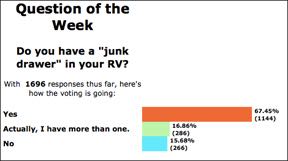
Today’s survey question is about whether you have a junk drawer in your RV. I have one. No matter how hard I try to organize my life, I need a junk drawer. Some objects have no other place.
My junk drawer at home is bigger than my RV’s junk drawer, so it has lots of junk — small junk, yes, but junk nonetheless. To be honest with you (as I always am, of course), I wish it would just go away. I should just dump it into a trash bag and toss it. I bet I would not miss a single thing.
The picture is of my home junk drawer. What a mess, huh?
I believe if I had a drawer that were ten times the size of my present home junk drawer, I would eventually fill it. Actually, that might describe my clothes closet, where I have a “junk corner.”
I also have a special “junk space” on my kitchen counter where I stack paper that I can’t find a place for. It mostly arrives in the mail, and it’s almost always nothing I ever wanted to begin with. I have tried going “paperless” with my bank, credit card company, utilities, doctors, etc., but they keep sending me more paper.
Remember years ago when everyone talked about a “paperless” society? They never envisioned ink jet printers.
AS A MEMBER OF THE GOOD SAM CLUB, which I usually call the Good Spam Club, I am privileged to receive its postal junk mail: hardly a week passes that the club doesn’t mail me a thick envelope with a letter telling me how special I am and therefore that I qualify to send them money for something I don’t want. But no problem: Good Spam mail goes straight to the recycling bin.
In my motorhome, thankfully, I have only one relatively small junk drawer so I have only minimal junk. My tiny clothes closet is too small for anything but clothes, which is good because even if I wanted to I couldn’t squeeze in any junk.
As I have said before, I have too much stuff, and that is why traveling in my motorhome, where I bring only what I really need, is such a pleasure. If my house burned down while I was away I would be sad, but not too sad because I would be relieved that my junk was gone.
I decided to earn my living as a writer only a few hours after my first day in my college newspaper class. I knew nothing about journalism at the time, and did not consider myself a writer. I was a business major.
But it took me only a few hours in the school newsroom to realize that I wanted to spend my future working on newspapers and magazines. I observed the student reporters writing their stories and then editors placing them on the pages that only hours later would appear in print on newsstands. The next morning I watched other students read those newspapers. I marveled at how quickly and effectively the reporters’ words were communicated to the masses. I wanted to be part of that world.
In the years that followed, I published a number of mostly short-lived and ill-fated specialty newspapers and magazines. Later, I decided to try writing for national newspapers and magazines. For the next decade that’s what I did, making just enough to live. But I loved sharing my words and pictures with thousands, sometimes millions of people.
I have been writing professionally now for more than 30 years. I am still addicted to writing stories and sharing them publicly. I love communicating with you in this newsletter.
But it’s a confusing time to be a professional writer. It’s no longer necessary to write for a newspaper or magazine to express yourself to a wide audience. Free blogging sites like Blogger.com along with Facebook allow anyone to circulate their writing and photos far and wide. If you are active on Facebook, you know the thrill of posting something and then reading the responses from friends, family and even strangers. The process is addictive.
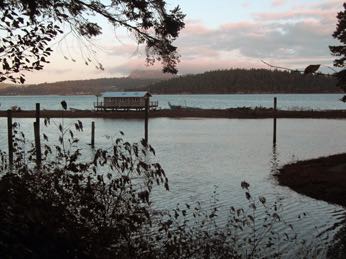
I SNUCK AWAY LAST WEEKEND for two nights of camping. My campsite at the La Conner, Wash., Thousand Trails park was right along the shore of an inlet on Puget Sound. I awoke to a beautiful scene — calm waters, Whidbey Island in the distance, a bald eagle perched atop a tall tree, and puffy clouds colored orange by the early morning sun. I snapped a quick photo from outside my motorhome’s front door, and then, without the slightest hesitation, I knew I MUST post it to Facebook. Moments later, people from far away were commenting on it. Wow! In the old days, what I wrote for publication may not have been read for months. Now, it takes a few minutes for a message to circle the Earth.
Even though I still earn my living as a writer, I wonder if one day when I no longer need to write for my livelihood if I could get the same satisfaction from posting to Facebook and on free blogs. I have a feeling I could.
It’s an exciting time to be an observer of media and mass communication. I love watching it all evolve. I bet 20 years from now we will view how we communicate today as primitive. Printed daily newspapers, I suspect, will be history. Who could have imagined Facebook at the turn of the 21st century? Some kid in a dorm room is probably already dreaming up something even more remarkable.
Photo: the early morning scene from my RV’s front door that I posted on Facebook (using my Verizon MiFi card to get Internet access).
We use cookies to ensure that we give you the best experience on our website. By continuing to use our site, you consent to accepting cookies. We NEVER have or will sell reader's data. For more info, please see our privacy policy page.


 So I pulled out a map last night to figure out my route. The coast route is always tempting — it’s so beautiful — but last night I kept thinking about U.S. 395, which travels east of two magnificent mountain ranges, the Cascades and Sierra, on the western edge of America’s outback.
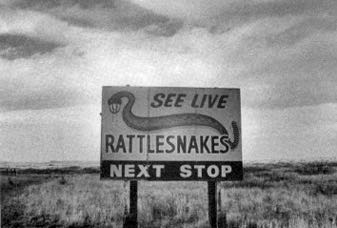 I love this photo. I snapped it a long time ago somewhere in New Mexico. It was along a rural highway. Just down the road was the small, tacky souvenir shop with the snakes. The store sold the regular stuff — jackalopes, toy Indian drums, assorted tee-shirts, snow globes, and scorpions preserved for eternity in clear plastic paperweights.
 The idea was this: Why don’t some RV parks offer $10 a night “no-frills” camping for self-contained RVers (only) who just want a place to sleep — no hookups, no use of the restrooms, pool or WiFi, and no use of their generators? They can stay for one night only, after 6 p.m., and they must be gone by 8:30 a.m. As is, thousands of these RVers stay for free in a Wal-Mart parking lot, a rest area, truck stop or other place.
 My first reaction was to agree with her. In this troubled economy it didn’t surprise me that an RV park might resort to such a drastic (and stupid) cost-cutting measure.


 When I am traveling, I feel more alive, happier. Traveling serves my short attention span well.
 It’s so sad what happened two weeks ago: five people died in a rented RV at a charity event at Tennessee’s Clarksville Speedway. They went to sleep and never woke up. A portable generator hummed outside. Unknown to the RVers, the exhaust was venting into the rig. Friends entered the next morning to wake them up. Oh, the horror!
 Other RVers drive on outdated, worn or poorly inflated tires. A front one blows out as they’re doing 60 and in that split second they don’t know how to react. They never bothered to learn. So they hit the brakes. Wrong! That will likely send an RV out of control — into a ditch or another lane, maybe flip it over.
  t’s raining. That’s what happens this time of year in the Northwest.
 A month ago, I whined here about how I was so hopelessly afflicted with wanderlust, and how frustrated I was I could not get away on a trip until January.
 My junk drawer at home is bigger than my RV’s junk drawer, so it has lots of junk — small junk, yes, but junk nonetheless. To be honest with you (as I always am, of course), I wish it would just go away. I should just dump it into a trash bag and toss it. I bet I would not miss a single thing.
 I also have a special “junk space” on my kitchen counter where I stack paper that I can’t find a place for. It mostly arrives in the mail, and it’s almost always nothing I ever wanted to begin with. I have tried going “paperless” with my bank, credit card company, utilities, doctors, etc., but they keep sending me more paper.
 I decided to earn my living as a writer only a few hours after my first day in my college newspaper class. I knew nothing about journalism at the time, and did not consider myself a writer. I was a business major.