Home Blog Page 2196

Chilling while driving your motorhome

0

By Russ and Tiña De Maris

A new reader sent us an email with an interesting question: “Can we run the propane generator while driving?”

It’s a great question, particularly for folks with larger motorhomes that, while equipped with factory “dash air,” don’t cool down with that comparatively miniscule-scale air conditioner.

Really, operating a motorhome’s roof air system while tooling down the highway is fine, whether the motorhome’s generator is LP-fired or otherwise. Keep in mind, if the generator draws from the motorhome’s fuel source — for example, a gasoline-fired generator drawing on the motorhome’s fuel tank — you’ll have fewer miles in the tank for getting wherever it is you’re going, and it will affect your fuel economy figures, if you’re keeping them.

There are other ways to keep yourself cool without drawing on the roof air. If you’re piloting a Class A motorhome or a large Class C and you find the dash air just doesn’t cut it, then take a tip from other RVers who’ve hung a heavy curtain behind the motorhome cockpit to isolate that area from the rest of the rig. Pull the curtain closed and you’ll reduce the area that the dash air needs to keep cool. Provided everyone is in the cockpit area, the result should be a less costly way to keep cool on the road.

Looking for deals? Check out the visitors bureau

0

By Bob Difley

When you’re traveling by RV, you cover a lot of ground — and you can spend a lot of money. Who doesn’t want a discount now and then to ease the wallet? Nearly all area attractions at one time or another offer either discounts, free days, two-for-ones or other incentives. How can you take advantage of them?

Always check at every tourist bureau and visitor information location you find and ask about your specific interests — as well as some things you may not have an interest in at present yet you may find interesting and entertaining.

The city of San Diego, for instance, sells a Balboa Park Museum Pass that is good for a week and offers admission to 17 museums in the park. With this pass you could visit museums that you might not otherwise choose to, and surprise yourself with the enjoyment of it.

Many restaurants offer early diner, senior, or two-for-one discounts. Ask the attendant for coupons. If an attraction offers a deal, the tourist bureaus and visitor centers will have the information — and the discount coupons — so these are must-stops. Check for senior and off-season discounts, as well.

Choosing an RV dealership – Part 1

0

by Steve Savage, Mobility RV Service

One of the recurrent questions asked by folks considering the purchase of an RV is very basic: Where should I buy? Here are the most important factors I would consider. Please note, my list may not agree with yours and is not in sync with conventional wisdom.

1. Unless I were a technician with a solid skill set or took a technician with me, I would not buy from a private party. Some private sellers are very honest; some are very dishonest, but unlike dealerships, private parties have no track record to maintain and some are not even knowledgeable enough to know what works and what doesn’t.

If you are thinking that buying privately will save you a bushel of money, unhappiness is sure to follow when the purchase price is low and the need for service after the sale is high. I might call this the “Yugo syndrome,” coined when that famous little import from Eastern Europe invaded the United States in the mid-’80s.

2. I would buy from a hometown dealership whenever possible. Even in this age of depersonalization, when shopping via the Internet is all the rage, there is much to be said in favor of buying close to home.

My reasoning here is twofold. First, hometown buyers are more likely to get hometown service. Why? Because they are the buyers who are most likely to return a second time. When I do service work, repeat local customers will most often find the first thing they hear when they call is that I answer by calling them by name because I loaded it in my smartphone. Like most dealerships, I have discovered repeat customers are the best customers and if they are close by, it increases the odds I will see them again.

Secondly, as a sequel to my first point, if you are committing to buying an RV, you are also committing to the inevitable service work that comes as part of the deal. Many dealerships service their own customers first. You may well save a few hundred or even a couple of thousand dollars by shopping on the Internet or buying hundreds of miles away, but if it takes two months in the middle of the camping season to get your RV repaired, the savings may not be quite so memorable!

3. I would buy from a small dealership rather than a mega multi-site conglomerate. I like personal service; I think most folks do. Small dealerships are more likely to remember me. With large businesses, I have too often heard the phrase, “It’s not personal; it’s only business.” Try to convince someone committing to purchase something with a long-term loan that it is not personal.

I know mega-site dealerships have a greater selection and sometimes getting what you want close to home is simply not possible. If that is truly the case, buying from a large dealership may make sense. More often, however, I see folks looking for a way to save money that in the end may not save them much at all.

I have three more points to cover, and I’ll do it in the next installment.

Read Part 2

Choosing an RV dealership – Part 2

0

by Steve Savage, Mobility RV Service

In my last installment, I gave three good ways to look for an RV dealership. If you haven’t seen them, I urge you to go back and take a look. Here are my last three points to help you be happy with your RV shopping experience:

4. I would look for feedback about dealerships on the Internet. Just for fun, Google “RV dealership reviews” and see what pops up. I don’t put much stock in a couple of bad reviews, but I do pay attention to dealerships that really get pounded by a number of reviewers — and there are several of those on the Internet.

What I look for in reviews is consistency. If there is a constant theme, I would be cautious of buying from that dealership. I do, however, also closely read the reviews. Some folks are simply never happy about anything and their complaints sound to me petty and childish. I ignore those types of reviews. But negative reviews that stick to the facts and sound well-grounded capture my attention and raise potential red flags.

5. If the dealership is local, I would try to talk with others who have purchased at the dealership I was considering. One of the advantages of buying close to home is you can gather feedback from neighbors and local owners. Ask them where they purchased their RV and what kind of experience they had. It is surprising how consistent feedback often is about a dealership, even if it is not posted on the Internet.

I would also ask about their service department, as sooner or later you are likely to turn up there. Some dealerships offer a great front-end experience, but service after the sale is abysmal.

6. Did I forget to mention price? No, I didn’t forget to mention it — I didn’t mention it on purpose. I am not naive. I know there are price differences among dealerships. What folks often fail to see is there is a reason some dealerships consistently underprice their competitors. Strange as it may seem, there is overhead involved in running an ethical business. For example, things can’t be done in a rush. Technicians who do more than replace parts come with a premium, employees who are worth keeping cost more, and so forth.

In order to always be the cheapest, corners have to be cut someplace. Would you rather have me do it by rushing through my explanations, by employing “parts changers” in my service department, or by fighting you on warranty coverage? Sometimes the dealerships that do not offer the lowest price when you buy are the cheapest to buy from over the long haul!

Again, my list may not agree with yours and is not in sync with conventional wisdom. I’m presenting points to take into consideration when shopping for an RV. —Steve Savage

Read Part 1 here.

Toilet can’t be disassembled to repair

0

Dear RV Shrink:
rvshrinkI guess we live in a throwaway society. My motorhome is only five years old and the toilet slide valve stopped closing completely. I tried to disassemble it and found that it does not come apart completely. Why would they build a unit that cannot be disassembled? I discovered that the problem was a buildup of calcium on the slide blade and gasket. There was also a lot of buildup inside the housing itself. Even though I was advised not to use Lime-A-Way, I did anyway. I had to keep spraying inside the housing and flushing it out because I couldn’t get a brush in very far. I am a retired engineer and have had RVs my whole life. This Thetford Aqua Magic V is definitely not Shadetree Mechanic friendly. I am writing to you to vent. It makes me feel so much better. Thanks for listening. —Another plumber, but not Ralph

Dear Not Ralph:
I agree. That is a popular unit that many manufacturers install. I have replaced one because the slide blade was stained brown (don’t know why that would happen). There is no way to replace the slide blade so the only option is a new $150 toilet. Maybe it was designed to sell more toilets. My only suggestion would be to vote with your dollars and buy another brand that does disassemble.

RV toilets do need regular maintenance to keep them functioning properly. It helps when you can work on them easily and replace parts. I have always used Lime-A-Way and have never had a problem with it doing damage to the seals. In your case you can replace both seals (slide and floor flange) pretty easily. I also use WD-40 silicone spray to keep everything slippin’ and slidin’. Thomas Lynch said, “The flush toilet, more than any single invention, has ‘civilized’ us in a way that religion and law could never accomplish.” So don’t get all upset. Just sit on the toilet and contemplate your next move. —Keep Smilin’, RV Shrink

The RV Shrink is not really a psychologist (or professional RV technician). But he does knows a lot.

Sleep better when it’s noisy outside

By Russ and Tiña De Maris

While most of us associate the RV lifestyle with “getting away from civilization” and back to nature, sometimes we first have to travel through the urban jungle to get there. It may mean overnighting at Walmart, or perhaps staying in an RV park in a busy city. In situations like these, when the sun goes down the noise level doesn’t necessarily do the same. Traffic keeps pumping, and sirens and other street noise can really impact your sleep. Just how can you get a decent night’s sleep?

Screen Shot 2016-04-04 at 2.53.59 PMThe answer may be counterintuitive: Add a little noise.

Sometimes called “white noise,” it’s a mixture of equal amounts of every frequency of sound within human hearing range. Pump a little white noise into your bedroom and it simply masks the existing noises, and keeps your mind from being alerted by those other unwelcome sounds. It’s sort of like this: You’re in a dark room and someone turns on a flashlight. Your eye quickly focuses on the flashlight. Now imagine you’re in a well-lit room and that same flashlight is turned on — it’s a whole lot easier to miss.

Some people find white noise “too much,” and don’t find it soothing to sleep around. But there are other noise-blanking sounds that work well to mask out startling sounds. Nature sounds like the lull of surf on the beach or wind blowing across the landscape are often soothing. Some folks turn on a fan and let a constant mechanical sound mask out other sounds.

Some years back, mechanical devices (other than electric fans) were developed as “white noise” machines. They often worked but tended to be expensive, and for boondocking RVers, were out of the question because of their shore power requirements. But for the techno-equipped RVer, that is someone with an electronic tablet or smart phone, there are swarms of apps that can be played on e-devices producing a variety of white-noise or “nature sounds” that can drown out even the most heart-gripping of troublesome noises. When he has power, RVtravel.com editor Chuck Woodbury swears by his Lectro Fan white noise machine.

We’ve experimented with using an Android tablet with a free download called Sleep&Noise Sounds (available on the Google Play Store). Initially we tried “playing” the sounds directly from the tablet, with limited success. Perhaps our sleeping area was too large, but it just didn’t work out well. Later we tried plugging in an external set of speakers, and the room coverage was so much better. The app provided a wide range of “noise” and other types of sounds — from a vacuum cleaner, to heart beats, a couple of different “rain” noises, even a crackling fire. More sound samples come with a “paid” version of this app.  For iPhone owners, the free app Sleep Pillow offers many relaxing sounds.

How well do these apps work? For one of us, flipping on “Gentle Rain” is an instant sleep-aid. On the other hand, “The Princess and the Pea” in our family doesn’t find that the system works as well as she’d desire — the best sleep “sound” for her is simply no sound at all. We’re working on earplugs that meet her needs.

You won’t really know which category you fit into until you try something like this out. That’s why we’d recommend shopping the iTunes or Play store for your device and downloading a free version or two to see if you get the desired relief. Then if it works, consider an upgrade.

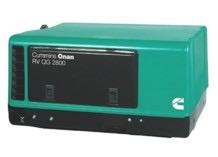
What’s the best generator: Propane, gas or diesel?

By Russ and Tiña De Maris
Having a generator in your RV can be a great blessing. In hot country and away from hookups, there’s little else that will run your air conditioner. Long day in the saddle and don’t feel like “going out” for dinner? Fire up the microwave and have dinner on the table in a few minutes.

Screen Shot 2016-04-07 at 6.42.39 PMBut when you have to make a purchase choice, what kind of generator will you buy? While there are really three major fuel forms for generators, gasoline, propane, and diesel, the latter is typically only an option when you’ve got a diesel fired motorcoach. Don’t discount diesel, will come back to it.

What’s the difference between these two top contenders in the generator competition? Price isn’t all that much different when it comes to initial purchase; oddly enough the prices were higher for gasoline than LP on “larger” comparable generators and lower on “smaller” comparable machines from the same retailer.

What about operational costs? Fuel can make a big difference. Compared to propane, gasoline delivers roughly 25 percent more energy per gallon. So if propane costs about 25 percent less than gasoline, you’re breaking even. Of course, dollar costs aren’t the only factor involved.

Gasoline burns “dirtier” when compared to LP; if you don’t run your generator regularly, you may find the curse that many RVers with gas generators have: A gummed up carburetor. When measured out over time, an LP fired generator will probably cost you less to maintain than the gasoline-fired equivalent. If you’re concerned about your environmental footprint, LP gas produces much less in terms of airborne particulates and greenhouse gas.

But putting financial and environmental costs aside, there is yet another factor: Availability of fuel. If you head off the beaten path, you’ll need to take more propane with you than gasoline for the same amount of generator run time. Many RVers report they’ve found that they’ve hit spots where LP is hard to find, but almost never hit a “dry spot” where gasoline can’t be had. We personally experienced that issue when traveling through Arkansas. We spent several hours one memorable day, trying to find LP, finally catching up with a “good old boy” who had to sell us LP “by guess and by God,” because his pump system gauge was broken. Believe me, there wasn’t anyone else for miles and miles we could buy from.

What about diesel? Diesel fuel produces about 14 percent more energy per gallon than gasoline. Again, costs differences between those two fuels can make a difference, but if you’re already driving a diesel motorhome, you can just “dip the tank” for your generator and never have to hassle with manhandling fuel containers. Diesel generators do cost more on initial purchase, but have a long life.

Like a lot of things in the RV lifestyle, there are many factors to weigh to come to a conclusion on what’s best for YOU.

#nrv

Why do RV generators surge?

Dear RV Doctor:
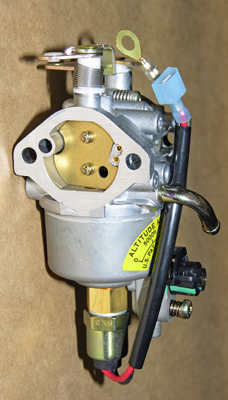
gary-736I recently purchased a toy hauler with a generator with only 27 hours on the meter. At first the governor appeared to be sticking, due to what I believe, bad fuel (varnished). I sprayed the carburetor with a cleaner and it ran fine for a while. The idle still surges with no load applied, and if I put a heavy load on it, it seems to get better. The butterfly plate at the front of the carburetor, when pushed down manually, makes it run smooth. Any ideas? —Mike C., Newbury Park, CA 

Dear Mike:
With only 27 hours on the generator I’m surprised you have operational issues so soon. I’m beginning to wonder if the generator ever received a proper set-up at the dealer. For a proper set-up, especially on the older machines, three components must be adjusted in harmony with one another; the carburetor, the governor and the choke (when so equipped).

Though the specific steps are too detailed to list here, you can, at least, check the position of the choke plate; it should be about 1/4 open when the generator is cold.

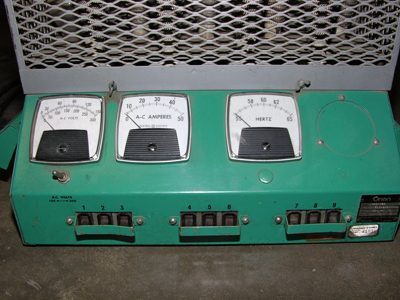
Prolonged surging is indicative of a governor and/or carburetor out of adjustment. Unfortunately, the carburetor and governor should only be adjusted while monitoring the voltage and frequency and while applying a measured load at the same time. In other words, RV generators cannot be tuned by ear. As I often state in my seminars, every mechanical adjustment on an RV generator carburetor and governor will have a direct electrical result, so I don’t condone any tweaking and twisting by RV owners. I’d recommend a generator set-up by a certified technician using a properly sized load bank (see photo). Some individual RV repair facilities may have such a diagnostic load bank, but you’re best bet is to take it to a certified shop for your brand of generator when possible.

Also, in severe cases of varnished fuel, it may be necessary to replace the complete carburetor anyway. In the old days, we used to rebuild generator carburetors, but with the newer models, replacement is the better option. (In some cases, the only option.)

Applying the proper set-up steps using a load bank will either eliminate the surging issue or lead you to the right repair track. By the way, if your shop has a load bank, but no knowledge about how to use it, I do have an older training video that is still viable and it just may help. Have your shop contact me.

Read more from Gary Bunzer at the RVdoctor.com.

#rvd737; #rvt741

Tire covers: Which protects best, black or white?

Russ and Tiña De Maris
We recently wrote about helping your rig be safe when stored in a hot, sunny climate. One of the points we made is this:

“Old Sol can make a proper job of burning things up with UV rays. Outside, be sure to thoroughly cover your tires. Industry folk tell us that tires are best preserved when blocked from all light — so dark (black) covers that fully wrap around are best.”

One of our readers took a bit of exception to this advice. He writes, “I can’t agree with using anything black to cover the tires. Black absorbs sunlight and the extra heat is not what you want on the tires. Light transmission has nothing to do with the color of the material but the material itself.”

We asked industry expert, Marvin Bozarth, about how to best protect tires from UV light. Mr. Bozarth is the Tire Industry Association (of America) technical expert. Marvin noted that indeed, black actually absorbs UV radiation, therefore stopping UV from getting through to a tire covered with a black cover; white (and other colors) unless especially treated to block UV rays will pass them through.

We then called on one of the top selling RV tire cover manufacturers for their take on the situation. A representative from ADCO Products, who make tire covers sold by outfits like Camping World, told us that yes, their tire covers are made with, “automotive vinyl that’s pressed with a UV inhibitor.” When we pressed for information as to just how resistant to UV radiation their covers are, the representative said he couldn’t tell us — not without laboratory analysis. Push come to shove, he could say that ADCO tire covers were, “in some way UV resistant.”

The Tire Industry Association’s Bozarth also told us that tires that are not completely covered with some material that resists UV radiation are susceptible to radiation damage wherever they are uncovered. UV radiation doesn’t have to fall directly on a tire, it can “bounce” as it were, and cause damage to the back side of the tire if unprotected. He did add that the additional heat captured by a black tire cover was not a concern in terms of damaging a tire.

Mr. Bozarth said his best advice for RV owners when it comes to tire longevity is this: Don’t let your tires stand idle for months at a time. Tires are manufactured with antiozinate chemicals which travel to the surface of the tires to protect them against UV radiation. However, these chemicals only migrate when the tires flex–meaning, the tires must be driven on to flex. He recommends that an RV be driven a bit every one to two months for best protection.

Black tire covers photos, courtesy pplmotorhomes.com

#nrv

Should RVers file complaint with shop for minor problem?

Dear RV Shrink:
rvshrinkWe recently had some work done on our motorhome levelers. The service was quick and reasonably priced, the owner was a great guy who treated us very well, and I was very pleased as I paid and walked out to the motorhome to leave. There I found my wife who moved back in once the unit was brought out of the shop. She was not a happy camper. The motorhome reeked of cigarette smoke. It was a cold morning, but she had several windows open trying to air it out. Although I had no control over this situation I got the hot tongue and cold shoulder for the next hundred miles, until the rig reeked no more.

My dilemma is I’m conflicted as to what to do. Should I complain to the business owner who was so nice, or let it slide? Even with this indiscretion I would highly recommend this place of business to other RVers. The excellent customer service otherwise is a rare occasion in the RV world. We try to preempt service oversights by putting down carpet coverings and upholstery covers because so many service organizations have no clue when it comes to entering vehicles and recreational vehicles. —Nicotined in Nashville

Dear Nic:
You will be doing the owner a disservice if you do not drop him a line. He needs to know how his customers feel, good and bad. I would be sure to tell him how pleased you were if you haven’t already. I am sure he will be eager to hear that after all his efforts to give you quick service and reasonable rates he gets scored lower for the actions of his mechanic. He may not even be aware of this work habit. It’s annoying that in this day and age people are still inconsiderate enough to smoke in someone else’s home without permission.

When I was in high school I worked for the largest Airstream dealer in the country. One of my jobs was to clean up trade-ins for resale. Part of that job was washing down the painted interior walls. Many trailers were yellow with nicotine stain that would roll off like wet paint when sprayed with cleaner. That may be why I, unlike Bill Clinton, have never inhaled. I never wanted the inside of my lungs to look like the inside of those used Airstreams.

The carpet and upholstery point is also well made. It is better safe than sorry when having work done on your rig to cover things yourself. It seems like that would be the first rule of service but I am amazed at how many business employees never give a thought to walking through an RV with their shoes on and not bringing any coverings for seats they may need to sit in. —Keep Smilin’, RV Shrink

Save those headlights from road hazards with this easy shield


By Greg Illes

As we prepared for our Alaska trip, we read many warnings about damage caused by flying rocks. Having traveled thousands of miles of dirt roads in the desert Southwest, we are no strangers to road hazards. But this time, the hazards were to come from other vehicles tossing stones up off the roadway.

One of the most vulnerable spots on our coach is the quad headlight installation, which consists of expensive, and difficult to replace, Hella halogen units. Chipping or breaking one of these puppies would be inconvenient at best.

Fortunately, the solution was simple and inexpensive. These headlights are recessed, and mounted behind a rectangular bezel with four screws. All that was needed was to cut a clear plastic cover, remove the screws and re-secure everything with the cover in place.

Note that the best choice here is not just any acrylic plastic, but a sheet of Lexan (polycarbonate). Although Lexan is softer than acrylic, and will scratch easier, it is extremely tough, and both crack- and shatter-resistant. In fact, you can actually cut a 1/16-inch thick sheet of Lexan with tin snips — try that with acrylic and you’ll end up with plastic shards in your lap. You can buy a small sheet of this stuff from your local plastic supply, or even on Amazon.

If your headlight setup isn’t as convenient as mine, you may still be able to use other techniques to mount your “invisible protective shield.” Use some stiff paper to make a template and when everything fits right, cut the plastic and drill your mounting holes using one of the special pointy plastic drills.

For areas with compound curves, new challenges arise. It’s possible, with patience, to heat the plastic and get a mild compound curve in it. This exercise is not for the faint-of-heart, and requires patience, practice, and some spare material. For aggressive curves, you may need to use a two-piece or partial-coverage approach.

Note that you do NOT want to have the shield come in direct contact with your headlights, especially if they are plastic. This would cause chafing and marring and would have a very negative effect on your lighting. Always keep air between the shields and your lights. You’ll also want to use nylon washers under the screw heads to keep from stress-cracking the plastic.

Once you have it fabricated and fitted, strip off the protective films, attach your new shields, and drive those rough byways with greater peace of mind.

photo: Greg Illes

Greg Illes is a retired systems engineer who loves thinking up RV upgrades and modifications. When he’s not working on his motorhome, he’s traveling in it. You can follow his blog at www.divver-city.com/blog.

Bring the light of day when you poke around under your bed

By Russ and Tiña De Maris

We previously wrote a piece about keeping your head safe from bumps and bruises when accessing your RV’s “under-bed” storage. We noted that sometimes the gas struts that are used to hold the bed up aren’t just skookum enough to hold up the weight of the mattress and the bedding. We suggested an add-on support rod that will definitely hold the mattress up, as follows: Buy a length of 3/4″ PVC pipe from the hardware store. Visualize the pipe as a rod near the open end of the mattress box (opposite the hinges). Using this pipe as a “prop,” you can hold the bed box open easily and safely. But what’s to keep your prop from slipping out? A set of closet rod flanges — one installed on the inside lid of the bed box, the other screwed to the floor — will serve to hold both ends of your new prop rod and keep it from slipping out at the wrong time. Best to find a closet rod flange set where both pieces are completely closed rather than the type with the opening to slide the closet rod down into. It’s a cheap, quick and easy fix.

Reader Terry Weymouth chimed in on the idea. Writes Terry: “Storage space under the bed is a great idea … until you need to get something in the dark of night. It is dark, the ceiling lights don’t shine under there and a flashlight requires one hand to hold it (unless you hold it in your teeth).”

Our immediate reaction to this situation would have been one or two of those “stick-on” battery-operated LED lights so popular in Walmart stores. But Terry aptly points out, ” I have found them to be generally unsatisfactory because they illuminate a small area and are not very bright.” We’ll second the motion. We must now have a half-dozen of these little LED “hockey pucks” floating around in various cabinets, and they’re hardly ever used since they just don’t put out the lumens required. So what’s to do? Here’s Terry’s illuminating suggestion:

“I fastened a low-profile fluorescent light fixture to the underside of the mattress board and permanently wired it with an extension cord that was long enough to reach to a nearby wall outlet. Now when I lift the mattress I simply plug in the extension cord and have plenty of hands-free light. It helps during the daytime, too.”

Great idea! Now for the boondocking set who don’t want to fiddle with firing up a generator or running about to turn on the inverter to get “shore power” to the power outlet, we can conceive of installing a 12-volt fluorescent fixture under the bed, and plumbing 12-volt DC to supply it. Not as convenient but a winner, nonetheless.

Thanks, Terry!