Home Blog Page 2216

Gruene Historic District in Central Texas

Gruene (Texas) Historic District at the Water Tower.  (Julianne G. Crane)

(Updated 3/25/2017) A relaxing and fun place to spend an afternoon and evening is Gruene, Texas. It is a perfect destination for a couple of snowbirds or an active family to leisurely meander through this “Historic District at the Water Tower.”

Jimmy and I first heard about Gruene from RVers Joy and Terry Walden of Vancouver, Wash., who have spend more than 15 years living in or traveling around the Lone Star State.
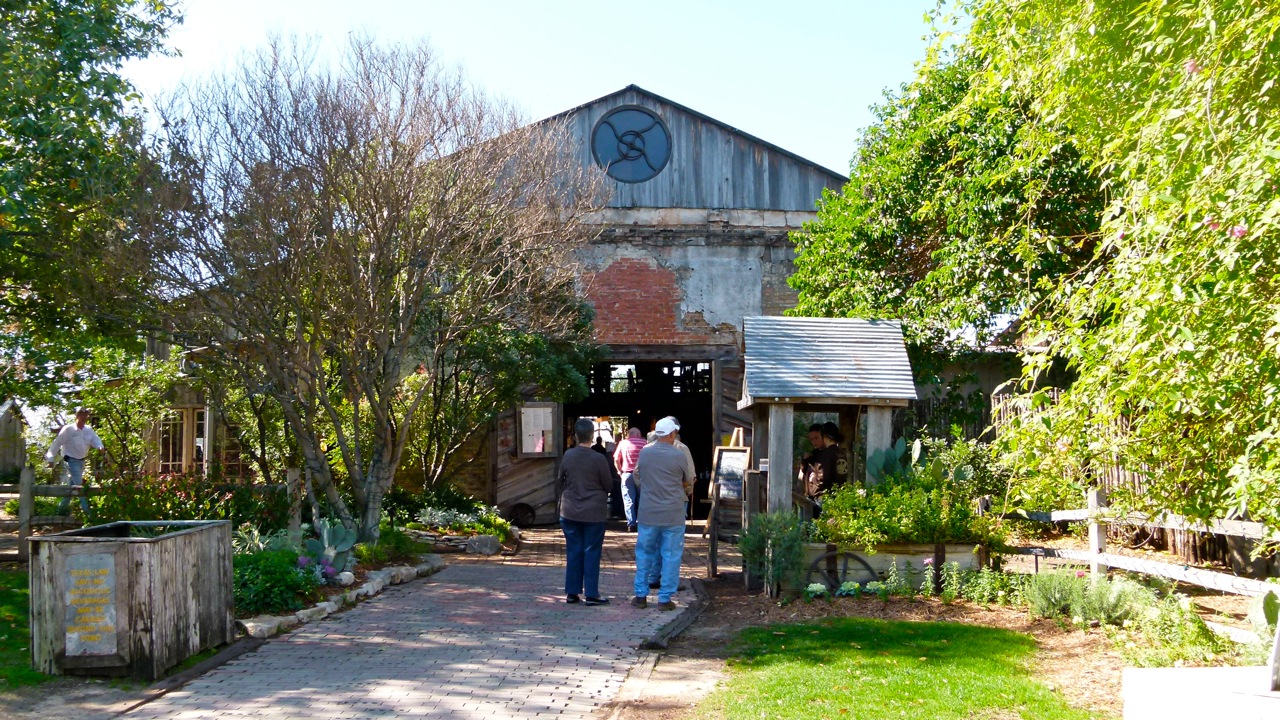
Gristmill Restaurant, former cotton gin.  (Julianne G. Crane)

 “You have got to go to the Gristmill River Restaurant for lunch,” said the Waldens. “And, then stop by Gruene Hall for a late afternoon drink and maybe catch the nightly entertaining practicing.”

We did stop by the Gristmill Restaurant … beneath the water tower … for a delightful lunch on a weekday afternoon. We were amazed by the character and ambiance of the sprawling complex. The restaurant includes part of an old cotton gin overlooking the Guadalupe River.  The hostess said that the place could easily seat just under 1,000 diners.

Gruene Hall historic bar, open daily. (Julianne G. Crane)

 Less than a hundred feet from the Gristmill is the incredible and historically famous, and infamous, Gruene Hall–The Oldest Texas Dance Hall.

Built in 1878, Gruene Hall has hosted such acts as Willie Nelson, George Strait, Townes Van Zandt, Jerry Jeff Walker, Lyle Lovett, Hal Ketchum, Gregg Allman and many more. It was also used as a set for Michael, starring John Travolta.

More information:
GrueneTexas.com
GrueneHall.com
GristmillRestaurant.com

— Text and photos:  Julianne G Crane.

Read more about the RV lifestyle at RVWheelLife.com

Map: Courtesy of GrueneTexas.com. Click on images to enlarge.

A bridge that’s not for you!


Some RVers are fascinated by bridges. They may take a week or so visiting covered bridges in New England. We knew one “retired” bridge engineer who made it a major point in this life to photograph as many unusual bridges he could find. While some bridges are “off limits” to pedestrian traffic–for obvious reasons, like oncoming trains–there is one bridge in Montana that’s off limits to pedestrians and vehicles alike. Animals only, mate!

This “animal bridge” is over Highway 93 near Evaro, Montana on the Salish-Kootenai Indian Reservation. If you happen to know the local jargon, you’ll find a lot of signs in this area written for non-English speakers. Somehow we doubt the local animals pay much attention to either the Native or English print, the bridge is their free pass across a busy highway that might otherwise spell, R-O-A-D-K-I-L-L.

photo: R&T DeMaris

City of Rocks: New Mexico’s fantasy town of nature-sculpted rock formations

0

At the apex of a triangle formed by Deming and Lordsburg, Silver City is the gateway to the 3.3-million acre Gila National Forest, sixth largest in the US and one of the most remote in the Southwest.

Halfway between Silver City and Deming lies City of Rocks State Park, rock formations that over the last 30 million years, give or take a few, have been sculpted by wind and rain into bizarre shapes and configurations resembling a fantasy world of city streets, houses, alleys, courtyards, and towers–features limited only by your imagination.

You can also find typical Chihuahuan plants in the park’s desert botanical garden as well as deer, javelina, pronghorns, coyotes, and jackrabbits. Hiking trails wind through the formations for exploring the crevices and caves–pottery shards and arrowheads from the ancients have been found here and continue to be found here.

Mysterious crosses etched on the rocks by Spanish Conquistadors are said to be clues to buried treasure, but don’t bring your shovel—no digging for treasure or artifacts is allowed. The campground has both primitive and hook-up sites but the closest supply point if you forgot your peanut butter is either Deming or Silver City.

This Las Vegas attraction has nothing to do with gambling

1

For RVers visiting the Red Rock area of Southern Nevada near Las Vegas the wild burros that hang out along the roadside have become a major attraction–and a major hazard.

Having realized that people will feed them, the burros often wander into the road when they hear vehicles approaching thinking it’s dinner time. They are quite often right as people regularly feed them.

However in recent years, several have been hit by vehicles and have had to be euthanized. Besides the damage to the poor burro, think of the damage an accident with one of these large desert animals would cause to your RV.

Take precautions. Slow down when in the area, avoid driving at night, and be ready to stop quickly. And don’t forget, there is a fine for feeding them.

In fact, it’s a good practice that if you have to drive anywhere at night in wild areas, slow down and be especially on the alert for wildlife.

Dinosaurs and dried fruit ‘n nuts lure road trippers off I-10 in Cabazon, California

Added to our list of “must stop” roadside attractions along I-10 in southern California’s Mojave Desert are Hadley Fruit Orchard’s store and the World’s Largest Dinosaurs in Cabazon, Calif.

In 1951, Paul and Peggy Hadley began selling their products from a roadside stand. To attract customers to the remote location, Paul bought slabs of lumber, painted signs in bright colors and set out to find neighbors and other property owners along the highway who would allow him to put up his homemade billboards.

Not too long after that, in the mid-50s, my family was emigrating to warm and sunny southern California from freezing, snow covered upstate New York. Five of us were had packed all our belongings into a Plymouth station wagon towing a 32-foot travel trailer. Just west of Palm Springs, we saw one of those painted signs that advertised ‘Date Shakes’ and pulled into Hadley’s. What we discovered was a bonanza of packaged fruit and nuts. We then knew for sure we were in the land of milk and honey.

A few years later, about two miles east of Hadley’s, the Cabazon Dinosaurs were created by Claude Bell, a theme park artist.

With the help of a few friends, Bell began building the dinosaurs in 1964.  It is said that Bell spent the next 11 years completing Ms. Dinny, (pronounced Dine-y) the 150-foot long Apatosaurus. Construction of Mr. Rex, the towering three-story concrete Tyrannosaurus, was begun in 1981.

Both Hadley’s and the Cabazon Dinosaurs are open daily.

More information: 

Hadley Fruit Orchard
48980 Seminole Dr.
Cabazon, CA 92230
(951) 849-5255
URL: www.HadleyFruitOrchards.com 

Cabazon Dinosaurs
 50770 Seminole Dr.
Cabazon, CA 92230
(951) 922-0076
URL: www.CabazonDinosaurs.com
General admission: $6.95; children: $5.95; military with ID and seniors: $5. Tours are self-guided.
On I-10 and the Main Street exit, 13 miles west of Palm Springs.


Read more of Julianne Crane’s writing at RVWheelLife.com
 

Photos: Aisles of dried fruit and nuts inside Hadley Fruit Orchard (Yelp.com/Jihan M) Mr. Rex (flicker.com)

Visit birthplace of the U.S. national anthem

0

When driving through the Fort McHenry Tunnel on I-95 near Baltimore, Maryland, you will be under the very water where Francis Scott Key was stuck on September 13 and 14, 1814 during the War of 1812. Key, a lawyer, had boarded the British flagship to secure the release of a friend.

He watched a gigantic flag with 15 white stars and 15 red and white stripes flutter defiantly on the ramparts of Fort McHenry. Sewn by Mary Young Pickersgill, her daughter Caroline, nieces and servants, it was so large (30′ x 42′) that it could not be stitched in their home. So they had it completed in a Baltimore brewery at a cost of $574.44.

Key waited out the 24 hours in “shock and awe,” as the British fired off 200-pound bombs, which often blew up prematurely in mid-air. At night they sent up signal rockets which burned in flaming arcs across the sky. Through all of that, at dawn Key was amazed to see Mary’s flag still waving and the Fort intact.

OVERCOME WITH EMOTION, he wrote some phrases on the back of a letter. His brother-in-law suggested singing the poem to the meter of a British drinking song, “To Anacreon in Heaven.” The song was an instant hit, but it took Congress until 1931 to designate it as the U.S. national anthem. If you want to see the flag, it is still a moving sight; it is displayed in the Smithsonian Institute, which is down I-95 a bit.

It’s only about an hour pitstop to tour Fort McHenry. In the summer months there are daily ranger talks, weekend living history, and drill, musket and artillery demonstrations. Do not miss the 10-minute orientation film with its surprise ending! The fort is at 2400 East Fort Ave. in Baltimore.

Visit Puerto Penasco (Rocky Point) for a quick Mexico winter escape

0

It may be Margaritaville to the college set, but it is also a winter escape for snowbirds, a dose of salt and sea air, and bargain shopping. Puerto Penasco, Mexico lies 66 miles below the border at Organ Pipe Cactus National Monument, 212 miles southwest of either Phoenix or Tucson.

Here you can revive nostalgic memories of those lost weekends or semester breaks, enjoying a cold Dos Equis, watching the parade of bikinis cruising the broad sandy beaches, or plying the streets in search of the perfect taco.

Near the northern tip of the Sea of Cortez, Rocky Point is the closest saltwater beach to Southern Arizona. Choose from several campgrounds with hookups where you can step from your RV right onto the sandy beach.

And who needs to be told about the bargains among the numerous streetside stalls offering Mexican-made goods from leather purses to colorful blankets, and rows of fishmongers line the sea front offering the catch of the day.

You can find Puerto Penasco at the end of Arizona Highway 85 (which becomes Mexico Highway 8).

James Dean Memorial, near fatal crash site where California Routes 41 and 46 meet

A little more than 56 years ago, cultural icon James Dean died tragically in a head-on traffic accident on Sept. 30, 1955.  Dean, only 24-years-old at the time of his death, had starred in just three major feature films–but had captured the angst-ridden feel of the Beat Generation.  He was the first actor to receive a posthumous Academy Award nomination for Best Actor for his performance as a loner in East of Eden (1955). He remains the only actor to have received two posthumous acting nominations, the second was for the surly ranch hand in Giant (1956) (See photo at left.)  In between those two films he starred as the misunderstood teenager in Rebel Without a Cause (1955).  Dean’s iconic appeal has been attributed to “the public’s need for someone to stand up for the disenfranchised young of the era.” To this day, James Dean fame is legendary and his estate earns millions. 
Another reason Dean remains such an iconic figure is because his life ended so abruptly one early autumn afternoon where two rural highways meet in Southern California northwest of Bakersfield.  The young star, who enjoyed racing cars, had recently acquired a Porsche 550 Spyder, one of only 90 manufactured. On this particular September day, Dean and his mechanic Rolf Wütherich were heading to a sports car race at Salinas, California. According to reports, “Dean was driving west on U.S. Route 466 (later State Route 46) east of Cholame, San Luis Obispo County, when a black-and-white 1950 Ford Custom Tudor coupe, driven from the opposite direction by 23-year-old Cal Poly student moved to take the fork onto State Route 41 and crossed into Dean’s lane. The two cars hit almost head-on.” 
It is said that Dean (who was driving within the speed limit) received massive injuries after being thrown from his car and died soon after the crash. His mechanic survived but suffered multiple injuries including a broken jaw. The college student “received a gashed forehead and bruised nose and was not cited by police for the accident. He was interviewed by the Tulare Advance-Register newspaper immediately following the crash, saying that he had not seen Dean’s car approaching,” according to Wikipedia.

The James Dean Memorial (pictured at left) is located a short distance from the crash site. A stylized sculpture composed of concrete and stainless steel surrounds a ‘tree of heaven‘ outside the Cholame, Calif., post office. The sculpture was made in Japan in 1977 and the entire project was sponsored by Seita Ohnishi. 
The location of the actual crash site, the intersection of Highways 41 and 46 was dedicated the James Dean Memorial Highway in September 2005. 

The memorial is in Cholame, Calif., on State Route 46 about 25 miles east of Paso Robles on U. S. Route 101, and 37 miles west of Interstate 5.
Photos: Wikipedia

Finney Lake an ideal stopover on the way to your snowbird destination

0

The snowbird migration is about to begin with RVers from the Pacific Northwest working their way through the Los Angeles basin south to San Diego then turning east on I-8 toward the Southwestern deserts.

Most of the I-8 freeway flyers miss tiny Finney Lake, 25 miles north of El Centro on SR 111, which is used mostly by local fishermen. But it has two of the ingredients that are difficult to find in the desert: a bird refuge that has lakeshore camping. Except for the cacophony of birds, it is a quiet spot and an ideal stop over for a few days on the way to your snowbird destination.

Finney Lake is a major resting place on the Pacific Flyway for migratory birds and an ideal and protected habitat for nesting birds. Non-motorized boats for fishing or birdwatching can be launched from lakeshore campsites or from the boat launch.

An adjacent off-limit pond during nesting season has crags and snags crammed full of Great and Snowy Egrets, Great Blue Herons, and a scattering of Cattle Egrets and Cormorants. Around the lake raucous Yellow-headed and Red-winged Blackbirds vie for the best spots, shy Soras poke through the shoreline reeds, Northern Shovelers  and Green-winged Teals (photo) feed on the lake’s delectable water plants, and squadrons of White-faced Ibis fly in at dusk.

There are a few miles of level dikes to walk, bike, and bird watch and a public dump station and water fill are within a quarter mile–and it’s all free. Just sign in, kick back in your camp chair, and spend your time adding to your bird list and enjoying the sunsets.

Historic SnakePit is fascinating roadside bar ‘n restaurant in north Idaho

0

The historic SnakePit tavern and restaurant (also known as the Enaville Resort) in Kingston, Idaho, sits just a few yards off the Trail of the Coeur d’Alenes, where each day thousands of visitors bicycle, jog and walk sections of its 71 miles of paved path.

This famed wooded relic was first constructed around 1880 and has a fascinating history–at one time being a boom town bar, railroad layover, wayside hotel, starting point for loggers and miners of yesteryear, and brothel.

These days it is a destination eatery with better-than-average burgers, buffalo chips, salad bar and rocky mountain oysters.

But, what it really has going for it is a four-star atmosphere.  Its interior is an informal regional museum that features hundreds of unique memorabilia including souvenir plates, black-and-white photographs, yellowing posters, stuffed animal trophies and unusual arts and crafts pieces. In a far corner of the restaurant, there are also pool tables and a couple arcade video games.

The original rustic bar is the same one at which movie star Pierce Brosnan sat and was filmed for a couple of scenes in the adventure movie ‘Dante’s Peak.’

More information:
The SnakePit / Evaville Resort
1480 Coeur d’Alene River Rd.
Kingston, ID 83839
Phone: (208) 682-3453
URL: http://enavilleresort.com/
No reservations needed
Price Range: $$
Directions: From I-90, take the Kingston Exit 43, turn north and drive 1.5 miles up the Coeur d’Alene River. The SnakePit is on the right

Photos: Top: RVers Bill (in front) and Mary Knowles (on stairs) leaving the historic SnakePit bar and restaurant. (Bottom) Fascinating stone fireplace dominates the SnakePit restaurant. By Julianne Crane

Pet companions howl over Dog Bark Park Inn

Twice a month during the summer of 2010 I would drive past the Dog Bark Park Inn on my trips between Spokane, Wash., and Riggins, Idaho, on the Salmon River.

Without fail, every time I hit the crest of the hill near Cottonwood, in north central Idaho, I’d glance to the side of Hwy. 95 and smile. Who wouldn’t smile at the sight of two huge beagles? I loved those dogs. They are such a ‘sweet’ sight.

‘Sweet’ because the Dog Bark Park Inn is home to ‘Sweet Willy’ and ‘Toby,’ the “World’s Two Biggest Beagles.”

Toby, a 12-foot tall beagle statue, was built by Dog Bark Park artists Dennis Sullivan and Frances Conklin.

Sweet Willy, officially known as Dog Bark Park Inn, “is one of America’s latest additions to the type of roadside architecture popular in the early days of automobile vacation travel when travelers would often buy gas, eat meals or stay overnight in a building that looked like something else,” say owners Dennis and Frances.


One recent review on TripAdvisor states: “Where else can you stay in a dog and cozy up for bed in his head? Dennis and Frances have created a one of a kind experience – not only by the unique accommodations, but by providing such a warm atmosphere with every creature comfort you could want – including a delicious breakfast and munchies.”

As for the town of Cottonwood, it boasts a population a tad under 1,000 and sits “in the heart of the Camas Prairie where wheat, barley, canola, blue grass and hay are the dominate crops.” The town features places to stock up on groceries and fuel.


Dog Bark Park Inn

2421 Business Loop 95

Cottonwood, ID 83522

208.962-3647

e-mail: frances@dogbarkparkinn.com

url: www.dogbarkparkinn.com

Hours: Open year round. Daily 11 a.m.-4 p.m.

Approximate driving times

From the North: Lewiston, Idaho 1 hour; Spokane/Coeur d’Alene, 4 hours.

From the South: Riggins, 1 hour; McCall, 2 hours; Boise, 4 ½ hours; Salt Lake City, 11 hours.

From the West: Richland, WA, 5 hours; Seattle/Portland, 7-8 hours

From the East: Missoula, 4 hours; Bozeman, MT, 8 hours

Julianne G. Crane
To read more articles about the RV lifestyle by Julianne G Crane, go to RVWheelLife.com

Photos: Courtesy of TripAdvisor

Historic Paper House, just north of Boston

In 1922, Ellis Stenman, a Swedish immigrant, started building a two-room summer cottage almost entirely out of newspaper.

The house, began as a hobby, has a wood, floors and roof, the walls however, consists of 215 layers of newspaper. Stenman mixed up his own glue, basically out of flour, water and “a little sticky stuff like apple peels.”

The furniture and curtains are also made from newspaper. Stenman, a mechanical engineer, painstakingly wrapped paper around wire to form chairs, desks, lamps and curtains.

In all, it is said he used about 100,000 newspapers. Visitors can pause to read the walls and find historic headlines from the 20s and 30s.

Paper House

Address: 52 Pigeon Hill St., Rockport – Pigeon Cove, MA

Hours: Daily 10 a.m. –5 p.m., spring through fall.

Admission: $2 adults, $1 children, 6-14

Phone: (978) 546-2629

URL: www.paperhouserockport.com

Photos of Paper House exterior and the (mostly) newspaper fireplace by Mister Bisson