Home Blog Page 2215

Visit Red Ryder in Pagosa Springs

0
RR greets you at the door

Anyone who grew up in the 1940s or early ’50s, especially boys, remembers Red Ryder, the cowboy hero of newspaper comic strips, comics, books, 38 feature movies, and for nine years a popular radio show. And countless millions of young boys ever since remember with fondness either owning or wanting to own their very own Red Ryder BB gun — as made famous by character Ralphie in the popular holiday movie “A Christmas Story.”

Harman’s studio for two decades

The man behind Red Ryder and his Indian sidekick Little Beaver was Fred Harman, who grew up and later spent much of his life in Pagosa Springs, Colorado. Late in life, Harman gain fame as a serious western artist.
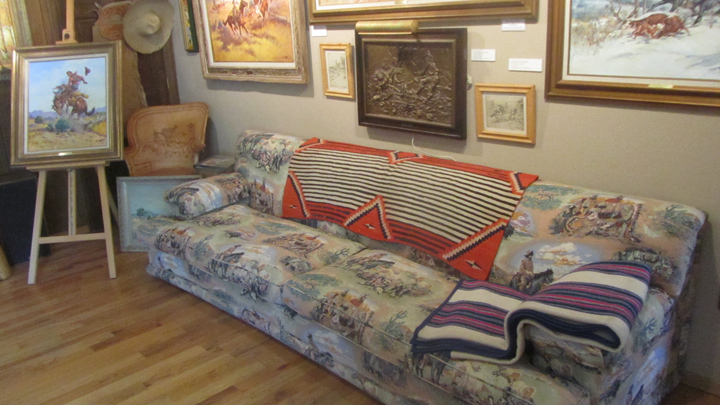
John Wayne slept here.

Early on, he struggled as an artist and businessman. When they were both getting started, he and his buddy Walt Disney formed a company that failed.

You can learn all about Harman and Red Ryder at the Fred Harman museum in Pagosa Springs, Colorado, on the western edge of town along state route 160. Admission is $3, less for kids.

Ralphie and BB gun.

Visit Harman’s studio and see his paintings and even originals of Red Ryder cartoons. Buy a genuine Daisy Red Ryder BB gun for $60, or spend $110 for a rare Ryder Ryder comic book. If you don’t want to buy a BB gun, then just admire the very first Red Ryder BB gun ever made. Harman’s serious art is displayed: one small painting sports a $10,000 pricetag. As an extra treat, sit or even lie down on the long couch that served John Wayne’s bed when he would visit.

The museum is open year round, but call first in the winter months to get the abbreviated schedule, (970) 731-5785.

RV parking appears limited when you drive in, but drive around back for more space, or just park on the grass — no problem.

Giant steaks and free overnight RVing

Ya’ll come now, ya hear? That’s pretty much the exhortation on Oregon’s high desert. By unofficial polling, it looks like the majority of folks out here wear western boots and drive pickup trucks. They also develop hearty appetites. If your roaming takes you anywhere near the Silver Lake area, you owe it to yourself to make a stop at the Cowboy Dinner Tree.

Lore has it that back yonder when cattle drives came through the area, one old particular tree marked the end of the day for many outfits. “Old Cookie” would fire up the evening fire and cook those hungry boys a dinner to hold them over until the next meal. That same spot is now home to the Cowboy Dinner Tree Restaurant. Of course you’re not expected to sit outside to eat (but you can if you wish). Diners are hosted in a rustic cabin with fans cooling in the summer and wood heat come winter.

The ambiance is heightened by the apparent dress code for waitresses: Period cowboy. Expect your drinks to be served in a canning jar. Rest your feet on the table foot rests–appropriately built out of retired horse shoes. And then there’s the food.

Not a lot of choice on the menu. When you call to make your (mandatory) reservation expect to be asked if you want steak or chicken. On arrival your waitress will bring you garden salad, home made soup, and home made dinner rolls–all served family style in with refills a’plenty. After you’ve plowed through these courses along comes the main part of the meal. For those who ordered chicken, a WHOLE chicken appears, minus the feathers and cooked. Beef lover? Hope so, because the steak tends to be around three to four inches thick and covers a major portion of the (non-matching) dinner plate. An oversized baked potato will compliment.

After you’ve requested a “take home” box to handle what’s left of your steak or bird, the waitress will hustle out with dessert. For us it was a fruit cobbler-like affair, and it was the perfect send-off. Happily the deserts aren’t on the Philistian-size scale, but far more manageable.

If you’ve come with your RV, just ask about staying overnight in the dry camping lot across the road from the restaurant. And if for some reason you don’t have time to take the RV in, ask about the nearby airstrip where hungry pilots put down. How they ever get off the strip after eating a meal this size does make a fellow wonder.

Hours are limited; cash or checks only. Reservations are a definite must. Check out the outfit’s website for more information.

Free RV camping with Arizona caving adventure

Gary Tenen and Randy Tufts kept a secret for 14 years. It was a long and deep secret–two and a half miles long, and deep under the ground near Benson, Arizona. Tufts and Tenen were spelunkers, cave explorers, and their secret was a wondrous limestone cavern, now open to the public called Kartchner Caverns.

Kartchner is a “living” cave, meaning its formations are still growing, albeit so slowly that you’d probably never see the effect in your lifetime. To keep it that way, the State of Arizona put $28 million in investments in air lock doors and environmental protection to help the cave maintain an atmosphere suitable for formation growth.

A part of the state’s park system, Kartchner Caverns entertains visitors from across the planet as they tour underground spectacles with names like the Cul-de-sac Passage, the Big Room, and Echo Passage. It’s a wonderful tour that we highly recommend.

Making it a bit easier on the pocketbook, the State offers a free night of camping in the park with the purchase of two adult cave tour tickets. You’ll need to make a reservation at (520) 586-2283 and specifically mention the promotion when you call. The offer is good through September 30.

photo: Mike Lewis on wikimedia commons.

Manito Park is a Spokane treasure

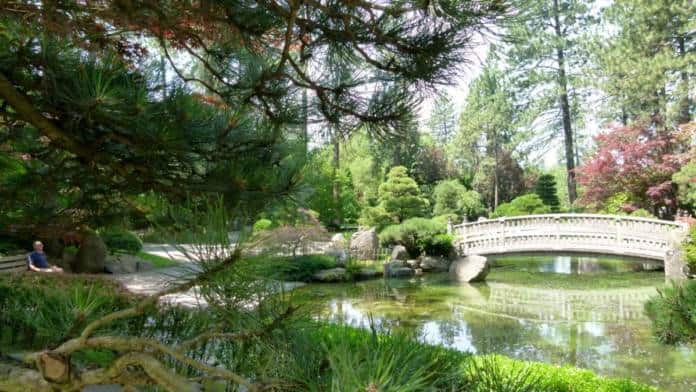
The Duck Pond is a central feature at Spokane’s Manito Park. (Julianne G. Crane)

Manito Park and Botanical Gardens in Spokane, Wash., is a 90-acre public park with five gardens, arboretum, conservatory and duck pond that are appreciated by more than 150,000 visitors each year.

Duncan Gardens in Manito Park.  (Julianne G. Crane)

Nestled in the South Hill section of The Lilac City, the park includes spacious manicured lawns, playgrounds, and walking and biking paths. A perfect family outing and destination point for many RVers traveling through the Inland Northwest.

Central fountain (Julianne G. Crane

The Gardens: 

Duncan Garden (above) is a formal 3-acre European garden with a large central granite fountain (right); designed and built in 1913.

The arrangement of the flower beds and plants make the Duncan Garden symmetrical. This is a popular location for  engagement and wedding pictures.

Ferris Perennial Garden (Julianne G. Crane)

Gaiser Conservatory sits at the top end of the Duncan Garden and houses exotic tropical plants and seasonal flowers.

Joel E. Ferris Perennial Garden features hundreds of colorful perennial plants painstakingly cared for by an army of volunteer master gardeners.

Thousands of roses (Julianne G. Crane)

Rose Hill has more than 1,500 rose bushes representing more than 150 varieties. It is an All-America Selections rose test garden.

Nishinomiya Japanese Garden was created in honor of Nishinomiya, Japan, Spokane’s sister city. In 1967 noted landscape architect Nagao Sakurai began its design. After his stroke in 1973, designs were completed by Shosuke Nagai and Hirohiko Kawai and the garden was dedicated in 1974.

RVer Jimmy Smith (left) relaxing in Manito Park’s Japanese Garden. (Julianne G. Crane)

Location:
17th Ave and Grand Blvd. in Spokane, Wash., USA.
Open daily without charge.

Sources of information:

Manito Park.org, Wikipedia,

To read more of Julianne G. Crane’s writings go to RVWheelLife.com

Great RV camping minutes from San Diego

wikimedia commons

San Diego. Renowned for its year-around mild climate, it’s wonder one and a third-million people call this big dot on the map home. Millions of visitors flock each year to the city near the Mexico border, many in RVs. But where, oh where, can you stay with your RV without pawning your first-born?

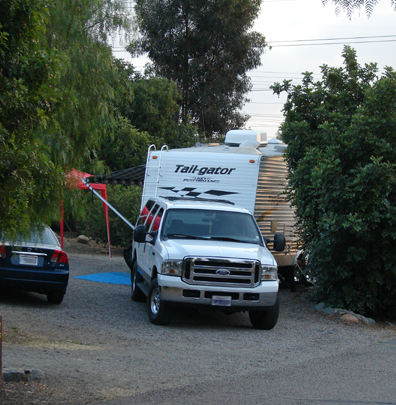
Psst! Here’s a little secret place, just 30 minutes from San Diego’s Qualcomm Stadium. It’s quiet. It’s green. It has full hookups and sits beside a great fishing lake. It’s Lake Jennings Park, a project of the local water district.

R&T DeMaris

Lake Jennings sits just outside the bedroom community of Lakeside, less than 20 miles via Interstate-8 to the downtown metro area. With 35 full-hookup sites, 37 with electric and water, many of the sites pull-through, its a wonder more folks haven’t made this fantastic discovery. “I know why,” says the critic, “the prices drive them away!” Hang on, Mr. Squeaky Money, full utility sites are but $32 a day, and if you don’t mind just dumping at the on-site free dump station, you can drop your per-night charges to just $28.

Don’t think this is a down-in-the-heels park, either. The volunteers who keep the Lake Jennings Campground up and running are top-notch. We’ve watched camp hosts roll into recently vacated campsites, hustling around with rakes, actually restoring the gravel pad areas to pristine condition for the next visitor. They really do care about this place. No trash, no mess, just a clean, well-cared for campground.

R&T DeMaris

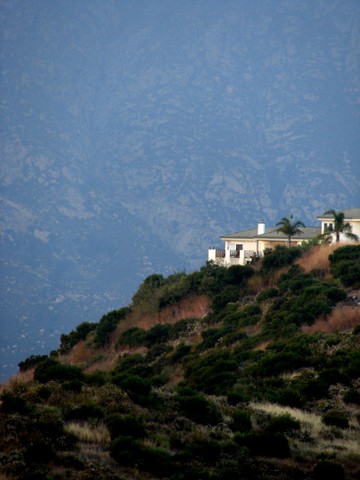
While easily accessible from the Interstate, it’s a couple of miles up in the back country, so you won’t be disturbed by freeway noise. The views of lake are great, and if you’re on the “other side” of the campground, you can peer across a green valley with misty-morning views. Once you’ve had your fill of the tourism downtown, if the kids are still pumped up with energy, the park staff has plenty of things for them to do including games and scavenger hunts. If you can’t get away from networking, fear not, free wifi hotspots abound in the campground at DSL speed.

Check out more on the Lake Jennings Park website.

Explore the frontier American West at the Buffalo Bill Center

1

The Buffalo Bill Historical Center in Cody, Wyoming, celebrates the spirit of the American West by weaving together the stories of the western experience—history and myth, art and Native culture, firearms technology and natural history—into the rich tapestry that is the West.

Named for William F. “Buffalo Bill” Cody, the man who “took the West to the world,” the Center reveals these stories of the past and present. Learn all about Buffalo Bill, his Wild West Show, and the West he knew and loved. Follow his life from frontiersman to actor, showman to entrepreneur, real man to the legend he became.

Discover the art of the West through stunning, priceless masterworks of painting and sculpture, with subjects ranging from inspirational landscapes, unique wildlife, diverse peoples, and the fascinating heroes and legends of the West.

Share the life stories—the culture, history, and art—of the Northern Plains Indian peoples, past and present, and hear these stories in their own voices.

The story of the American West is incomplete without firearms. As you tour the most comprehensive collection of American-made firearms in the world, see how firearms factories, competition, and production innovations have as much to do with the West as the gun itself.

Learn more about Buffalo Bill Historical Center, an affiliate of the Smithsonian Institution, at its website. And no problem with parking for large RVs. The park lot of spacious.

Le Cordon Bleu gourmet lunch in Scottsdale

Le Cordon Blue Technique Restaurant, Scottsdale, Ariz. (Julianne Crane)

This is not a restaurant review, or at least not one in the traditional sense. I’m not a gourmet cook, actually I’m not much of a cook at all. However I do love to eat.

On a recent trip to the Phoenix-Scottsdale area where we visited with friends (and Airstream owners) Mary and Bill Knowles, we were treated to a delightful and tasty lunch at the Le Cordon Blue school’s student-run Technique Restaurant, which is three-parts eatery and one-part tourist attraction.
 

Mary Knowles (l), Jimmy Smith, Julianne Crane and and Bill Knowles.

According to its Website: “Le Cordon Bleu is one of the most respected names in culinary education, originating in Paris in 1895. For students in North America, working in the Technique restaurants is the capstone of Le Cordon Bleu’s unique, hands-on curriculum.”

The restaurant provides “a straightforward menu inspired by classic techniques, giving students the opportunity to practice what they have learned in the craft of fine cookery. The focus is cooking with simplicity and elegance, using the finest ingredients culled from high quality, sustainable local sources.”

It’s a unique opportunity to enjoy an elegant meal, at a reasonable price. When we were there, the three-course lunch was $10. Patrons choose one starter, one entrée and one dessert. Dinner includes the three-course $10 choice or a four-course selection for $15 where patrons select two starters, one entrée, and one dessert.

Contact:

Cheese Cake (Julianne Crane)

Le Cordon Bleu Technique
4301 N. Scottsdale Rd, Scottsdale, AZ 85251
(480) 425-3025

Hours:
Tuesday-Friday
Lunch: 11:30 a.m. – 1 p.m.
Dinner: 6 p.m. – 7:30 p.m.
Strongly suggest reservations. (Mary made reservations online two weeks in advance.) Limited number of walk-ins are seated.
URL: (Online reservations can be made through this link) TechniqueRestaurant.com/locations/scottsdale

To read more RV lifestyle writing by Julianne G. Crane go to RVWheelLife.com.

Photos: (Top) Technique Restaurant, Le Cordon Blue, Scottsdale, Ariz. (Julianne G Crane)

Yosemite Mountain Sugar Pine Railroad

The Yosemite Mountain Sugar Pine Railroad is a four-mile scenic railroad excursion near Fish Camp, Calif., and Yosemite National Park’s South gate.

This narrow-gauge trip back in time is located on Yosemite Highway 41, about 60 miles north of Fresno, Calif., and is open March through November (weather permitting).

On the day we visited in mid-April, there had been a spring snow storm in the Sierra Nevada Mountains, with almost 18 inches accumulation at the railroad station.

Yosemite Mountain Sugar Pine Railroad Station (Julianne Crane)

We boarded Shay locomotive #15 for the 12:30 p.m. Logger Steam Train ride.  This particular vintage machine was built by Lima Locomotive Works of Lima, Ohio, in May 1913 for the Sierra Nevada Wood and Lumber Co. near Truckee Calif. It continued in service through 1961. The Yosemite Mountain Sugar Pine Railroad purchased the #15 in 1986. It weights 59 tons, with a capacity of 900 gallons of fuel oil and 3,000 gallons of water.

Train conductor (and RVer) Rick Phillips (Julianne Crane)

According to the Logger Steam Train’s conductor, Rick Phillips (who is also a fulltimer RVer), our locomotive once hauled massive logs through the Sierra Mountains.

Hardy lumberjacks felled old growth timber and miles of flumes carried sections of trees to the valley.

Yosemite Mountain Sugar Pine Railroad also features rides on the quaint ‘Model A’ powered Jenny Railcars. These trolly-like railcars where once used to provide transportation for logging and track repair crews. 

RVer Laurie Phillips works in the museum.

The conductor’s wife, Laurie Phillips, works in the Thornberry Museum, which offers a glance at life at the turn of the 20th century.

Family members can pan for real gold and a local prospector will give a hand and demonstrate the technique to find ‘the yellow treasure just like the Ol’ Forty-Niners’

If you go:
Yosemite Mountain Sugar Pine Railroad
56001 Yosemite Hwy 41
Fish Camp, CA 93623
(559) 683-7273
Url: www.ymsprr.com

Open March-October
Schedule changes as weather warms. Moonlight specials begin in May. Melodramas begin in July. Click here for most current information.

Read more of Julianne Crane’s writing by clicking on RVWheelLife.com 
Photos: Click on images to enlarge. (Julianne Crane)

Eatin’ organic at the RV park

Organic RVing? Does that mean pesticide free biodiesel? Out in Larkspur, Colorado it means RVers munching on organically grown garden goodies. Matt Fredell at the local Jellystone Park is taking Yogi off picnic baskets and putting him into healthy fare like broccoli and carrots. In fact, Fredell–an organic farmer–wants all the guests to taste his organically grown produce. Campground owner Ian Steyn is so far behind the concept that he’s hired a pair of award-winning chefs, Tom and Shari Fritz-Scholten, to teach campground guests gourmet meal-making and win-pairing this summer. “We want to start teaching our guests about the principals of good stewardship, of taking care of yourself and the things around you,” Steyn said in a press release. The campground cookoffs are slated this way:

  • An outdoor food and wine pairing class on Memorial Day weekend
  • A gourmet barbecue class on June 16 in celebration of Father’s Day and to help guests prepare for their own July 4 celebrations
  • A “farm to table” gourmet weekend on July 21, celebrating Colorado’s history and agricultural heritage
  • A wine pairing class on Aug. 18, which will help guests prepare for Labor Day weekend activities
  • A fall farm to table celebration on Sept. 21.

If you sign on, you won’t need to bring your own silverware. “We plan to serve the food on recycled paper plates, which will then be fed to 10,000 earthworms that will consume the paper and any leftovers. We will then use the casings from the worms as fertilizer for our organic gardens. So everything will go full circle,” Steyn said.gag photo: olgaberrios on flickr.com

Visit the future “World’s Largest Ski Fence”

0

There is no business sign identifying the North Cascades Nursery along U.S. 2 near Sultan, Wash. But you can’t miss the place — it’s surrounded by a fence made of used snow skis. The Stevens Pass ski area is about a half hour drive east in the Cascades.

Three years ago, owner Jake Sharpe posted a sign asking passersby to leave their old skis.

Now, hundreds of them stand side-by-side to form the unusual fence, which is expanding all the time. When it finally circles the business, Sharpe plans to contact Guinness Book of World Records to request the “World’s largest ski fence” title.

The fence is mostly skis, but there are some snowboards, too — some with boots still attached.

There is plenty of room out front to park your RV for a quick stop to look at plants or snap a photo of the most unusual fence.

Dreamy pastries, historic murals in old downtown New Braunfels, Texas

Naegelin’s Bakery and Alex Brochon’s mural in New Braunfels, Texas (JulianneG. Crane)

If you’re heading south along I-35 toward San Antonio, or north to Austin — old New Braunfels, Texas, is a perfect stopping off point for a yummy pastry and a little taste of public art.

In its historic downtown area, New Braunfels offers two irresistible attractions — a series of free outdoor murals and Naegelin’s Bakery, a longtime, mouth-watering eatery.

Inside Naegelin’s Bakery

This family-operated establishment first opened in 1868, making it
the oldest continuously operating bakery in the state of Texas.

Before walking through Naegelin’s front door, I was only in search of something sweet to eat, then I was overcome by the warm, fresh-baked smells and vast array of homemade pastry choices.

It took several minutes, but eventually among the veritable rainbow of cookies, cakes and pies, I spotted my pastry-of-choice since childhood–a huge, plump, powdered-sugar dusted, custard-filled cream puff.

Cream puff in hand, Jimmy and I sat outdoor and enjoyed the view of the downtown’s Main Plaza and the nearby “Lindheimer-The Father of Texas Botany” mural, painted by Alex Brochon of San Antonio. (See above and “C” on the map below.)

‘The City of a Prince” by Clinton Baermann and Cassandra Mourfield.

Within an easy walking distance from the bakery there are two additional murals.

Just a short city block away is “The City of a Prince” mural by Clinton Baermann, Texas Senate honored muralist and historian from Llano, Texas, and Cassandra Mourfield, a New Braunfels artist. It is painted on the exterior wall of the Downtown Antique Building. (“B” on the map below.)

“Spass and Gemutlichkeit” by painter Brent McCarthy.

Turn your gaze slightly to the left and take in the “Spass and Gemutlichkeit” mural created by New Braunfels artist Brent McCarthy, which adorns the outside of Friesenhaus Restaurant known as Krause Strasse, in the 100 block of Castell Avenue. (“A” on the map below.)

All three murals are within one block of the Main Plaza.


For more information:
 

Historic Outdoor Art Museum map.

New Braunfels 
424 South Castell Ave.
New Braunfels, TX 78130
Phone: (830) 221-4000
www.nbtexas.org

Naegelin’s Bakery
129 South Seguin Ave.
New Braunfels, TX 78130
Phone: (830) 625-5722 Toll Free: (877) 788-2895
www.naegelins.com

New Braunfels Historic Outdoor Art Museum
www.nbmurals.org

Read more articles about the RV lifestyle written by Julianne G. Crane at RVWheelLife.com
 

Photos: Julianne G. Crane  Click on all images to enlarge.

Article updated 10/14/2015.

Learn about Sacajawea and the Lewis and Clark expedition at the Sacajawea Interpretive Center in Salmon, Idaho

1

When the Lewis and Clark  Corps of Discovery–31 men, one woman, and one dog–set off from Fort Mandan on April 7, 1805 to explore the land west of the Mississippi River, they were accompanied by an Indian woman interpreter named Sacajawea.

Born a member of the Agaidika tribe in 1788 near present day Salmon, Idaho, she was captured by a raiding party of Sioux and later sold to a French trapper named Charbanneau, an interpreter, who would accompany the expedition. She was pregnant with his child when the party set off on their epic journey.

Sacajawea, though not a guide, was familiar with the some of the country through which they traveled and was instrumental in their peaceful trading with the native tribes as they crossed the continent. If she were alive and the same age today, she’d be too young for middle school. When she was born, the United States was 12 years old and ended at the Mississippi River. Sacajawea didn’t know it existed. None of the members of her band had ever seen a white person.

They traveled up the Missouri River in six canoes and two larger, flat-bottomed pirogues. Sacajawea set up a warm tepee the first night, a skill learned as part of her Agaidika education. Most of the men slept outside. The tepee was reserved for Lewis and Clark, Charbonneau and another civilian interpreter, and Sacajawea and her baby. It was used until it fell apart.

On the third day, Sacajawea dug Jerusalem artichokes for the men to eat. It was the first of many times she added variety to a diet that relied heavily on meat. One of her most important contributions, however, was her mere presence. Though Lewis and Clark thought of themselves as traveling through unexplored territory, the continent west of the Mississippi was actually well known. It was home to dozens of Indian tribes who knew the land intimately and vigorously defended their turf. Intruders ran the risk of paying with their lives. Without Sacajawea, the Corps of Discovery could have been mistaken for a war party and annihilated. The presence of a woman and a child assured potential enemies that its intentions were peaceful.

You can learn more at the Sacajawea Interpretive Cultural and Education Center, 200 Main St., Salmon, Idaho. info@sacajaweacenter.org