

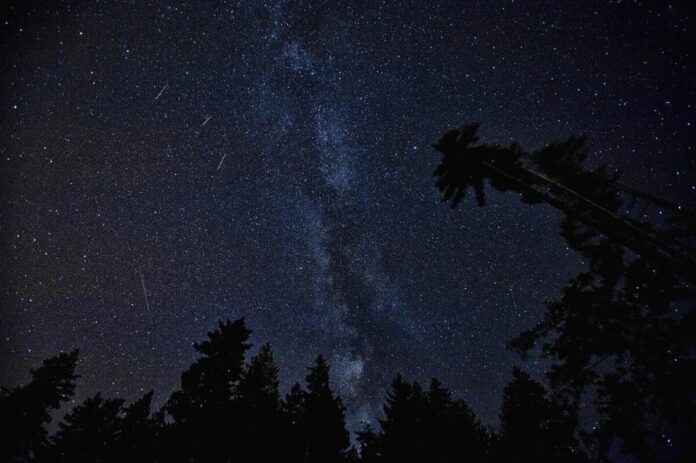
This weekend, RVers across the U.S. have a front-row seat to one of the year’s most spectacular celestial events—the Perseids meteor shower. Known for its bright, fast-moving meteors, the Perseids are a summer favorite, especially for those camping under dark skies.
When to watch
The Perseids are expected to peak on the nights of August 11th and 12th, with the best viewing times after midnight until dawn. If you’re an early riser, you might catch the “shooting stars” just before dawn, when the meteor activity peaks.
Where to watch
For the best views, you’ll want to find a spot far away from city lights. Here’s a quick guide to the best viewing areas across the U.S. for RVers:
Western U.S.: If you’re in the deserts of Arizona, Utah, or Nevada, you’ll have some of the clearest skies. National parks like Joshua Tree (but be careful, traffic jams are expected here), Bryce Canyon, and Great Basin are ideal, offering minimal light pollution.
Mountain states: The Rockies provide high-altitude, clear skies. Consider camping in Colorado’s Rocky Mountain National Park or Montana’s Glacier National Park for optimal viewing.
Midwest: In the Great Plains, locations like Badlands National Park in South Dakota or Theodore Roosevelt National Park in North Dakota offer dark skies and wide-open spaces.
Northeast: Maine’s Acadia National Park or New York’s Adirondacks are great for a clear view of the meteors.
Southeast: The Great Smoky Mountains in Tennessee and North Carolina, or Florida’s Everglades, are prime spots for meteor watching.
Tips for viewing the Perseids meteor shower
- Find a dark sky: The darker the sky, the more meteors you’ll see. Head to a rural area or a campground far from city lights.
- Bring the right gear: A comfortable chair, a warm blanket, and a thermos of coffee or hot cocoa can make the experience more enjoyable. No telescopes needed—these meteors are visible with the naked eye!
- Give your eyes time to adjust: It takes about 20 minutes for your eyes to fully adjust to the dark. Turn off any lights and avoid looking at your phone screen to maximize your meteor viewing.
This weekend’s Perseids promise to be a memorable experience, with up to 100 meteors per hour at peak times. Whether you’re in a national park or a quiet campsite, it’s the perfect opportunity to kick back, relax, and enjoy the show.
##RVT1169b
Thank you, RV Travel! 🙂 Well, seem to be a lot of decent (or better) places to watch. I tend to go to sleep late most nights. Perhaps I can catch them before bedtime one of those nights. Thanks again, have a great weekend, safe travels, and safe stays! 🙂
I remember a grand meteor shower in either 1967 or 1968. The meteors actually hissed as they fell thru the sky, and they were huge. I also remember taking the grand children outside to see the Quadrantids which fell UP from the eastern horizon. Dear son went thru an astronomy phase and we spent many Friday nights in the far reaches of Palm Beach County with the Astronomy Association. It’s a wonderful subject and I hope to see a few more showers durin
I would love to watch this but alas, I cannot stay awake much past 9 pm anymore.
We’ll be at Lake George rv park, NY on the 12th to watch the meteors! Join us in the parking lot near the rec center!
DJ, Rosie, Sophia, Vivian, Maggie the Beagle