

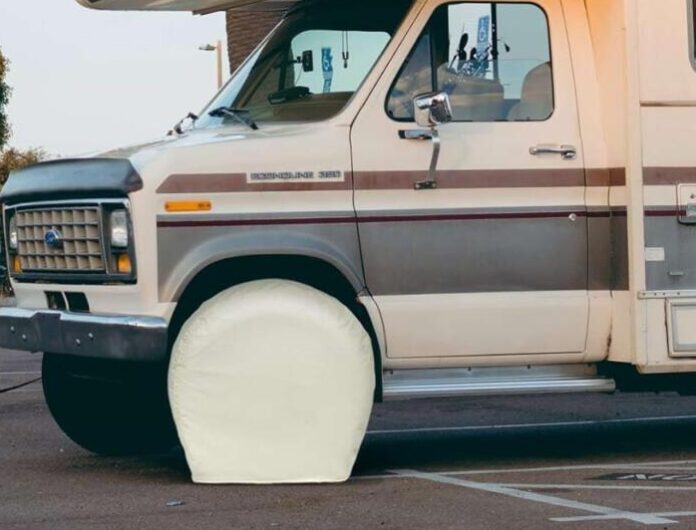
My husband and I do not agree when it comes to RV tire covers. I think they should be covered at all times. My husband contends that our slide-outs shade the tires, so no tire covers are needed.
What’s your take? Do you cover your tires every time you camp in your RV?
Cover up
I believe that tire covers slow weathering. While the covers won’t make your RV tires invincible, I think they will extend the life of the tires.
The National Highway Traffic Safety Administration (NHTSA) says tire aging happens through service, storage, and environmental conditions. It specifically notes that sunlight, warmer climates, poor storage, and poor maintenance all contribute to aging.
No cover
The case for skipping tire covers is strongest when the RV is not sitting in harsh conditions for long. Michelin advises that tires should be stored in a cool, dry, dark place away from sunlight and ozone. Wouldn’t it make sense to keep them shielded from these elements when camping, too? NHTSA emphasizes monthly tire-pressure checks, tread checks, and regular maintenance for tire longevity.
Some RVers decide that shelter, use, inflation, and inspections matter more than a separate tire cover. This especially holds true if the rig is parked indoors, under a roof, or moved often enough that the tires are not baking in the sun for months at a time.
Which is better?
The case for covering tires is strongest when an RV lives outdoors. Goodyear says direct sunlight and UV can speed aging. It specifically says covering the vehicle and tires can help protect against UV rays.
Goodyear adds that outdoor covers should allow moisture to escape so the tires do not sit in a damp, sealed environment. For RVers in open storage lots, driveways, or full-sun campsites, that extra shield can be worthwhile.
Middle-ground approach
A good middle-ground approach is to match the solution to the conditions. If your RV sits outside in strong sun, a cover makes sense. If it lives under shelter and you are already checking pressure, tread, and visible damage, covers may be optional rather than essential.
NHTSA notes that RVs and other low-mileage vehicles can be more at risk for tire aging, so the key is not just whether you cover the tires, but whether you also keep up with tire care.
Vote
Vote in our poll and leave a comment to back up your choice.
RELATED
- Which are better, white or black tire covers?
- Are RV tire covers necessary? Are they worth the money?
- Do you need an external spare tire cover?
- Plus, take some of our more than 5,000 other polls here.
RVT1255

A week or more, I probably will. But less than that, no.
I cover when it is in storage. One side gets direct sun all day.
cover my tires when it’s parked between trips. When camping we do not because we have slides which cover the tires and we stay at a campsite for 4 days and then go home, so it’s not worth getting down on my ageing knees to cover
I used to use tire covers until I realized my rig spends very little time sitting and when not traveling or camping sits inside my shop; so I got rid if the covers.
Always covered when in storage. My tire covers are made from the same material as the cover. They are breathable.
I spray them with 303 once a month, covered or not.
As far as the monthly pressure checks, I check them constantly.
I also store the trailer with the tires on a 2X10 covered with a rubber mat.
Tires that roll frequently don’t need to be covered. So if it is just an overnight or one day stop, I don’t pull out the covers. Otherwise, I do.
Our trailer is outside only when camping. When it’s in storage the trailer is inside a barn.
Use 303 and then cover them if we are staying over a week at one campground.
Our motorhome is stored in a building next to our home, so always out of the weather while not in use.
When traveling I cover the tires if the site will receive a lot of sun and we’re there more than a few days.
Wow. The results are surprising. I bought my RV with the intent to use it so much that the tread wears out versus leave it sit so long that I convince myself the tires need covers to keep from dry-rotting.
I don’t think I’ve ever seen a trucker put tire covers on his trailers or his truck. In fact, I can’t remember ever seeing a U-Haul dealer storing their trucks and trailers with tire covers.
Nope. If my tires are going to be stationary long enough I worry they’ll dry rot, it’s time to sell or put my rig on blocks and buy new tires when and if it ever leaves those blocks.
For an overnight stay, tire covers aren’t necessary. But if you’re spending four months on the Texas coast, tire covers are definitely a must in my opinion.
As a Tire Design and Forensic engineer (45 years) I cover the tires that would get sunlight whenever I will be parked for more than a day.
I used to cover them. But had a lot of problems with rust on brake parts causing calipers to stick. So I stopped covering them and this seems to have helped. I’d rather have to buy tires more often than have full entire brake replacement jobs every few years. That included calipers, rotors, lines (along with the pads).
The age of the tire probably matters more. Unless you’re a full timer and actually wear-out your tires in a few years, you’re going to age out your tire before it wears out. Most RV tire manufacturers and experts recommend replacing tires every 5–7 years, regardless of how they look or how many miles are on them. Every tire has a DOT code molded into the sidewall. Here’s how to read it:
Look for “DOT” on the inner or outer sidewall of the tire. The DOT code ends with a 4-digit number — that’s the date code. First 2 digits = week of the year (01–52) Last 2 digits = year Example:
DOT XXXX XXXX **2319**→ made in the 23rd week of 2019With a tag axle we have six tire covers, so I figure if we are going to be in one spot six days or longer, I will put them on. DW agrees with Gail, anything that makes those expensive tires last a little longer is worthwhile. Happy wife, happy life.
We camp 2 weeks at a time. I cover the tires while we’re there and then move to the next place. White covers because this reflects the sun.
35-seasons on the road we never used tire covers…until the last few years. We bought a windshield sun screen and it came with a set of tire covers. We used them if we were parked for longer than a week. That means we didn’t use tire covers for roughly 30 of our 35-seasons we didn’t have tire covers and I don’t recall any sidewall sun damage.
We had a windshield sun cover (external) and tire covers. Besides the rust I mentioned on brake parts, all those covers sometimes got nasty dirty. Now we cover all the cab windows (windshield, driver & pass windows) from the inside. Regular accordion sun shield for the windshield and cardboard cut to fit the side windows. Much better.
Many years ago, I tried using them. The MH was only being used during school vacations, maybe once or twice a year. The covers only protected the outer sides of the tires. When I removed them prior to a trip, there were full of spiders and bugs. They were no fun to clean out and took up valuable storage space. I hated them. Tire covers or not, I still needed to replace the tires at 6 years. I didn’t see how using tire covers made any real difference and stopped using them.
Thank you for the question and discussion, Gail. Yes, we almost always put covers on our tires. The exception is when we are staying somewhere 3 nights or less. In those instances we do not place our tire covers on our RV tires. When we arrive home, we put on the tire covers and then level the RV before opening the slides in order to unload dirty clothes and uneaten food. Have a great day and safe travels!