

Have you ever dreamed of the perfect camping trip, picturing a spacious site surrounded by nature? Then, reality hits: You’re squeezed into an RV park where you can practically hear your neighbor snoring. Is this the RV life you signed up for?
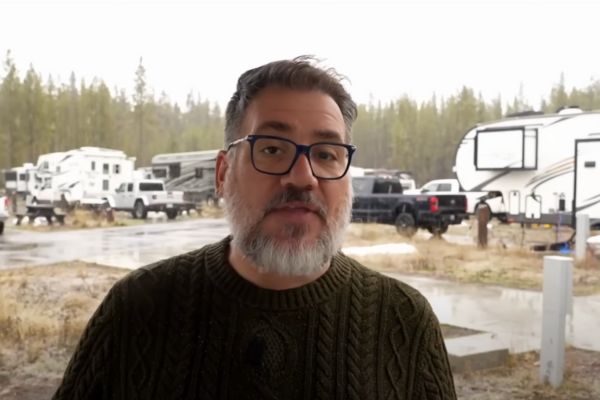
A viewer of Jason Epperson’s at RV Miles recently asked if all campgrounds are like Fishing Bridge RV Park in Yellowstone, known for its tightly packed RVs. The short answer? Thankfully, no. While Fishing Bridge is common for RV parks with full hookups, it’s not typical of all national park campgrounds.
So, why are some RV parks so cramped? In the video near the bottom of this page, Jason explores the reasons.
Location plays a huge role. Campgrounds near popular destinations, such as national parks and monuments like Devil’s Tower, often have higher demand. To accommodate more RVers, sites get packed together. It’s a simple matter of supply and demand.
Let’s be honest: Corporate greed is also a factor. Cramming more sites into a smaller space means more revenue. The more RVs they can fit, the more money they make. It’s an unfortunate reality in some RV parks.
Full hookups—electricity, water, and sewer—come at a price. Running these utilities costs money, and the closer the sites, the shorter (and cheaper) those runs will be. Sewer lines, in particular, require careful grading, adding to the expense.
The pull-through RV site paradox
Pull-through RV sites are convenient, especially for large RVs and quick overnight stays. No need to back in—just pull through, dump tanks, hook up to power, do laundry, eat and sleep, and hit the road. However, this convenience comes at a cost.
Pull-through sites take up a lot more space than back-in sites. This often leads to narrower sites and less personal space. They’re usually longer and skinnier than back-in sites with the same (or even more) square footage. And, despite being less enjoyable, pull-through sites are often the most expensive.
Imagine a 3-acre campground with 53 sites: 34 back-in and 19 pull-through. That’s almost twice the recommended density of 10 sites per acre.
Let’s break down the site dimensions:
Back-in sites:
• Dimensions: 33 ft. x 60 ft.
• Driveway: 45 ft.
• Parking pad: 12 ft.
• Total square footage: 1,980 sq. ft.
• Concrete/asphalt/gravel: 700 sq. ft.
Pull-through sites:
• Dimensions: 24 ft. x 84 ft.
• Parking pad: 12 ft. x 84 ft.
• Total square footage: 2,016 sq. ft.
• Concrete/asphalt/gravel: 1,000 sq. ft.
Even though the square footage is similar, pull-through sites feel much smaller because of their narrow width. There’s often little space for a picnic table, and you’re right next to your neighbors.
Removing the pull-through sites would allow for nine additional back-in sites. Plus, back-in sites only need a one-lane road, saving even more space.
The demand dilemma
Campgrounds are responding to demand for pull-through sites. By prioritizing pull-throughs, we sacrifice space and create less enjoyable campgrounds. Jason (RV Miles) tries to avoid pull-through sites, unless it’s a quick overnight stay or the campground forces the issue. Some campgrounds don’t allow bigger rigs to use shorter sites, even if they fit.
Jason dreams of being the “Arnold Palmer of campground design,” creating campgrounds with a more naturalistic feel, like state parks. Instead of segregating cabins, RV sites, and tent areas, imagine a campground with a mix of site types within the same area. A loop of nice back-in sites with the occasional pull-through, cabins and glamping tents mixed in. Improved landscaping could enhance privacy and create a sense of separation, even in close-quarters campgrounds.
What do you think?
What are your campground preferences? Do you only park in pull-throughs? Do you avoid crowded RV parks? Do you prefer state parks, national park campgrounds, or boondocking? What do you think about the current state of campground design? Have any suggestions?
Leave your comments below.
YOU MIGHT ALSO ENJOY:
- Ten tips about how to find quiet RV parks
- RVers discuss: Is the 10-year rule ‘snooty’?
- RVtravel.com readers reveal their favorite state parks
- Exploring a 1960s abandoned RV park
RVT1211

We consider price, fit and grade. If we can’t reasonably (and safely) fit, the other two considerations don’t matter. Likewise, if the site is so unlevel that we need a step ladder to reach our steps, the price and fit doesn’t matter.
Pull through or back-in doesn’t matter BUT fire safety does. If we get parked next to an RV that looks like a fire hazard, we will ask to move. These things burn quick, especially when squeezed in.
With a 36ft and a toad a pull through is better for a one night stop. Narrow sites don’t matter as we are not there to join in the fun but just to rest. We also cannot back in due to the toad.
We use state parks all the time and find the cost difference back in vs pull through to not be that great.
I tend to reserve pull-throughs for overnight stops. It’s a time issue.
It’s a fact that single axle trailers when pushed rather than pulled tend to drift more easily than multi-axle trailers. Ditto for bumper vs 5th wheel hitch. It takes a bit more wheel and positioning finesse to back a single axle camper – which can mean a bit more time with narrow, unsmooth, or unlevel sites.
I gambled wrong at one overnight park. I should have taken a back-in site. The pull-through was rutted, unlevel and the base was sand. Worse, the electric and water were at one end of the site and the waste was at the other. A back-in would have been faster.
My wish would be that all back in sites would allow for backing in using the driver’s side mirror. (Might save a few relationships as well)
Of course the dimensions of those imaginary sites in an imaginary campground are made up to prove a predetermined point. Pull thru sites can be wide or narrow, short or long. Correctly angled pull thru sites can possibly utilize narrower one way roads. The most important issue is optimum site and road layout from the beginning. Public parks are often limited by conforming to the natural landscape whereas private parks and some public, start out by bulldozing the entire property creating a clean slate.
Interesting article about site dimensions. We have found pretty much the opposite. The pull-throughs seem to be much more spacious for usable patio area because of the longer parking pad. Referring to state parks we have visited, the pull -through and back-ins are all the same price. Just depends on preference.
If it’s just overnight and not crowded I’ll take the convenience of a drive-thru.
I’m with you Tom. Pull thru’s for overnights and back-ins for stays of 2 nights or longer are preferred.
We travel with our 27′ Class C MH and a small 10′ aluminum trailer (with our Harley Trike on it). I have too much trouble backing that up. So Pull-Thrus are worth it.
Since 2013 start we have loved the state park system mostly & usually land in back in sites. Past couple years finds us making some of those long-haul trips & don’t want to disconnect overnight if possible so we will look for the pull thru for one-night stays. One thing we ran into last year was campground amenities & the places we would spend money with them was far from the pull thru area – so we did not spend any extra money at the campground when there overnight. Having the pull thru location close to where travelers can spend money means money is more likely to flow, i.e. – mini golf, local museum, bar & grill….
Thank you for summarizing Jason’s video, Cheri! We are happy with either type of site, depending on circumstances. We have traveled 17 of the last 19 days, covering 4171 miles. Most nights were in a pull-through site with only power connected. Departure mornings mainly entailed walking dog #3, making the bed, and eating a bit of breakfast. When we are somewhere for a few days, back-in sites work well because we’ll be using the Jeep every day. We unhitch at or near check-in and DW usually leads me to our site. I have noticed that campgrounds in proximity to the Alaskan highway mostly have pull-through sites. Makes sense. Have a great day and safe travels!